
TL;DR:
- Effective AI selection involves criteria like performance, interpretability, and privacy management.
- AI applications such as predictive analytics, dynamic pricing, segmentation, and basket analysis boost ecommerce revenue.
- Success depends on integrating AI as a strategic tool with human oversight, transparency, and organizational readiness.
Choosing the right AI tools for your ecommerce operation is one of the most consequential decisions a marketing manager or data analyst can make right now. The market is packed with vendors promising transformative results, but most evaluations stall because teams lack a clear framework for comparison. This article cuts through the noise by giving you specific criteria to filter your options, detailed breakdowns of the four most impactful AI applications in ecommerce, and honest perspective on where these tools succeed and where they fall short. By the end, you will know exactly which AI capabilities align with your segmentation goals and revenue targets.
Table of Contents
- Key criteria for selecting AI applications in ecommerce
- Predictive analytics: Anticipate trends and customer needs
- Dynamic pricing: Optimize revenue with real-time adjustments
- Advanced customer segmentation: Personalize at scale
- Market basket analysis: Drive bundles and cross-sell with AI
- Our take: The AI advantage requires human strategy
- Unlock ecommerce growth with actionable AI
- Frequently asked questions
Key Takeaways
| Point | Details |
|---|---|
| Prioritize trust and transparency | Effective AI depends on interpretable solutions and respect for privacy to avoid eroding consumer confidence. |
| Pick the right AI tool | Choose applications based on business impact, operational fit, and ethical considerations. |
| Measure and adjust regularly | Continuously monitor AI performance to ensure it drives ROI without introducing bias or trust issues. |
| Blend automation with human oversight | Managers and analysts must guide AI strategies for sustained competitive advantage. |
Key criteria for selecting AI applications in ecommerce
Having set the stage for strategic AI adoption, it is crucial to filter your options with the right evaluation criteria. Not every platform that claims AI-powered results actually delivers measurable lift, and picking the wrong solution costs you time, budget, and customer trust.
Start by asking these questions before any demo:
- Performance on your data: Does the vendor offer benchmarks on datasets similar to yours in size and category mix?
- Interpretability: Can the model explain why it made a recommendation, or is it a pure black box?
- Segmentation and sales alignment: Does the tool map directly to your specific goals, whether that is churn reduction, average order value lift, or campaign targeting?
- Privacy and consent management: How does the platform handle data residency, anonymization, and opt-out compliance?
- Vendor transparency: Is the pricing model clear? Are SLAs defined? Can you audit model outputs?
Two risks that often get underestimated are over-personalization and data bias. AI boosts personalization and efficiency but simultaneously raises privacy and trust considerations that can damage brand perception if ignored. A model trained on skewed historical data will replicate those skews at scale.
Understanding the benefits of AI in ecommerce is the starting point, but the AI guide for store owners offers a practical lens for translating those benefits into operational decisions.
Pro Tip: Before committing to any AI platform, run a 30-day pilot using a single product category or customer cohort. Measure lift in conversion rate and average order value against a control group. If the vendor will not support a structured pilot, that tells you something important.
Predictive analytics: Anticipate trends and customer needs
With solid criteria in place, let us dive into the standout AI applications, starting with predictive analytics. This category uses historical transaction data, browsing behavior, and external signals to forecast what will happen next in your store.
The most common use cases include:
- Stock optimization: Predict which SKUs will spike in demand before your buyers catch the trend manually
- Promotional timing: Identify the optimal window to launch a sale based on predicted demand curves
- Churn prediction: Flag customers whose purchase frequency is declining before they go fully dormant
- Revenue forecasting: Give finance and operations teams reliable forward-looking numbers
The ROI case for predictive analytics is strong. AI-driven analytics improve personalization measurably, but they require clear consent and transparency to maintain the customer trust that makes those recommendations effective. Brands that skip the transparency step often see short-term conversion gains followed by opt-out spikes.
The interpretability challenge is real here. Many predictive models operate as black boxes, making it difficult for your team to explain a recommendation to a skeptical CFO or a compliance officer. Prioritize vendors who offer feature importance scores or plain-language explanations alongside their predictions.
For a deeper look at how AI analytics in ecommerce create measurable advantages, and how AI sales optimization strategies translate forecasts into revenue, both resources are worth bookmarking before your next planning cycle.
Stat to know: Ecommerce brands using AI-powered demand forecasting report inventory carrying cost reductions of up to 20%, freeing capital for growth initiatives.
Dynamic pricing: Optimize revenue with real-time adjustments
Beyond forecasting, AI transforms pricing strategies with real-time market response. Dynamic pricing models continuously ingest competitor pricing data, your own inventory levels, and live demand signals to recommend or automatically execute price changes.
Here is how traditional and AI-driven pricing compare in practice:
| Metric | Traditional pricing | AI-driven pricing |
|---|---|---|
| Price update frequency | Weekly or monthly | Continuous or hourly |
| Gross margin improvement | Baseline | Up to 8-12% lift |
| Sales volume impact | Stable | 5-15% increase in peak periods |
| Customer retention effect | Neutral | Positive if transparent, negative if perceived as unfair |
| Operational effort | High (manual reviews) | Low (automated with guardrails) |
The ethical dimension of dynamic pricing deserves direct attention. Personalization driven by AI can yield strong ROI but may also cause trust issues if customers perceive price differences as unfair or invasive. This is especially true when price variations correlate with demographic segments, even unintentionally.
Review AI trends in pricing and the broader AI for sales retention context to understand how pricing decisions ripple into customer lifetime value.
Pro Tip: Always configure hard price floors and ceilings in your dynamic pricing system. Automated models can produce absurd outputs during data anomalies. A guardrail that prevents prices from dropping below cost or rising above a defined ceiling protects both margin and brand reputation.
Advanced customer segmentation: Personalize at scale
Segmentation powers advanced personalization, so understanding how AI elevates this process is critical. Manual segmentation typically relies on three or four demographic variables. AI-powered clustering can process hundreds of behavioral signals simultaneously, creating segments that actually predict purchase behavior rather than just describe it.

| Factor | Manual segmentation | AI-powered segmentation |
|---|---|---|
| Effort required | High (analyst hours) | Low (automated clustering) |
| Segment granularity | Broad (5-10 groups) | Fine (50+ micro-segments) |
| ROI accuracy | Moderate | High |
| Complexity | Low | Medium to high |
| Privacy risk | Low | Higher (requires governance) |
Here is how to launch a segmentation project from scratch:
- Collect and clean your transaction data: Remove duplicates, standardize product identifiers, and confirm date accuracy
- Define your segmentation goal: Retention, upsell, reactivation, or new customer nurture each require different model inputs
- Choose your clustering method: RFM (recency, frequency, monetary value) is a strong starting point for most ecommerce teams
- Validate segments with your marketing team: Data scientists build the clusters, but marketers must confirm they are actionable
- Build and launch targeted campaigns: Map each segment to a specific message, channel, and offer
- Measure and iterate: Track conversion and retention per segment, then refine the model quarterly
Over-personalization by AI can erode consumer trust even as it boosts efficiency, so build explicit consent checkpoints into your data collection workflow. Explore unlocking AI retail growth and AI strategies in ecommerce for implementation frameworks that balance performance with privacy.
Market basket analysis: Drive bundles and cross-sell with AI
Finally, let us examine how AI uncovers product relationships for smarter merchandising. Market basket analysis (MBA) uses association learning to identify which products customers buy together, revealing affinities that no human analyst would spot in a catalog of thousands of SKUs.
Practical applications include:
- Cross-sell recommendations: Automatically surface complementary products at checkout or in post-purchase emails
- Bundle creation: Package high-affinity products together with a modest discount to lift average order value
- Personalized homepages: Serve returning customers a product mix based on their own basket history
- Inventory planning: Stock complementary items together to reduce split shipments
“Advanced AI models carry both great efficiency potential and a new responsibility for privacy-first approaches that protect customer data while delivering relevant experiences.”
One risk that teams underestimate is historical bias reinforcement. If your training data reflects a period when a certain product was heavily promoted, the model will keep recommending it even after the promotion ends. Regular model retraining and bias audits are not optional, they are maintenance.
For a broader view of top ecommerce AI solutions and how MBA fits into a full analytics stack, that resource is a useful next read. You can also explore luxury retail AI trends to see how high-margin categories are applying basket analysis to curated recommendations.
Our take: The AI advantage requires human strategy
With the main AI applications mapped out, it is worth pausing to reflect on what real-world implementation actually looks like. Here is an uncomfortable truth: most AI projects in ecommerce underperform not because the technology is weak, but because the organizational structure around it is not ready.
The brands that get the most out of predictive analytics, dynamic pricing, and segmentation share one trait. They treat AI as a strategic lever that amplifies human judgment, not as a replacement for it. A model that flags churn risk is only valuable if a marketer knows what campaign to trigger in response.
The privacy paradox is equally important to name directly. The more granular your personalization, the more data you need, and the more exposure you carry. Transparency is not just an ethical obligation. It is a retention strategy. Customers who understand how their data is used are more likely to stay.
For teams working on AI conversion optimization, the biggest unlock is usually organizational, not technical.
Pro Tip: Build cross-functional pods that pair a data scientist with a marketing manager for every AI initiative. The scientist ensures model integrity. The marketer ensures the output is actually usable in a campaign. Neither succeeds without the other.
Unlock ecommerce growth with actionable AI
The frameworks and comparisons in this article give you a strong foundation, but putting them into practice requires the right tools and resources alongside your strategy.
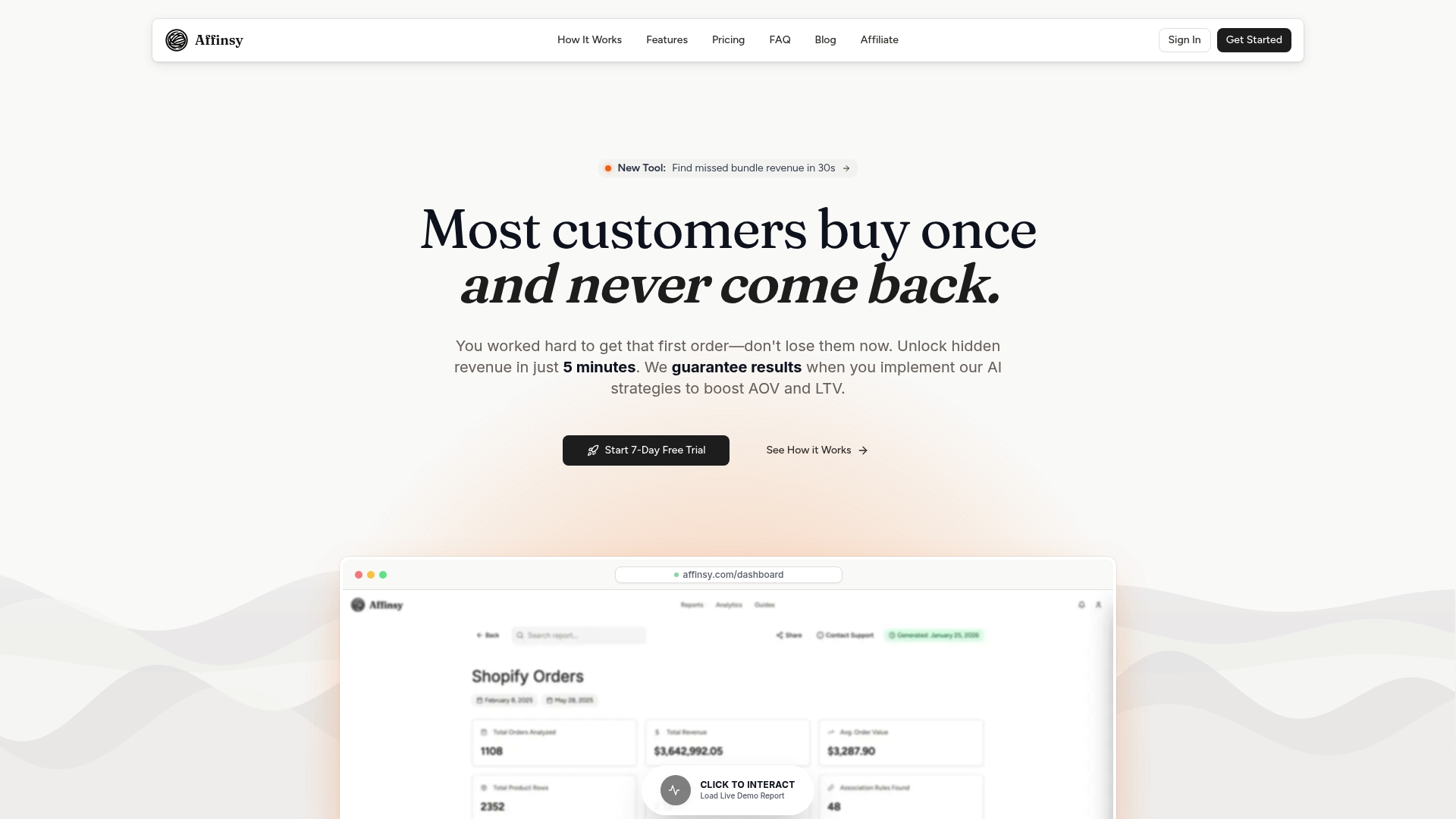
Affinsy is built for exactly this kind of work. Whether you are exploring predictive analytics explained for the first time or ready to deploy customer segmentation tools at scale, the platform gives you AI-powered analysis without requiring a data science team. You can also dig into market basket analysis to start uncovering product affinities from your existing transaction data. Start free with up to 20K line items, no credit card required, and see what your data has been telling you all along.
Frequently asked questions
What is the most impactful AI application for ecommerce ROI?
Predictive analytics drives higher ROI and better personalization when implemented transparently, making it the most consistently cited AI tool for measurable ecommerce revenue gains.
Can AI in ecommerce harm customer trust?
Yes. Over-personalization or unclear consent procedures can decrease trust significantly, which is why privacy-first design and clear data communication are non-negotiable.
How does AI-powered segmentation differ from manual methods?
AI enables much finer segmentation using behavioral and real-time data patterns, delivering higher segmentation accuracy and efficiency than manual approaches that rely on static demographic variables.
What is the risk of data bias with AI in ecommerce?
If not properly managed, AI can reinforce historical data biases. Constant oversight to avoid bias and interpretable models are required to ensure fairness across all customer segments.
How can ecommerce teams start implementing AI responsibly?
Start with pilot projects tied to clear goals, maintain transparent communication with customers about data use, and conduct ongoing impact reviews. Responsible AI requires phased rollout and explicit consent at every stage.
Recommended
- AI Sales Optimization Strategies for E-commerce in 2026 - Affinsy Blog | Affinsy
- Top 5 AI Solutions for Online Retail 2026 - Affinsy Blog | Affinsy
- Best 7 AI Analytics Tools for Ecommerce 2026 - Affinsy Blog | Affinsy
- Analytics trends in 2026: AI boosts ecommerce sales 95% ROI - Affinsy Blog | Affinsy
- AI in business: practical steps for UK SMEs in 2026 - Kefihub
- How to Optimize Website Conversions for eCommerce Success – Lind Creative