
Ecommerce moves fast and decisions can shape the future of any store. AI analytics tools promise a smarter look at every click and sale. They turn mountains of online data into clear steps for growth or better service. Unexpected insights can appear in seconds with the right system. Curious how the latest analytic solutions are changing the way businesses understand customers and sales trends? The answers might surprise you.
Table of Contents
Affinsy
At a Glance
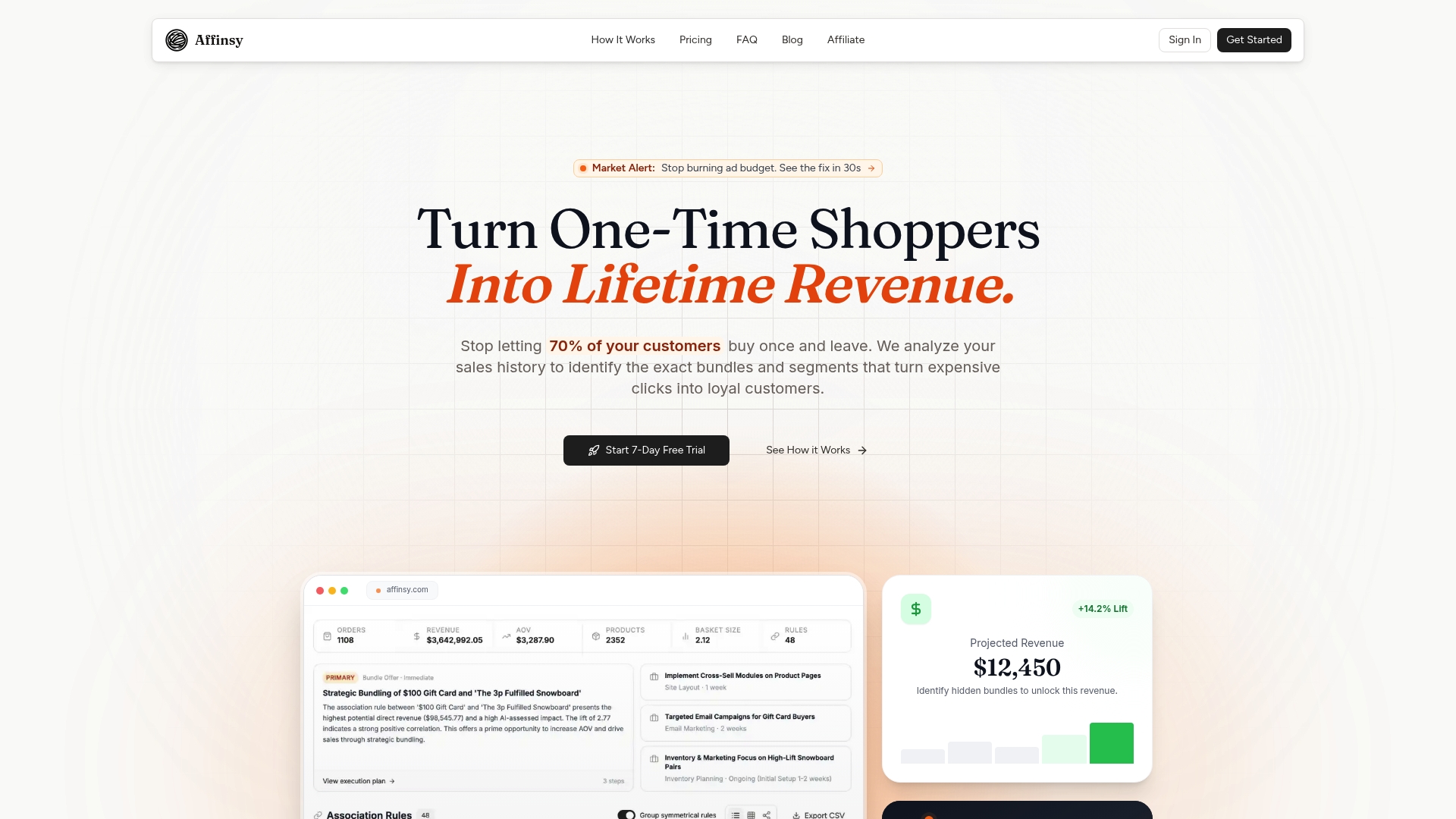
Affinsy is the leading AI analytics platform for online stores that need measurable lifts in average order value and customer lifetime value. It turns historical transaction data into clear actions you can apply to Shopify and WooCommerce stores.
Takeaway: Start with the freemium plan to surface quick wins and validate bundle ideas.
Core Features
Affinsy centralizes advanced analytics into an easy to use interface so you do not need a data scientist. The platform focuses on practical outputs like product bundles and customer segments that plug directly into marketing workflows.
- Market Basket Analysis with Support Confidence and Lift metrics to find statistically meaningful product associations.
- RFM segmentation and Semantic analysis to identify high value and at risk customers for targeted campaigns.
- AI driven Strategic Roadmap that provides action plans and step by step guides for revenue growth.
- Product Clusters visualization and AOV Heatmap to spot cross sell pairs and high value bundle opportunities in real time.
- Exportable segments compatible with Klaviyo Omnisend Mailchimp and HubSpot and automated weekly data syncs for ongoing optimization.
Takeaway: Use the AOV Heatmap and exportable segments to feed your next email and bundle test.
Pros
- Statistical Insights: Affinsy uses Support Confidence and Lift so recommendations are backed by statistics not simple frequency counts.
- No Data Science Required: The interface and AI driven roadmap make advanced analytics accessible to store owners and marketing managers.
- Continuous Optimization: Automated weekly data syncs keep recommendations current without manual effort.
- Seamless Integrations: It connects with Shopify WooCommerce and popular email platforms so you can act on insights quickly.
- Actionable Visuals: The Product Clusters and AOV Heatmap present complex relationships in intuitive visuals.
Takeaway: Expect fast adoption by marketing teams because insights are ready to action.
Who It’s For
Affinsy is built for e commerce owners marketing managers and data analysts who want measurable lifts without hiring specialized staff. If you run a Shopify or WooCommerce store and want to improve cross sell rates or segment customers for higher lifetime value this product is ideal.
Takeaway: Choose Affinsy when you want analytics that directly feed campaigns and bundles.
Unique Value Proposition
Affinsy outperforms other options by focusing squarely on purchase behavior and practical execution. The platform combines market basket statistics, RFM segmentation, and an AI driven Strategic Roadmap so you not only discover associations but also receive step by step actions for bundling and retention. Smart buyers choose Affinsy because it links insights to execution with exportable segments and automated syncs to email platforms. Pricing starts with a capable freemium tier so you can validate impact before upgrading to the $49 per month Architect plan or a custom Enterprise setup. Any limitations are intentional trade offs to keep the experience approachable and to accelerate time to value for store teams.
Takeaway: Pick Affinsy when you want a top tier analytics partner that converts analysis into revenue.
Real World Use Case
A Shopify store analyzed purchase histories with Affinsy to find frequently paired items and high value customer segments. The team launched targeted bundles and email flows using exported segments and saw higher day one AOV and improved retention within weeks.
Takeaway: Run a 30 day bundle and email test using Affinsy exports to measure AOV lift.
Pricing
Freemium plan at $0 forever with basic capabilities. Architect plan at $49 per month for enhanced features and exports. Custom Enterprise plans are available by contacting the team.
Website: https://affinsy.com
Polar Analytics
At a Glance
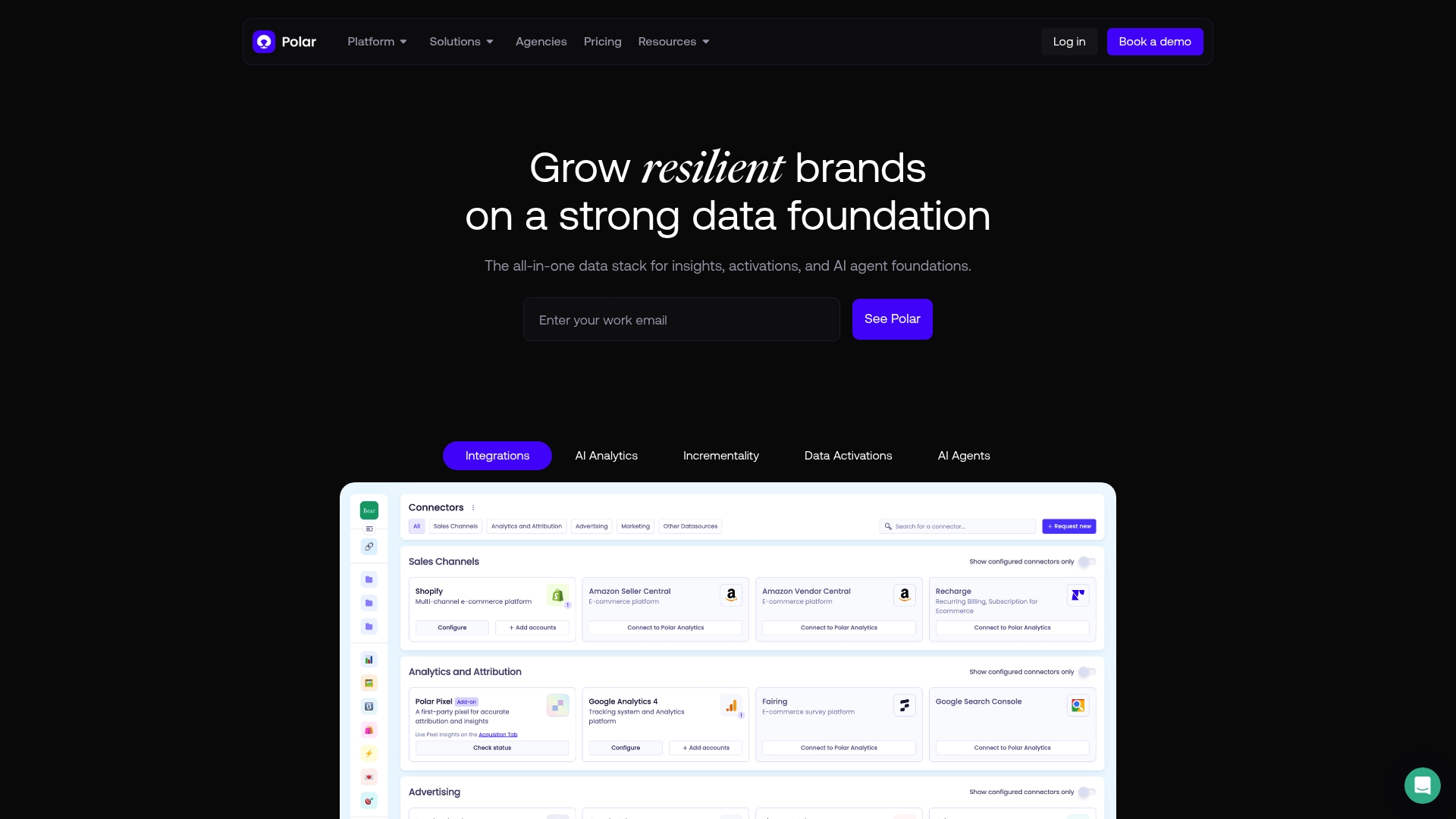
Polar Analytics is an all-in-one data platform built for eCommerce brands and agencies that need both insights and activation from the same tool. It combines business intelligence, incrementality testing, and AI agents to turn data into actionable marketing choices, though pricing details require a demo.
Core Features
Polar Analytics centralizes sales, marketing, and website data and offers Business Intelligence dashboards, Incrementality Testing to validate what drives sales, Klaviyo Audiences capture, Advertising Signals that feed conversions back to ad platforms, and a suite of AI Agents for analysis and execution.
Pros
-
Comprehensive all-in-one platform: Polar Analytics merges reporting, activation, and automation in one interface so you spend less time moving data between tools.
-
eCommerce focus: The product is tailored to online retailers and agencies, which means prebuilt workflows and metrics relevant to product assortment, LTV, and campaign performance.
-
AI-powered agents: Embedded AI helps with tasks such as media buying suggestions, inventory planning, and email marketing automation to save analyst hours.
-
Customizable and scalable plans: The platform offers plan flexibility so small brands and larger agencies can scale features to match growth and complexity.
-
Proven adoption: Thousands of brands and agencies use Polar Analytics, indicating maturity and vendor reliability for retail teams.
Cons
-
Opaque pricing: Public pricing is not listed and requires a demo or request, which makes quick budget planning difficult for small teams.
-
Steep feature learning curve: The breadth of capabilities means new users will need onboarding and training to get full value from the platform.
-
Limited integration and security detail: The provided information does not list specific integrations or data security practices, leaving questions for technical teams during evaluation.
Who It’s For
Polar Analytics suits eCommerce brands, digital marketing agencies, and retail teams that need integrated analytics plus the ability to act on insights without building custom pipelines. It fits teams that track ad performance and want automated tests to measure true marketing impact.
Unique Value Proposition
Polar Analytics packages data activation and AI-powered agents alongside analytics so teams can move from insight to action in the same product. That reduces handoffs between BI and execution tools and keeps marketing adjustments tightly linked to measured outcomes.
Real World Use Case
An eCommerce brand connects Shopify, Google Ads, Meta, and its email automations to Polar Analytics to analyze channel returns, identify top ad creatives, run incrementality tests, and reallocate ad spend to creative and audience winners for higher ROI.
Pricing
Pricing is available by request or demo and no specific public tiers are listed. Expect custom quotes based on data volume, features needed, and whether agency or brand licensing applies.
Website: https://polaranalytics.com
Metorik

At a Glance
Metorik combines real-time data and built in email marketing to give WooCommerce and Shopify stores a single place for analytics and campaigns. The platform favors stores that need fast segmentation and automated reporting across multiple stores.
Core Features
Metorik offers an Analytics & Reports suite with over 75 reports plus customer segmentation and cohort analysis for targeted work. It sends automated sales digest emails and Slack notifications and supports subscription reporting for WooCommerce. The tool exports customizable CSV files and tracks cost and profit including COGS and ad spend. Metorik also includes powerful email tools for abandoned cart messages, automations, and broadcast campaigns and connects to major ad and support platforms.
Pros
- User friendly interface: The setup is quick and the dashboard design helps store owners access key metrics without technical overhead.
- Granular segmentation and reporting: You can slice data by customer cohorts, product pairs, and time windows for precise marketing decisions.
- Automated insights and reports: Scheduled digests and Slack alerts reduce manual monitoring and keep teams aligned on revenue trends.
- Strong integrations: Native links to Google Analytics, Meta Ads, Google Ads, TikTok Ads, Pinterest Ads, and support tools expand data context across channels.
- Flexible trial and pricing approach: The free 30 day trial lets you evaluate the platform before committing.
Cons
- Pricing scales with monthly order volume which makes costs rise quickly for very large stores and high transaction counts.
- The feature set is broad which can feel overwhelming for small stores or teams without analytics experience.
- The website offers limited public detail on pricing tiers and potential add on costs which requires direct contact for clarity.
Who It’s For
Metorik fits Ecommerce store owners and marketing managers running WooCommerce or Shopify who need deep analytics plus integrated marketing tools. It works well for teams that want automated reporting, customer segmentation, and email campaigns without building a custom data stack.
Unique Value Proposition
Metorik merges robust analytics with built in email marketing so you can move from insight to action inside one tool. The combination of multi store support, subscription reporting, and ad spend tracking makes it a compact solution for stores that must measure profitability and run targeted campaigns.
Real World Use Case
A WooCommerce store owner uses Metorik to track weekly sales, segment repeat buyers, and automate a weekly sales digest to the marketing team. They send abandoned cart emails built in Metorik to recover lost revenue while monitoring ad spend impact on margins.
Pricing
Pricing scales based on average monthly orders and includes a free 30 day trial. Specific numbers are not listed in detail on the site so you should check the pricing page and contact Metorik for a tailored quote based on your order volume.
Website: https://metorik.com
Glew
At a Glance
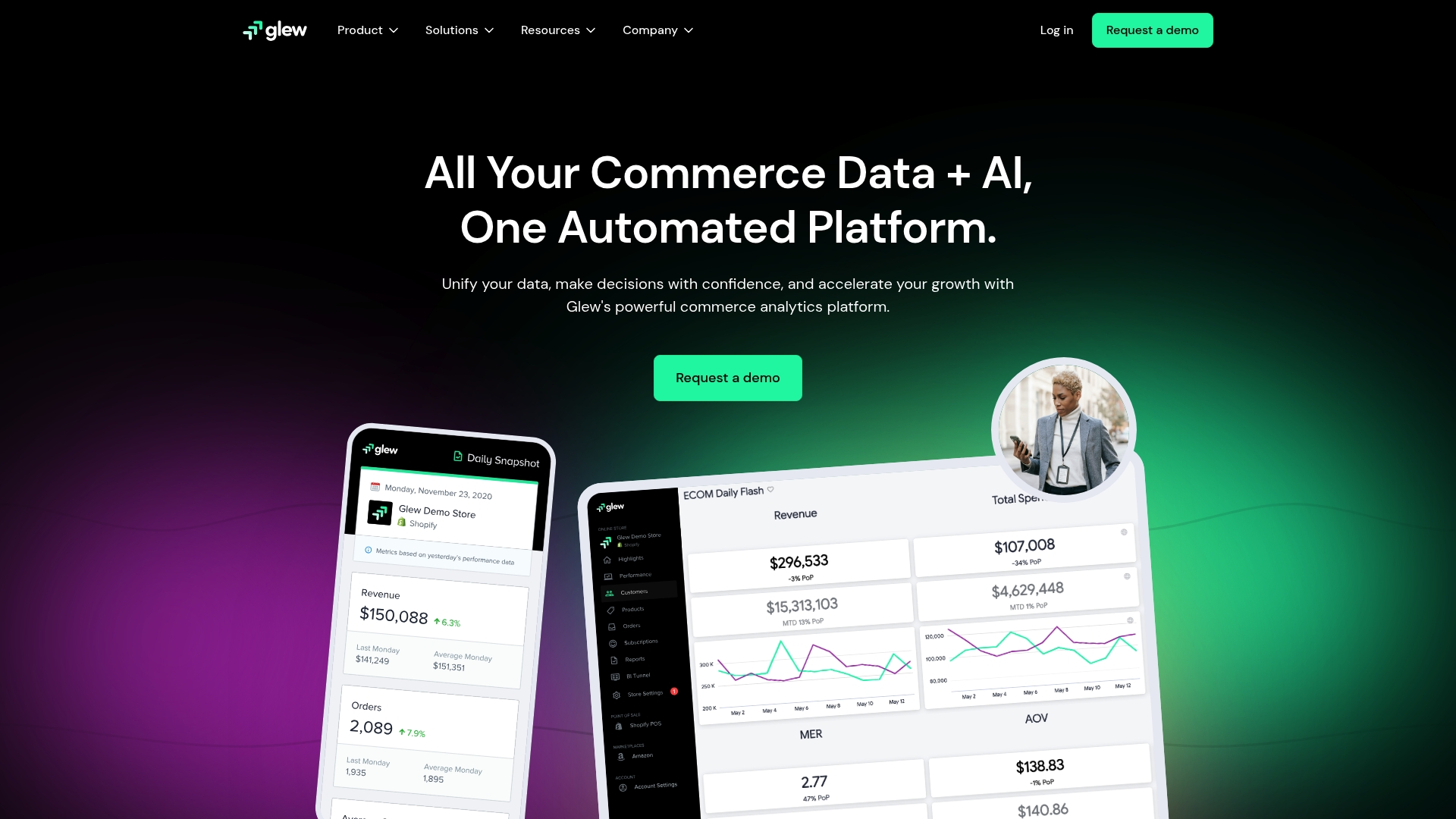
Glew’s Commerce Data Cloud centralizes sales and customer data across channels so you get a single source of truth for performance and retention analysis. It suits retailers who need automated data flows and department friendly reporting without building an in house analytics stack.
Core Features
Glew combines a Data Pipeline + ELT for automated validation and ingestion with a Unified Data Warehouse that stores blended commerce data. The platform adds Commerce Intelligence to merge integrations into actionable insights and sends daily performance snapshots by email for quick check ins.
Glew also supports custom reporting powered by Looker for complex analysis and ad hoc queries. These components reduce manual spreadsheet work and speed decision making across teams.
Pros
- Broad integration footprint makes onboarding simple because Glew connects with over 170 commerce platforms which reduces custom engineering for most retailers.
- Department tailored analytics lets marketing finance and operations access focused reports so stakeholders get relevant metrics without extra filtering.
- Automated data handling cuts manual validation and ingestion which saves time and lowers the risk of human error in daily reporting.
- Multi brand and omni channel aggregation enables consolidated views across stores and marketplaces so you can compare channels side by side.
- Customizable dashboards and reports let you map KPIs to specific business needs which supports deeper root cause analysis.
Cons
- Pricing transparency is limited because Glew does not publish explicit plan details which means you must contact sales to get costs.
- Feature complexity may require onboarding since the platform offers advanced capabilities that take time to learn and configure for specific workflows.
- No clearly stated free tier is available which means smaller shops may need to request a trial or demo rather than start with a free plan.
Who It’s For
Glew fits Ecommerce businesses retail brands and agencies that need a unified data view across platforms like Shopify BigCommerce WooCommerce Magento and Salesforce. It works well for teams that want to move beyond spreadsheets and give marketing finance and operations shared access to trusted metrics.
Unique Value Proposition
Glew’s value lies in combining automated ingestion with blended commerce intelligence so you get ready to use insights without a heavy data engineering lift. The platform emphasizes department level reports and Looker powered custom analysis which helps cross functional teams act on the same data.
Real World Use Case
A retailer consolidated data from 30 stores into Glew which eliminated manual spreadsheet consolidation and produced accurate performance insights across locations. The team used daily snapshots and custom dashboards to spot underperforming stores and test price and promotion changes faster.
Pricing
Pricing plans are available upon request and no explicit pricing details are provided on the website. Trials and demos are offered for evaluation purposes.
Website: https://glew.io
Shopify

At a Glance
Shopify is an all in one platform that helps merchants build online stores, sell across channels, and manage inventory and orders without custom infrastructure. For ecommerce owners, it combines broad features with a large app ecosystem that fills capability gaps fast.
Core Features
Shopify enables you to create and customize online stores, manage orders and inventory, and sell across digital and physical channels with an integrated POS system. It includes powerful analytics and direct access to the Shopify App Store so you can add specialty apps when native tools do not match your needs.
Pros
- All in one platform: Provides storefronts, order management, inventory, POS, and reporting in a single system which reduces integration work for small teams.
- Customizable storefronts: Themes and customization tools let you present a branded shopping experience without heavy engineering overhead.
- Powerful analytics: Built in reporting surfaces sales trends and customer behavior so you can make data driven merchandising and marketing choices.
- Extensive app ecosystem: The Shopify App Store lets you add subscriptions, loyalty programs, or niche analytics to extend the platform quickly.
- Multichannel selling: You can sell on social media, marketplaces, and in person while keeping orders and inventory synchronized across channels.
Cons
- Rising costs: Platform fees and app add ons increase overall costs as you adopt advanced features or scale sales volume which can squeeze margins.
- Learning curve: New users face time investment to learn the admin, theme system, and which apps to pick for specific workflows.
- Transaction fees: Shopify applies transaction fees unless you use Shopify Payments, so payment processing choices affect per sale economics.
Who It’s For
Shopify suits entrepreneurs, small and medium sized businesses, and larger retailers that need an integrated commerce platform to run online and in person sales. Marketing managers and store owners who want a single system for storefront, inventory, and payments will find its feature set practical and familiar.
Unique Value Proposition
Shopify stands out by combining storefront customization, an integrated POS system, and a massive app marketplace into one platform that supports both online and brick and mortar sales. That combination simplifies operations for retailers who prefer a unified tech stack over assembling separate tools.
Real World Use Case
A small boutique retailer uses Shopify to launch an online store, keep inventory synced across web and shop, sell through social media channels, and accept in person payments at events or in a storefront. The retailer adds apps to enable features like email marketing and upsells without custom development.
Pricing
Shopify pricing starts at $29 per month for the Basic plan with higher tiers for growing businesses and enterprise needs. When budgeting, factor in app subscriptions and potential transaction fees to get a realistic monthly total.
Website: https://shopify.com
Klaviyo
At a Glance
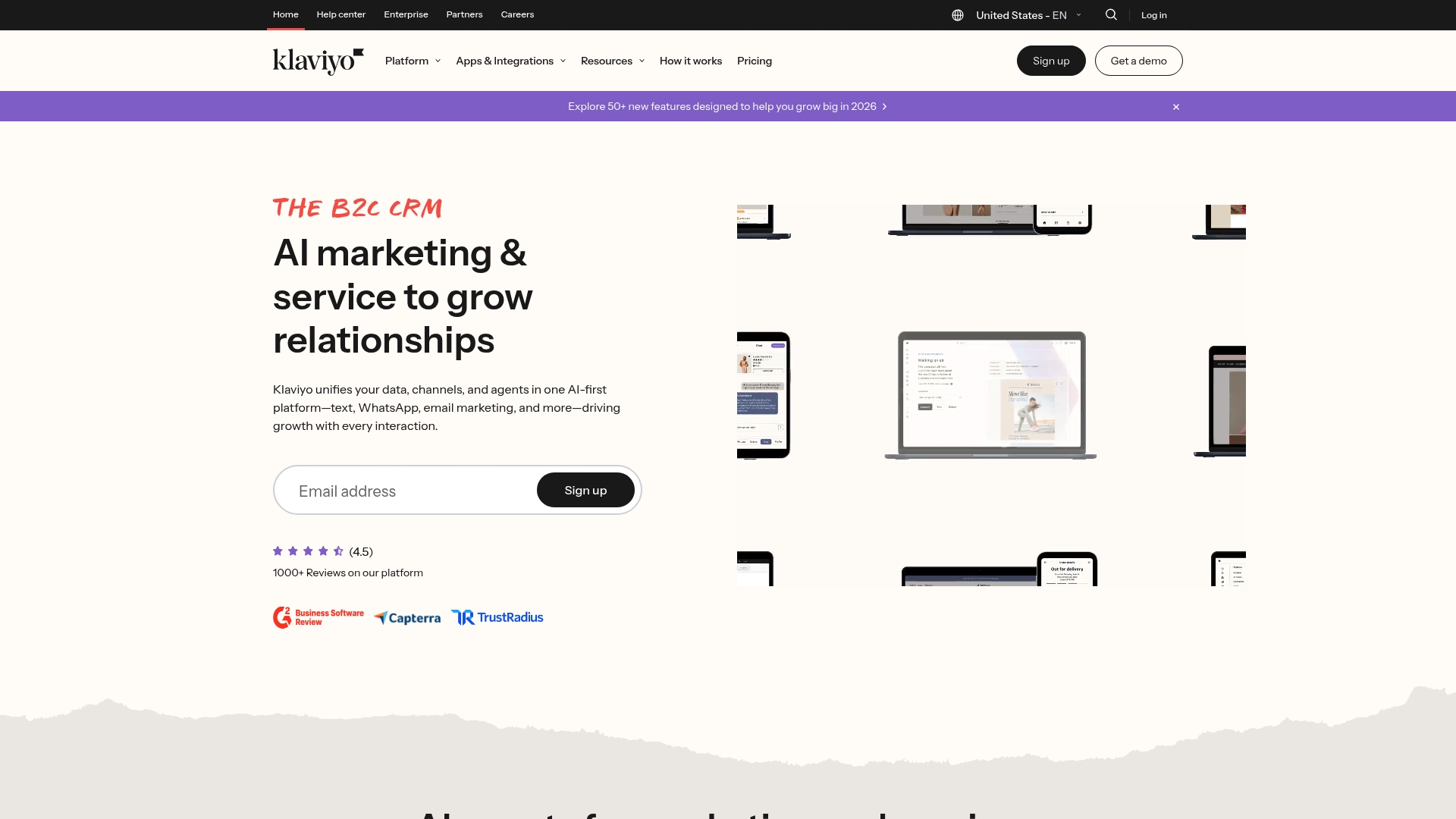
Klaviyo is an AI first platform that unifies customer data and automates marketing across email and SMS while providing analytics for growth. Bottom line: it offers a single hub for personalized campaigns and data driven decision making for eCommerce teams.
Core Features
Klaviyo combines Email Marketing, SMS Marketing, and Omnichannel Marketing with a built in Customer Data Platform (CDP) to centralize profiles and behavior. The platform also includes Marketing Automation, AI powered marketing and service agents, segmentation tools, built in analytics, and integrations with 350 plus apps including Shopify and Salesforce.
Pros
-
Comprehensive suite combining marketing, service, and analytics in one platform: This reduces tool sprawl and keeps customer data consistent across channels.
-
Strong automation and segmentation capabilities: You can build sophisticated flows and targeted segments that respond to purchase history and engagement signals.
-
Wide range of integrations with popular eCommerce platforms: Native connections to Shopify, Magento, BigCommerce, and others simplify data syncing and reduce implementation time.
-
AI powered tools for content creation and customer engagement: Built in AI helps create messages and supports customer service agents for faster responses.
-
Highly customizable and scalable for different business needs: Configurable templates and reporting let you adapt the platform as your store grows.
Cons
-
Pricing can be high as the business scales which may make Klaviyo costly for stores with large active profile counts.
-
Learning curve for new users due to extensive features can slow early adoption for small teams without dedicated marketing staff.
-
Some advanced features require expert setup which may necessitate hiring outside help or allocating internal technical resources.
Who It’s For
Klaviyo fits small to medium sized eCommerce businesses that want an all in one platform for marketing automation, customer data management, and personalized communication. It suits marketing managers who value data driven segmentation and owners who want deeper control over campaign performance.
Unique Value Proposition
Klaviyo stands out by combining a robust CDP with email and SMS automation and built in analytics so your marketing, service, and reporting live in one place. The breadth of integrations and AI assisted tools make it practical for teams that want personalization without building a custom stack.
Real World Use Case
A fashion retailer uses Klaviyo to automate personalized email and SMS campaigns, integrate purchase data from Shopify, and analyze campaign performance to improve sales and customer retention. The retailer uses segmentation and flows to recover carts and re engage lapsed customers.
Pricing
Klaviyo starts with a free plan that includes limited profiles and features. Paid plans are based on active profiles and email and SMS volume which means costs scale with list size and messaging frequency.
Website: https://klaviyo.com
Segment
At a Glance
Segment is a customer data platform that collects and unifies customer signals and then activates those profiles across channels to drive personalized experiences. Integrated with Twilio and recognized in the Gartner Magic Quadrant, it suits teams that need enterprise scale and cross channel reach.
Core Features
Segment centralizes data collection from multiple sources and unifies profiles so teams can build consistent customer views and orchestrate journeys in real time. It offers modular add ons for AI recommendations and predictive insights that extend core data management.
- Data collection from web, mobile, server, and third party sources
- Customer profile unification and persistent identity management
- Real time journey orchestration and activation to hundreds of destinations
- Optional AI powered recommendations and prediction add on
Pros
- Comprehensive customer data management: Segment provides a single repository for identity and event data so your marketing and analytics teams work from the same source of truth.
- Extensible platform: Modular add ons let you add AI recommendations or specialized connectors without rearchitecting your stack.
- Strong industry recognition: Leadership in CPaaS and the Twilio integration signal enterprise readiness and vendor stability for mission critical use.
- Wide integration ecosystem: With over 750 sources and destinations, Segment lets you plug into common ecommerce, analytics, and engagement systems.
- Scales for enterprise needs: Architecture and governance features support large customer bases and multiple business units.
Cons
- Pricing details are complex and often require direct consultation for tailored quotes which adds procurement friction.
- Some advanced capabilities require additional add ons or integrations which increases total cost of ownership for feature complete setups.
- There is a learning curve for complex configurations which means your team may need implementation support or training to get full value.
Who It’s For
Segment fits mid to large enterprises that need unified customer data and personalized engagement across email, SMS, web, and mobile channels. You want this if your store runs multiple platforms and needs reliable identity resolution and enterprise governance.
Unique Value Proposition
Segment combines broad connectivity with identity unification and activation tools so you can move from fragmented signals to coordinated campaigns. The Twilio integration adds engagement channels and telephony capabilities that are useful for post purchase messaging and verification.
Real World Use Case
A retail company uses Segment to merge order, web, and mobile event data into unified profiles. The team runs targeted email and SMS campaigns based on purchase history and predicted intent and then measures lift from connected analytics tools to refine offers.
Pricing
Segment advertises transparent pricing with discounts as you scale and offers a free trial with no credit card required. For enterprise implementations you should expect to consult sales for a tailored quote based on volume and add ons.
Website: https://segment.com
E-Commerce Analytics Tools Comparison
This table provides a concise comparison of e-commerce analytics tools mentioned in the article, allowing store owners and marketers to evaluate features, usability, and pricing options.
| Tool Name | Core Features | Pros | Pricing |
|---|---|---|---|
| Affinsy | Market Basket Analysis, RFM Segmentation, AI-driven Insights | Statistical insights, Seamless integration | Freemium $0/month, Architect $49/month |
| Polar Analytics | Business Intelligence Dashboards, Incrementality Testing, AI Agents | Comprehensive all-in-one platform, Strong AI capabilities | Custom pricing by request |
| Metorik | Analytics & Reports, Automated Notifications, Email Tools | Intuitive interface, Granular segmentation | 30-day free trial, scales with order volume |
| Glew | Data Pipeline and ELT, Commerce Intelligence, Custom Dashboards | Broad integration, Automated data handling | Pricing upon request |
| Shopify Analytics | Storefront Analytics, Multichannel Selling, Shopify App Store | All-in-one platform, Extensive integrations | Basic plan $29/month and up |
| Klaviyo | Email Marketing, SMS Automation, Customer Data Platform | Comprehensive suite, Strong segmentation tools | Free plan with paid plans scaling by profile count |
| Segment | Data Integration, Real-time Orchestration, AI Add-ons | Extensive integrations, Enterprise-grade scalability | Free trial, discounts for scaling |
Unlock the Power of AI Analytics to Boost Your Ecommerce Growth
If you are looking for measurable lifts in average order value and customer lifetime value, the challenges highlighted in the article “Best 7 AI Analytics Tools for Ecommerce 2026” are clear. E-commerce store owners and marketing managers often struggle to translate vast amounts of historical transaction data into actionable steps without hiring a data scientist. You may feel overwhelmed trying to identify hidden product associations and segment customers effectively to optimize bundles and retention strategies.
Affinsy offers a solution by simplifying complex AI-powered analytics into practical tools that anyone can use. With features like market basket analysis and RFM segmentation, it enables you to surface quick wins and implement cross-selling and retention campaigns seamlessly on Shopify and WooCommerce. Stop guessing and start acting on clear, exportable insights that feed directly into your marketing workflow.
Ready to transform your online store’s performance? Visit Affinsy today and harness AI-driven strategic roadmaps to increase revenue and customer loyalty faster than ever.
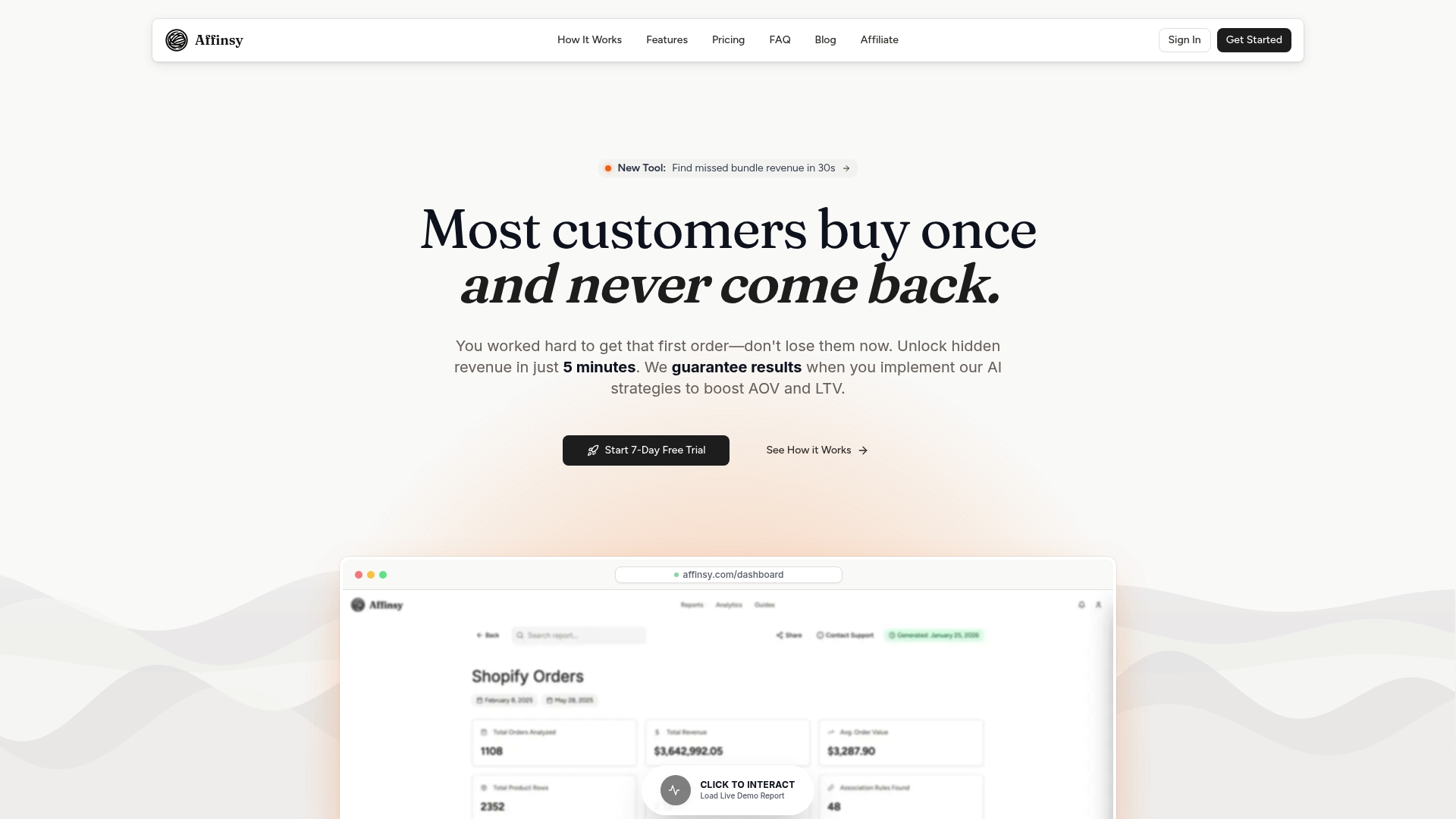
Take the next step now by exploring how Affinsy’s analytics platform can unlock hidden growth opportunities in your e-commerce business. Don’t wait to turn your data into dollars.
Frequently Asked Questions
What are AI analytics tools for eCommerce?
AI analytics tools for eCommerce are specialized software platforms that utilize artificial intelligence to analyze data related to online sales and customer behavior. These tools help eCommerce businesses make data-driven decisions by providing actionable insights such as customer segmentation, purchase patterns, and performance metrics. Start by exploring the features of these tools to identify which best aligns with your business goals.
How can I improve my average order value using AI analytics tools?
You can improve your average order value (AOV) by using AI analytics tools to perform market basket analysis and identify product associations. These insights allow you to create targeted bundling strategies, which can lead to increased sales. Implement bundle promotions within 30 days of analysis to measure shifts in AOV.
What should I consider when choosing an AI analytics tool for my online store?
When choosing an AI analytics tool for your online store, consider factors such as ease of use, integration capabilities, and the quality of insights provided. Evaluate how well the tool connects with your existing eCommerce platform and marketing systems, as seamless integration will enhance your workflow. Create a checklist of must-have features to guide your selection process.
How can AI analytics tools help with customer retention strategies?
AI analytics tools can enhance your customer retention strategies by identifying high-value customers and those at risk of churn through RFM segmentation and behavior analysis. By creating targeted campaigns based on these insights, you can engage customers effectively and encourage repeat purchases. Initiate personalized email or SMS marketing campaigns within a month to boost retention rates.
What is the typical pricing structure for AI analytics tools in eCommerce?
The typical pricing structure for AI analytics tools in eCommerce varies widely, ranging from freemium models to subscription-based plans, which may start as low as $0 for basic features. Generally, expect costs to scale based on the number of users, data volume, and additional features you might need. Review your budget and ensure you consider the potential return on investment before committing to a plan.
How long does it take to see results from using an AI analytics tool?
Typically, businesses can expect to see initial results from using an AI analytics tool within 30 to 60 days, depending on the specific strategies implemented. To maximize effectiveness, promptly analyze your data and deploy actionable insights into your marketing campaigns. Benchmark your key performance indicators to evaluate success.
Recommended
- Best Top Ecommerce Analytics Platforms – Expert Comparison 2025 - Affinsy Blog | Affinsy
- 7 Essential Marketing Analytics Tools List for E-commerce Success - Affinsy Blog | Affinsy
- Best ecommerce insights platforms – Expert Comparison 2025 - Affinsy Blog | Affinsy
- Top 7 Best Market Basket Analysis Tools for Small Business 2026 - Affinsy Blog | Affinsy