
TL;DR:
- Strategic product bundling can increase average order value by up to 50% without harming margins.
- Effective bundles are based on data and customer behavior, not intuition or guesswork.
- Regularly testing and refining bundles ensures sustained performance and revenue growth.
Most e-commerce managers assume that discounts are the fastest path to higher sales. But that assumption leaves serious revenue on the table. Strategic product bundling has helped online retailers increase average order value by as much as 50%, without slashing margins the way blanket discounts do. This guide covers everything you need: a clear definition of product bundling, the main types, the measurable benefits, the mistakes that hurt ROI, and a step-by-step framework to launch bundles that actually perform.
Table of Contents
- What is product bundling?
- Common types of product bundles
- Benefits of product bundling for e-commerce brands
- Common mistakes and pitfalls in product bundling
- How to implement effective product bundling
- A smarter perspective on product bundling: Why strategy beats intuition every time
- Explore more resources to power up your bundling strategy
- Frequently asked questions
Key Takeaways
| Point | Details |
|---|---|
| Bundling basics | Product bundling means selling multiple items together to boost perceived value and average order value. |
| Strategic bundle types | Pure, mixed, and curated bundles suit different goals and products in e-commerce. |
| Data-driven results | Well-designed bundles can raise average order value between 20% and 50%. |
| Avoid common mistakes | Set bundle prices carefully and always design for real customer needs. |
| Plan, test, and refine | Successful bundling relies on using data, segmenting customers, and ongoing optimization. |
What is product bundling?
Product bundling means selling two or more complementary products together as one combined offering, typically at a price that feels more attractive than buying each item separately. The mechanic is straightforward: you group related items, set a bundle price, and present the package as a single purchase decision. The result is fewer friction points for the buyer and a higher revenue per transaction for your store.
Here are a few examples that show how this works in practice:
- A skincare brand bundles a cleanser, toner, and moisturizer into a “starter routine” kit priced 15% below the combined individual prices.
- A gaming accessories retailer pairs a headset with a controller stand and cable organizer as a “setup bundle.”
- A coffee brand groups three bag sizes, each a different roast, into a “sampler pack” for first-time buyers.
In each case, the bundle increases perceived value. The customer feels like they are getting something curated and useful, not just a random collection. From the brand side, bundles reduce the marketing cost per unit sold, move more SKUs per transaction, and can clear slow-moving inventory without a blunt discount.
Pro Tip: Use bundling to launch new products. Pairing an unproven item with a bestseller exposes it to buyers who already trust your brand, which is far more effective than promoting it cold.
Common types of product bundles
Not every bundle is built the same way. The main types of product bundles include pure, mixed, cross-sell, and curated bundles, and each serves a different goal.

Pure bundles force the customer to buy the full package. There is no option to purchase items separately. This works well for products that are genuinely interdependent.
Mixed bundles give buyers flexibility. They can choose the bundle or purchase items individually. This reduces risk if customers are price-sensitive.
Cross-sell bundles surface complementary products at checkout or on product pages, encouraging add-on purchases. Think “frequently bought together” on any major marketplace.
Curated or thematic bundles are built around a specific occasion, audience, or use case, like a holiday gift set or a “work-from-home starter kit.”
| Bundle type | Key feature | Best use case |
|---|---|---|
| Pure bundle | Items sold only as a set | Interdependent products, subscriptions |
| Mixed bundle | Items available separately or together | Price-sensitive audiences, broad catalogs |
| Cross-sell bundle | Suggested at point of purchase | High-traffic product pages, cart upsells |
| Curated bundle | Themed around a need or occasion | Gift seasons, niche buyer segments |
Use cases by type:
- Pure: Subscription boxes, software feature tiers, proprietary accessory kits
- Mixed: Apparel bundles, beauty multi-packs, home goods sets
- Cross-sell: Electronics with warranties, food with condiments, fitness gear with supplements
- Curated: Holiday packs, onboarding kits for new customers, lifestyle-themed gift sets
Choosing the right type depends on your product catalog, your buyer behavior data, and the purchasing pattern of your audience.
Benefits of product bundling for e-commerce brands
Once you match the right bundle type to your strategy, the business impact becomes measurable fast. Bundle initiatives result in 20 to 50% gains in average order value, which is one of the most reliable levers you have for growing revenue without increasing your ad spend.
Top benefits your brand can expect:
- Higher average order value (AOV) per transaction
- Improved conversion rates when buyers perceive greater value
- Stronger customer loyalty through curated, relevant offers
- Faster inventory turnover for slower-moving products
- Lower customer acquisition cost per dollar of revenue
| Metric | Before bundling | After bundling |
|---|---|---|
| Average order value | $48 | $67 |
| Conversion rate | 2.1% | 2.9% |
| Items per order | 1.4 | 2.3 |
| Return customer rate | 22% | 31% |

These numbers are illustrative but consistent with what data-driven DTC brands report after implementing structured bundling programs. The biggest driver is not just the price discount. It is the reduction in decision fatigue. When you curate the bundle well, the customer trusts your judgment and buys faster.
Subscription add-ons and themed gift packs are particularly effective because they create a natural reason to bundle. A monthly subscription box signals ongoing value. A gift pack reduces the research burden for buyers during high-intent shopping periods like holidays or back-to-school.
Key insight: Bundling is not just a revenue tactic. It is a customer experience decision. When you bundle thoughtfully, you are telling your buyers that you understand how they actually use your products.
Common mistakes and pitfalls in product bundling
Bundling fails when it is done without rigor. Improper bundle pricing and poor consumer targeting can erode perceived value and decrease profitability, which is the opposite of what any campaign should deliver.
Here are the five most common mistakes brands make:
- Poor pricing logic. Setting a bundle price that is barely lower than buying items separately removes the perceived benefit. Buyers do the math. Make the value obvious.
- Low product relevance. Grouping items that do not naturally go together confuses buyers and signals that you are just trying to move inventory, not serve their needs.
- Too many bundle options. Offering 12 different bundles creates choice paralysis. Start with two or three focused options and iterate.
- Ignoring behavioral data. Building bundles based on what you think goes together rather than what customers actually buy together is a common and costly error.
- Skipping feedback loops. Launching a bundle and never revisiting performance data means you miss the signal on what is working and what is not.
Pro Tip: Always A/B test new bundles before scaling. Run two versions with different price points or product combinations on a segment of your traffic. Let the data decide, not assumptions.
For deeper guidance on expert bundling tips that prevent these errors, the pattern is consistent: brands that avoid these five mistakes see sustained lift, while those that skip them see early success followed by sharp drop-offs.
How to implement effective product bundling
With a clear view of the pitfalls, here is a framework any e-commerce team can follow. The key insight is that customer segmentation paired with data-driven insights ensures bundles appeal to the right buyers at the right moment.
- Set your goal. Define whether you are targeting AOV growth, inventory clearance, new product adoption, or customer retention. Your goal shapes every decision that follows.
- Gather order data. Export your transaction history and look for products that are frequently purchased together. This is the foundation of good bundle design.
- Segment your customers. Different buyer groups respond to different bundles. High-frequency buyers want value-adds. New customers need entry-level curated sets. Use RFM segments to guide your targeting.
- Design the bundle. Build a small set of two to three product combinations based on your data findings. Keep it focused and relevant.
- Set the price. Apply a clear value discount, typically 10 to 20%, that makes the bundle price feel like a genuine win without destroying your margin.
- A/B test. Run the bundle against a control group. Measure AOV, conversion rate, and return rate over at least two weeks.
- Refine and scale. Take the winning version, improve on it, and roll it out more broadly. Repeat the cycle quarterly.
Pro Tip: Data-driven bundle creation using market basket analysis removes the guesswork entirely. Instead of asking “what might go well together,” you ask “what does our order history prove goes together.” That shift alone can double bundle relevance.
A smarter perspective on product bundling: Why strategy beats intuition every time
Here is something most brands learn the hard way: the bundles that feel obviously right are rarely the bundles that perform best. A team will spend a week designing a “premium” gift set based on what they personally find appealing, launch it with confidence, and watch it underperform. Then they run a data pull and discover that customers have been quietly buying two completely different products together for months.
Intuition has its place in creativity, but not in bundle selection. The brands that win at bundling treat it as a living program, not a one-time promotion. They revisit bundle performance quarterly, retire what is not working, and build the next set from updated order data. AOV bundling lessons from high-performing retailers consistently point to the same truth: frequency of iteration, not the size of the initial launch, is what drives compounding results.
Market basket analysis is the tool that makes this practical. It shows you which product pairs appear together across thousands of transactions, which means you are designing from evidence, not opinion. That is the edge most brands leave untapped.
Explore more resources to power up your bundling strategy
If you are serious about turning product bundling into a reliable revenue engine, the next step is getting the right data infrastructure in place. Understanding market basket analysis is the foundation for identifying which products belong in a bundle, and combining that with predictive analytics lets you get ahead of what your customers will want next.
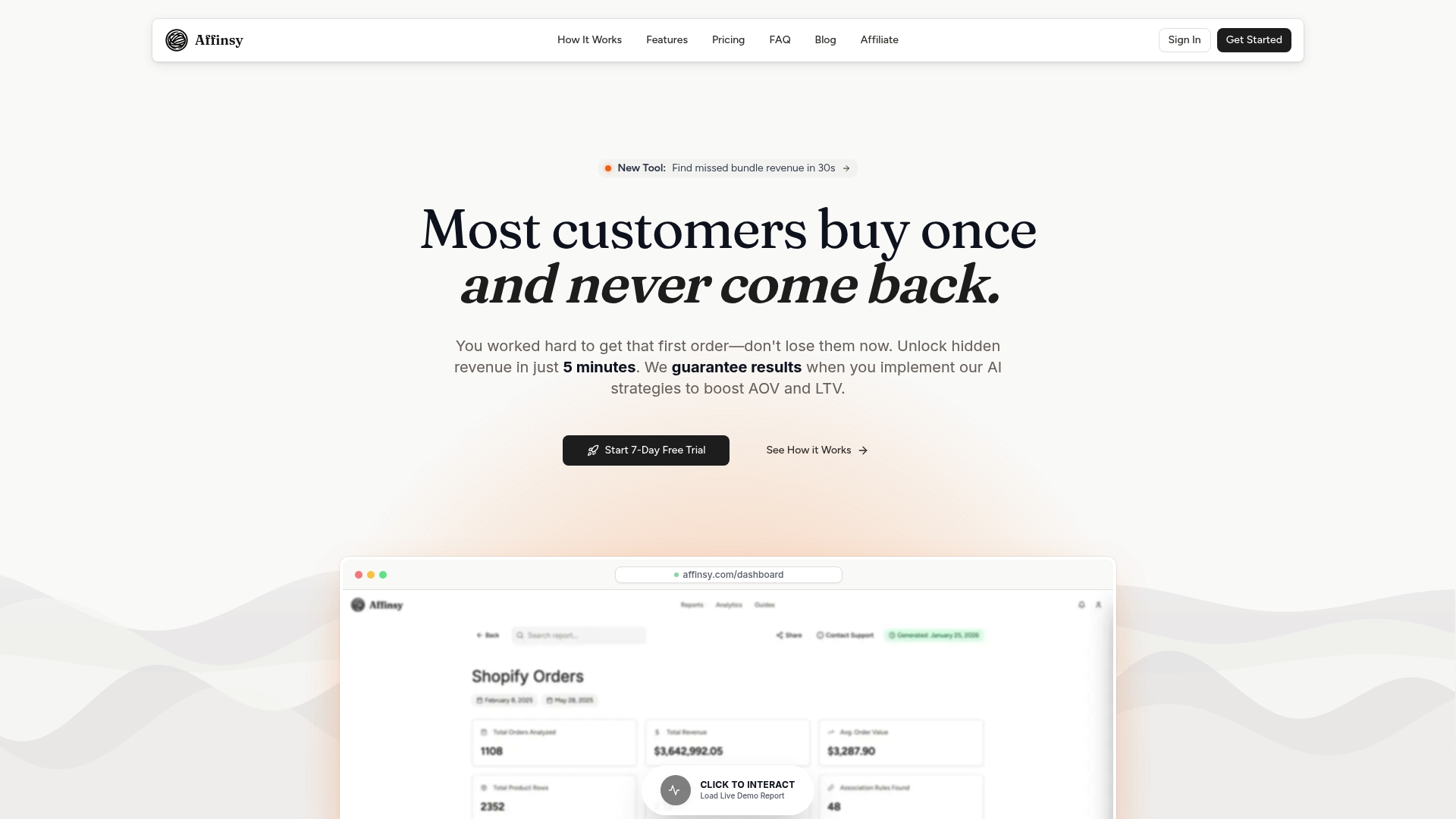
Affinsy analyzes your historical transaction data to surface real product associations and customer segments, so you stop guessing and start building bundles that convert. You can start for free with up to 20K line items, no credit card required. Explore all Affinsy resources to see how analytics can make every bundling decision sharper.
Frequently asked questions
What are the most effective types of product bundles for online stores?
Curated, cross-sell, and mixed bundles often perform best, but the right choice depends on your customer data and product catalog. Bundle types should align with how your specific buyers already shop.
How much can product bundling increase sales?
Brands consistently see AOV increases of 20 to 50% when using strategic product bundles backed by order data.
What is the biggest mistake in product bundling?
The most common error is poor bundle pricing or grouping irrelevant products that do not reflect how customers actually shop.
How do I get started with product bundling?
Begin by analyzing your order history and customer segments, then design and test small bundles before scaling. Data-driven segmentation ensures your first bundles are built on evidence, not guesswork.
Recommended
- Master Product Bundling Strategies for E-Commerce Success - Affinsy Blog | Affinsy
- The DTC Bundling Playbook: How to Build Data-Driven Product Bundles That Actually Increase AOV on Shopify - Affinsy Blog | Affinsy
- Master Product Bundling on Shopify for Increased Sales - Affinsy Blog | Affinsy
- Product Bundling — E-Commerce Glossary | Affinsy | Affinsy
- 6 Effective Ways to Boost B2B Order Size for Brands