
TL;DR:
- Data-driven analysis reveals natural co-purchase patterns for effective bundling strategies.
- Segmenting customers enables personalized bundles that increase conversions and customer satisfaction.
- Continuous testing and AI personalization are essential for optimizing bundle performance and margins.
Product bundling looks simple on paper: group related items, offer a slight discount, watch average order value climb. But mid-to-large e-commerce brands know the reality is messier. Bundles that ignore customer behavior, rely on deep discounts, or mismatch products can quietly erode margins and frustrate shoppers. The good news is that data-driven bundling, powered by AI and proper analytics, changes the equation entirely. In this guide, you’ll get seven actionable tips to build bundles that genuinely lift revenue, protect profit, and keep customers coming back.
Table of Contents
- Start with data: Analyze your order history for opportunities
- Segment customers: Tailor bundles to buyer personas
- Get pricing right: Avoid excessive discounts and value erosion
- Test and optimize: Use analytics and AI for ongoing improvement
- Why most product bundling advice fails mid-to-large brands
- Supercharge your bundling with advanced analytics and automation
- Frequently asked questions
Key Takeaways
| Point | Details |
|---|---|
| Leverage order data | Start with basket analysis to uncover natural product pairings for strategic bundles. |
| Segment bundle offers | Match bundles to specific buyer personas for higher relevance and sales. |
| Protect your margins | Use thoughtful bundle pricing to avoid over-discounting and maintain perceived value. |
| Continuously optimize | Rely on analytics and AI to test, refine, and personalize bundles over time. |
Start with data: Analyze your order history for opportunities
Every high-performing bundle starts with a question: what do your customers already buy together? Your order history holds the answer. Before you create a single bundle, pull your transaction data and look for natural co-purchase patterns. This is the foundation that separates strategic bundling from guesswork.
Using basket analysis on your historical orders reveals which products appear together most often, at what frequency, and across which customer types. These are your highest-probability bundle candidates because the market has already validated them.
Here’s a sample of what that data might look like:
| Product A | Product B | Co-purchase rate | Avg. order value |
|---|---|---|---|
| Running shoes | Compression socks | 38% | $112 |
| Yoga mat | Resistance bands | 44% | $87 |
| Coffee grinder | Specialty beans | 51% | $94 |
| Laptop stand | Wireless keyboard | 29% | $143 |
Those co-purchase rates are not random. They reflect genuine customer intent. Once you have this view, dig deeper with these questions:
- Are these pairings seasonal, or do they hold year-round?
- Do customers who buy these combos have a higher lifetime value?
- Is the pairing driven by a specific segment, like new buyers or repeat purchasers?
- Does the co-purchase rate increase after a promotion, or is it organic?
- Are there three-product combos hiding inside two-product patterns?
This line of questioning helps you avoid a critical trap: bundles fail when misaligned with purchasing segments or product relationships. A bundle that works for a power user will confuse a first-time buyer. Data keeps you honest.
Pro Tip: If manual analysis feels overwhelming, tools built for master product bundling strategies can surface non-obvious associations across thousands of SKUs in minutes, connections no spreadsheet would catch.
Segment customers: Tailor bundles to buyer personas
Once you’ve identified bundle opportunities in your data, the next step is customizing them to fit different customer groups. A single bundle offer pushed to your entire list is a missed opportunity at best and a revenue leak at worst.
Start with customer segmentation basics to define who you’re actually selling to. Three segments come up repeatedly in e-commerce bundling:
- SuperFans: High purchase frequency, strong brand loyalty, willing to pay full price for curated experiences
- CasualFans: Moderate engagement, respond well to themed or seasonal bundles
- Price shoppers: Motivated primarily by perceived savings, best served by value packs
Here’s how those segments map to bundle types:
| Segment | Key traits | Best bundle type | Discount sensitivity |
|---|---|---|---|
| SuperFan | High LTV, repeat buyer | Exclusive or themed add-ons | Low |
| CasualFan | Seasonal, event-driven | Curated starter kits | Medium |
| Price shopper | Deal-driven, low loyalty | Volume or value packs | High |
The criteria for segmenting your bundles should include purchase frequency, typical cart size, product category affinity, and recency of last purchase. These inputs let you build offers that feel personal rather than generic.

AI-based bundling takes this further by dynamically adjusting which bundle a customer sees based on their real-time behavior and historical patterns. This reduces overlap between segments, meaning your SuperFan doesn’t get the discount-heavy value pack that would actually cheapen their experience. Explore agentic commerce and personalization to see how this plays out in practice.
Segment-aligned bundles consistently outperform generic ones because relevance drives conversion. When a customer sees a bundle that feels built for them, the decision to add it to cart becomes easy.
Get pricing right: Avoid excessive discounts and value erosion
After tailoring your bundles by segment, focus on balancing attractive pricing with sustainable margins. This is where many brands stumble. The instinct to offer a big discount to move bundles is understandable, but it creates a long-term problem.
“Excessive discounts in bundles erode value or train customers to wait for deals.”
Once shoppers learn to expect a 30% bundle discount, they stop buying at full price. You’ve essentially created a discount dependency. The fix is a more disciplined pricing framework.
Here are the most effective bundle pricing approaches:
- Anchor pricing: Show the individual item total alongside the bundle price so customers feel the savings without you needing to go deep on discount
- Tiered bundles: Offer a base bundle and a premium version, letting customers self-select their price point
- Perceived value stacking: Include a lower-cost item with high perceived value to make the bundle feel richer without cutting margin
- Flat-rate bundles: Fix a round number price that’s easy to process and still profitable
A practical margin-protection formula: set your bundle price at no less than the combined cost of goods plus your minimum acceptable margin, then work backward from what the customer perceives as fair. If the math doesn’t work, the bundle isn’t ready.
Use bundle pricing strategies to test different structures before committing. Pair that with retail analytics for AOV to track whether each pricing model actually lifts average order value over time.
Pro Tip: Before rolling out a new bundle price site-wide, run it against a small segment first. A 5% price shift can have an outsized impact on conversion, and you want that data before it affects your entire catalog.
Test and optimize: Use analytics and AI for ongoing improvement
With bundles and pricing in place, ongoing experimentation is crucial for sustained success. Launching a bundle and leaving it untouched is one of the most common mistakes established brands make.
Here’s a repeatable process for testing and improving bundle performance:
- Set a clear hypothesis: “Adding product C to this two-item bundle will increase conversion by 10% among CasualFan buyers.”
- Define your control and variant: Keep the existing bundle as the control, introduce the new version as the variant.
- Run the A/B test for at least two full purchase cycles to account for behavioral variation.
- Measure conversion lift, AOV change, and margin impact side by side, not just top-line revenue.
- Analyze segment-level results: A bundle that underperforms overall may be a strong performer for one specific segment.
- Iterate based on findings: Kill what doesn’t work, scale what does, and document the logic for future tests.
The payoff is real. Brands using retail analytics consistently report bundle-driven AOV improvements of up to 50%, which compounds quickly across a large customer base.
AI/dynamic bundling personalizes offers in real time, adjusting which bundle a customer sees based on their session behavior, past purchases, and predicted intent. This removes the manual guesswork from optimization. Pair it with AI sales optimization strategies to build a system that improves itself.
One thing to watch: deal fatigue. If a bundle runs too long or too aggressively, customers stop responding. Monitor engagement rates monthly and rotate or refresh bundles before performance drops. Learn more about how to improve AOV with bundling as part of a sustained optimization cycle.
Why most product bundling advice fails mid-to-large brands
Here’s the uncomfortable truth: most bundling guides are written for small stores with simple catalogs. Tips like “bundle similar products” or “offer a 10% discount” are fine starting points, but they collapse under the operational weight of a brand managing thousands of SKUs, multiple customer segments, and quarterly promotions.
At scale, bundling is not a marketing trick. It’s a continuous optimization process that requires segment alignment, pricing discipline, and real-time data feedback. Static bundles built on gut feel become liabilities as your catalog grows and customer expectations shift.
The contrast is sharp. Traditional bundling removes customer choice and risks alienating your highest-value buyers. But AI/dynamic bundles personalize to minimize SuperFan overlap while maximizing CasualFan reach, a fundamentally different approach that treats bundling as a living strategy, not a set-it-and-forget-it tactic.
Brands that use analytics to boost AOV treat every bundle as a hypothesis to be tested, not a permanent fixture. That mindset shift is what separates brands that grow through bundling from those that slowly erode their margins chasing short-term lift.
Supercharge your bundling with advanced analytics and automation
Ready to put these advanced tips into action and accelerate your bundling ROI? Affinsy gives e-commerce teams the analytical firepower to move from guesswork to precision.
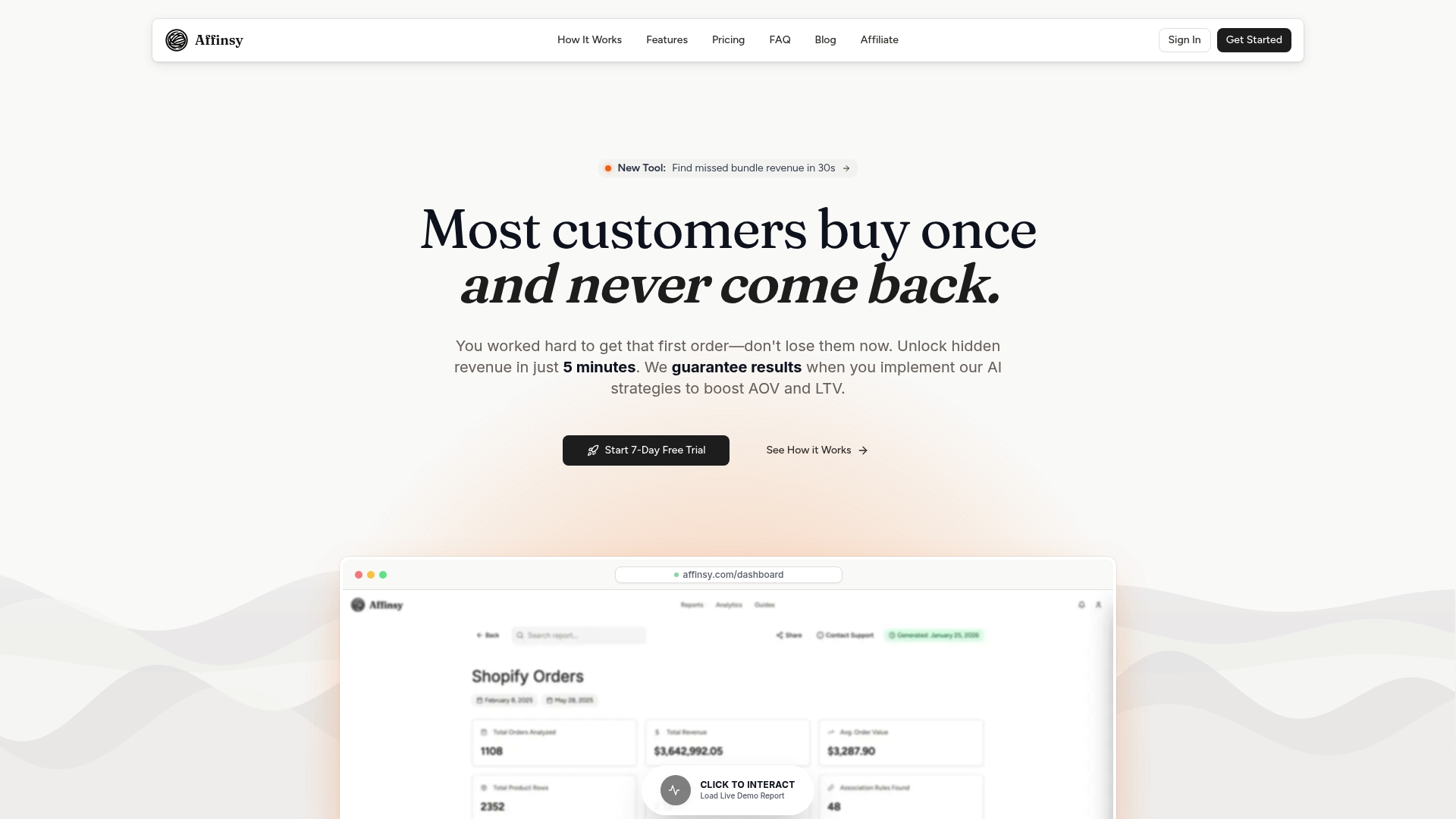
Start by running market basket analysis on your existing transaction data to surface the bundle combinations your customers already want. Explore the product bundling glossary to sharpen your strategy vocabulary and align your team. Then visit Affinsy to see how the platform automates bundle discovery, customer segmentation, and performance tracking in one place. No data science skills required, just your order data and a clear goal.
Frequently asked questions
What are the most common mistakes in product bundling?
Bundles fail when they combine unrelated products, target the wrong customer segments, or rely on excessive discounts that train shoppers to wait for deals rather than buy at full price.
How can AI improve the effectiveness of product bundles?
AI/dynamic bundling personalizes offers to each buyer segment, minimizes overlap between high-value and deal-seeking customers, and continuously optimizes bundle composition based on real purchase behavior.
How often should I update my product bundles?
Review and test bundles at least quarterly, or sooner if analytics show declining conversion rates or shifts in customer purchase patterns.
Does product bundling work better for some segments than others?
Yes. Price-sensitive and new customers respond strongly to value packs, while high-LTV superfans prefer curated or exclusive bundles that reflect their loyalty rather than just a discount.
Recommended
- The DTC Bundling Playbook: How to Build Data-Driven Product Bundles That Actually Increase AOV on Shopify - Affinsy Blog | Affinsy
- 7 Smart Bundle Pricing Strategies for E-commerce Success - Affinsy Blog | Affinsy
- Master Product Bundling Strategies for E-Commerce Success - Affinsy Blog | Affinsy
- Master Product Bundling on Shopify for Increased Sales - Affinsy Blog | Affinsy
- Die 7 besten E-Commerce Tools 2026