
TL;DR:
- Effective product bundling significantly increases revenue when properly managed and optimized for customer behavior. Native BigCommerce tools are useful for simple configurations, but larger or complex bundles require third-party apps and API-driven solutions to ensure accuracy and scalability. Regular analysis, personalization, and data-driven adjustments are essential for maintaining high-performing, future-proof bundle strategies.
Product bundling should be one of your highest-return tactics, yet so many BigCommerce stores leave serious money on the table because their bundle setups are clunky, inventory tracking is unreliable, or the wrong products end up paired together. When bundles miss the mark, customers skip them, operations teams scramble, and your average order value stays flat. The good news: BigCommerce gives you a capable foundation, and when you layer AI-driven analytics on top, you can build bundle strategies that actually convert, scale cleanly, and adapt to real shopper behavior over time.
Table of Contents
- Understanding BigCommerce product bundles
- Requirements and tools for effective BigCommerce bundling
- Step-by-step: Building and launching bundles
- Troubleshooting and optimizing bundle performance
- What most guides miss: Making BigCommerce bundles scalable and future-proof
- Unlock smarter bundling and analytics with Affinsy
- Frequently asked questions
Key Takeaways
| Point | Details |
|---|---|
| Bundling boosts sales | Smart bundles increase average order value and cross-sell opportunities. |
| Native vs API solutions | API-driven kit builders offer more scalability and reduce manual admin, especially for complex bundles. |
| Inventory accuracy is critical | Use kit builder logic and apps to ensure bundled components reflect correct stock, preventing lost sales. |
| AI drives bundle optimization | Harness AI analytics to suggest new bundles based on real shopping behavior and keep offers relevant. |
| Plan for operational limits | Native tools can hit item caps—advanced solutions let you bundle at scale without friction. |
Understanding BigCommerce product bundles
Before you build anything, you need a clear picture of what you’re actually working with. BigCommerce product bundles are multi-item offers sold as one combined package, typically made of complementary goods or services. That’s different from a multipack, which groups multiples of the same product. A camera with a memory card and a carrying case is a bundle. Three of the same phone case is a multipack. The distinction matters operationally, because how you structure inventory, pricing, and promotions will differ significantly.
There are several bundle types worth knowing:
- Pre-built bundles: A fixed set of products grouped under one SKU and sold at a set price. Fast to launch, great for gift sets.
- Build-your-own (BYO) bundles: Shoppers select components from a defined list. Higher engagement, but more complex to configure.
- Tiered bundles: “Buy 2, save 10%; buy 3, save 20%” mechanics that reward higher volume.
- Cross-sell bundles: Triggered by cart or product page behavior, suggesting a natural companion product.
Understanding product bundling basics helps you match bundle type to your catalog and customer intent. A skincare brand might thrive with pre-built seasonal gift bundles, while a sporting goods store might benefit far more from BYO kit configurations.
Here’s a quick comparison of bundle types:
| Bundle type | Best use case | Complexity | AOV impact |
|---|---|---|---|
| Pre-built | Gift sets, promotions | Low | Medium |
| Build-your-own | Custom kits, gear | High | High |
| Tiered volume | Consumables, B2B | Medium | Medium-High |
| Cross-sell | Impulse additions | Low | Medium |
The business case is strong. Promotional pricing tips from conversion-focused retailers consistently show that bundling increases average order value while also improving perceived value for shoppers. Customers feel like they’re getting a deal; you move more inventory in a single transaction. Across the shopping journey, bundles reduce decision fatigue by presenting curated choices rather than overwhelming product lists. That’s a win for conversion rates on both desktop and mobile.
Exploring proven bundling strategies early will save you from launching bundles that look right but never convert.
Requirements and tools for effective BigCommerce bundling
Getting bundles right in BigCommerce requires the right combination of native features and, in many cases, third-party tooling. Let’s be direct about what’s available and where the gaps are.

The most common native bundle method in BigCommerce uses Modifier Options with Pick Lists. Modifier Options let you attach additional choices to a base product. Pick Lists allow shoppers to select a specific product variant as one of those choices. By stacking these, you can effectively create a BYO bundle experience without needing custom development. It’s accessible, it’s free, and it works for many small-to-mid catalog scenarios.
Here’s what you need before you start building:
- A clearly defined base product (the “anchor” of your bundle)
- Identified companion products with available inventory
- Agreed-upon pricing strategy (flat discount, percentage off, or bundled price)
- Warehouse or fulfillment team aligned on how bundled SKUs will be picked and shipped
- Analytics on which products are frequently purchased together (this is where AI earns its keep)
Understanding what’s involved in bundle requirements from the start prevents mid-launch surprises. For larger catalogs with hundreds of SKUs, native tools alone often fall short. Inventory management becomes a real pain point: if a component in a bundle sells out individually, the bundle listing may still show as available, leading to fulfillment errors and customer complaints.
This is exactly why BigCommerce partner tooling exists. Third-party kit and bundle apps address operational edge cases like inventory accuracy across bundle components, real-time stock syncing, and bundle-specific analytics. Norsland Lefse, a specialty food brand, used a kit builder approach to keep component inventory accurate without requiring manual overrides after every sale.
Pro Tip: If your store carries more than 50 active bundle configurations, invest in a dedicated kit builder app before you launch. Retrofitting inventory logic after the fact is significantly more costly than building it in from the start.
You should also explore how bundles impact the broader commerce ecosystem, especially as AI-driven and agentic commerce tools increasingly rely on structured product relationships. Bundles that are cleanly set up in your catalog are far easier to surface through personalization engines and recommendation APIs.
For teams evaluating third-party kit apps, look for solutions that offer component-level inventory control, bundle-specific discount logic, and integration with your existing fulfillment workflow.
Step-by-step: Building and launching bundles
Here’s a practical sequence for building and launching bundles that work:
- Identify bundle candidates using transaction data. Pull your order history and look for products that are frequently purchased together. Market basket analysis tells you which pairings have genuine demand, not just intuitive appeal.
- Define your bundle mechanics. Choose pre-built, BYO, or tiered based on your catalog complexity and customer behavior.
- Create the base product in BigCommerce. Set your bundle pricing here. Name it clearly so shoppers immediately understand the value proposition.
- Add Modifier Options. Navigate to the product editor, add a Pick List modifier, and assign the companion products as selectable options.
- Set pricing rules. Apply a discount at the product level or use BigCommerce’s native promotions engine to offer a bundle-specific price.
- Configure inventory tracking. Decide whether the bundle tracks inventory at the base product level or across components. For complex bundles, a third-party tool is your best option here.
- QA the checkout experience. Add the bundle to cart, walk through checkout, and verify that pricing, product names, and inventory deductions behave correctly.
- Launch and monitor. Set a performance review window, typically 30 days, and track add-to-cart rate, bundle conversion rate, and AOV lift.
For complex dynamic bundles, BigCommerce teams implement bundle relationships via pick list modifier fields, but can hit practical limits, such as a 30-item cap per modifier. If you need shoppers to configure a large or multi-step kit, you’ll run into this ceiling quickly with native tools alone.
The teams that scale bundle revenue fastest are the ones that treat bundle setup as a systems problem, not just a merchandising task. Clean data, reliable inventory, and clear pricing logic are the foundation.
API-driven kit builders solve this. A BigCommerce case study of Toolden, a hardware retailer, showed significant revenue uplift and faster kit configuration after migrating from rigid legacy bundle functionality to a bespoke, API-driven kit builder. When shoppers can configure complex product kits in real time with accurate pricing and availability feedback, conversion rates follow.
For simpler bundles, native tools are perfectly adequate. For anything involving more than 10 components, conditional logic, or real-time pricing calculations, an API-driven approach is worth the development investment.
Bundle pricing tips show that the discount framing matters as much as the discount amount. “Save $15” outperforms “10% off” for most product categories because the concrete savings figure is easier for shoppers to process. And expert bundling tips consistently emphasize that bundles should feel curated, not arbitrary. Random pairings don’t convert; complementary pairings that solve a specific problem do.
Connecting your bundle building strategies to a broader marketing mix approach ensures bundles don’t exist in isolation but reinforce your promotional calendar and customer acquisition strategy.
Pro Tip: Run A/B tests on bundle names and value messaging before committing to a long-term configuration. “Complete Starter Kit” and “Save $20 Today” can perform very differently for the same bundle, depending on your audience.
Troubleshooting and optimizing bundle performance
Even well-built bundles break down over time. Here are the most common failure points and how to address them.
Inventory misalignment is the most frequent operational problem. When a component sells out via individual purchases, the bundle listing stays active and takes orders you can’t fulfill. Fix this by using component-level inventory tracking through a dedicated kit builder, not BigCommerce’s base-level stock management alone.
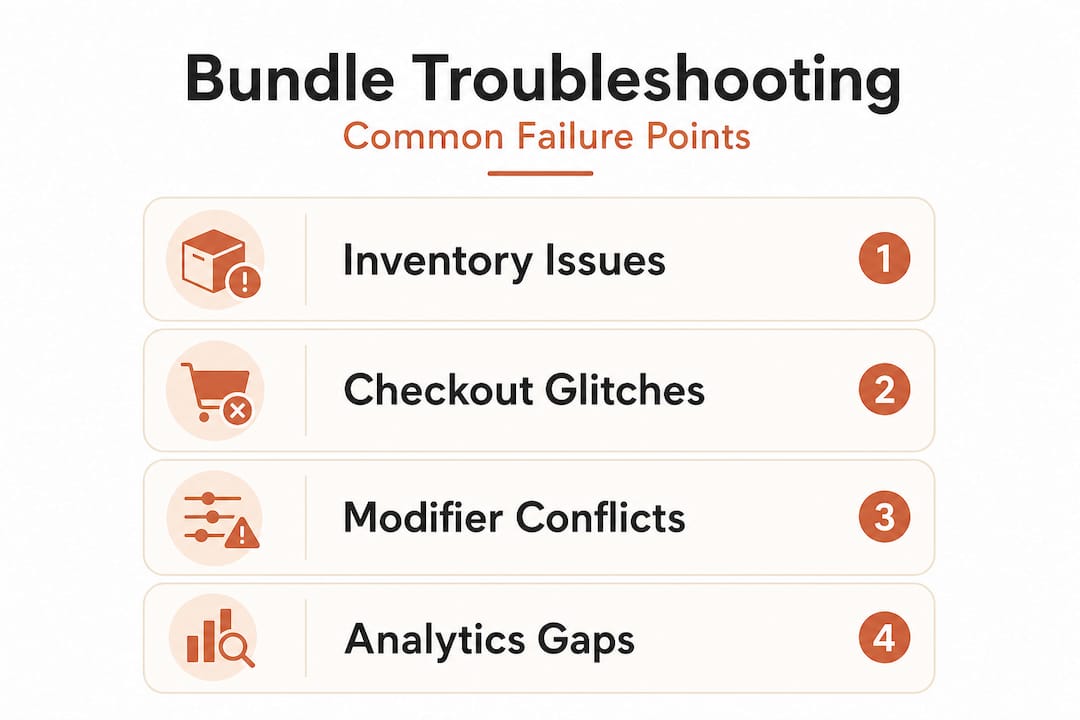
Checkout glitches often stem from modifier option conflicts, especially when bundles interact with discount codes or shipping rules. Always test bundles in a staging environment before pushing to production, and retest after any theme or app updates.
Low-converting bundles are usually a data problem. If your pairings aren’t grounded in actual purchase behavior, shoppers won’t see the value. This is where AI bundle tools come in. AI-driven recommendations use co-purchase behavior and ongoing performance monitoring to surface which bundles are genuinely resonating and which need adjustment. They also apply replacement fallbacks for out-of-stock items, keeping bundle pages live and converting even when individual components run low.
Key performance metrics to track for every bundle:
- Bundle view rate: What percentage of shoppers landing on a bundle page actually view it?
- Add-to-cart rate: Of those who view it, how many add it to cart?
- Bundle conversion rate: Of those who add it, how many complete purchase?
- AOV lift: Does the bundle transaction value exceed your store average?
- Return rate: Bundles with high return rates often signal a mismatch between customer expectation and product fit.
AI product recommendations take this further by personalizing bundle suggestions based on individual shopper history, not just aggregate co-purchase patterns. A returning customer who has already bought a base product should see bundles that add new value, not recycle what they already own. This level of personalization requires smart recommendations infrastructure that goes beyond native BigCommerce capabilities.
For a broader view of how AI analytics are reshaping sales and segmentation in e-commerce, the pattern is clear: stores that act on data-driven bundle insights consistently outperform those running on gut instinct and category intuition.
What most guides miss: Making BigCommerce bundles scalable and future-proof
Here’s an opinion most bundle guides won’t give you: the tools you start with will determine whether your bundle program grows into a revenue asset or becomes a maintenance burden at scale.
Most e-commerce teams underestimate how quickly native pick list configurations become cumbersome. Mechanics choice matters: native pick list bundles can be fast to implement but can become cumbersome for large, multi-step “build-your-own” experiences. That 30-item cap isn’t a minor inconvenience for a sporting goods store or a B2B hardware seller. It’s a hard ceiling that forces architectural rework when you’re already under sales pressure.
The smarter approach is to plan your bundle infrastructure for the catalog size and complexity you’ll have in 18 months, not the one you have today. If you’re adding SKUs, expanding categories, or moving into personalized recommendations, a kit builder with API access is the right foundation from the start.
The second thing most guides miss is that bundle optimization is never a one-time project. Shopper behavior shifts seasonally, inventory pressures change pairings, and new products enter the mix. Data-driven bundling means running market basket analysis on your transaction data regularly, not just at launch. The bundles that drove AOV six months ago may be stale today.
The third insight: customer segmentation changes what “optimal” means for a bundle. A first-time buyer and a loyal customer at 10 orders need different bundle framing, different price points, and often different product combinations. AI-powered analytics platforms can surface these distinctions automatically, letting your marketing team act on segment-specific bundle recommendations without building custom queries from scratch.
The bottom line is this: bundles are not a set-and-forget tactic. Treat them as a living part of your product strategy, backed by transaction data and refreshed regularly, and they’ll keep delivering compounding returns.
Unlock smarter bundling and analytics with Affinsy
Understanding BigCommerce bundle mechanics is the first step. Turning those mechanics into measurable revenue lift requires knowing which products to pair, which segments to target, and where conversion is actually breaking down.
Affinsy makes that analysis fast and accessible without requiring a data science team. Feed your BigCommerce order export into Affinsy via CSV upload or API, and the platform runs market basket analysis to surface high-confidence product pairings based on real co-purchase patterns. RFM customer segmentation identifies which shopper groups are most receptive to bundle offers, so you’re not running the same promotion across your entire list. You can start on the permanent free tier with up to 20K line items and no credit card required, then scale to Pro ($49/mo) or Max ($199/mo) as your dataset and API needs grow. If you’re serious about bundle performance, this is where the data conversation starts.
Frequently asked questions
How do BigCommerce bundles differ from multipacks?
BigCommerce bundles combine complementary products into a single package, while multipacks group multiples of the same product. The two require different inventory setups and promotional approaches in BigCommerce.
What’s the best way to ensure inventory accuracy for bundle components?
Use a dedicated kit builder or third-party app to manage component-level inventory. Partner tooling ensures bundled components reflect correct stock in real time, preventing oversell situations.
How can AI analytics improve bundle performance in BigCommerce?
AI-driven bundle tools use co-purchase behavior and ongoing performance monitoring to surface and optimize high-converting pairings, with replacement fallbacks that keep bundles live when components run low.
What operational limits should I watch out for when building large or custom bundles?
Native pick lists can hit a 30-item cap and become difficult to manage for multi-step bundle configurations. API-driven solutions are the right choice for complex or high-volume scenarios.
Can I automate product bundle creation in BigCommerce?
Yes. With API-driven kit builders, you can automate bundle assembly based on shopper activity, enabling faster configuration and more personalized kit experiences at scale.
Recommended
- Master Product Bundling on Shopify for Increased Sales - Affinsy Blog | Affinsy
- What is product bundling? Boost e-commerce AOV by 50% - Affinsy Blog | Affinsy
- Master Product Bundling Strategies for E-Commerce Success - Affinsy Blog | Affinsy
- 7 expert tips for smarter product bundling in 2026 - Affinsy Blog | Affinsy