
Finding the right data management tool can feel like searching for a needle in a haystack. Different platforms offer a mix of features that promise smoother workflows and easy collaboration. As more teams rely on smart solutions to handle ever growing piles of data, the need for powerful yet simple tools is greater than ever. Whether you value speed, flexibility, or just want something more intuitive, there are some impressive choices to consider. Curious to see what could fit your needs better? Let us take a look at what makes these options stand out.
Table of Contents
Affinsy
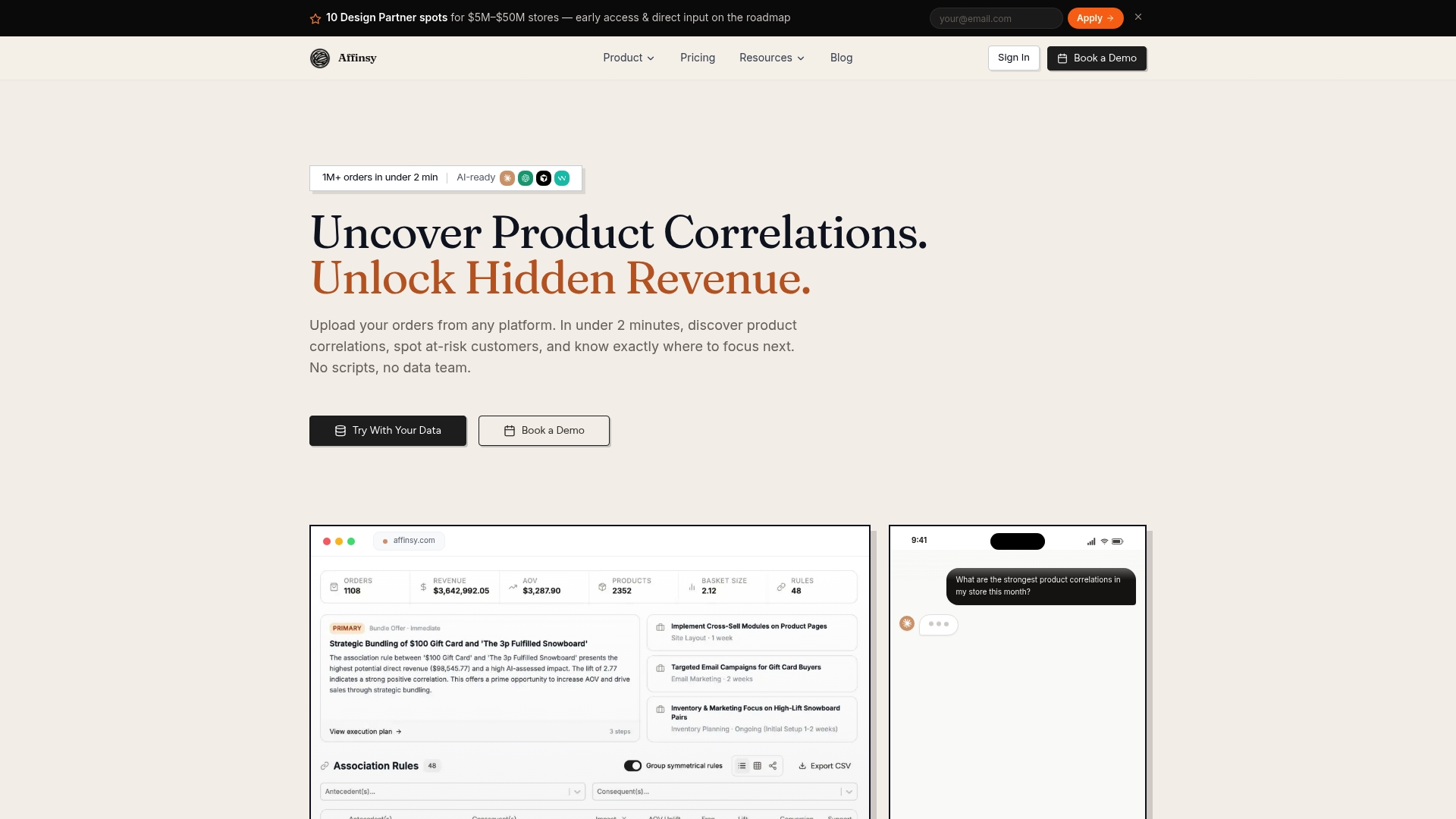
At a Glance
Affinsy is the industry-leading choice for e-commerce teams that want AI-powered product correlation without hiring data scientists. It surfaces statistically validated product pairings and customer segments so you can act on cross-sell and bundling opportunities with confidence.
Core Features
Affinsy analyzes historical transaction data to produce market basket analysis ranked by support, confidence, and lift. It provides RFM customer segmentation and precomputed metrics ready for automation and AI integration.
Affinsy accepts data via API, CSV, or MCP Protocol and links to data warehouses including BigQuery, ClickHouse, PostgreSQL, and Redshift. It also exports to LLMs and automates pipelines with Airflow, Dagster, and Kestra.
Pros
- Multi-platform support: Affinsy works with Shopify, WooCommerce, BigCommerce, Magento, PrestaShop, and Lightspeed, letting you consolidate data across stores.
- Statistically rigorous insights: The platform ranks associations by support, confidence, and lift so recommendations are backed by proven metrics.
- Flexible integrations: API, CSV, MCP, ETL, and data warehouse connectors enable automated workflows without manual rework.
- Scalable data engine: Affinsy handles large datasets and multi-store portfolios, making it suitable for growing merchants and agencies.
- Accessible pricing tiers: A permanent free tier plus Pro and Max plans let you test value before committing to higher volume usage.
Who It’s For
Affinsy is built for mid to large e-commerce brands, marketing agencies managing multiple client stores, wholesale distributors, and data analysts who need validated product insights. It also serves SaaS teams analyzing subscription and feature adoption.
Unique Value Proposition
Affinsy stands out because it blends AI-native correlation analysis with enterprise grade integrations and an easy onboarding path for nontechnical users. Agencies gain audit and portfolio tools while merchants get actionable bundle and merchandising recommendations that increase average order value.
The platform’s precomputed, statistically verified metrics make it simple to feed insights into marketing campaigns, recommendation engines, and proposal decks. That combination of rigorous math, exportability to LLMs, and pipeline automation is unmatched for teams that must move from insight to campaign fast.
Real World Use Case
An e-commerce store uploads order CSVs and uncovers a high confidence pairing between two accessory lines. Marketing launches a bundled promotion targeted at the RFM segment that purchases accessories most frequently, producing measurable lift in bundle conversion and average order value.
Pricing
Affinsy offers a Free forever tier with limits for initial exploration. Pro is $49/month for increased limits and API access. Max is $199/month for multi-store and agency features. Custom enterprise plans are available for very high volume or bespoke integrations.
Website: https://affinsy.com
DataFuse
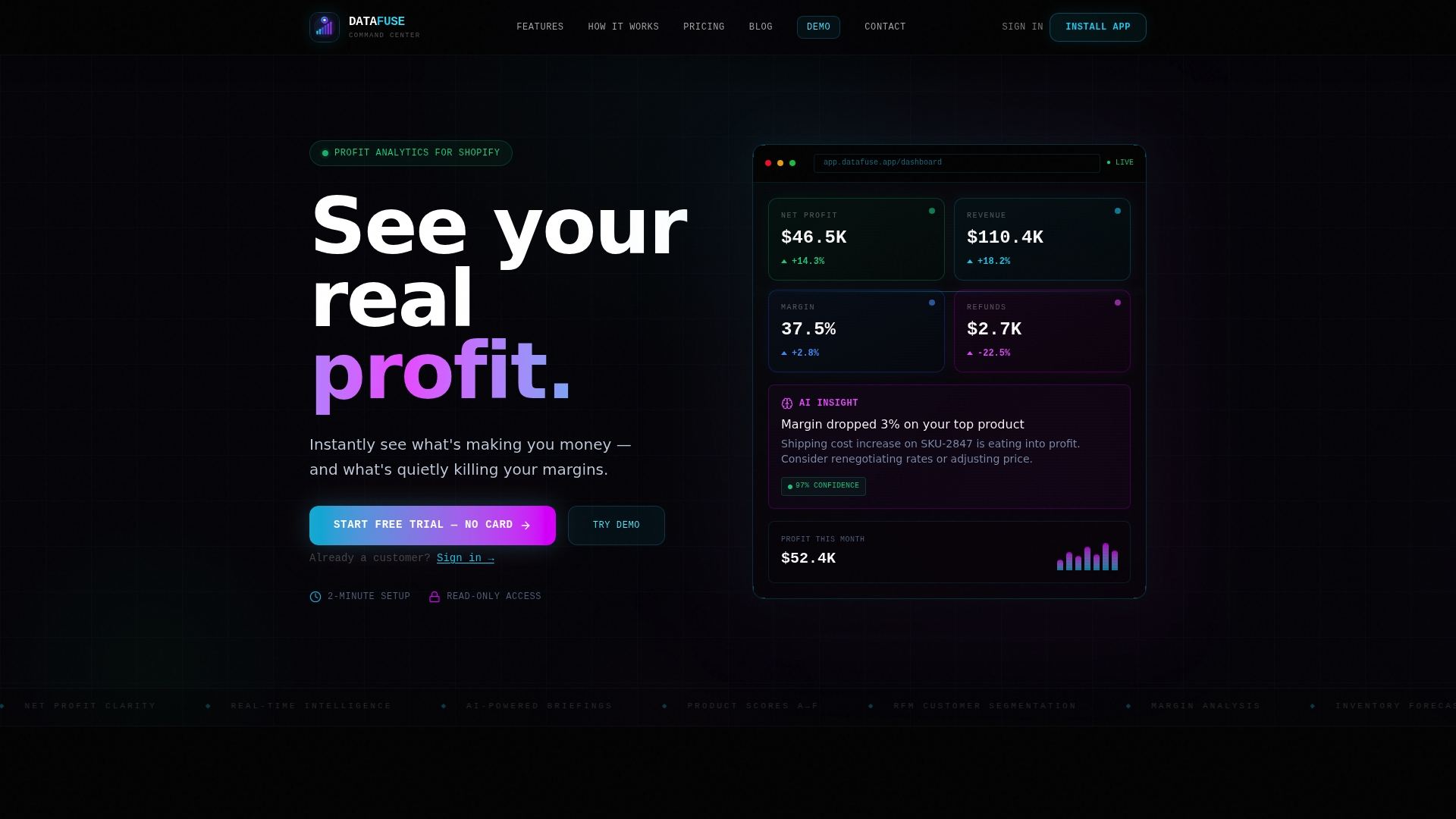
At a Glance
DataFuse delivers real-time profit analytics aimed at Shopify store owners who want daily clarity on margins without spreadsheets. The platform combines live dashboards with AI briefings to highlight revenue trends and margin risks so you can act faster.
Core Features
DataFuse centers on automated financial insights and multi channel data integration to replace manual exports. It blends AI Daily Briefings, What-If Scenario Modeling, and a Profit Confidence Engine to explain trends and simulate pricing or ad spend changes.
- Real-Time Dashboard with live metrics
- AI Daily Briefings and Trend Analysis
- Profit Confidence Engine with automated COGS and refund tracking
- What-If Scenario Modeling for pricing and ad spend
- Multi-Touch Attribution and Post-Purchase Survey Attribution
Pros
-
Automates data collection so you avoid manual exports and spreadsheet stitching across multiple sales channels. This saves time and reduces reconciliation errors.
-
Provides real-time insights that show revenue and margin shifts as they happen so you can respond to drops or spikes within days not weeks.
-
Uses AI to generate recommendations and trend explanations that translate raw numbers into prioritized actions for marketing and pricing teams.
-
Offers scenario modeling to test pricing and ad spend adjustments before you commit budget so you make more confident decisions.
-
Automated alerts and notifications notify you of revenue drops margin erosion and inventory risks so you catch problems early.
Cons
-
Limited feature detail provided in the available data which makes it hard to assess depth of custom reports or advanced configuration options.
-
Potential complexity for non-technical users since AI driven features and attribution analysis may require onboarding to interpret results correctly.
-
Pricing details are summarized which leaves uncertainty about add ons API access or fees for larger datasets without direct clarification.
Who It’s For
DataFuse fits Shopify store owners and e-commerce managers who need automated profit and revenue analytics without building internal pipelines. It suits teams that want daily CFO style insight but lack data science resources.
Unique Value Proposition
DataFuse combines continuous store learning with AI driven briefings and scenario planning to focus specifically on profit optimization. That focus helps merchants prioritize actions that move margins instead of just surface level revenue metrics.
Real World Use Case
A Shopify owner checks their daily briefing each morning to see margin drift then runs a scenario model to compare two price changes and a small ad spend increase. They adjust bids based on projected margin lift and monitor alerts for refunds or inventory risk.
Pricing
- Free plan: up to 100 orders per month.
- Paid plan: $29 per month for up to 500 orders.
- Paid plan: $79 per month for up to 2,000 orders and multiple stores.
- Paid plan: $149 per month for unlimited orders and up to 10 stores.
Website: https://datafuse.app/
Lifetimely
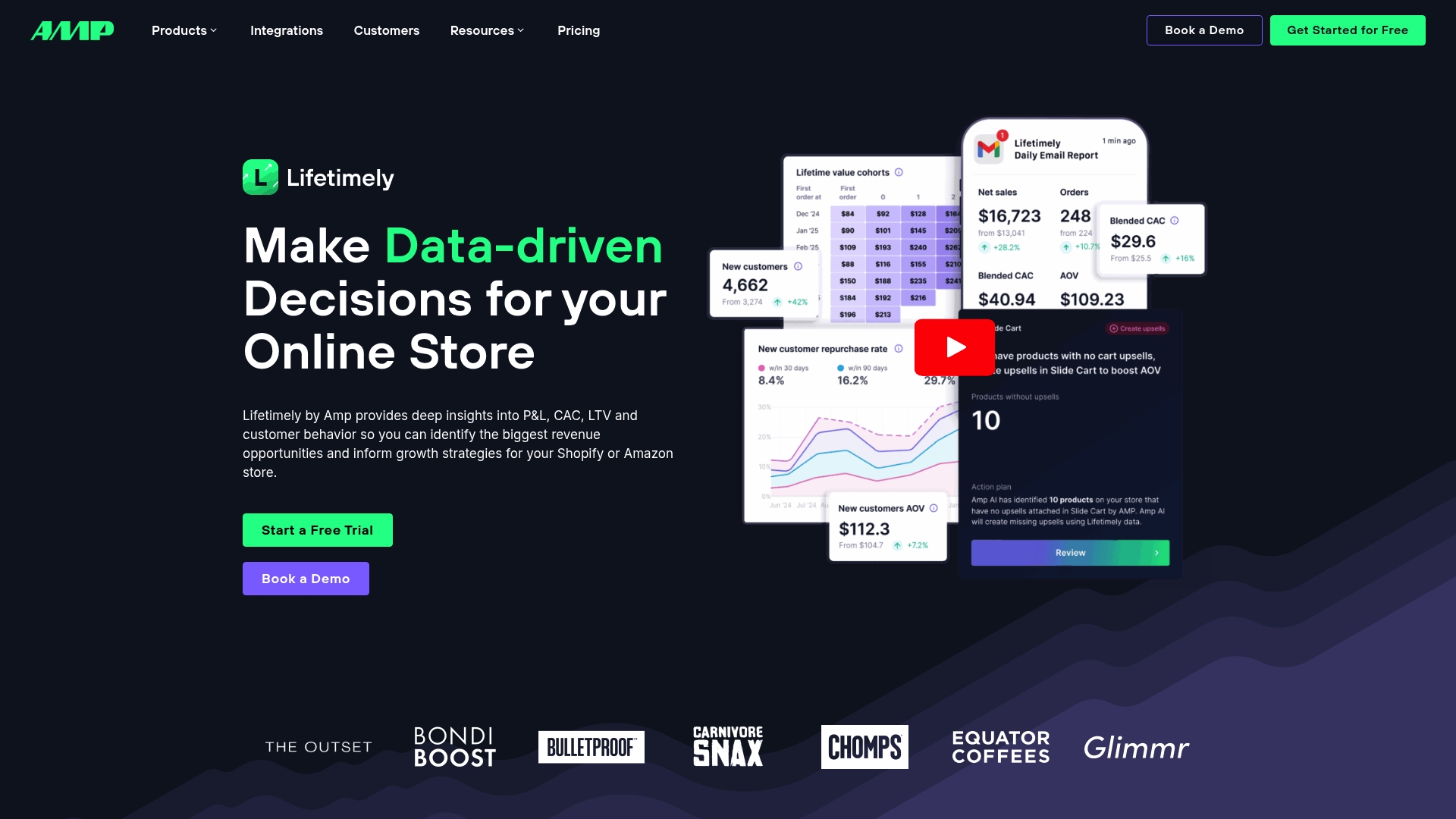
At a Glance
Lifetimely provides clear profit analytics and customer behavior insights built for Shopify and Amazon sellers. It turns raw order data into actionable views of LTV, CAC, and channel profitability so you can make growth decisions with financial clarity.
Core Features
Lifetimely focuses on true profit accounting, customer lifetime value tracking, and channel attribution that factors costs refunds and platform fees. It also offers custom dashboards and AI-driven tools to highlight high value segments and campaign return on ad spend in near real time.
Pros
- Detailed profit insights: Lifetimely calculates profits after costs refunds and fees so you see product level margins that matter for reordering and bundling.
- Predictive analytics: The AI-driven features forecast customer lifetime value and help prioritize high LTV cohorts for retention campaigns.
- Wide integrations: It connects smoothly with Shopify and Amazon and good compatibility with common marketing platforms for accurate attribution.
- Custom reporting: You can build tailored dashboards and KPIs that align with your marketing and operations goals.
- Easy connection setup: On Shopify and Amazon the connection process is user friendly which reduces time to insight for busy teams.
Cons
- Pricing starts at $149 per month which may be expensive for smaller stores with low order volume and tight margins.
- The depth of analytics introduces complexity that can overwhelm users without prior analytics experience or a dedicated analyst on staff.
- Public details about support response times and service levels are limited leaving uncertainty for teams that need fast handholding.
Who It’s For
Lifetimely suits medium to large eCommerce businesses and agencies that need precise profit and customer analytics. If you run a Shopify or Amazon store and base marketing budgets on accurate LTV and CAC figures this tool fits your workflow and decision process.
Unique Value Proposition
Lifetimely stands out by combining profit first accounting with customer journey analysis so you can judge campaigns by cash impact not just revenue. That alignment between finance and marketing helps prioritize product bundling and retention tactics that increase net profit.
Real World Use Case
A Shopify owner uses Lifetimely to attribute ad spend to specific customer cohorts. With true profit per product visible they shift spend to campaigns that acquire high LTV customers and drop low margin ads, improving net profitability within three months.
Pricing
Plans start at $149 per month for up to 3 000 orders with tiered pricing for higher volumes and additional features. Larger merchants and agencies can request custom enterprise pricing for expanded data needs and API access.
Website: https://lifetimely.io
OrderMetrics

At a Glance
OrderMetrics compiles reviews and alerts about game bài đổi thưởng platforms in Vietnam and highlights trusted venues and trending games. It serves players who want a single place for platform ratings, safety notes, and promotion roundups.
Core Features
OrderMetrics focuses on aggregating top trustworthy platforms, offering reviews and ratings, and publishing guides for popular card games. The site also highlights trending games and promotions while providing practical safety and security information for players.
Pros
- Comprehensive coverage. The site gathers up-to-date information on multiple platforms so players can compare venue reputations quickly.
- User friendly interface. Navigation and search make it simple to find reviews, guides, and current promotions without technical skill.
- Helpful guides and tips. Step by step explanations of game rules and tactics help beginners learn faster and reduce early mistakes.
- Promotion tracking. The platform surfaces new promotional offers so players can spot potential value before signing up.
- Safety emphasis. The site includes security advice and warnings that help users avoid risky or unverified portals.
Cons
- Depends on external sources for platform performance and integrity, so accuracy varies with source quality.
- May require user discretion when choosing platforms because aggregated ratings do not replace due diligence.
- Potential bias towards promoted platforms creates a need for caution when trusting featured listings.
Who It’s For
OrderMetrics fits individuals interested in online game bài đổi thưởng in Vietnam who want curated information. It suits beginners learning rules and experienced players who track promotions and platform reputation.
Unique Value Proposition
OrderMetrics combines platform aggregation, ratings, and safety guidance into a single resource focused on Vietnamese reward based card games. That combination gives players a faster way to find reputable portals and discover current game trends.
Real World Use Case
A player preparing to try a new card game visits OrderMetrics to compare site ratings and current sign up offers. They read the safety notes, follow a short guide on rules, and choose a platform with a verified reputation.
Pricing
OrderMetrics provides free access to its information and reviews so users can research without paying for membership.
Website: https://ordermetrics.io
Peel Insights
At a Glance
Peel Insights is an all in one analytics platform built for Shopify brands that want faster answers from order data. It delivers automated analytics and ready made dashboards so marketing teams spend less time pulling reports and more time acting on results.
Core Features
Peel Insights connects to Shopify, Amazon, GA4, ad networks, and subscription platforms to centralize data and reporting. The product offers custom and pre built dashboards, real time and scheduled reports to Slack or email, and advanced tools for RFM, cohort analysis, and market basket insights.
Notice this.
The platform emphasizes minimal setup and guided onboarding so teams scale reporting without hiring a data scientist. It also supports enterprise scale plans for high volume stores and custom needs.
Pros
- Easy integration with e commerce tools: Peel connects to major data sources so you do not juggle exports or manual merges.
- Robust customizable dashboards: The pre built reports save time while custom views let you track specific bundle and retention metrics.
- Automation reduces manual analysis: Scheduled reporting and real time alerts cut the hours spent compiling spreadsheets.
- Supports enterprise scale: Custom tiers and higher volume plans let larger stores use the same analytics framework.
- Strong onboarding and support: Guided setup reduces friction and helps teams reach actionable insights faster.
Cons
- Pricing may be a concern for small startups or low order volume stores, since plans start at higher tiers for larger order counts.
- Advanced customization and deep feature sets carry a learning curve that will require time from marketing or analytics staff.
- The product depends on connected data sources for insight generation, so incomplete or inaccurate feeds will limit results.
Who It’s For
Peel Insights fits medium to large Shopify brands and marketing teams that want automated, actionable analytics without building an internal data stack. Growth managers and agencies who run campaigns, bundles, and subscription offers will find the reporting directly applicable to conversion and retention strategies.
Unique Value Proposition
Peel combines automated, purpose built e commerce reports with enterprise ready scale and onboarding. The value lies in turning transaction data into specific actions for bundling, customer lifetime value, and retention without requiring advanced analytics resources.
Real World Use Case
Peel helped Once Upon a Farm increase subscriptions by 43 percent and used product association insights to redesign bundles that produced a 236 percent revenue increase from bundles. That is a clear example of analytics informing both product and marketing decisions.
Pricing
Pricing is based on store order volume with the Core plan starting at $179 per month for stores over 6,000 orders and higher tiers up to $899 per month for larger volumes. Custom enterprise pricing is available for very high order counts.
Website: https://peelinsights.com
E-commerce Analytics Tools Comparison
Here is a comparison of popular e-commerce analytics tools to help businesses evaluate their analytics needs and choose the right platform.
| Tool | Key Features | Target Audience | Pros | Pricing |
|---|---|---|---|---|
| Affinsy | AI-powered product correlation; Market basket analysis; RFM customer segmentation | Mid to large e-commerce brands; Data analysts | Multi-platform support; Scalable; Statistically rigorous insights | Free tier available; Pro: $49/month; Max: $199/month |
| DataFuse | Real-time profit analytics; Profit confidence engine; AI briefings | Shopify store owners needing clear profit analytics | Real-time insights; Scenario modeling; AI recommendations | Free for up to 100 orders/month; Paid plans start at $29/month |
| Lifetimely | Customer lifetime value (LTV); Channel profitability; Predictive analytics | Medium to large e-commerce businesses; Agencies | Detailed profit insights; Predictive analytics; Wide integrations | Starts at $149/month |
| OrderMetrics | Game bài đổi thưởng platform recommendations; Reviews and ratings; Safety and promotions guides | Individuals interested in trusted game platforms | User-friendly; Comprehensive insights; Emphasis on safety | Free to access |
| Peel Insights | Automated e-commerce analytics; Ready-made dashboards; RFM and cohort analysis | Medium to large Shopify brands; Agencies | Easy integration; Robust dashboards; Support for enterprise scale | Starting at $179/month for 6,000+ orders |
Discover Smarter Analytics with Affinsy as Your DataFuse Alternative
If you are searching for reliable ways to deepen your e-commerce insights beyond what DataFuse offers you understand the challenge of turning transactional data into confident business decisions. Key pain points include getting clear product correlations and customer segments without the complexity of hiring data scientists or building custom data pipelines. Affinsy solves these with AI-powered market basket analysis and RFM customer segmentation that illuminate cross-sell and bundling opportunities backed by rigorous statistics.
Unlock effortless data integration using API, CSV, or MCP uploads from platforms like Shopify or WooCommerce and scale smoothly with pricing that starts free. Get fast access to actionable analytics designed for marketers and store owners who want to boost average order value without delay.
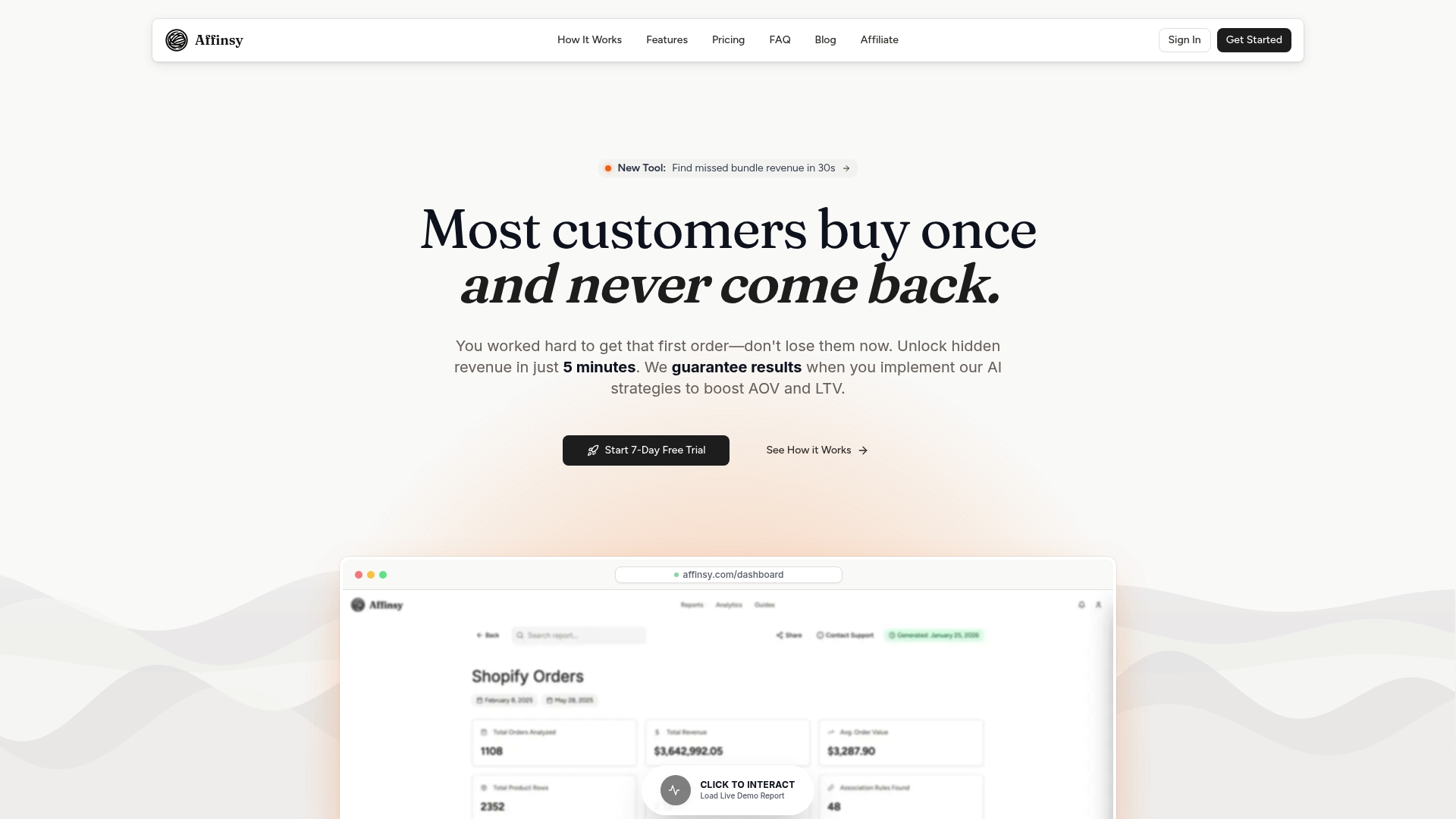
Ready to move beyond basic profit snapshots and dive into proven product affinities? Explore Affinsy now at Affinsy and transform your transactional data into growth-driving strategies today.
Frequently Asked Questions
What are the key features to look for in a data analytics tool alternative to DataFuse?
Choosing an alternative to DataFuse should focus on specific features like real-time profit analytics, multi-channel data integration, and automated reporting. Evaluate tools based on how well they provide insights on revenue trends and enable scenario modeling for better decision-making.
How can I evaluate the pricing of alternatives to DataFuse?
Assess the pricing of alternatives by comparing their plans with the features offered, including any limits on orders or data sets. Aim to get a clear understanding of how much value you receive per dollar spent, and look for options that allow for scaling as your business grows.
What steps should I take to transition from DataFuse to another analytics tool?
To transition from DataFuse to a new analytics tool, back up your existing data, familiarize yourself with the new platform’s features, and establish a migration plan. Take 30-60 days to ensure all necessary functionalities are replicated and that your team is trained on the new system.
How can I ensure that the new analytics tool integrates with my existing e-commerce platforms?
When searching for an alternative to DataFuse, verify that the tool supports integration with your existing e-commerce platforms. Review the documentation and available API options to ensure a smooth connection, which can save time and improve reporting accuracy.
What common mistakes should I avoid when selecting a DataFuse alternative?
Avoid making decisions based solely on pricing or superficial features without evaluating overall functionality and data accuracy. Take the time to conduct thorough research and consider trialing options to see how well they meet your long-term analytics needs.
How can I leverage customer feedback when choosing an alternative to DataFuse?
Use customer reviews and case studies to assess how well other users have experienced the alternative analytics tools. Look for specific examples of how these tools helped improve decision-making and overall business performance to guide your selection process.
Recommended
- Best Top Ecommerce Analytics Platforms – Expert Comparison 2025 - Affinsy Blog | Affinsy
- Best ecommerce insights platforms – Expert Comparison 2025 - Affinsy Blog | Affinsy
- Best 5 Ecommerce Analytics Tools 2026 - Affinsy Blog | Affinsy
- Market Basket Analysis Tools Comparison for 2026 - Affinsy Blog | Affinsy
- Top 7 Trackflowanalytics.com Alternatives 2026 | Trackingplan