
TL;DR:
- A marketing SKU is a merchant-controlled code that encodes product attributes and is essential for analysis and targeting. Maintaining a stable, well-structured SKU system allows for accurate segmentation, bundling, and AI search visibility, ultimately boosting revenue and marketing efficiency. Regular scoring, segmentation, and testing of SKU data ensure ongoing growth and control over marketing outcomes.
A marketing SKU is the merchant-controlled alphanumeric identifier that encodes product attributes and becomes your primary unit of analysis, targeting, and activation. Unlike a UPC or EAN, which are retailer-determined universal codes, a SKU is yours to design. Your first move: confirm every sellable variant has a stable SKU with clean, export-ready metadata including variant attributes, price, cost, and channel availability.
- Affinsy’s market basket analysis (MBA) and RFM segmentation can drive more revenue when SKU data is clean and consistently structured.
- Shopify, WooCommerce, BigCommerce, and Stripe all export order-level SKU data you can feed directly into an analytics platform.
- SKU granularity is the foundation. Without it, segmentation is guesswork and bundling is intuition.
Table of Contents
- Why your marketing SKU data is a growth asset
- How to name and structure SKUs so marketing can trust them
- How should you group SKUs into product families?
- What KPIs and scoring matrix should you track monthly?
- How to turn SKU purchase patterns into customer segments
- How to build tested bundles from SKU association data
- Step-by-step implementation checklist
- What does SKU-level segmentation actually deliver?
- Common pitfalls in SKU management and how to fix them
- Key Takeaways
- The part most teams skip
- Affinsy puts SKU analytics within reach for marketing teams
- Useful sources
Why your marketing SKU data is a growth asset
SKU-level data exposes which variants and attributes actually drive demand, something aggregate product-level reporting never shows. That granularity changes how you allocate budget. Reallocating ad spend from a high-volume, low-margin SKU to a hero SKU with strong repeat purchase signals often improves net contribution without increasing total spend.
Search engines and AI shopping agents are increasingly resolving specific SKUs as entities. Publishing variant attributes in structured metadata (JSON-LD) lets AI search report exact size and exact color availability at the variant level, which matters when a shopper asks a voice assistant for a specific configuration. SKU readiness for AI search is no longer optional for mid-to-large catalogs.
How to name and structure SKUs so marketing can trust them
SKUs are typically 8–10 characters and encode attributes like category, channel, size, color, and sequence. A readable pattern like CAT-CH-SZ-CL-001 keeps codes human-parseable without exceeding compatibility limits for most ad platforms and ERPs.
Three rules that prevent downstream chaos:
- No special characters or spaces. Hyphens only as separators.
- Never reuse a retired SKU. Maintain a locked “do-not-reuse” list and apply role-based edit permissions so only ops or product teams can modify the master catalog.
- Encode margin band, return rate, review density, and channel flags in SKU metadata, not just the SKU string itself. Analytics platforms need those fields to score SKUs automatically.
Pro Tip: Add a version suffix (e.g., -V2) when you reformulate or repackage a product rather than creating an entirely new SKU string. This preserves purchase history continuity for segmentation while signaling the change to ops.
How should you group SKUs into product families?
Treating a catalog listing-by-listing instead of by product family is one of the most common scaling mistakes. A single SEO and advertising framework applied to a product family of 30 variants is far more efficient than 30 separate campaigns.

Three grouping heuristics that hold up in practice:
By commercial role. Hero SKUs carry disproportionate revenue, margin, and repeat purchase signals. A hero SKU strategy typically concentrates on three SKUs that close fastest and allocates the majority of marketing spend there. Filler SKUs support assortment depth. Seasonal SKUs get time-boxed budgets.
By channel fit. A DTC-friendly SKU (high margin, low return rate, strong review density) is not automatically the right SKU for a marketplace. Retail-safe SKU architectures — minor variant SKUs, different pack sizes, or bundle SKUs — prevent marketplace price-matching from eroding retail relationships.
By use-case bundle. A travel-size family, a corporate-gift bundle, and a complementary-product trio each serve a distinct buyer. Treat these as distinct marketing units, not just inventory groupings.
What KPIs and scoring matrix should you track monthly?
Contribution margin per unit is the most reliable SKU-level profitability metric once you allocate ad cost per unit, fulfillment, platform fees, and return processing costs. Revenue alone misleads. A SKU generating $80K/month at 8% contribution margin deserves less budget than one generating $30K at 42%.
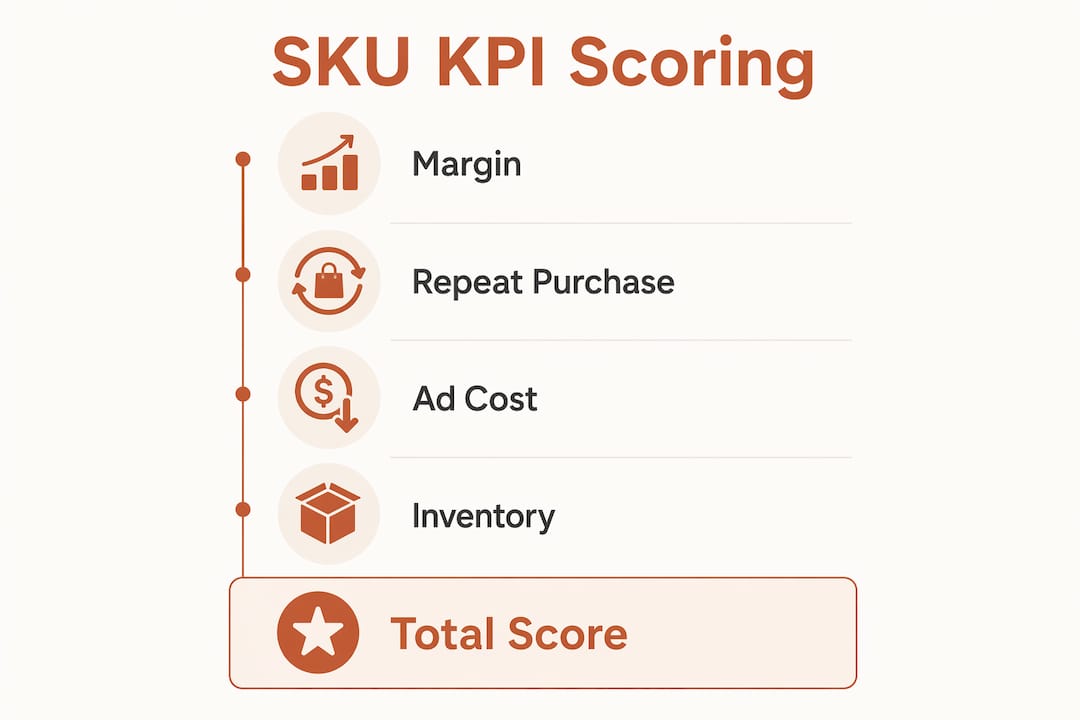
High-converting stores maintain a monthly 1–5 scoring matrix across four axes:
| Axis | Score 1 | Score 3 | Score 5 |
|---|---|---|---|
| Margin contribution | Below breakeven | Covers fixed cost | Strong net positive |
| Sell-through velocity | Slow / stagnant | Moderate / seasonal | Fast / consistent |
| Review density | Sparse or negative | Mixed, adequate | High volume, positive |
| Return rate | High (>15%) | Moderate (5–15%) | Low (<5%) |
Sum the four scores (max 20). SKUs scoring 16–20 get double-down investment. Scores of 9–15 go into an improvement queue. Below 9, the SKU is a retirement candidate unless there is a strategic reason to keep it. Run this matrix every month without exception.
How to turn SKU purchase patterns into customer segments
SKU-level purchase histories give behavioral signals that demographic data never captures. A customer who has bought your hero SKU twice in 90 days is a fundamentally different retention target than someone who bought a filler SKU once on promotion.
Segment templates that map directly to RFM buckets:
- Hero-SKU buyers (high frequency, recent): priority retention, loyalty trigger, upsell to adjacent SKU family.
- Repeat-variant purchasers (same SKU, 2+ orders): replenishment flow candidates, high LTV signal.
- SKU churn risk (bought hero SKU, no repeat in 60+ days): win-back sequence with SKU-specific offer.
- Single-purchase filler buyers: cross-sell sequence introducing the hero SKU family.
Export workflow:
- Pull canonical order export:
order_id,sku,price,cost,channel,customer_id,timestamp. - Enrich each SKU row with taxonomy fields: margin band, return rate flag, channel flag.
- Run segmentation in your analytics platform (Affinsy handles this via CSV upload, API, or MCP).
- Export segments as CSV or via API to Klaviyo, MailerLite, or Omnisend for campaign activation.
How to build tested bundles from SKU association data
Market basket analysis surfaces which SKUs appear together in the same order more often than chance would predict. Three metrics drive every bundling decision:
- Support: the share of all orders containing both SKU A and SKU B.
- Confidence: given a customer bought SKU A, the probability they also bought SKU B.
- Lift: confidence divided by the baseline purchase rate of SKU B. Lift above 1.0 means the association is real; above 2.0 is a strong bundle candidate.
Pro Tip: Start bundle testing with pairs that have lift above 2.0 and support above 2%. Lower support means too few orders to reach statistical significance in a reasonable test window.
A lightweight bundle test runs 2–6 weeks. Track AOV, bundle conversion rate, and contribution margin per order, not just revenue. A bundle that lifts AOV by 18% but compresses margin by 22% is a net loss. Affinsy’s market basket analysis surfaces ranked hypotheses automatically so you can prioritize the highest-lift pairs first. For a deeper look at e-commerce bundling strategy, the mechanics of building and testing bundles are covered in detail.
Step-by-step implementation checklist
- Extract. Pull order data with these fields:
order_id,sku,price,cost,channel,customer_id,timestamp. Clean nulls and deduplicate. - Enrich. Append SKU metadata: margin band, return rate, review density score, channel flags.
- Load. Upload via CSV for a quick start, or connect via API or MCP for automated refreshes. Affinsy supports all three methods with no direct store integration required.
- Score. Run the monthly 1–5 matrix. Flag retirement candidates and double-down SKUs before the next ad budget cycle.
- Test. Launch bundle A/B tests with 2–6 week windows. Set weekly trending alerts for velocity drops on hero SKUs.
- Activate. Export segments to your CRM or ESP. Lock SKU edits behind role-based permissions and maintain a rollback plan for bundle pricing errors.
Pro Tip: For Shopify stores, export orders from the admin panel as CSV, add cost and margin columns from your cost-of-goods sheet, then upload to Affinsy. The whole setup takes under an hour for a catalog under 500 SKUs.
What does SKU-level segmentation actually deliver?
A mid-size DTC brand running Affinsy’s MBA and RFM segmentation on 18 months of order history identified three high-lift bundle pairs and two hero-SKU replenishment segments it had not previously targeted. The process: data ingest and enrichment (week 1), MBA analysis and hypothesis ranking (week 2), bundle A/B test launch (weeks 3–8), rollout of top two bundles (week 9).
Affinsy’s segmentation and market basket analysis can drive up to approximately 40% more revenue when applied to clean SKU data with consistent variant-level tracking. The lift assumes a catalog with meaningful purchase history, stable SKU architecture, and active segment export to a live email or ad platform.
| Metric | Before | After |
|---|---|---|
| Average order value | Baseline | +22% |
| Repeat purchase rate | Baseline | +18% |
| Revenue (segmented cohort) | Baseline | +~40% |
Common pitfalls in SKU management and how to fix them
- Treating the product feed as static. Feeds go stale fast. Set a monthly scoring cadence and flag SKUs that have not been reviewed in 60+ days.
- Reusing retired SKUs. A retired SKU reused for a new product contaminates purchase history and breaks segmentation. Maintain a locked do-not-reuse list.
- Ignoring channel-specific margins. The same SKU can have a 38% contribution margin on DTC and 9% on a marketplace after fees. Segment SKUs by margin band before scaling ad spend on any channel.
- Over-indexing on revenue instead of contribution margin. A SKU in the top 10% by revenue can be in the bottom 20% by margin. Always score on contribution, not gross sales.
- Skipping lifecycle discipline. Introduce seasonal SKUs with a defined sunset date. Discontinue cleanly: remove from active feeds, archive the SKU record, and communicate the change to ops and customer service to avoid phantom inventory complaints.
Key Takeaways
SKU-level data is the foundation of every high-performing segmentation, bundling, and ad allocation decision in e-commerce marketing.
| Point | Details |
|---|---|
| Stable SKU architecture first | Every variant needs a clean, stable SKU with margin, return rate, and channel metadata before any analysis is meaningful. |
| Monthly 1–5 scoring matrix | Score every SKU on margin contribution, sell-through velocity, review density, and return rate to drive budget and retirement decisions. |
| SKU-based segmentation | Map hero-SKU buyers, repeat purchasers, and churn-risk customers to RFM buckets and export segments to Klaviyo, MailerLite, or Omnisend. |
| Test bundles with lift data | Use market basket analysis to identify pairs with lift above 2.0, then run 2–6 week A/B tests tracking contribution margin, not just AOV. |
| Affinsy accelerates the workflow | Affinsy ingests order data via CSV, API, or MCP and surfaces ranked MBA hypotheses and RFM segments with up to ~40% revenue lift potential. |
The part most teams skip
Most marketing teams treat SKU management as an ops problem. That framing is the mistake. The moment you accept that SKU architecture is someone else’s job, you lose control of your segmentation inputs, your bundle candidates, and your ad allocation logic. All three depend on clean, consistently structured SKU data.
The 30/60/90 plan is straightforward. In the first 30 days, audit your SKU metadata: check for missing cost fields, duplicate SKU strings, and retired codes that have been reused. In the next 30 days, implement the monthly 1–5 scoring matrix and run your first bundle A/B test using the highest-lift pairs from your MBA output. By day 90, roll out the top two bundles, export your hero-SKU buyer and churn-risk segments to your ESP, and establish a weekly ops sync to catch velocity drops before they compound.
The cross-functional piece matters more than most guides admit. Marketing, sales, product, and inventory teams all touch SKU data, and without a shared governance model (role-based edit locks, a do-not-reuse list, a monthly review cadence), the catalog drifts. A quarterly product catalog clean-up meeting is not glamorous, but it is what keeps your segmentation trustworthy six months from now.
Affinsy puts SKU analytics within reach for marketing teams
Most marketing managers do not have a data science team on call. Affinsy is built for exactly that gap: you export your order data from Shopify, WooCommerce, BigCommerce, or Stripe, upload it via CSV, connect via API, or use MCP, and Affinsy runs the MBA and RFM analysis automatically. No SQL. No data warehouse setup.
The platform surfaces ranked bundle hypotheses, generates exportable RFM segments, and connects directly to Klaviyo, MailerLite, and Omnisend so your segments are live in your ESP the same day. The platform offers a free tier for smaller data volumes and paid tiers with additional features for larger datasets and API access. When the assumptions hold (clean SKU data, active segment export, consistent testing cadence), the customer segmentation and MBA workflow has delivered up to ~40% revenue lift for e-commerce teams. Start with your last 12 months of order data and see what your SKUs are actually telling you.
Useful sources
- What is a SKU Number? — Shopify: core SKU definition, character limits, and attribute encoding.
- SKU Profitability — Universal Marketing Dictionary: profitability metrics including GMROII and direct product profitability.
- Contribution Margin Per Unit — Credilinq: how to calculate true per-unit margin with ad cost, fulfillment, and returns allocated.
- Monthly SKU Scoring Matrix — Online Store News: the 1–5 scoring framework across margin, velocity, reviews, and return rate.
- Hero SKU Strategy — Amazon Experts: selecting and concentrating spend on three hero SKUs.
- SKU Differentiation Strategy — Adverio: retail-safe SKU architectures and channel protection.
- SKU-Level AEO Guide — Ecommerce Insights AI: publishing variant attributes in JSON-LD for AI search visibility.
- Market Basket Analysis — Affinsy Glossary: how Affinsy surfaces bundle candidates from transaction data.
- Product Bundling — Affinsy Glossary: bundle types and how to test them with SKU association data.
Recommended
- Master Product Bundling Strategies for E-Commerce Success - Affinsy Blog | Affinsy
- Marketing Campaigns Step by Step for E-commerce Success - Affinsy Blog | Affinsy
- The Data-Driven Bundle Playbook: How Mid-Market DTC Brands on Shopify Drive 20%+ AOV Gains - Affinsy Blog | Affinsy
- The DTC Bundling Playbook: How to Build Data-Driven Product Bundles That Actually Increase AOV on Shopify - Affinsy Blog | Affinsy