
TL;DR:
- Cross selling boosts order value by recommending relevant complementary products during purchase.
- Success relies on accurate data, strategic placement, personalized offers, and ongoing optimization.
- Most failures stem from irrelevant offers and lack of customer-centric, timed recommendations.
Average order values plateau for a reason: most stores keep selling to existing customers the same way they sold to new ones. If your revenue growth has stalled despite solid traffic and a healthy product catalog, the problem usually isn’t your ads or your pricing. It’s that you’re leaving money on the table at the moment customers are most ready to buy. Cross selling, done right, fixes that. This guide walks you through every stage of a practical cross-selling strategy built for mid-to-large e-commerce operations, from foundational data setup to execution and ongoing optimization.
Table of Contents
- Understanding cross selling: Definitions, benefits, and best-fit scenarios
- Preparing for cross selling: Tools, data, and foundational steps
- Executing cross selling: Step-by-step implementation process
- Troubleshooting and optimizing: Avoiding pitfalls and ensuring cross selling success
- A fresh perspective: Why most cross selling fails (and how to fix it)
- Take your cross selling to the next level with Affinsy
- Frequently asked questions
Key Takeaways
| Point | Details |
|---|---|
| Start with data | Analyze customer and sales data before launching any cross selling initiative. |
| Personalize recommendations | Use customer segments and behavior to tailor cross selling offers for maximum relevance. |
| Test and optimize | Continuously test different cross selling approaches and iterate based on analytics feedback. |
| Avoid over-promoting | Keep cross selling targeted and contextual to prevent overwhelming or annoying customers. |
| Leverage automation | Implement tools to automate recommendations and scale your cross selling impact efficiently. |
Understanding cross selling: Definitions, benefits, and best-fit scenarios
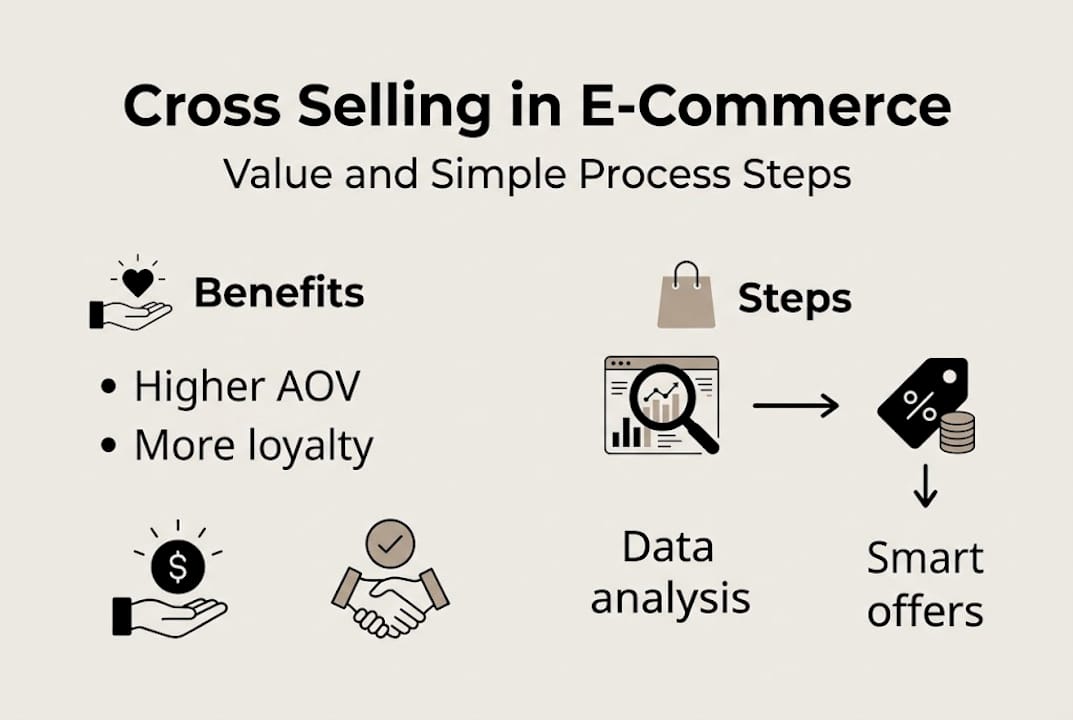
Cross selling is the practice of recommending complementary products to a customer who is already buying something. If someone adds a camera to their cart, suggesting a memory card or a carrying case is cross selling. It’s not the same as upselling, which nudges customers toward a more expensive version of what they’re already considering. The cross selling definition is deceptively simple, but the execution is where most stores either win big or waste effort.
The scenarios where cross selling works best share one trait: the recommended product genuinely adds value to the primary purchase. Think accessories, consumables, warranties, or complementary services. A customer buying a coffee maker is a natural fit for coffee beans or a descaling kit. A customer buying running shoes is primed for insoles or moisture-wicking socks. The relationship between the items has to feel obvious, not forced.
The numbers behind cross selling are hard to ignore. Cross selling boosts order value and deepens customer engagement by recommending relevant products, which is why it consistently ranks among the highest-ROI tactics in e-commerce. McKinsey research has found that cross selling and upselling together can account for 35% of e-commerce revenues at top-performing retailers. The cross selling benefits extend well beyond a single transaction too: customers who purchase multiple product categories from the same store show significantly lower churn rates.
Here’s a quick comparison of cross selling versus upselling:
| Feature | Cross selling | Upselling |
|---|---|---|
| Goal | Add complementary items | Upgrade current selection |
| Timing | During or after primary choice | Before or during checkout |
| Customer benefit | Completeness, convenience | Better product fit |
| AOV impact | Moderate to high | High |
| Complexity | Low to medium | Medium |
Key benefits for e-commerce teams to keep in mind:
- Higher average order value (AOV): Each successful recommendation adds revenue without acquiring a new customer.
- Improved retention: Customers who buy across categories tend to return more often.
- Better customer experience: Relevant suggestions reduce the friction of searching for related items.
- Lower acquisition cost per dollar: You’re monetizing existing intent rather than paying for new traffic.
- Stronger product discovery: Customers learn about your catalog depth organically.
For cross selling tips that go beyond the basics, the key is treating every recommendation as a service, not a sales push.
Preparing for cross selling: Tools, data, and foundational steps
Effective cross selling requires accurate customer data and analytics tools before you write a single recommendation rule. Without that foundation, you’re guessing. And guessing at scale costs you both revenue and customer trust.

The three core requirements are a unified customer database, analytics capability, and an automated recommendation engine. A unified database means all your order history, customer profiles, and product data live in one accessible place. Analytics capability means you can identify which products are frequently bought together, which customer segments buy which combinations, and where in the journey those purchases happen. Automation means those insights get delivered to the right customer at the right moment without manual intervention.
Here’s how common tool categories stack up:
| Tool type | Best for | Limitations |
|---|---|---|
| Native platform tools | Quick setup, small catalogs | Limited segmentation depth |
| Advanced analytics platforms | Deep pattern recognition, segmentation | Requires data export or API |
| Email/SMS automation | Post-purchase cross selling | Needs clean product association data |
| AI-powered MBA tools | Finding non-obvious product pairs | Requires historical transaction volume |
MBA stands for market basket analysis, a method that identifies which products customers tend to buy together based on real transaction history rather than assumptions.
Foundational steps before you launch:
- Map your product relationships: Group products into logical clusters based on use case, not just category.
- Segment your customers: Use customer segmentation to separate high-value repeat buyers from one-time purchasers. Each group needs different offers.
- Audit your inventory: Don’t recommend products that are frequently out of stock. It trains customers to ignore your suggestions.
- Set baseline metrics: Record current AOV, conversion rate, and repeat purchase rate before you change anything.
- Choose your data input method: Whether you use API, CSV upload, or another method, your analytics tool needs clean, complete order data to surface meaningful patterns.
Pro Tip: Start with your top 20 best-selling products and identify what customers bought in the same order. Those pairs are your fastest path to early wins with minimal setup time. Predictive analytics for cross selling can then extend those findings across your full catalog.
Executing cross selling: Step-by-step implementation process
With the groundwork laid, you can roll out cross selling using this tested, sequential method. A clear, structured rollout plan multiplies cross selling ROI by reducing guesswork and ensuring every touchpoint is intentional.
- Identify your highest-opportunity product pairs. Use transaction data to find products that appear together in at least 10-15% of orders containing either item. These are your anchor pairs.
- Define placement locations. Decide where recommendations will appear: product pages, cart pages, checkout, post-purchase emails, or all of the above. Each location serves a different stage of intent.
- Write personalized recommendation copy. Generic copy like “You might also like” underperforms. Tie the suggestion to the primary product: “Most customers who buy this camera also grab a 64GB memory card for uninterrupted shooting.”
- Set up automation rules. Configure your recommendation engine to trigger the right offer based on what’s in the cart, the customer’s purchase history, or their segment. This is where cross selling implementation process details matter most.
- Launch with a test group first. Roll out to 20-30% of traffic before going site-wide. Measure AOV lift, click-through rate on recommendations, and conversion rate on suggested items.
- Scale what works, cut what doesn’t. After two to three weeks of data, double down on placements and pairs that show positive lift. Kill anything that adds friction without adding revenue.
“Testing variations isn’t optional. It’s the mechanism that separates stores with 5% AOV lift from those with 30%.”
For cross selling for online stores at scale, automation isn’t a nice-to-have. It’s the only way to maintain relevance across thousands of SKUs and customer segments simultaneously.
Pro Tip: Avoid recommending more than two to three products at once. Overloading customers with choices causes decision fatigue and often results in them buying nothing extra at all. The cross selling success tips that consistently deliver results all share one principle: restraint.
Troubleshooting and optimizing: Avoiding pitfalls and ensuring cross selling success
Even with strong execution, continuous monitoring and refinement are needed for lasting success. Data-driven adjustments increase cross selling conversion rates and customer satisfaction, which is why optimization isn’t a one-time task.
The most common errors that derail cross selling programs:
- Over-promotion: Showing cross sell offers on every page, in every email, and at every touchpoint trains customers to tune them out.
- Irrelevant offers: Recommending products with no logical connection to the primary purchase destroys trust faster than no recommendation at all.
- Ignoring segment feedback: A recommendation that works for your high-frequency buyers may actively annoy first-time customers.
- Static rule sets: Product associations change with seasons, trends, and inventory shifts. Rules that worked in Q1 may underperform in Q3.
- No control group: Without a baseline to compare against, you can’t accurately measure what your cross selling is actually doing.
Here’s how leading optimization tools and strategies compare:
| Approach | What it measures | Best use case |
|---|---|---|
| A/B testing | Offer copy, placement, timing | Ongoing refinement |
| Market basket analysis | Product pair frequency and lift | Identifying new pairs |
| Customer surveys | Perceived relevance of offers | Qualitative feedback |
| Cohort analysis | Long-term retention impact | Retention-focused programs |
Well-optimized cross selling programs regularly achieve 10-30% AOV uplift compared to stores with no recommendation strategy. The gap between those numbers comes down almost entirely to how often teams revisit and refine their rules based on actual performance data.
For mastering cross-sell strategy at a mid-to-large scale, build a monthly review cadence into your team’s workflow. Check which pairs are converting, which placements are being ignored, and whether your segments are still behaving as expected.
A fresh perspective: Why most cross selling fails (and how to fix it)
Here’s the uncomfortable truth: most cross selling programs fail not because of poor execution but because of poor intent. Teams treat cross selling as a revenue extraction mechanism rather than a customer service tool. The result is a flood of generic, poorly timed offers that customers learn to ignore or, worse, resent.
The stores that see the strongest results treat every recommendation as a question: “Does this genuinely help this specific customer right now?” That shift in framing changes everything. It means fewer offers, not more. It means timing matters as much as product selection. And it means that cross selling fails when offers are unpersonalized or disrupt the customer journey, which is the exact pattern most stores repeat.
The fix isn’t a better algorithm. It’s a better question. Before any recommendation goes live, ask whether it serves the customer’s current goal. If the answer isn’t an obvious yes, cut it. Less, but more relevant, always wins. The cross selling impact compounds when customers start to trust that your suggestions are worth paying attention to.
Take your cross selling to the next level with Affinsy
With the right mindset and tools, your cross selling efforts can deliver both rapid wins and sustainable growth.
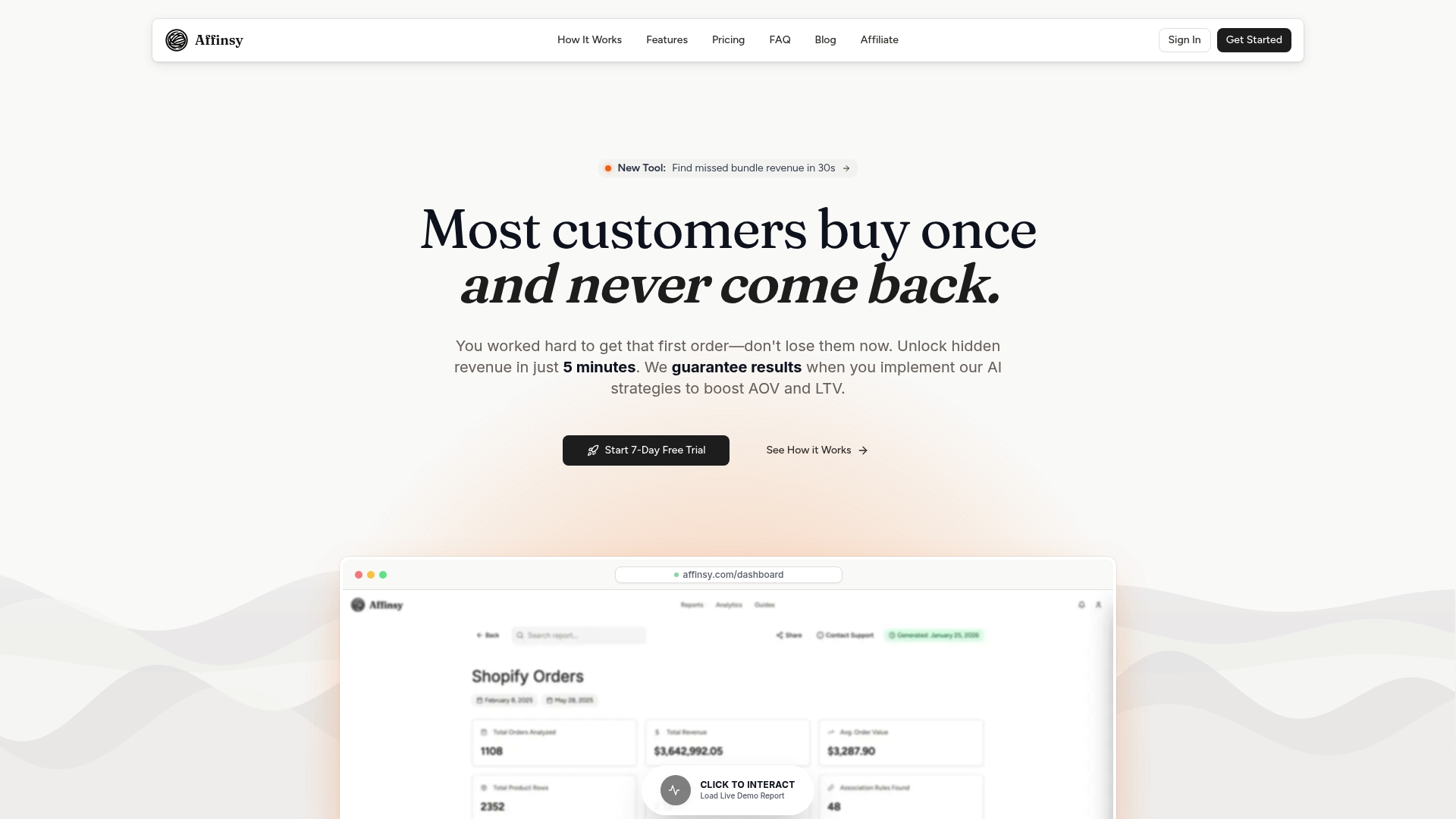
Affinsy makes it practical. The platform analyzes your historical transaction data to surface real product associations through market basket analysis, so your recommendations are grounded in what your customers actually buy together, not assumptions. If you’re running WooCommerce, the WooCommerce cross sell editor lets you apply those insights directly to your store without developer work. The free tier covers up to 20K line items with no credit card required, so you can validate the approach before committing. Explore everything Affinsy offers and start turning your transaction data into a cross-selling engine that actually performs.
Frequently asked questions
What is a simple way to start cross selling in my e-commerce store?
Start by identifying products that are frequently bought together and set up automated recommendations on your product or cart pages. Data-driven matching of frequently purchased products is one of the most effective entry points for cross selling.
How do I measure the success of my cross selling strategy?
Track average order value, conversion rate on recommendations, and customer retention to get a clear performance snapshot. Metrics like AOV and conversion rate offer direct insights into cross selling effectiveness.
What’s the difference between cross selling and upselling?
Cross selling offers related products, while upselling suggests an upgrade or more expensive alternative to what the customer is already considering. Upselling involves upgrades, cross selling involves complementary products.
Are automated tools necessary for cross selling?
Automation greatly improves relevance and efficiency, especially for larger catalogs or audiences, though it’s not strictly required for smaller operations. Automation increases cross selling accuracy and scale in ways manual processes simply can’t match.
Recommended
- Cross Sell Strategies Step by Step for E-Commerce Growth - Affinsy Blog | Affinsy
- Cross-Selling Strategy Process for E-Commerce Success - Affinsy Blog | Affinsy
- Cross Selling Strategies Guide to Boost Online Store Revenue - Affinsy Blog | Affinsy
- How to Improve Cross-Selling With Data-Driven Strategies - Affinsy Blog | Affinsy
- Pricing Strategy for Small Business: How to Set Prices That Maximize Profit | John Galt