
TL;DR:
- Cross-selling can significantly increase e-commerce revenue by utilizing customer data and AI personalization.
- Targeted, multi-touchpoint offers that match customer intent outperform generic suggested products.
- Focusing on relevant, well-timed cross-sells with compelling copy yields better results than volume-driven strategies.
Cross-selling is quietly one of the most underleveraged revenue levers in e-commerce. While most brands obsess over traffic and conversion rates, 10-30% of e-commerce revenue is already sitting inside your existing customer base, waiting to be activated through smarter product suggestions. In 2026, the gap between brands that cross-sell strategically and those that do it generically is widening fast. Multi-touchpoint strategies, AI-powered personalization, and data-driven product pairings are no longer nice-to-haves. They are the baseline for competitive performance. This guide breaks down exactly how to build cross-sell programs that drive real results.
Table of Contents
- Start with data: Leverage purchase behavior for profitable cross-sells
- AI-powered recommendations: Multiply your cross-sell acceptance rates
- Timing and relevance: The science of multi-touchpoint cross-sell offers
- Copy strategies that convert: Social proof, benefits, and completeness framing
- A fresh perspective: Why less (but smarter) cross-selling wins in 2026
- Take your cross-selling strategy further with Affinsy
- Frequently asked questions
Key Takeaways
| Point | Details |
|---|---|
| Leverage customer data | Use order history and purchase patterns to reveal the best cross-sell combinations for your brand. |
| Implement AI recommendations | AI-powered engines dramatically lift both cross-sell acceptance rates and average order value. |
| Time and personalize offers | Multi-touchpoint delivery and tailored copy drive higher conversions and customer satisfaction. |
| Focus on relevance, not volume | Customers respond better to helpful, curated cross-sells than to generic, pushy offers. |
Start with data: Leverage purchase behavior for profitable cross-sells
With the importance of cross-selling established, let’s uncover how to target your offers for maximum impact, beginning with your own customer data.
Your order history is the most honest signal you have. It tells you what customers actually buy together, not what you think they should buy together. Data-driven cross-selling starts by mining that history for high-frequency product pairings. When you see that 40% of customers who buy a standing desk also add a cable management kit within 30 days, that is a cross-sell opportunity hiding in plain sight.
Market basket analysis (MBA) is the technique behind this kind of discovery. It identifies association rules between products based on real transaction patterns. You do not need a data science team to run it. You need clean order data and the right tool. Purchase data analysis combined with functional complementarity and “Frequently Bought Together” bundles built from order history is one of the most reliable frameworks for building relevant cross-sell offers.
Here is a quick breakdown of how to prioritize your cross-sell combinations:
| Pairing type | Example | Conversion potential |
|---|---|---|
| Functional complement | Laptop + laptop sleeve | Very high |
| Consumable refill | Printer + ink cartridge | High |
| Experience upgrade | Camera + extra battery | High |
| Style match | Shoes + matching belt | Medium |
| Seasonal add-on | Grill + grill cover | Medium |
Segmenting your cross-sell offers by customer lifecycle stage adds another layer of precision. New customers respond better to safe, obvious pairings. High-AOV (average order value) repeat buyers are more open to premium add-ons. Lapsed customers may need a value-focused bundle to re-engage. One-size-fits-all cross-sell logic leaves money on the table.
Key actions to take right now:
- Export 12 months of order data and run frequency analysis on product co-purchases
- Build separate cross-sell logic for first-time buyers vs. repeat customers
- Add “Frequently Bought Together” modules to both product pages and cart pages
- Review cross-selling statistics to benchmark your current attach rate against industry norms
- Test product bundling strategies as a complement to individual cross-sell offers
Pro Tip: Filter your product pairings by margin, not just frequency. A high-frequency pairing with thin margins may be less valuable than a medium-frequency pairing with strong contribution margins.
AI-powered recommendations: Multiply your cross-sell acceptance rates
After unlocking top product pairings through raw data, the next step is improving personalization and effectiveness. This is where AI-powered recommendation engines shine.
Rules-based cross-selling, where you manually define “if customer buys X, show Y,” works up to a point. But it does not scale, and it cannot adapt in real time to individual behavior signals. AI recommendation engines process hundreds of variables simultaneously: browsing history, purchase recency, session behavior, cart composition, and more. The result is a recommendation that feels personal because it actually is.
The performance gap is significant. AI-powered recommendations boost acceptance rates by 28%, lift AOV by 15-22%, and increase revenue by 10-30% compared to static rules-based approaches. For a brand doing $5M annually, that revenue lift alone justifies the investment many times over.

Here is how AI-powered cross-selling compares to classic approaches:
| Feature | Rules-based | AI-powered |
|---|---|---|
| Personalization depth | Low | High |
| Real-time adaptation | No | Yes |
| Scalability | Limited | Unlimited |
| Setup complexity | Low | Medium |
| Revenue lift | Baseline | 10-30% higher |
How to get the most from AI recommendations:
- Feed your AI engine clean, complete historical data. Garbage in, garbage out.
- Segment your recommendation logic by customer tier (new, returning, VIP).
- Use behavioral triggers like “viewed but did not add” to surface timely cross-sells.
- A/B test AI recommendations against your current rules-based setup to quantify the lift.
- Revisit your AI sales optimization strategy quarterly as models improve with more data.
One underrated advantage of AI is its ability to surface non-obvious pairings. A rules-based system would never suggest a yoga mat alongside a standing desk. But if your transaction data shows a strong behavioral correlation, an AI engine will catch it. Staying current on 2026 analytics trends helps you understand where these models are heading and how to stay ahead.
Pro Tip: Do not treat AI recommendations as a set-it-and-forget-it feature. Monitor acceptance rates monthly and retrain or adjust your model if performance plateaus after 60-90 days.
Timing and relevance: The science of multi-touchpoint cross-sell offers
Knowing what to offer is only half the battle. Delivering it at the precise moment dramatically multiplies success.
Most brands default to showing cross-sell offers on the product page and call it done. That is leaving significant revenue behind. Multi-touchpoint cross-selling across product pages, cart, post-purchase, and email yields 25-45% higher AOV than single-touchpoint approaches. Each stage in the customer journey has a different psychological context, and your offers need to match it.
Here is how each touchpoint works best:
- Product page: Show complementary items while intent is high. Keep offers tightly related to the viewed product. Avoid overwhelming the page with too many options.
- Cart page: This is prime real estate. The customer has committed to buying. A well-placed add-on here has strong acceptance because the purchase decision is already made.
- Post-purchase: Often ignored, but powerful. A customer who just converted is in a positive emotional state. A relevant offer on the confirmation page or in a follow-up email can capture incremental revenue with almost zero friction.
- Email follow-up: Cross-sell email timing matters enormously. Sending a cross-sell email 3-7 days after delivery, when the customer is actively using the product, outperforms emails sent immediately after purchase.
Behavioral triggers add another dimension. If a customer views a product three times without buying, that is a signal to serve a cross-sell that lowers the barrier, maybe a bundle that adds value to the item they keep returning to. Strategies for boosting average order value often hinge on this kind of trigger-based logic rather than static placement.
The brands winning at cross-selling in 2026 are not showing more offers. They are showing fewer, better-timed offers that feel like a natural extension of what the customer already decided to do.
For a deeper look at AOV boosting strategies and how ecommerce cross-selling growth connects to long-term retention, both are worth exploring alongside your timing strategy.
Copy strategies that convert: Social proof, benefits, and completeness framing
With smart placement and timing, your next lever is copy. The words that move customers to act on your cross-sell.
Most cross-sell copy is lazy. “You might also like” is not a reason to add something to your cart. It is a placeholder. High-converting cross-sell copy does three things: it communicates a specific benefit, it reduces perceived risk through social proof, and it frames the offer as completing something the customer already started.
Benefit-driven copy is the foundation. Instead of listing a product name, lead with the outcome. “Extend your battery life by 40%” outperforms “Add extended battery” every time. The customer is not buying a battery. They are buying uninterrupted use. Benefit-driven copy paired with social proof framing like “9 out of 10 customers added this” removes hesitation by showing that others already made this decision.
Here is a proven framework for writing cross-sell copy that converts:
- Lead with the outcome. What does the customer gain by adding this item? State it in one sentence.
- Add a social proof signal. Use real data: purchase frequency, review counts, or customer quotes.
- Use completeness framing. Phrases like “Complete your setup” or “Most customers also grab” create a sense of an unfinished task that the customer can resolve with one click.
- Keep it short. Three to five words for the headline, one sentence for the benefit. Cross-sell copy is not a product description.
- Test urgency sparingly. “Only 3 left” works when true. When overused, it destroys trust fast.
The bundling playbook for DTC brands offers additional copy frameworks specifically designed for bundled cross-sell offers, which often require slightly different language than individual product suggestions.
Pro Tip: Run copy tests in isolation. Change only the headline or only the social proof element, not both at once. This gives you clean data on what is actually driving the lift.
A fresh perspective: Why less (but smarter) cross-selling wins in 2026
Here is the uncomfortable truth most cross-sell guides will not tell you: more offers do not mean more revenue. They often mean more friction, more cognitive load, and more abandoned carts.
The brands that are seeing the biggest gains right now are the ones pulling back on volume and doubling down on relevance. Good cross-selling feels helpful, not pushy. When a customer sees a cross-sell offer that genuinely solves a problem they were already thinking about, they do not feel sold to. They feel understood.
The most common mistake we see is brands treating cross-selling as a numbers game: more placements, more SKUs, more popups. The result is a shopping experience that feels like a gauntlet. Customers tune it out or leave.
The smarter play is to pick two or three high-confidence cross-sell moments and execute them exceptionally well. Use your data, sharpen your copy, and time your offers to match customer intent. Then measure, iterate, and expand. Strategies for improving cross-selling strategies consistently show that relevance beats volume in every meaningful metric: AOV, conversion rate, and customer satisfaction. In 2026, adaptation is the strategy.
Take your cross-selling strategy further with Affinsy
Ready to apply these proven tactics at scale?
Affinsy gives e-commerce teams the analytical foundation to build cross-sell programs that actually perform. By running market basket analysis on your historical transaction data, Affinsy surfaces the product associations your team would never find manually. Whether you manage a Shopify store, WooCommerce catalog, or any platform that exports order data, you can upload a CSV or connect via API and start uncovering high-value pairings within minutes.
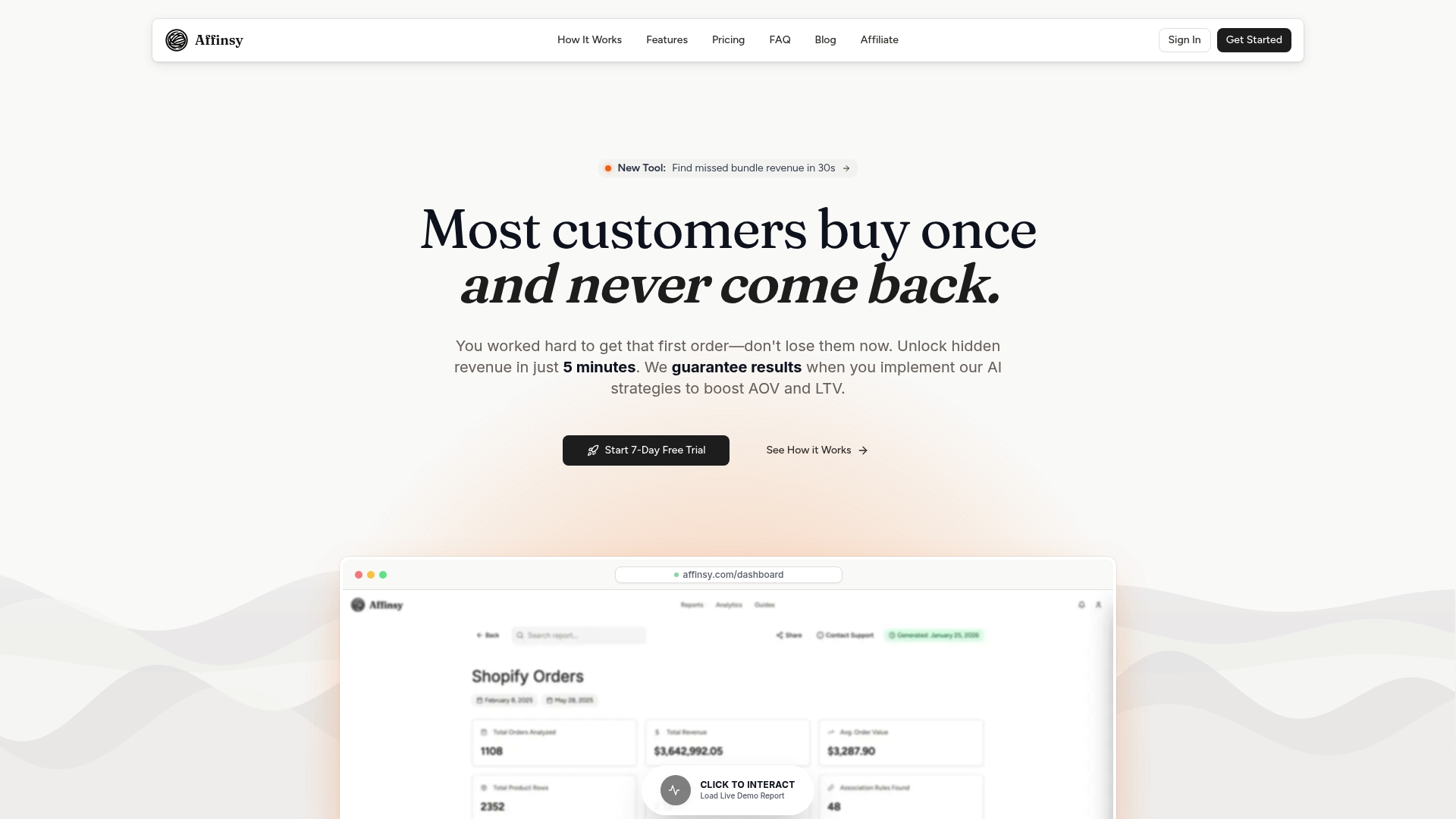
For teams looking to act on insights quickly, bulk cross-sell tools make it easy to deploy recommendations at scale without manual configuration. Start free, no credit card required, and see what your data has been telling you all along. Explore Affinsy solutions and put your transaction data to work.
Frequently asked questions
What is the difference between cross-selling and upselling?
Cross-selling offers related products a customer may also want, while upselling encourages the purchase of a higher-end version of the item they chose. Notably, cross-selling generates 3x more revenue than upselling, though individual offer conversion rates tend to be lower.
How can I identify the best products to cross-sell?
Analyze your order history for frequently co-purchased items and layer in AI tools to predict high-value combinations you might miss manually. Frequently Bought Together bundles built from real transaction data consistently outperform manually curated suggestions.
Do AI-powered cross-sell engines really increase sales?
Yes. Brands using AI recommendation engines report 28% higher acceptance rates and a 15-22% lift in average order value compared to static rules-based cross-sell systems.
When is the best time to show a cross-sell offer?
Product page, cart, post-purchase, and follow-up email each serve a different intent stage, but post-purchase and well-timed emails often see the strongest acceptance. Multi-touchpoint strategies consistently yield 25-45% higher average order value than single-placement approaches.
Recommended
- AI Sales Optimization Strategies for E-commerce in 2026 - Affinsy Blog | Affinsy
- 7 Effective Ways to Maximize Revenue in E-commerce - Affinsy Blog | Affinsy
- Cross-Selling Strategy Process for E-Commerce Success - Affinsy Blog | Affinsy
- Cross Sell Strategies Step by Step for E-Commerce Growth - Affinsy Blog | Affinsy