
Most ecommerce store owners leave money on the table. While they obsess over acquiring new customers, a simpler strategy quietly drives 10 to 30% revenue growth: cross selling. Amazon credits 35% of its revenue to product recommendations, yet many online retailers barely scratch the surface of this powerful technique. The gap between potential and practice is wide, but AI-driven analytics is closing it fast. This guide reveals why cross selling matters for your bottom line and how to implement it effectively using smart technology that scales with your business.
Table of Contents
- Key takeaways
- What is cross selling and its role in ecommerce
- How AI-driven analytics enhances cross selling effectiveness
- Comparing cross selling strategies: AI-powered vs manual approaches
- Implementing effective AI-powered cross selling in your ecommerce store
- Explore Affinsy’s AI-driven ecommerce solutions
- Frequently asked questions
Key Takeaways
| Point | Details |
|---|---|
| Revenue uplift range | Cross selling can lift revenue by about 10 to 30 percent through higher AOV and CLV. |
| AI driven personalization | AI driven analytics enhance cross selling by predicting shopper needs across signals and automating the timing of recommendations. |
| Automation saves effort | Automation reduces manual effort by about 89 percent and scales strategies through AI powered platforms. |
| Data driven insights | Using data insights helps avoid common cross selling pitfalls and keep recommendations aligned with customer intent. |
What is cross selling and its role in ecommerce
Cross selling is the practice of recommending complementary or related products to customers based on their current purchase or browsing behavior. When a customer adds running shoes to their cart, suggesting moisture-wicking socks or a fitness tracker is cross selling. This differs fundamentally from upselling, which encourages customers to buy a more expensive version of the same product, like upgrading from basic running shoes to premium ones.
The financial impact is substantial. Cross selling boosts revenue by 10 to 30% through higher average order value (AOV) and customer lifetime value (CLV), with ecommerce recommendations converting at 10 to 20%. AOV measures the average dollar amount spent each time a customer places an order, while CLV represents the total revenue you can expect from a single customer throughout their relationship with your store. Both metrics directly influence profitability and growth potential.
Why does cross selling work so effectively? It taps into existing customer intent. Someone already committed to purchasing is more receptive to relevant suggestions than a cold prospect. The strategy also deepens customer engagement by demonstrating you understand their needs, which builds loyalty over time. For ecommerce businesses operating on thin margins, increasing transaction value without proportionally increasing acquisition costs creates a powerful competitive advantage.
Consider these proven benefits of strategic cross selling:
- Maximizes revenue from existing traffic without additional marketing spend
- Improves customer satisfaction by surfacing products they genuinely need
- Increases inventory turnover by promoting slower-moving complementary items
- Strengthens brand perception as helpful rather than purely transactional
Understanding what is cross selling at a fundamental level helps you recognize missed opportunities in your current sales process. Many store owners focus exclusively on traffic generation, but optimizing the value of each visitor often delivers faster returns. The next evolution involves using artificial intelligence to make cross selling smarter, faster, and more personalized at scale.
How AI-driven analytics enhances cross selling effectiveness
Artificial intelligence transforms cross selling from guesswork into precision. Traditional approaches rely on manual product groupings or simple “customers also bought” logic, but AI analyzes thousands of behavioral signals simultaneously to predict what each shopper wants next. It processes purchase history, browsing patterns, cart abandonment data, and even time spent on product pages to build sophisticated recommendation models.
The results speak clearly. AI-driven analytics boosts CLV by 22% and revenue by 25%, with Amazon attributing 35% of its revenue to recommendations. These aren’t marginal improvements. They represent fundamental shifts in how effectively you convert interest into sales. AI identifies non-obvious product relationships that humans miss, like discovering that customers who buy yoga mats frequently purchase essential oils within 14 days, enabling perfectly timed follow-up campaigns.

Automation is equally transformative. AI reduces manual effort by 89% and operationalizes strategies via platforms like Salesforce Einstein, freeing your team to focus on strategy rather than spreadsheet maintenance. Instead of manually updating product bundles or segmenting customers, AI continuously learns and adjusts recommendations based on real-time performance data. This creates a self-improving system that gets smarter with every transaction.
Key AI capabilities that drive cross selling success include:
- Predictive analytics that forecast purchase intent before customers explicitly signal it
- Dynamic segmentation that groups customers by behavior rather than static demographics | Real-time personalization that adapts recommendations based on current session activity
- Automated A/B testing that optimizes recommendation placement and messaging
The role of AI in ecommerce extends beyond simple automation. It enables personalization at a scale impossible for human teams. However, poor data quality or inadequately trained models can undermine effectiveness, generating irrelevant suggestions that frustrate customers and damage trust. Success requires clean, comprehensive data feeding well-designed algorithms.
Pro Tip: Invest in data quality before deploying AI cross selling tools. Audit your transaction history for duplicates, correct product categorizations, and ensure customer identifiers link properly across sessions. Clean data is the foundation that determines whether AI delivers breakthrough results or disappointing mediocrity. Understanding why use AI in ecommerce helps justify this upfront investment.
Comparing cross selling strategies: AI-powered vs manual approaches
The difference between manual and AI-powered cross selling resembles the gap between handwritten ledgers and automated accounting software. Both accomplish the goal, but efficiency, accuracy, and scalability vary dramatically. Manual approaches rely on merchandising intuition and static product groupings, while AI dynamically adjusts to individual customer behavior in real time.
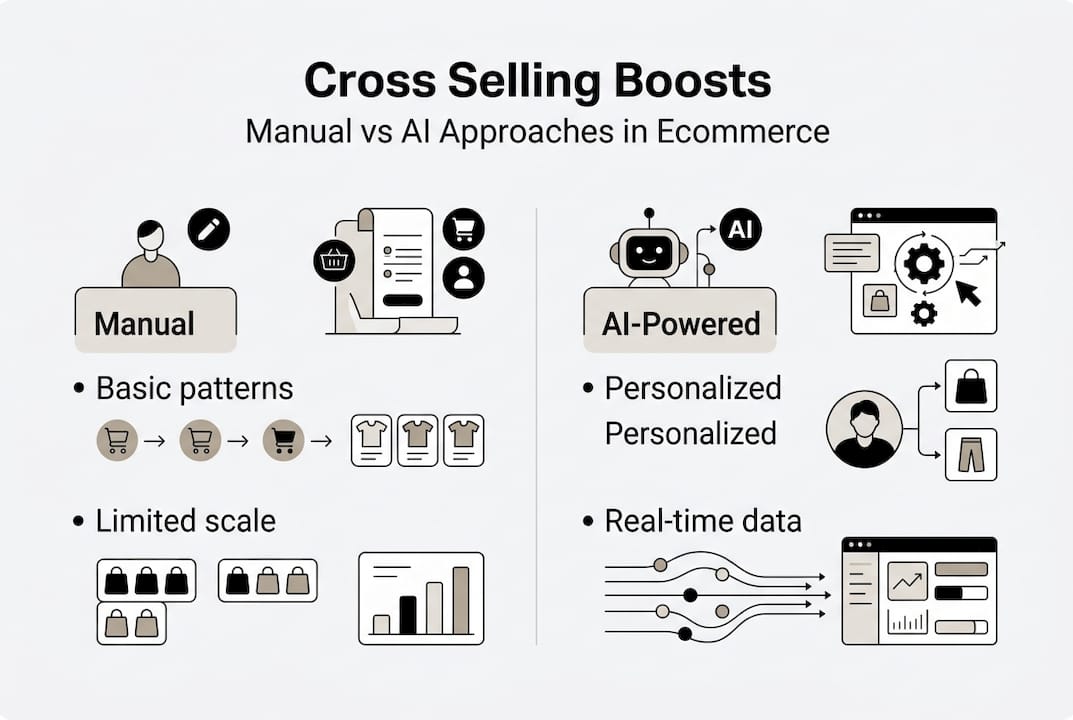
| Factor | Manual Cross Selling | AI-Powered Cross Selling |
|---|---|---|
| Personalization | Generic bundles for all customers | Individualized recommendations per shopper |
| Conversion Rate | 3 to 5% typical | 10 to 20% with AI optimization |
| Setup Effort | High initial and ongoing maintenance | High initial, minimal ongoing |
| Scalability | Limited by team capacity | Unlimited with proper infrastructure |
| Data Utilization | Basic purchase history | Behavioral, temporal, and predictive signals |
| Optimization Speed | Weeks to months for changes | Real-time continuous improvement |
The numbers validate AI’s superiority. Gartner reports 34% of upsell revenue is driven by AI-based recommender systems, demonstrating that major retailers have already made this transition. Customer loyalty dynamics also influence outcomes. High store loyalty affects cross-buying retention differently, meaning AI must account for relationship depth when suggesting products to maximize acceptance rates.
Manual cross selling offers some advantages worth acknowledging:
- Lower technology costs for very small catalogs under 50 products
- Greater merchandising control for highly curated brand experiences
- Simpler implementation without technical integration requirements
However, AI-powered approaches deliver compelling benefits that scale:
- Dramatically higher conversion rates through precise personalization
- Continuous learning that improves performance without manual intervention
- Ability to test thousands of recommendation variations simultaneously
- Insights into hidden product relationships that inform inventory decisions
Pro Tip: Start with AI for your top 20% of products by revenue, then expand coverage as you validate results. This focused approach minimizes risk while demonstrating ROI quickly, making it easier to secure budget for full implementation. Explore AI sales optimization strategies ecommerce 2026 for additional tactical guidance on phased rollouts.
The choice isn’t whether to adopt AI, but when and how. Manual methods simply cannot compete at scale, and customer expectations for personalized experiences continue rising. Retailers who delay adoption risk losing market share to competitors delivering superior shopping experiences.
Implementing effective AI-powered cross selling in your ecommerce store
Successful implementation follows a structured process that balances technical requirements with business objectives. Rushing deployment without proper preparation wastes resources and risks damaging customer relationships with irrelevant recommendations. Follow these steps to launch AI-driven cross selling that delivers measurable results.
-
Audit and prepare your data foundation. Export at least 12 months of transaction history, ensuring customer IDs, product SKUs, timestamps, and order values are accurate and complete. Clean duplicate records and standardize product categorizations.
-
Define clear business objectives and KPIs. Specify whether you’re prioritizing AOV growth, inventory turnover for specific categories, or CLV improvement. Different goals require different recommendation strategies.
-
Select an AI platform that integrates with your ecommerce system. Evaluate options based on your tech stack, whether Shopify, WooCommerce, or custom-built. Prioritize solutions offering transparent algorithms you can audit and adjust.
-
Configure recommendation logic and placement. Determine where suggestions appear: product pages, cart, checkout, or post-purchase emails. Test different placements to identify highest-converting positions.
-
Launch with monitoring and rapid iteration. Start with a small product subset or customer segment, measure performance daily, and refine based on acceptance rates and revenue impact.
Best practices that separate successful implementations from disappointing ones include:
- Limiting recommendations to three to five items to avoid overwhelming customers
- Using clear, benefit-focused copy that explains why suggestions matter
- Ensuring mobile optimization since over 60% of ecommerce traffic comes from phones
- Respecting customer preferences by allowing easy dismissal of irrelevant suggestions
Common mistakes that undermine cross selling effectiveness:
- Recommending products customers already own or just purchased
- Ignoring price sensitivity by suggesting items far outside typical purchase range
- Failing to update recommendations as inventory changes or trends shift
- Neglecting to test recommendation performance across different customer segments
Track these essential KPIs to measure success and guide optimization:
| Metric | Target Range | Measurement Frequency |
|---|---|---|
| Revenue Uplift from Cross Selling | 15 to 30% increase | Monthly |
| Average Order Value | 10 to 25% increase | Weekly |
| Customer Lifetime Value | 20 to 35% increase | Quarterly |
| Recommendation Acceptance Rate | 12 to 18% | Daily |
| Cart Abandonment Rate | 5 to 10% decrease | Weekly |
Cross selling can increase revenue by up to 30% and conversion rates by 10 to 20% when using AI recommendations, but only if you align strategies with customer journey stages. Early-stage browsers need inspiration and discovery, while checkout-stage customers respond better to quick-add convenience items. Segment your approach accordingly.
Continuous optimization based on analytics feedback separates good cross selling from great. Review performance data weekly to identify underperforming recommendations, test new product combinations, and refine targeting rules. AI learns faster when you actively guide it with business context that algorithms cannot infer independently. Dive deeper into product recommendations ecommerce strategies for advanced tactics.
Understanding the AI in ecommerce analytics role helps you interpret performance data correctly and make informed decisions about strategy adjustments. Technical integration matters too. Explore ecommerce integration AI analytics best practices to ensure your systems communicate effectively and data flows seamlessly between platforms.
Explore Affinsy’s AI-driven ecommerce solutions
Implementing sophisticated cross selling strategies becomes significantly easier with the right tools. Affinsy’s AI-powered analytics platform analyzes your historical transaction data to uncover hidden product associations and customer segmentation patterns that manual analysis misses. The platform integrates seamlessly with Shopify, WooCommerce, and Google Analytics, delivering actionable insights without requiring data science expertise.

Deepen your understanding of core concepts by exploring Affinsy’s comprehensive glossary resources. Learn the nuances of cross selling implementation, discover how customer segmentation drives personalization, and master product recommendations best practices. These resources provide the knowledge foundation needed to maximize your ecommerce analytics investment and turn data into revenue.
Frequently asked questions
What is the difference between cross selling and upselling?
Cross selling recommends complementary or related products that enhance the original purchase, like suggesting a phone case when someone buys a smartphone. Upselling encourages customers to choose a more expensive version of the same product, such as upgrading from a basic to a premium phone model. Both increase transaction value but through different psychological mechanisms.
How does AI improve the success rate of cross selling?
AI analyzes thousands of behavioral data points simultaneously to predict which products each individual customer is most likely to purchase next, creating personalized recommendations that feel relevant rather than random. It automates this process at scale, continuously learning from acceptance and rejection patterns to refine suggestions in real time. This precision dramatically increases conversion rates compared to generic manual recommendations.
What metrics should I track to measure cross selling performance?
Focus on average order value to measure immediate transaction impact, customer lifetime value to assess long-term relationship growth, and recommendation acceptance rate to gauge relevance. Monitor revenue uplift specifically attributed to cross selling campaigns by comparing performance against control groups. These metrics together provide a complete picture of cross selling effectiveness and ROI.
Can poor data quality hurt my AI cross selling efforts?
Absolutely. Inaccurate or incomplete data causes AI to generate irrelevant recommendations that frustrate customers and damage trust in your brand. Missing product categorizations, duplicate customer records, or inconsistent transaction logging all degrade model performance. Maintaining clean, comprehensive data is the single most important factor determining whether AI delivers breakthrough results or disappointing mediocrity.
Recommended
- Cross-Selling Strategy Process for E-Commerce Success - Affinsy Blog | Affinsy
- Cross Sell Strategies Step by Step for E-Commerce Growth - Affinsy Blog | Affinsy
- Cross Selling Strategies Guide to Boost Online Store Revenue - Affinsy Blog | Affinsy
- What Is Cross-Selling and Its E-Commerce Impact - Affinsy Blog | Affinsy
- Ramai autentic in promovare e-commerce | Strategie 2025