
TL;DR:
- Effective AI-ready analytics require governed semantic layers, metric governance, and strict access controls to ensure reliable, compliant outputs. Many teams overlook building these foundations early, leading to trust issues, regulatory risks, and inconsistent results. Implementing structured data lineage, automated governance, and secure agent connections greatly enhances AI trustworthiness and operational resilience.
Most e-commerce and SaaS teams assume that clean data plus a dashboard equals AI-ready analytics. That assumption is costing them trust, compliance exposure, and real revenue. AI-ready analytics is not just about formatting your data correctly or plugging in a machine learning model. It is about building governed, explainable, and semantically consistent data systems that AI can actually rely on without drifting, hallucinating, or violating regulations. This article walks you through the foundational requirements, compliance realities, and practical frameworks your team needs to get there.
Table of Contents
- Key takeaways
- What AI-ready analytics actually requires
- Compliance and regulatory considerations
- How AI agents connect securely to your analytics
- Platform features and frameworks that actually work
- Applying AI-ready analytics to real business decisions
- My take on what teams get wrong
- How Affinsy brings AI-ready analytics to your store
- FAQ
Key takeaways
| Point | Details |
|---|---|
| Governance beats data quality | Semantic layers and metric governance matter more than raw data cleanliness for reliable AI outputs. |
| Compliance starts at architecture | EU AI Act and GDPR requirements must be built into your data pipeline, not retrofitted later. |
| MCP enables secure AI agents | Model Context Protocol lets AI agents interact with live business data without creating security gaps. |
| Analytics-as-code reduces drift | Versioned, programmatically defined metrics prevent inconsistency as your data environment grows. |
| Real use cases drive ROI | Customer segmentation, market basket analysis, and product bundling deliver measurable outcomes from AI-ready data. |
What AI-ready analytics actually requires
Here is the misconception that trips up most teams: AI-ready data differs fundamentally from analytics-ready data. Analytics-ready data is structured for human interpretation, think clean tables, readable labels, and pre-aggregated reports. AI-ready data is optimized for context, signal density, and model comprehension. The difference is architectural, not cosmetic.
The four pillars that actually define AI-ready analytics readiness are:
- Governed semantic layer. Every metric your AI touches should pass through a single, authoritative definition layer. Governance enforced at query time ensures that both AI and BI tools draw from the same consistent logic, preventing the divergence that causes stakeholders to distrust outputs.
- Metric composability. Chaining metrics through a governed surface area is what separates trustworthy AI analytics from hallucination-prone raw SQL. A semantic layer with 90% governed surface area can answer most business questions reliably.
- Deterministic logic. AI agents need business rules that produce the same result every time. Ambiguity at the definition level creates inconsistency at the output level.
- Access controls and identity. Embedding access readiness into your data architecture prevents unauthorized training data exposure and inference leakage. This is not optional; it is a security baseline.
Pro Tip: Before evaluating any AI analytics tools, audit your semantic layer first. If your “revenue” metric is defined differently in your CRM, your data warehouse, and your BI tool, no AI model will produce outputs your team can trust.
The 88% of organizations now using AI analytics tools report low trust in outputs precisely because most implementations skip semantic governance. They bolt AI onto existing messy data pipelines and then wonder why the insights are unreliable.
Compliance and regulatory considerations
Regulatory frameworks are not abstract future concerns. They are requirements that directly shape how you architect AI-ready analytics today. Three regulations deserve your immediate attention.
- EU AI Act, Article 10. This regulation establishes strict data governance requirements for high-risk AI systems, including bias detection, data quality controls, and relevance standards. Any e-commerce or SaaS company selling into the EU and using AI for customer scoring, pricing, or segmentation needs to treat this seriously.
- EU AI Act, Article 18. The Act mandates 10-year retention of machine-readable technical documentation for high-risk AI systems. This means your data lineage cannot live in spreadsheets or tribal knowledge. It needs to be automated, structured, and retrievable on demand.
- GDPR and HIPAA. Both regulations require demonstrable data lineage and the ability to explain automated decisions. AI systems that operate without traceable logic are not just a trust problem. They are a legal liability.
The practical answer is automated data lineage embedded at the runtime level. Automated lineage tracking reduces audit preparation time by 60 to 70 percent and significantly improves operational resilience when something breaks in production.
“Without explainability and traceability, AI systems operate like black boxes, causing trust and regulatory risks that stakeholders and regulators cannot overlook.” — Data Lineage in AI Auditability
The teams that treat compliance as a phase two problem consistently face expensive rework. Audit trails, data provenance metadata, and governance logs need to be designed into your pipeline from day one. If you are implementing AI-enabled data analysis for any customer-facing decision, document how that decision was made while the data is still fresh.
How AI agents connect securely to your analytics
AI agents are no longer just assistants that answer questions. MCP servers shift AI agents into operational partners that automate workflows without requiring deep technical skills from every team member. But connecting those agents to production systems requires strict controls.
Model Context Protocol (MCP) has become the industry standard for giving AI agents scoped, secure access to business systems. Think of it as a controlled gateway. Instead of giving an AI agent broad database access, MCP exposes specific surfaces with defined permissions, preventing injection attacks and unauthorized data retrieval.
The most common production failures in MCP deployments come from tool discovery drift. When an MCP server updates its available tools without version pinning, AI agents can hallucinate missing tools or call deprecated endpoints. The practical mitigations are:
- Pin MCP server versions in all production environments. Treat MCP server updates like library dependencies: test before you deploy.
- Run integration tests after every MCP server change. Verify that agent-tool communication remains stable before exposing the updated configuration to production workflows.
- Audit agent action logs. Platforms like Redpanda’s Agentic Data Plane record 100% of agent actions with immutable, compliance-grade transcripts. This gives you both a security trail and a debugging resource.
Pro Tip: For SaaS teams integrating AI agents with subscription data, treat your MCP surface area definition with the same rigor as your API contract. Every tool the agent can call is a surface that needs documentation, versioning, and testing.
The payoff for getting MCP right is significant. AI agents that have secure, well-defined access to live data can automate tasks like customer segmentation updates, real-time pricing adjustments, and anomaly detection without any manual intervention.
Platform features and frameworks that actually work
When evaluating predictive analytics software or AI analytics tools for your stack, the marketing language all sounds the same. Here is what actually separates capable platforms from glorified dashboards.
| Feature | What to look for | Why it matters |
|---|---|---|
| Governed semantic layer | Single metric definitions shared by AI and BI tools | Prevents output inconsistency across teams |
| Analytics-as-code | Versioned, programmatic metric definitions | Reduces collaboration gaps and prevents logic drift |
| Explainability tools | Decision traces and reasoning outputs | Required for regulatory compliance and team trust |
| Real-time processing | Sub-second query latency on live data | Enables real-time AI analytics for time-sensitive decisions |
| Warehouse integration | Native connectors to Snowflake, BigQuery, Databricks | Keeps data in your environment rather than copying it out |
| MCP support | Native or configurable MCP server | Lets AI agents interact with live metrics securely |
Analytics-as-code deserves special emphasis. Defining your metrics programmatically, with version control and peer review, does for data what software engineering practices did for code quality. When a business rule changes, you update it in one place and every downstream AI model and report reflects that change automatically. This is the only reliable way to scale machine learning analytics without creating metric sprawl.

For e-commerce teams specifically, look for platforms that natively support data-driven ecommerce strategies through market basket analysis and RFM segmentation on top of governed data. These are not reporting features. They are signals your AI needs to be trained on consistently.
Applying AI-ready analytics to real business decisions
Once your data infrastructure is governed and your agents are secured, the actual business applications become more powerful and more trustworthy. The most impactful use cases for e-commerce and SaaS teams right now are:
- Customer segmentation. RFM (Recency, Frequency, Monetary) models built on AI-ready data produce segments that stay stable over time, because the underlying metrics are governed and consistent. This directly improves retention campaigns and lifetime value modeling.
- Product bundling and market basket analysis. When your transaction data is clean, semantically consistent, and AI-accessible, association rule mining surfaces product relationships you would never find manually. These relationships power cross-sell recommendations that convert because they reflect actual purchase behavior.
- Churn prediction for SaaS. Feature adoption patterns analyzed through machine learning analytics can identify at-risk accounts weeks before they churn. The earlier the signal, the more time your customer success team has to intervene.
- Real-time pricing and inventory decisions. Real-time AI analytics on live transaction streams lets you respond to demand spikes within minutes rather than days.
- Monitoring AI agent behavior. Decision logs from AI agents give you a continuous feedback loop. If an agent starts making recommendations that diverge from business logic, the log shows you exactly where the drift started.
The common thread in all of these is that the quality of the output is directly tied to the quality of the governance underneath. Artificial intelligence insights are only as reliable as the data contract they are built on.
My take on what teams get wrong
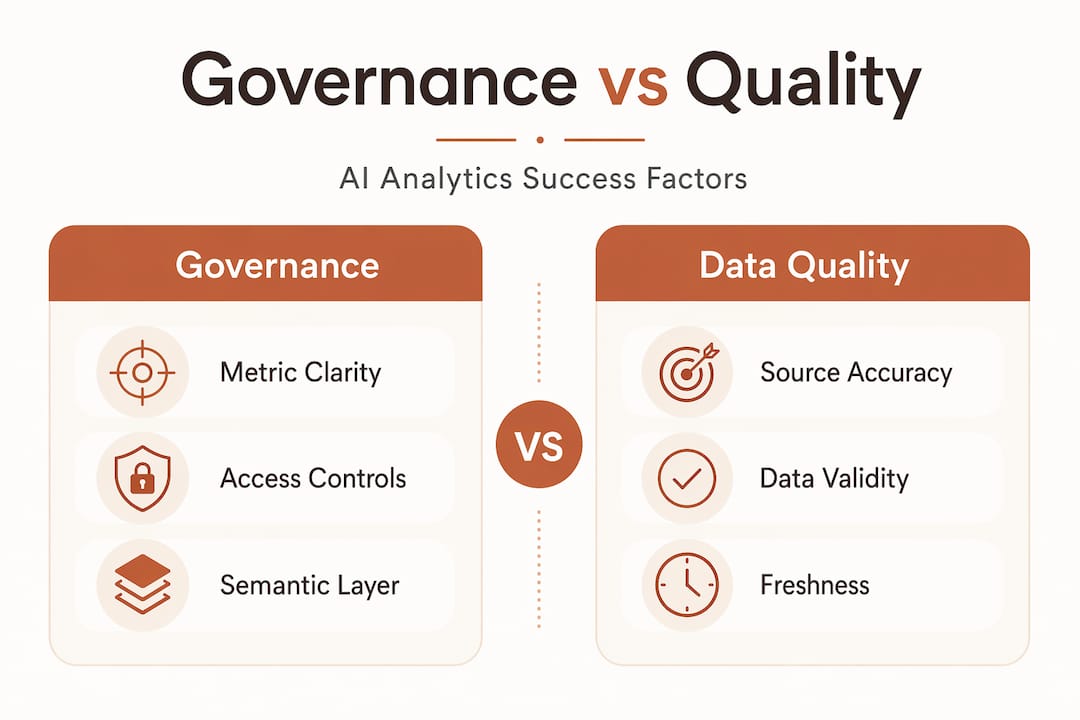
I have worked with enough e-commerce and SaaS teams on data infrastructure to see the same mistake repeat itself: they treat governance as something they will add later, once the AI is “working.” That sequencing is backward, and it costs real money to fix.
In my experience, the teams that build a governed semantic layer before they run a single AI model spend maybe 30% more time upfront and save themselves months of debugging inconsistent outputs. The ones who skip it spend that time, plus more, trying to figure out why their customer segmentation keeps shifting or why their churn model contradicts their revenue reports.
What I have learned about metric composability is that it is genuinely underappreciated. Most professionals hear “semantic layer” and think it is an analytics infrastructure concern for data engineers. But the moment you ask an AI agent a business question, that agent is composing metrics in real time. If those metrics are not governed, the agent is essentially doing its own interpretation of your business rules. That is where hallucinations and metric drift come from.
The compliance angle is the one that genuinely surprises people. I have seen teams build impressive AI systems, only to realize they have no way to produce the audit trail an enterprise client or regulator is asking for. Building lineage in retroactively is painful. Building it from day one is just engineering discipline.
My practical advice: start with your metric definitions. Document them. Version them. Make governance a prerequisite for any AI feature, not an afterthought. The teams that do this have AI systems their stakeholders actually trust.
— Mateusz
How Affinsy brings AI-ready analytics to your store
Affinsy is built specifically for e-commerce and SaaS teams that want AI-powered insights from their transaction data without needing a data science team to extract them. The platform takes your existing order data, whether you export it from Shopify, WooCommerce, BigCommerce, or Stripe, and runs governed market basket analysis and RFM customer segmentation on top of it.
For WooCommerce users, the free order exporter plugin makes getting your data into Affinsy a one-step process. For teams with developer resources, the API and native MCP support let you feed live transaction data directly into the analytics engine.
The permanent free tier covers up to 20,000 line items with full product access and no credit card required. You can explore product bundling insights and segmentation patterns on your real data before committing to a paid plan. For larger catalogs, Pro starts at $49/month and Max at $199/month, with enterprise pricing available on request.
FAQ
What is AI-ready analytics?
AI-ready analytics refers to data systems that combine governed semantic layers, metric composability, access controls, and automated lineage tracking so AI models can produce consistent, explainable, and compliant outputs. It goes well beyond clean data or basic automation.
How does AI-ready analytics differ from traditional analytics?
Traditional analytics is designed for human interpretation through dashboards and reports. AI-ready analytics is architected for model consumption, prioritizing signal density, consistent metric definitions, and machine-readable lineage that AI agents can act on reliably.
What compliance requirements affect AI-ready analytics in 2026?
The EU AI Act requires up to 10 years of machine-readable data lineage for high-risk AI systems. GDPR mandates explainability for automated decisions affecting EU residents. Both require that your data governance be built into the pipeline, not added after deployment.
How does Model Context Protocol (MCP) support AI-ready analytics?
MCP gives AI agents scoped, permission-controlled access to live business data and tools, preventing security risks like injection attacks and unauthorized data retrieval. Version pinning and integration testing are critical to keeping MCP deployments stable in production.
Can smaller e-commerce teams realistically implement AI-ready analytics?
Yes. Platforms like Affinsy make it possible to run governed market basket analysis and customer segmentation on exported transaction data without data science skills. Starting with structured exports and a governed analytics layer is enough to produce reliable artificial intelligence insights at any scale.
Recommended
- Complete Guide to AI in Ecommerce Analytics - Affinsy Blog | Affinsy
- Best Top Ecommerce Analytics Platforms – Expert Comparison 2025 - Affinsy Blog | Affinsy
- Sales Data Analysis: Unlocking E-Commerce Growth - Affinsy Blog | Affinsy
- Why Use AI Analytics? 20% Sales Boost & Retention - Affinsy Blog | Affinsy