
TL;DR:
- Consumer segmentation is shifting toward intent-signal layering and AI-driven models that reflect real-time buyer behaviors. Marketers must adopt adaptive, continuously updated segments built on unified data and cross-functional governance to stay relevant. Effective strategies focus on a small number of actionable segments and prepare content for AI-mediated buyers.
Consumer segmentation is the practice of dividing a market into distinct groups based on shared behaviors, characteristics, or intent signals so that marketing messages reach the right people with the right content. This guide to consumer segmentation trends covers what has changed through 2025–2026, why traditional demographic models are losing ground, and how marketing teams can build adaptive systems that keep pace with fluid, AI-influenced buyer behavior. The shift is not incremental. Behavioral data, AI-driven scoring, and the rise of the “Polyclass” consumer are rewriting the rules of target market analysis.

What are the latest consumer segmentation trends shaping strategy?
The most significant shift in market segmentation is the move from static firmographic profiles to intent-signal layering. 76% of B2B marketing teams had adopted intent-signal layering on top of traditional ICPs by 2024. That number signals a structural change, not a passing experiment.
AI-driven scoring models are replacing rules-based prioritization across both B2B and e-commerce. McKinsey’s 2024 research shows that AI-driven scoring produces a 10%–30% conversion lift compared to rules-based models. A lift of that magnitude justifies rebuilding segmentation infrastructure from scratch.
The consumer identity itself is also shifting. Over 50% of respondents in a 4,000-person study alter their self-presentation across social and professional contexts. This “Polyclass” consumer does not fit neatly into a demographic box, which means any segmentation model built on static categories is already outdated.
Three additional trends define the current state of segmentation marketing techniques:
- Micro-segmentation at scale. AI enables granular audience splits that update in near real time, replacing quarterly persona refreshes.
- Psychographic validation. Psychographic signals are now testable using behavioral data like email engagement and public LLM queries, removing the guesswork from attitudinal segmentation.
- AI-mediated buyers. A growing share of purchases are influenced or made by AI agents, requiring marketing teams to develop content strategies that address both human readers and AI intermediaries simultaneously.
Pro Tip: Run a quick audit of your current ICP. If it relies solely on firmographics like company size and industry, you are missing the intent and behavioral signals that now drive conversion.
Kantar’s research reinforces that segmentation works best when it moves from a one-time research project to a living organizational strategy embedded across marketing, product, and sales. Cross-functional governance is not optional. It is the mechanism that keeps segments accurate and commercially relevant.
What prerequisites do marketing teams need for advanced segmentation?
Modern consumer segmentation strategies require three foundational elements before any AI tool delivers value: clean data, resolved identity, and organizational alignment.
Clean, unified first-party data
Failing to resolve multiple customer identities across channels produces inaccurate segments. Trusted Customer 360 identity resolution is foundational for accurate machine learning models. Without it, the same customer appears as three different people in your dataset, and every downstream model inherits that error.
AI and agentic modeling tools
Agentic segmentation models operate continuously, updating audience definitions from natural-language instructions without IT handoffs. This means marketing teams can perform segmentation at scale without writing SQL. The practical benefit is speed: segments refresh daily or weekly instead of quarterly.
Cross-functional alignment
Cross-functional ownership and segment-level measurement correlate strongly with high-performing go-to-market teams. Marketing, Sales, RevOps, and IT each own a piece of the segmentation data. Without a shared governance structure, those pieces never connect.
The table below maps each prerequisite to the team responsible and the primary risk if it is missing.
| Prerequisite | Responsible team | Risk if absent |
|---|---|---|
| Customer 360 identity resolution | IT, Data Engineering | Duplicate profiles, inaccurate ML models |
| Real-time behavioral data feeds | Marketing, RevOps | Stale segments, missed intent signals |
| AI/ML scoring infrastructure | Data Science, IT | Rules-based models with lower conversion rates |
| Cross-functional governance board | Marketing, Sales, RevOps | Misaligned segments, no commercial KPI tie-in |
| Segment-level measurement framework | Marketing, Analytics | No way to prove segmentation value |
Pro Tip: Before buying any AI segmentation tool, map your existing data sources and check whether customer identities are unified across your CRM, e-commerce platform, and email system. A tool is only as good as the data it reads.
You can also explore behavior segmentation techniques that connect real-time behavioral signals to retention outcomes, which is a practical starting point for teams building their first unified data layer.
How to implement consumer segmentation based on current trends
Building or upgrading a segmentation model in 2026 requires a clear sequence. Skipping steps creates the same problems the model is supposed to solve.
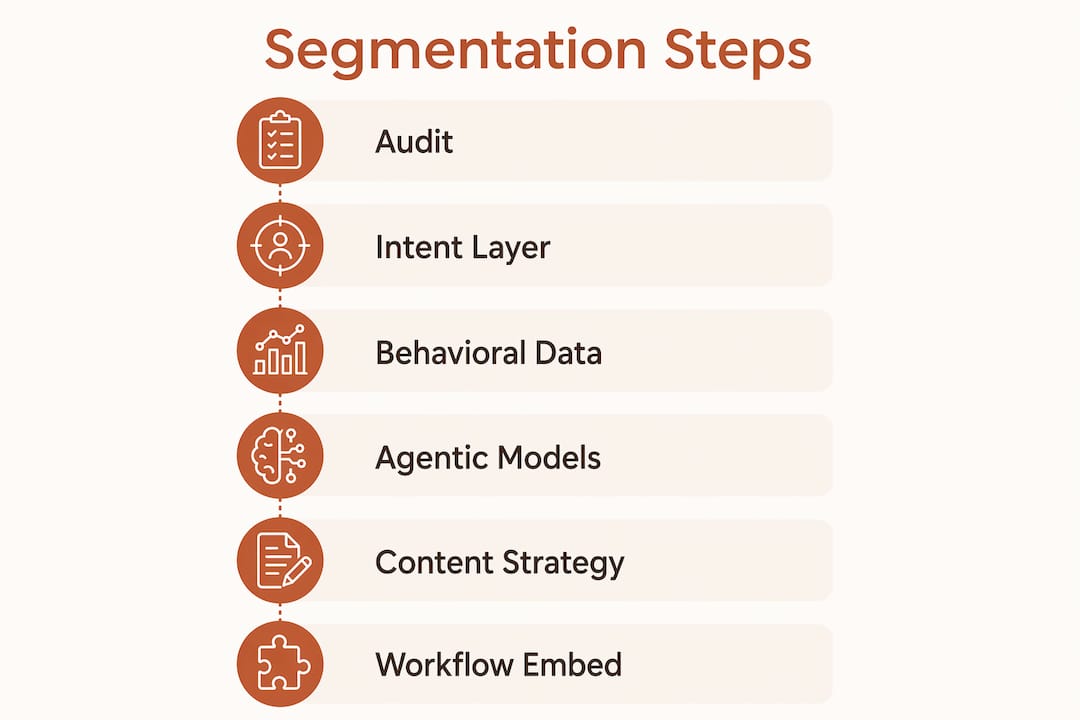
Step 1: Audit your existing segmentation model. Identify every segment definition currently in use. Flag any segment built solely on demographics or firmographics with no behavioral or intent data attached. These are your highest-priority rebuilds.
Step 2: Layer intent signals onto your ICP. Pull in third-party intent data, on-site behavioral signals, and search query patterns. Map these signals to your existing firmographic profiles. The goal is a composite score that reflects what a prospect is doing right now, not just who they are on paper.
Step 3: Add behavioral and psychographic dimensions. Incorporate email engagement rates, purchase frequency, content consumption patterns, and public behavioral signals. Psychographic segmentation is now testable using these behavioral proxies, so you do not need to rely on survey data alone.
Step 4: Build adaptive, agentic segmentation systems. Replace static segment definitions with models that update continuously. Legacy segmentation models alone are insufficient. Layering real-time behavioral and intent signals produces adaptive models that refresh weekly or faster. Set a minimum refresh cadence of once per week for high-volume segments.
Step 5: Develop a dual content strategy for AI-mediated buyers. Structure product pages and campaign content to serve both human readers and AI agents. This means providing structured facts, schema markup, and clear data points that LLMs can retrieve and cite. The biggest segmentation risk in 2026 is marketing to AI-mediated buyers with content built only for humans.
Step 6: Embed segmentation into organizational workflows. Assign segment ownership to named individuals across marketing, sales, and product. Tie segment performance to commercial KPIs such as revenue per segment, churn rate by cohort, and conversion rate by intent tier. Review governance quarterly and update segment definitions when behavioral data signals a meaningful shift.
For practical examples of how e-commerce brands apply these steps, the customer segmentation examples on the Affinsy blog show how adaptive models work in retail contexts.
What common challenges arise when applying new segmentation trends?
The most frequent failure mode in modern segmentation is not a technology problem. It is a scope problem.
Segment bloat. Most marketing teams create too many personas. Effective segmentation requires 3–5 actionable segments, each with a differentiated marketing approach. A team managing 27 personas cannot execute meaningfully against any of them.
Stale segment definitions. Quarterly refreshes are outdated and risk compounding inaccuracies over time. Automate behavioral data ingestion so segments update at least weekly. Any segment that has not been touched in 90 days should be treated as suspect.
Fragmented data sources. When CRM data, e-commerce transaction data, and ad platform data live in separate systems, segments built on any single source are incomplete. A unified customer view is not a nice-to-have. It is the baseline for accurate segmentation.
Undifferentiated marketing actions. Segments that receive identical messaging deliver no measurable lift. Each segment must trigger a distinct creative, offer, or channel strategy. If two segments receive the same email, they are functionally one segment.
AI-mediated purchase journeys. As AI agents increasingly research and shortlist products on behalf of buyers, traditional SEO and ad targeting miss a growing portion of the funnel. Adapt by structuring content for LLM retrieval and testing whether your product data surfaces accurately in AI-generated responses.
Pro Tip: Test your psychographic hypotheses with behavioral proxies before building full campaigns around them. Check whether the segment you labeled “price-sensitive” actually responds differently to discount messaging versus feature-focused messaging. If it does not, the segment is not real.
Understanding how AI analytics measures brand awareness can also help you validate whether your segments are responding to brand signals the way your model predicts.
Only 8% of marketing organizations report that their current segmentation strategies improve high-level business decisions on expansion opportunities. That number reflects how rarely segmentation connects to commercial strategy. Fixing that connection is the highest-leverage change most teams can make.
Key Takeaways
Effective consumer segmentation in 2026 requires adaptive, AI-driven models built on unified first-party data, cross-functional governance, and segment definitions that update continuously rather than quarterly.
| Point | Details |
|---|---|
| Intent signals over firmographics | Layer behavioral and intent data onto demographic profiles to reflect what buyers are doing now. |
| AI scoring lifts conversion | AI-driven models produce 10%–30% higher conversion rates than rules-based segmentation. |
| Limit to 3–5 core segments | More segments dilute focus; each segment must have a distinct marketing action to deliver value. |
| Update segments weekly | Quarterly refreshes create inaccuracies; agentic models should refresh behavioral data continuously. |
| Plan for AI-mediated buyers | Structure content for LLM retrieval to reach the growing share of purchases influenced by AI agents. |
What I have learned about segmentation that most guides skip
Segmentation is treated as a research deliverable in most organizations. A consultant produces a deck, the team nods, and the personas get pinned to a wall where they age quietly for two years. That is not segmentation. That is documentation.
The teams I have seen get real results from segmentation treat it as infrastructure. They assign owners, connect it to revenue data, and update it when the data changes. The segmentation-as-single-source-of-truth model is not a methodology. It is a cultural commitment to letting data override assumptions.
The “Polyclass” consumer finding is the one that should make every brand strategist uncomfortable. If more than half of your customers present differently depending on context, then the persona you built from a survey is a snapshot of one context. Your customer in a professional LinkedIn mindset is not the same person as your customer browsing Instagram at 10 PM. Building one static profile for both moments is a structural error.
My honest recommendation: start smaller than you think you need to. Pick two or three segments, build genuinely different campaigns for each, and measure the lift. That proof of concept will do more for organizational buy-in than any segmentation framework presentation ever will.
— Mateusz
How Affinsy supports modern segmentation for e-commerce teams
Affinsy applies AI-powered analytics directly to your transaction data to surface customer segmentation patterns you cannot see in a spreadsheet. The platform uses RFM customer segmentation to group buyers by recency, frequency, and monetary value, giving your team segments that reflect actual purchase behavior rather than assumed demographics. It also runs market basket analysis to identify which products your highest-value segments buy together, feeding directly into cross-sell and bundling strategy.
You upload order data via CSV or connect through API, and Affinsy handles the analysis without requiring a data science team. The permanent free tier covers up to 20,000 line items with full product access and no credit card required. For teams ready to act on the latest consumer segmentation trends, the customer segmentation glossary is a practical starting point.
FAQ
What is consumer segmentation?
Consumer segmentation is the process of dividing a market into distinct groups based on shared behaviors, demographics, or intent signals. Each group receives marketing tailored to its specific characteristics.
Why are traditional demographic segments losing effectiveness?
Over 50% of consumers now alter their self-presentation across contexts, making static demographic profiles unreliable. Behavioral and intent data produce more accurate and current segment definitions.
How often should segments be updated?
Segments should update at least weekly using real-time behavioral data. Quarterly refreshes are outdated and introduce compounding inaccuracies as consumer behavior shifts.
What is the right number of segments to maintain?
Effective segmentation uses 3–5 core segments, each with a distinct marketing action. More segments than that dilute execution focus and reduce measurable impact.
How does AI change consumer segmentation strategies?
AI-driven scoring models produce 10%–30% higher conversion rates than rules-based models and enable continuous segment updates without IT handoffs. AI agents also now influence purchase decisions, requiring content structured for both human readers and LLM retrieval.
Recommended
- Customer Segmentation SaaS: Strategies That Drive Growth - Affinsy Blog | Affinsy
- Customer Segmentation: Complete Guide for E-Commerce - Affinsy Blog | Affinsy
- 7 Effective Customer Segmentation Examples for E-commerce - Affinsy Blog | Affinsy
- 7 Customer Segmentation Ideas to Boost Your Sales - Affinsy Blog | Affinsy