
TL;DR:
- A small percentage of customers generate most of the e-commerce revenue.
- Data-driven decision making enhances targeting, segmentation, and product planning for better growth.
- Human judgment remains crucial to validate models and avoid common pitfalls.
About 5% of your customers generate 25.5% of your sales, and your top 22% account for nearly 60% of total revenue. Most e-commerce teams sense this imbalance but lack the tools to act on it systematically. Data-driven decision making (DDDM) changes that. Instead of acting on instinct or isolated reports, you build a continuous feedback loop where customer behavior, product performance, and marketing outcomes all inform each other. This guide walks through what DDDM really means, how to apply it through segmentation and product strategy, and what pitfalls to sidestep so your analytics investments actually pay off.
Table of Contents
- What is data-driven decision making?
- Customer segmentation: How data drives targeted marketing
- Product strategy optimization: Using data to shape your assortment
- Pitfalls, limitations, and the role of judgment
- Data, insight, and judgment: What most e-commerce teams miss
- Take your data-driven strategy further
- Frequently asked questions
Key Takeaways
| Point | Details |
|---|---|
| Small segments make big impact | A minority of customers drive a majority of e-commerce revenue, so uncovering and targeting them is crucial. |
| Blend data with judgment | Data-driven strategies work best when paired with context, transparent models, and informed human oversight. |
| Product and marketing win with applied analytics | Using advanced data and AI tools empowers both targeted marketing and optimized assortments for growth. |
| Avoid common pitfalls | Over-reliance on dashboards, failure to validate models, and neglecting governance can lead to costly mistakes. |
What is data-driven decision making?
Data-driven decision making means using structured analytics to guide your choices rather than relying on gut feel or anecdotal feedback. For e-commerce teams, that translates into using transaction data, behavioral signals, and attribution models to decide what to sell, who to target, and how to allocate marketing budget. It does not mean running every decision through a spreadsheet and ignoring instinct entirely.
One of the most persistent myths is that DDDM replaces human judgment. It does not. What it does is give your judgment a much better foundation. Think of it like GPS navigation: the system shows you the fastest route, but you still decide whether to stop for gas, avoid a rough neighborhood, or take a scenic detour. The data informs; you decide.
Another misconception is that DDDM is only for large enterprises with data science teams. In practice, data-driven decision making in retail is increasingly accessible to mid-market brands through modern SaaS platforms that handle the heavy analytics work for you.
So what does a genuine DDDM setup look like? A few core elements:
- Dashboards and KPIs: Real-time visibility into revenue, conversion rates, and customer lifetime value
- Cohort analysis: Tracking how different customer groups behave over time to measure retention and churn
- Multi-touch attribution: Understanding which channels and touchpoints actually influence a purchase, not just the last click
- Segmentation models: Grouping customers by behavior, not just demographics, to personalize outreach
The revenue impact is real and significant. Structured analytics can yield a 3.7x revenue lift per marketing dollar compared to intuition-led approaches. That is not a marginal improvement; it is a fundamentally different return profile.
“The goal is not to eliminate uncertainty but to make better bets. Data sharpens your odds; it does not guarantee outcomes.”
If you want a broader look at explained data-driven marketing, the principles carry across channels. The foundation is always the same: reliable data, a clear question, and a framework for acting on the answer.
Where most teams stumble is not in collecting data but in structuring decisions around it. You need a repeatable process, not just a prettier dashboard. Data beats hype in e-commerce, but only when the questions you ask of your data are sharp and specific.
Customer segmentation: How data drives targeted marketing
Knowing that a small group of customers drives most of your revenue is useful. Knowing which customers, why they buy, and when they are at risk of churning is what actually lets you act. That is where RFM segmentation earns its reputation.

RFM stands for Recency, Frequency, and Monetary value. Each customer gets scored on how recently they bought, how often they buy, and how much they spend. Combining those three scores places customers into segments with very different needs and profit potential.
Here is a quick comparison of RFM against more advanced models:
| Segmentation model | Complexity | Best for | Key advantage |
|---|---|---|---|
| Standard RFM | Low | Quick wins, small teams | Simple to implement, clear segments |
| RFM + cart abandonment (R+FMD) | Medium | Recovering lost revenue | Captures intent signals |
| K-means clustering | High | Large datasets | Groups by behavioral similarity |
| Gaussian Mixture Models (GMM) | High | Overlapping behaviors | Handles ambiguous segment boundaries |
Clustering algorithms like k-means and GMM consistently outperform standard RFM when datasets are large enough, but RFM remains the fastest entry point for most teams.
Here is a practical way to implement RFM in five steps:
- Export your order history including customer ID, order date, and order value
- Calculate R, F, and M scores for each customer on a 1-5 scale
- Combine scores to assign segment labels (Champions, Loyal, At Risk, Lost)
- Map each segment to a specific campaign or retention action
- Monitor segment migration over time to measure campaign effectiveness
The payoff is significant. Champions and Loyalists, who typically make up 15-25% of your customer base, generate 60-80% of revenue. Ignoring them in favor of broad acquisition campaigns is one of the most expensive mistakes in e-commerce marketing.
Pro Tip: Your “At Risk” segment, customers who used to buy frequently but have gone quiet, is often your fastest win. A targeted win-back campaign using RFM segmentation for win-back can recover significant revenue with minimal ad spend because these customers already know and trust your brand.
If you want to go deeper on methodology, you can master RFM analysis through practical walkthroughs built specifically for e-commerce contexts. Shopify merchants in particular benefit from tailored approaches, as covered in the RFM for Shopify retention playbook.
Product strategy optimization: Using data to shape your assortment
Customer segmentation tells you who is buying. Product analytics tells you what they want, what they ignore, and what keeps them coming back. Together, these two data streams let you build a product strategy that is genuinely responsive to demand rather than driven by supplier availability or buyer intuition.
AI and ML models are now central to serious assortment planning. Data-driven assortment planning uses historical sales data alongside product attributes like color, size, and category to predict which SKUs to stock, in what quantities, and for which customer segments. It also models demand transference, meaning what customers buy instead when their first choice is out of stock.
Here is what this looks like in practice, before and after applying data-driven product insights:
| Metric | Before optimization | After optimization |
|---|---|---|
| SKU count | 1,200 | 840 |
| Out-of-stock events (monthly) | 47 | 12 |
| Slow-moving inventory (% of stock) | 34% | 11% |
| Average order value | $68 | $84 |
| Product return rate | 18% | 11% |
Those are not hypothetical numbers pulled from thin air. They reflect the kind of gains brands consistently report when they replace gut-driven buying with analytics-led decisions.
To put data at the center of your product strategy, focus on these areas:
- Prevent oversaturation: Too many similar SKUs split demand and inflate inventory costs without improving conversion
- Forecast demand by segment: Your Champions may want premium variants; your new customers may gravitate toward entry-level SKUs
- React to trend signals early: Search data, social listening, and cart behavior often signal demand shifts weeks before sales data confirms them
- Use market basket analysis: Identifying which products are bought together lets you bundle strategically and boost average order value
For a broader look at how analytics connects to revenue, unlocking e-commerce revenue is worth exploring. And if you want the tactical side, smarter e-commerce growth covers specific strategies with implementation detail.
Pitfalls, limitations, and the role of judgment
Data-driven approaches are powerful. They are not infallible. Before you scale your analytics program, you need to understand what can go wrong and why it often does.
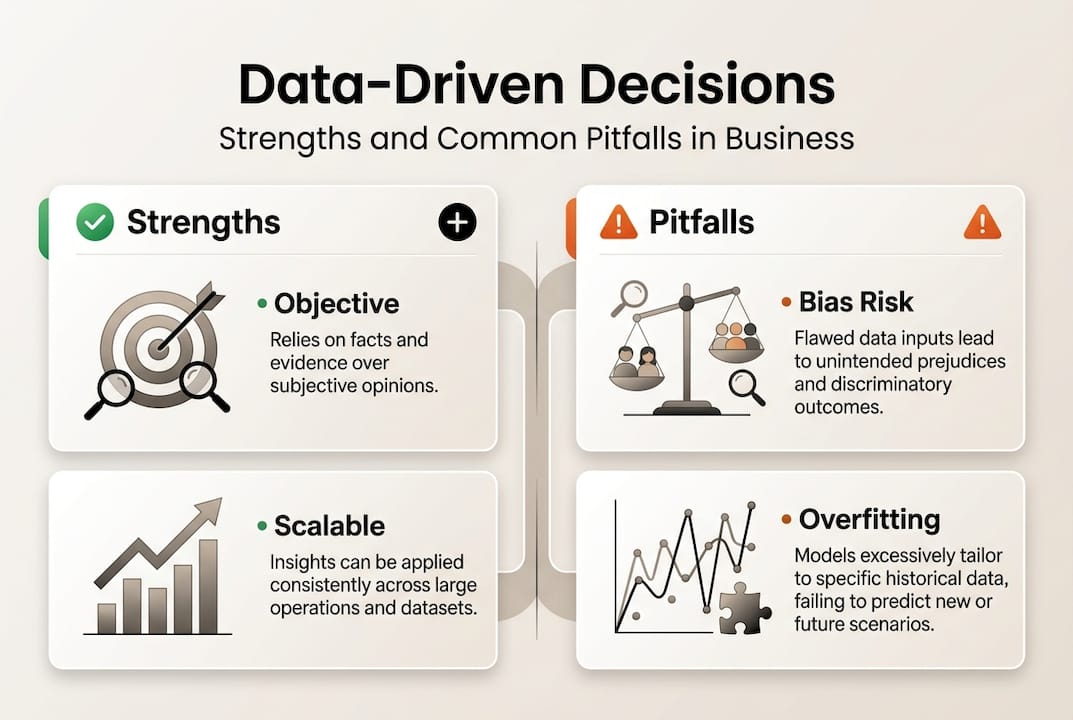
The first and most important point: data redistributes judgment, it does not eliminate bias or subjectivity. The decisions you used to make about which customers to target now get embedded in your segmentation thresholds and model parameters. If those choices are flawed, the model amplifies the error at scale.
Here are the most common pitfalls e-commerce teams encounter:
- Confusing correlation with causation: Two metrics moving together does not mean one causes the other. Acting on spurious correlations leads to wasted budget.
- Ignoring sample size: Small customer segments produce noisy data. A 15% open rate from 40 customers tells you very little.
- Model drift: A segmentation model trained on pre-pandemic data may misclassify customers in today’s market. Models need regular revalidation.
- Over-relying on a single metric: Optimizing purely for conversion rate can tank customer lifetime value if it pulls in low-quality buyers.
- Governance gaps: AI acceleration outpacing governance is a real organizational risk, especially as more teams adopt automated decision tools without clear oversight protocols.
“The question is never whether to use data. The question is whether your team has the discipline to challenge the data before acting on it.”
Pro Tip: Build a model validation step into your quarterly review cycle. Check for confounders, validate against holdout sets, and review whether segment definitions still reflect actual customer behavior. This discipline separates teams that get lasting lift from those that chase dashboards.
For practical guidance on blending analytics with strategic judgment, maximizing sales and retention covers this balance well. And if you want to connect analytics to your broader campaign approach, marketing strategies for e-commerce growth ties the two together.
Data, insight, and judgment: What most e-commerce teams miss
Here is an uncomfortable truth: most e-commerce teams are not failing because they lack data. They are failing because they have too much data and too little framework for using it wisely.
The impulse to add another dashboard, another attribution tool, or another segmentation layer is almost always a mistake if your team has not yet built the discipline to act on what you already have. More data does not produce better decisions; better questions do.
What the strongest teams we see do differently is this: they treat analytics as a conversation, not a verdict. A segmentation model tells you something; it does not tell you everything. The analyst who notices that the “Loyal” segment is aging out and asks why is more valuable than the one who simply reports the numbers.
True DDDM maturity means knowing when to trust the model and when to override it based on market context, brand positioning, or strategic bets the data cannot capture. Explore advanced e-commerce strategies to see how leading brands operationalize this kind of critical thinking. The edge in 2026 belongs to teams that combine rigorous analytics with genuine domain expertise, not to those who have the most tools.
Take your data-driven strategy further
Ready to move from insight to action? Affinsy is built specifically for e-commerce teams that want to put their transaction data to work without needing a data science team on staff. You can upload your order data via CSV or connect through API, and immediately start uncovering customer segments and product patterns that are not visible in your standard reports.
Start with a free account (no credit card required) and explore how predictive analytics explained connects to your day-to-day decisions. If you want to understand the mechanics behind RFM and behavioral grouping, the customer segmentation glossary is a great reference. And if product bundling and cross-sell optimization are your priority, market basket analysis shows exactly how Affinsy surfaces those opportunities from your existing data.
Frequently asked questions
What is data-driven decision making in e-commerce?
Data-driven decision making in e-commerce means using structured analytics like cohort analysis and attribution to guide marketing and product choices, replacing guesswork with evidence from your actual transaction and behavioral data.
What are RFM segments, and why do they matter?
RFM segments group customers by recency, frequency, and monetary value. Because top 22% of customers generate 60% of revenue, knowing exactly who they are lets you allocate budget and attention where it generates the most return.
Are there risks to relying on data alone for decisions?
Yes. Data redistributes bias into model thresholds and framing choices rather than eliminating it, so human oversight and regular model validation are essential parts of any responsible analytics program.
How does data-driven assortment planning improve product strategies?
AI-driven assortment planning analyzes historical sales and product attributes to identify which SKUs to stock, in what volume, and for which segments, reducing overstock and out-of-stock events while improving average order value.
Recommended
- Data-Driven Merchandising Workflow: 23x Sales Growth Guide - Affinsy Blog | Affinsy
- Data-Driven Decision Making in Ecommerce: Maximizing Sales and Retention - Affinsy Blog | Affinsy
- Data-Driven Ecommerce Strategies for Smarter Growth - Affinsy Blog | Affinsy
- Data-Driven Marketing Explained: Unlocking E-Commerce Growth - Affinsy Blog | Affinsy
- Datenanalyse für Amazon-Händler: Performance & Umsatz steigern
- HVAC Predictable Growth Process for Reliable Revenue Boost