
TL;DR:
- Moving from intuition to analytics-driven strategies unlocks significant e-commerce revenue.
- Building a unified data infrastructure enables precise segmentation, product bundling, and personalized promotion.
- Advanced analytics and machine learning improve targeting, reduce churn, and increase average order value.
Most e-commerce brands are still running promotions on gut feeling, seasonal guesses, and last year’s playbook. The result? Discounts that erode margins, bundles nobody buys, and customer segments so broad they’re practically useless. Brands unlock $100M+ value by moving away from blanket promotions toward targeted, analytics-driven strategies. This article walks you through exactly how to do that, from building the right tech foundation to applying machine learning for smarter product bundling and customer segmentation that actually moves the needle.
Table of Contents
- What is data-driven marketing and why does it matter?
- Building a tech stack for advanced analytics
- Applying data-driven marketing to product bundling
- Elevating customer segmentation with predictive analytics
- The uncomfortable truth: Why intuition alone won’t scale your e-commerce brand
- Ready to unlock your data advantage?
- Frequently asked questions
Key Takeaways
| Point | Details |
|---|---|
| Data drives ROI | Brands using data-driven marketing increase both revenue and efficiency through targeted promotions. |
| Bundling boosts sales | Machine learning enables smarter product bundles that raise conversion rates and average order value. |
| Segmentation unlocks value | Advanced analytics deliver highly personalized customer experiences and reduce churn. |
| Tech stack is critical | Unified data and scalable analytics infrastructure are required for effective data-driven marketing. |
| Intuition needs analytics | Gut feelings cannot replace evidence-based decisions for large-scale e-commerce success. |
What is data-driven marketing and why does it matter?
At its core, data-driven marketing explained is the practice of using real customer and transaction data to guide every promotional decision, from which products to bundle together to which customers to target with a specific offer. Instead of relying on assumptions, you let behavioral patterns, purchase history, and predictive models do the heavy lifting.
Traditional marketing tends to treat customers as a single audience. You run a sitewide sale, push a generic email blast, or create bundles based on what your merchandising team thinks looks good. Data-driven marketing flips this entirely. Every decision is rooted in evidence, and every campaign is tested, measured, and refined.
Here’s what separates the two approaches in practice:
- Real-time analytics that surface buying patterns as they happen
- Customer segmentation based on actual behavior, not demographics alone
- Dynamic targeting that adjusts offers based on purchase stage and predicted value
- Automated personalization at scale, without manual intervention
- Closed-loop measurement that ties every promotion back to revenue impact
The contrast becomes clearer when you look at outcomes side by side:
| Dimension | Traditional marketing | Data-driven marketing |
|---|---|---|
| Targeting | Broad audience segments | Behavioral microsegments |
| Promotions | Fixed discounts for all | Personalized offers per segment |
| Bundling | Manually curated | ML-driven, dynamic |
| Measurement | Sales lift estimates | Attribution at SKU level |
| Iteration speed | Weeks or months | Days or real-time |
The efficiency gains are significant. AI-driven targeted promotions, predictive CLTV, and ML are now considered core methodologies for brands that want to compete on margin, not just volume. When you know which customer is likely to churn, which product pairs drive the highest basket size, and which segment responds to urgency versus value messaging, your marketing budget stops being a cost center and starts being a growth engine.
For marketing managers at mid-to-large brands, this shift isn’t optional anymore. The brands winning on conversion and retention are the ones treating their transaction data as a strategic asset. Understanding data-driven decision retail principles is the first step toward building that competitive edge.
Building a tech stack for advanced analytics
Knowing why data-driven marketing works is one thing. Building the infrastructure to actually execute it is another. Most brands stumble here because they try to bolt analytics onto an existing stack that was never designed for it. The better path is intentional and sequential.
Here’s a practical build order for a scalable analytics infrastructure:
- Unify your data sources. Pull transaction data, customer records, and behavioral signals into a single, clean repository. Fragmented data produces fragmented insights.
- Establish a data warehouse. Tools like BigQuery or Snowflake give you a structured environment to store and query large datasets efficiently.
- Layer in an analytics platform. This is where you run segmentation models, cohort analysis, and funnel reporting.
- Integrate machine learning models. Start with market basket analysis and customer lifetime value prediction before moving to more complex propensity models.
- Build a measurement framework. Define your KPIs upfront: AOV, conversion rate by segment, churn rate, and promotion ROI.
- Automate reporting loops. Set up dashboards that surface anomalies and opportunities without requiring manual data pulls every week.
The technologies that support each layer vary, but the logic is consistent:
| Stack layer | Example tools | Key benefit |
|---|---|---|
| Data unification | Segment, Fivetran | Single customer view |
| Data warehouse | BigQuery, Snowflake | Scalable querying |
| Analytics platform | Looker, Affinsy | Segmentation and pattern detection |
| ML models | Python, built-in AI tools | Predictive scoring |
| Measurement | Custom dashboards | Closed-loop attribution |
McKinsey’s framework reinforces that a well-structured tech stack is the mechanism through which brands unlock significant revenue value through targeted promotions. The infrastructure isn’t glamorous, but it’s what separates brands that talk about personalization from those that actually deliver it.
For teams exploring data-driven campaign optimization, the most important principle is prioritizing data quality before sophistication. A clean, unified dataset running through a simple model will outperform a complex model fed messy, siloed data every time.
Pro Tip: Before evaluating any new analytics tool, audit your existing data for completeness and consistency. Missing order IDs, duplicate customer records, and inconsistent product naming will corrupt every model you build on top of them.
Applying data-driven marketing to product bundling
With a solid foundation in place, product bundling is one of the fastest ways to see a return on your analytics investment. The traditional approach to bundling is largely subjective: a merchandiser picks products that seem complementary, sets a bundle price, and hopes for the best. Data-driven bundling works differently.

Machine learning scans your entire transaction history to identify products that are frequently bought together in ways that aren’t always obvious. A customer who buys a specific coffee grinder is statistically likely to purchase a particular brand of filters within 14 days. That’s a bundle opportunity your merchandising team would never spot manually across thousands of SKUs.
The data sources that feed effective bundling models include:
- Market basket analysis on historical order data to surface co-purchase patterns
- Purchase sequence data showing what customers buy second, third, and fourth
- On-site behavior including heatmaps and product page views before purchase
- Return and refund data to avoid bundling products with high return correlations
- Seasonal and trend signals that shift which combinations perform best over time
Static bundles versus dynamic bundles produce very different outcomes:
| Bundle type | How it’s built | Typical AOV impact | Personalization level |
|---|---|---|---|
| Static | Manual curation | Moderate | None |
| Dynamic | ML-driven, real-time | High | Individual or segment-level |
Brands that shift to dynamic bundling consistently report AOV improvements of 30 to 50 percent when bundles are personalized to purchase history. The mechanics behind this are straightforward: you’re showing customers combinations they were already likely to buy, just making it easier and slightly cheaper to do it in one transaction.
If you want to go deeper on execution, there are practical expert bundling tips that cover how to structure bundle pricing, test bundle placement, and measure lift accurately. The key principle for improving AOV through bundling is always starting with what the data shows, not what feels intuitive.
Pro Tip: Run your bundling analysis on at least 90 days of transaction data before drawing conclusions. Short windows produce noisy patterns that don’t hold up in production.
Elevating customer segmentation with predictive analytics
Bundling optimizes what customers buy. Segmentation determines who you talk to, when, and how. Most brands segment by basic RFM criteria: recency, frequency, and monetary value. That’s a good start, but advanced segmentation goes further.
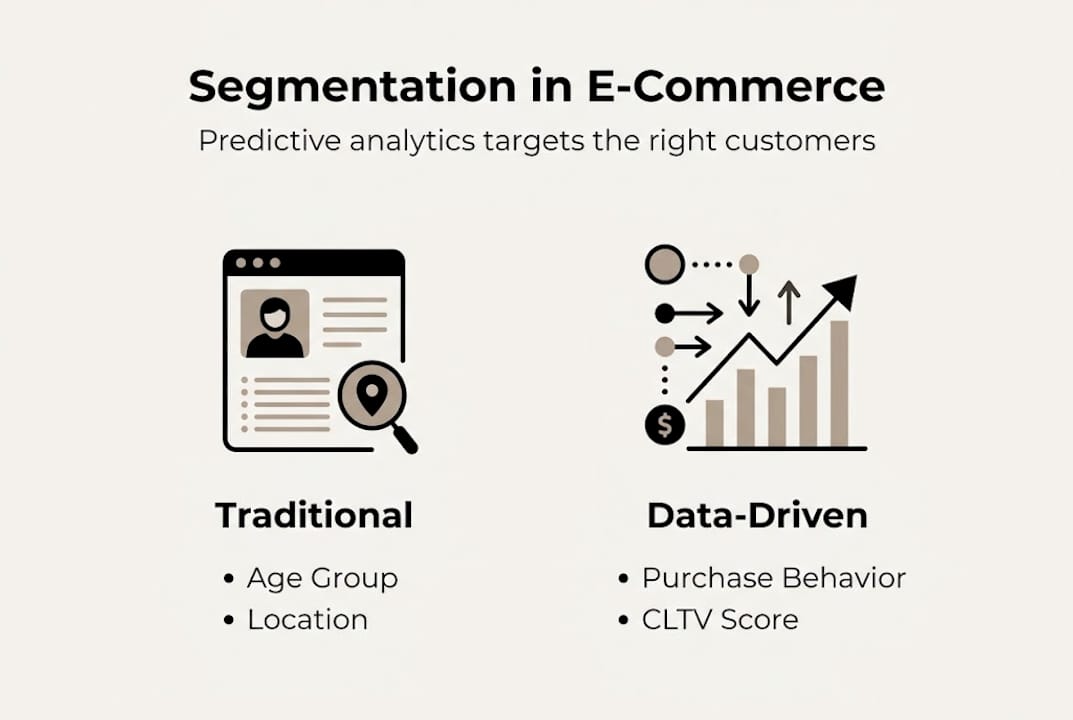
Predictive CLTV, RFMVDA modeling, and propensity scoring represent the current standard for brands serious about maximizing customer value. Predictive CLTV estimates how much revenue a customer will generate over their lifetime based on behavioral signals, not just historical spend. RFMVDA adds two dimensions to classic RFM: variety (breadth of categories purchased) and depth of engagement. Propensity scoring assigns each customer a probability of taking a specific action, like making a second purchase or responding to a win-back campaign.
The benefits of getting segmentation right are measurable:
- Higher conversion rates because offers match actual intent
- Reduced churn by identifying at-risk customers before they leave
- Better retention spend by focusing budget on high-CLTV segments
- Stronger loyalty through relevance, not just rewards programs
- Lower acquisition costs by using lookalike modeling on your best segments
“Retailers using advanced segmentation and targeted promotions have reported promotional efficiency improvements of 20 to 30 percent, with some brands capturing hundreds of millions in incremental revenue by replacing blanket discounts with precision offers.”
A practical example: a mid-size apparel brand segments its customer base using predictive CLTV and identifies a cohort of 8,000 customers with high future value but declining purchase frequency. Instead of a generic 20% off email, they send a personalized bundle offer based on that segment’s purchase history. The result is a 34% higher click-through rate and a 22% lift in reactivation compared to the control group.
This is the impact of segmentation done right: not just categorizing customers, but using those categories to drive decisions that are provably better than the alternative.
The uncomfortable truth: Why intuition alone won’t scale your e-commerce brand
Here’s something most analytics vendors won’t tell you: the biggest barrier to data-driven marketing isn’t technology. It’s the organizational habit of trusting instinct over evidence.
We’ve seen brands invest in sophisticated ML platforms and still run promotions based on what the VP of Marketing feels will work this quarter. The tools sit underused because the decision-making culture never changed. Data-driven marketing only works when the people making decisions actually trust the output and build processes around acting on it consistently.
The brands that win long-term aren’t necessarily the ones with the most advanced models. They’re the ones that have made evidence-based decisions a repeatable habit. They test, measure, and iterate. They treat a failed bundle test as valuable data, not a wasted effort.
Intuition still has a role. It’s useful for generating hypotheses. But it can’t scale. You can’t gut-feel your way through 50,000 SKUs and 200 customer microsegments simultaneously. That’s what master product bundling strategies built on data actually solve.
Pro Tip: Start with one analytics use case, prove the ROI clearly, and use that win to build internal momentum for broader adoption. Trying to transform everything at once is the fastest way to stall.
Ready to unlock your data advantage?
If you’ve been running on intuition and broad segments, the good news is that your transaction data already holds the answers. You don’t need to rebuild your entire stack overnight.
Affinsy makes it practical to start extracting value from your order history immediately. Upload a CSV or connect via API, and you get AI-powered market basket analysis and RFM segmentation without needing a data science team. Whether you want to sharpen your understanding of product bundling, build smarter customer segmentation strategies, or get a clearer picture of what market basket analysis can do for your brand, Affinsy gives you a permanent free tier to explore with no credit card required. Start with what you have and scale from there.
Frequently asked questions
How does machine learning improve product bundling in e-commerce?
Machine learning analyzes purchase patterns to create dynamic, personalized bundles that boost average order value and conversion rates. Unlike manual curation, ML surfaces non-obvious product combinations across thousands of SKUs simultaneously.
What is predictive CLTV and why is it important?
Predictive CLTV uses behavioral analytics to estimate a customer’s future revenue potential, enabling brands to prioritize retention spend and tailor promotions to high-value segments. It shifts your focus from past spend to future opportunity.
How can e-commerce brands start building a data-driven tech stack?
Begin by unifying customer and transaction data into a single clean source, then layer in analytics and ML tools for segmentation and prediction. McKinsey’s framework recommends building measurement infrastructure in parallel so you can validate ROI from day one.
Can data-driven marketing help reduce churn?
Yes. Precise segmentation and propensity scoring help identify at-risk customers before they disengage, allowing you to intervene with targeted offers that are far more effective than broad win-back campaigns.
Recommended
- Data-Driven Ecommerce Strategies for Smarter Growth - Affinsy Blog | Affinsy
- Data-Driven Marketing Strategies Guide to Boost AOV - Affinsy Blog | Affinsy
- Understanding Data-Driven Campaign Optimization for E-Commerce - Affinsy Blog | Affinsy
- Developing a Marketing Strategy to Maximize E-commerce Sales - Affinsy Blog | Affinsy
- Why predictive analytics transforms dropshipping success