
TL;DR:
- ReportDash.com alternatives in 2026 offer deeper insights by analyzing transaction data to uncover product associations and customer segments.
- Platforms like Affinsy provide AI-driven analysis with minimal technical expertise required, unlike traditional BI and dashboard tools that focus on visualization.
If you’re looking for ReportDash.com alternatives that go beyond dashboard display and actually surface product associations and customer segments from your transaction data, the field has narrowed considerably. Most reporting tools visualize data you already understand. The platforms worth your time in 2026 analyze it to tell you something you didn’t know.
Here’s where the leading options stand for e-commerce and SaaS teams:
- Affinsy — AI-powered market basket analysis and RFM segmentation built specifically for transaction data; permanent free tier up to 20K line items, Pro at $49/mo, Max at $199/mo; connects via API, CSV, or MCP; targets mid-to-large e-commerce brands and SaaS businesses
- Enterprise BI platforms (Microsoft Power BI, Tableau) — deep analytics power with semantic layers and certified datasets, but require dedicated analysts and significant budget
- Marketing intelligence platforms — pre-built connectors, automated data transformations, and visual dashboards suited for agencies; limited AI modeling depth
- Dashboard-first tools — fast setup and clean visuals, but data blending and cleaning fall on you
Table of Contents
- What do the best ReportDash.com alternatives actually offer?
- How to evaluate and choose the right AI analytics platform
- Why AI-powered analytics matter more than dashboards in 2026
- Key Takeaways
- The analytics tool landscape rewards patience, not speed
- Affinsy gives you AI analytics without the analyst overhead
What do the best ReportDash.com alternatives actually offer?
The gap between a dashboard tool and a genuine AI analytics platform is wider than most buyers expect. ReportDash focuses on visual reporting. The alternatives below compete on different terrain: how deeply they process your data before it reaches a chart.
| Criteria | Affinsy | Enterprise BI platforms | Marketing intelligence platforms | Dashboard-first tools |
|---|---|---|---|---|
| AI capabilities and accuracy | MBA algorithms, RFM segmentation, AI-driven product associations | Advanced ML with semantic layer; requires analyst setup | Basic automated insights; limited AI modeling | Minimal; display-only |
| Features | Market basket analysis, RFM segmentation, analytics dashboard, data export | Custom dashboards, predictive analytics, certified datasets | Pre-built connectors, cross-channel reporting, automated transforms | Visual dashboards, KPI tracking |
| Integration methods | API, CSV upload, MCP | Native connectors, APIs, cloud/hybrid | API | Direct integrations, CSV |
| Pricing and free tiers | Free tier (20K line items); Pro $49/mo; Max $199/mo; Enterprise on request | Mid-range to enterprise; per-user or capacity pricing | Mid-range; subscription tiers | Budget-friendly to mid-range |
| User types targeted | E-commerce brands, SaaS teams, growth agencies, data analysts | Enterprise data teams, analysts | Marketing agencies, performance marketers | Small teams, freelancers |
| Support and resources | Developer docs, API resources, CSV onboarding | Extensive documentation, community, professional services | Agency-focused support, white-labeling | Basic support, community forums |
| Data security and privacy | Data governance via structured input methods | Role-based access control, row-level security, certified datasets | Basic sharing permissions | Basic permissions |
| Scalability | Scales with paid tiers; Enterprise for large datasets | Highly scalable; cloud and hybrid deployment | Scales with connector volume | Limited at higher data volumes |
| Data processing speed | Optimized for transactional datasets with AI layer | Fast with semantic layer; slower without analyst tuning | Dependent on connector refresh rates | Fast for display; no processing depth |
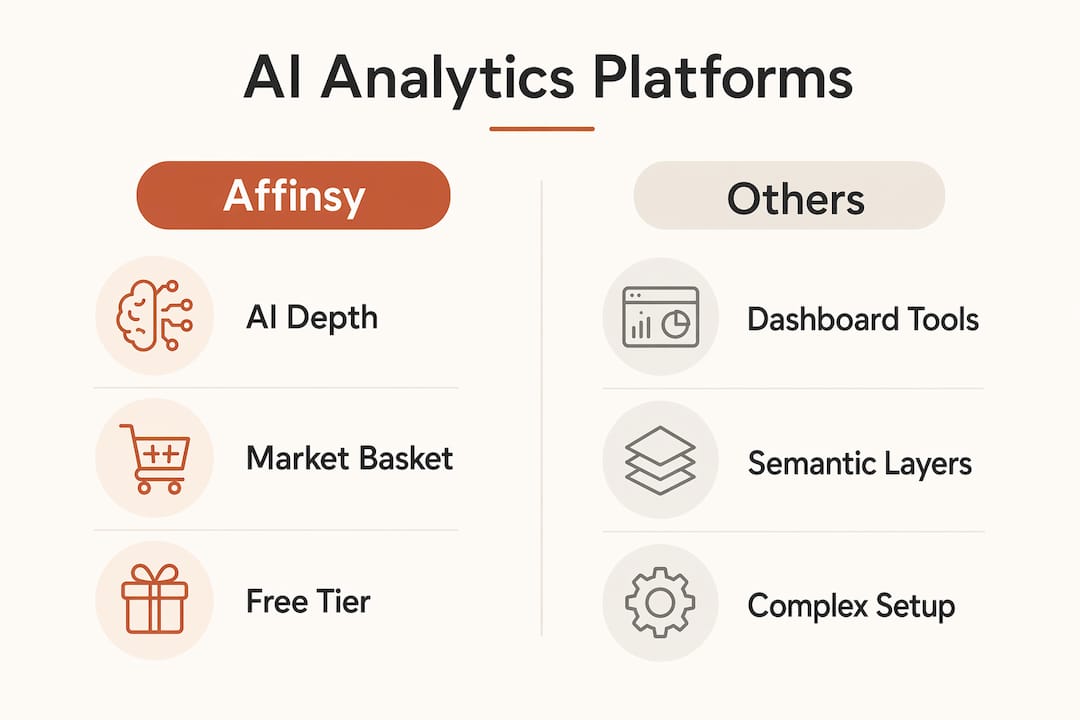
Enterprise BI platforms like Microsoft Power BI and Tableau offer genuine semantic layers and certified datasets, but they need dedicated analysts for data model maintenance. That’s a real cost most marketing teams can’t absorb. Marketing intelligence platforms trade some of that flexibility for ease of use, which works well for agencies running cross-channel reports but falls short when you need product-level association modeling.
How to evaluate and choose the right AI analytics platform
The wrong tool costs you more than its subscription fee. It costs you the months you spend waiting for insights that never arrive in a usable form.
Start with these criteria:
- Define your core use case first. Are you running market basket analysis to build product bundles, or segmenting customers by recency, frequency, and monetary value for retention campaigns? Platforms optimized for transaction-level AI analysis differ from those built for campaign reporting.
- Assess your team’s technical depth. CSV upload access matters if you don’t have a developer. API access matters if you do. Tools requiring SQL or custom data models will stall non-technical marketing teams.
- Check data governance. A centralized semantic layer ensures your customer lifetime value calculation means the same thing in every department. Without it, AI outputs vary by team and trust collapses fast.
- Evaluate integration fit. If your orders live in Shopify, WooCommerce, BigCommerce, or Stripe, confirm the platform accepts exports from those systems, whether via native connector, API, or CSV.
- Request a trial or demo before committing. Most leading platforms offer trial periods. Use them to test with your actual data, not sample datasets.
- Match pricing to your data volume and growth trajectory. A free tier is useful for validation. A paid tier needs to scale without forcing a platform migration six months later.
Pro Tip: Before signing any contract, ask the vendor how they define “customer lifetime value” in their system. If the answer is vague or configurable without governance controls, your AI-driven segments will drift over time as different teams apply different logic.
AI-powered analytics for e-commerce growth depends heavily on clean, consistently defined inputs. Garbage in, garbage out is not a cliché here. It’s the failure mode that kills most analytics initiatives.

Why AI-powered analytics matter more than dashboards in 2026
Dashboard-first tools display data as-is. That’s useful for monitoring. It’s not useful for discovering that customers who buy product A also buy product B within 30 days at a rate worth building a bundle around.
AI-powered market basket analysis surfaces those associations automatically from raw transaction records. The Apriori and FP-Growth algorithms that underpin most MBA implementations scan millions of order combinations to find statistically meaningful co-purchase patterns. No analyst required. No pivot table marathon.
RFM segmentation adds a second layer. By scoring customers on recency, frequency, and monetary value, AI-enhanced customer segmentation lets marketing teams identify which customers are about to churn, which are primed for upsell, and which represent the top revenue concentration. The difference between manual RFM scoring and AI-assisted scoring is speed and granularity: AI updates segments continuously as new transactions arrive.
For SaaS businesses, the same logic applies to subscription and feature adoption data. Which features predict long-term retention? Which usage patterns precede cancellation? These are MBA-style questions applied to behavioral data rather than purchase data.
The governance piece matters here too. Without consistent metric definitions across teams, AI-driven customer metrics can vary widely between departments, undermining cross-functional decisions. A semantic layer that certifies how “active customer” or “high-value segment” is calculated prevents that drift.
Key Takeaways
The strongest ReportDash.com alternatives for e-commerce and SaaS teams in 2026 are platforms that combine AI-driven transaction analysis with clear data governance, not just faster dashboards.
| Point | Details |
|---|---|
| AI depth separates tools | Dashboard-first tools display data; true AI platforms analyze transaction patterns to surface product associations and customer segments. |
| Semantic governance is non-negotiable | Without a centralized semantic layer, AI-generated metrics drift between teams and produce unreliable outputs. |
| Integration method determines adoption | API, CSV, and MCP access determine whether your team can actually use the platform without a developer on standby. |
| Pricing must match data volume | A permanent free tier validates fit; paid tiers need to scale without forcing a platform switch as transaction volume grows. |
| Affinsy targets this gap directly | Affinsy’s MBA and RFM engine runs on your existing transaction exports with no data science skills required, starting free. |
The analytics tool landscape rewards patience, not speed
Most teams shopping for reporting tool alternatives make the same mistake: they evaluate on UI and connector count, then discover six months later that the platform can’t answer the questions that actually drive revenue.
The real question is not “does this tool have a nice dashboard?” It’s “can this tool tell me which products to bundle, which customers to retain, and which segments to target next quarter, using only the transaction data I already have?” Those are different questions, and they require different architecture.
Marketing intelligence platforms built for agencies are excellent at cross-channel reporting. They’re not built for product association modeling. Enterprise BI tools can do almost anything, but they require analyst resources that most e-commerce and SaaS marketing teams don’t have. Dashboard-first tools are fast and clean, but they stop at display.
The platforms worth serious evaluation in 2026 are those purpose-built for transaction-level AI analysis, with governance controls that keep outputs trustworthy as your team and data volume grow. That’s a narrower category than the reporting software comparison lists suggest.
Affinsy gives you AI analytics without the analyst overhead
Most AI analytics platforms ask you to choose between power and accessibility. Affinsy doesn’t. It runs market basket analysis and RFM segmentation directly on your transaction exports, whether you connect via API or upload a CSV, and delivers product association insights and customer segments your marketing team can act on the same day.
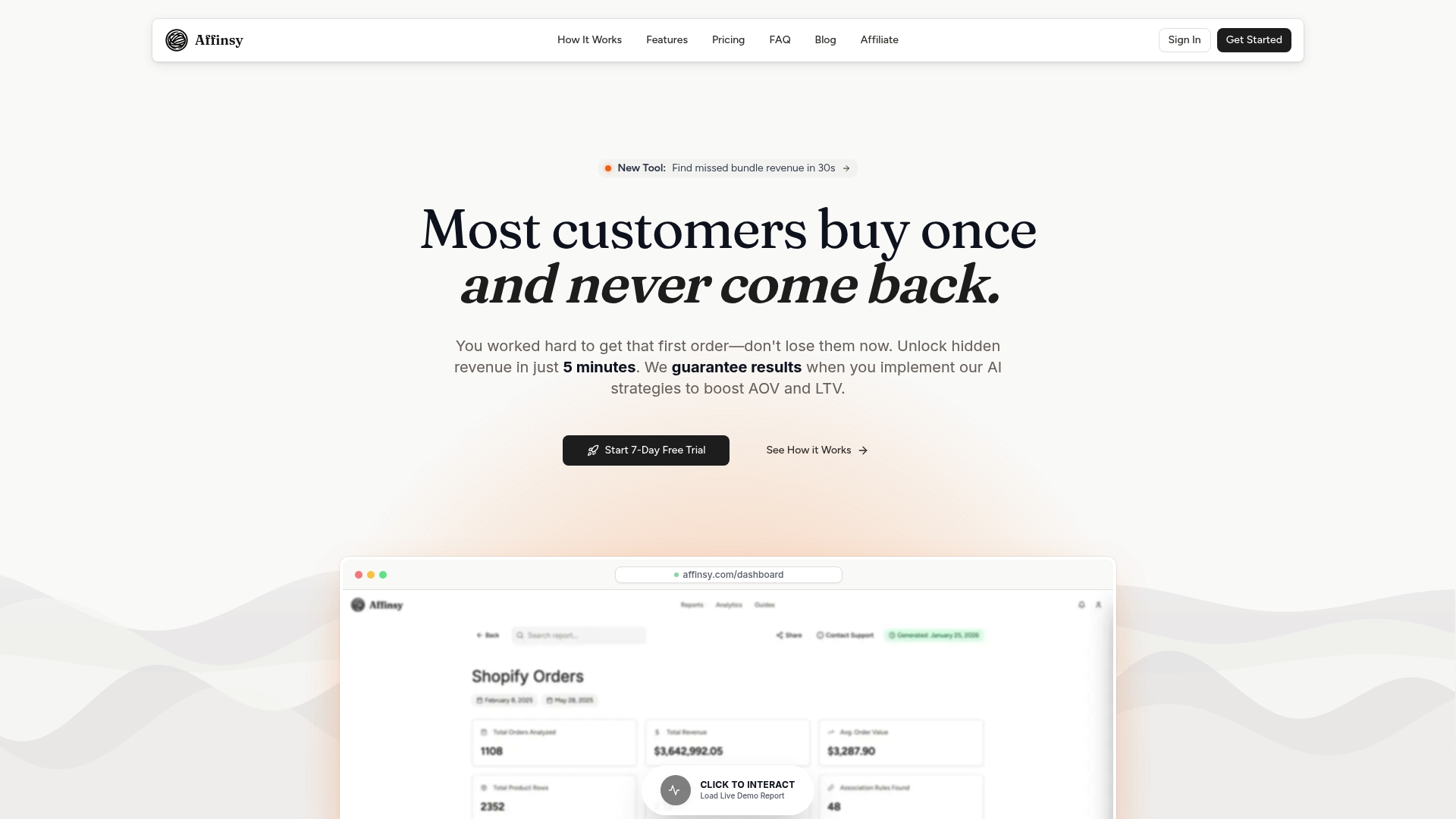
The permanent free tier covers a limited number of line items with full product access and no credit card required. This allows validation of whether Affinsy surfaces associations worth building bundles around before spending money. Paid plans scale with your data volume, and enterprise pricing is available for larger operations. Data from Shopify, WooCommerce, BigCommerce, Stripe, or any system that exports order records feeds straight in.
Start with the free tier at affinsy.com and run your first market basket analysis on real transaction data today.