
TL;DR:
- Effective retail segmentation divides customers into groups based on shared behaviors and characteristics to boost campaign ROI. This process depends on clean, unified data and generates 3 to 5 actionable segments for optimal operational targeting. Regular updates, aligned with business goals, ensure segmentation remains relevant and drives personalized customer experiences.
Retail segmentation analysis is the process of dividing a customer base into distinct groups based on shared characteristics, so each group can be targeted with relevant offers, messages, and experiences. Done well, well-executed segmentation delivers double-digit percentage-point lifts in campaign ROI. That result is not a ceiling. It is a baseline for teams that treat segmentation as a living workflow rather than a one-time project. This guide to retail segmentation analysis covers every stage: data preparation, segment building with methods like RFM analysis and K-Means clustering, activation across channels, and the pitfalls that quietly kill execution. Retail analysts and marketers who follow this process will spend less on broad campaigns and earn more from the customers they already have.
What does a guide to retail segmentation analysis actually cover?
Retail segmentation analysis, also called retail market segmentation in academic and industry literature, is the structured practice of grouping customers by behavior, demographics, geography, or psychographics to inform marketing and operations. The goal is not just cleaner data. The goal is decisions that map to real customer differences.

Segmentation matters because 71% of consumers now expect personalized experiences from the brands they shop with. Retailers that cannot deliver relevance lose wallet share to those that can. Segmentation is the mechanism that makes personalization possible at scale.
The four classic segmentation criteria are demographic (age, income, household size), psychographic (values, lifestyle, purchase motivation), geographic (region, climate, urban vs. rural), and behavioral (purchase frequency, basket size, category affinity). Effective retail segmentation layers multiple data types rather than relying on any single dimension. A customer’s zip code tells you where they live. Their purchase cadence tells you how much they value your brand.
Beyond marketing, segmentation shapes inventory planning, store layout decisions, and customer service staffing. A segment of high-frequency, low-basket shoppers needs a different in-store experience than a segment of infrequent, high-value buyers. Treating both groups identically wastes resources on one and underserves the other.
What prerequisites and data preparation are necessary for effective segmentation?
Segmentation quality is a direct function of data quality. Fragmented systems produce fragmented segments, and fragmented segments produce campaigns that miss their mark.
Consolidate your data sources first
The minimum viable data set for retail segmentation pulls from four sources:
- Point-of-sale (POS) systems: transaction history, basket composition, purchase frequency
- E-commerce platforms: online order data, browsing behavior, cart abandonment signals
- Loyalty programs: visit cadence, redemption patterns, tier status
- Foot traffic data: store visit frequency, dwell time, cross-location behavior
Each source captures a different slice of customer behavior. No single source is sufficient on its own.
Why unified customer profiles matter
Customer Data Platforms (CDPs) eliminate data silos and allow real-time segment updates that reflect current customer intent. Without a CDP or equivalent data layer, a customer who buys online and in-store appears as two separate records. That duplication corrupts segment membership and inflates apparent customer counts.
Data deduplication, standardized identifiers, and a defined update frequency are non-negotiable. Segments built on stale data reflect who customers were, not who they are now. A quarterly refresh is the minimum for most retailers. High-velocity categories like grocery or fast fashion require monthly or even weekly updates.
Pro Tip: Before building a single segment, audit your data for completeness. If more than 20% of customer records are missing a key behavioral field like purchase frequency, fix the data pipeline first. Segmentation built on incomplete records will produce misleading clusters.
The role of AI in retail analytics has expanded significantly here. AI-powered tools can identify and reconcile duplicate records, flag anomalies, and surface data quality issues that manual audits miss.
How to execute the retail segmentation workflow step by step
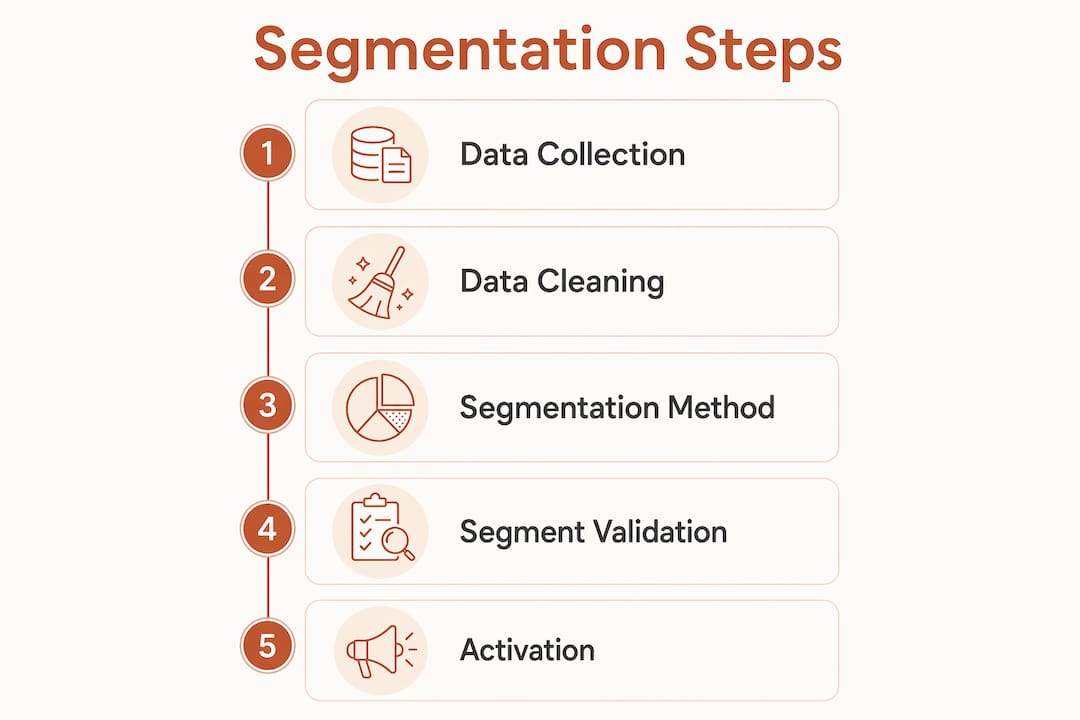
A repeatable retail segmentation workflow follows five stages. Skipping any stage produces segments that look good in a presentation but fail in the field.
-
Define your business objective. Segmentation built without a goal produces academic clusters, not operational ones. Decide first: are you targeting retention, new customer acquisition, win-back, or loyalty deepening? Each goal favors different segmentation variables and different segment counts.
-
Select your segmentation method. RFM analysis (Recency, Frequency, Monetary value) is the most widely used behavioral framework in retail. It scores each customer on three dimensions and groups them by score combination. K-Means clustering is the most common algorithmic approach for larger datasets. K-Means with four segments effectively categorizes large retail datasets, with one segment capturing roughly 64% of total revenue from just 21% of the customer base. That concentration is typical and has direct implications for where you focus campaign spend.
-
Build and label your segments. Run your chosen method against your unified customer data. Label each segment with a plain-language name that operations staff can understand. “High-frequency, low-basket” communicates more than “Cluster 3.” Naming segments by behavior keeps the entire organization aligned on what each group represents.
-
Validate segment effectiveness. Most retail organizations can realistically execute strategies for only 3–5 distinct customer segments. More than that strains marketing, operations, and store staff beyond what they can consistently deliver. Test each segment against historical store performance data before committing to a campaign plan.
-
Back-test against revenue outcomes. Compare segment membership to actual revenue contribution over the prior 12 months. If a segment labeled “high value” does not correlate with high revenue, the segmentation variables need adjustment.
| Segmentation method | Best use case | Data requirement |
|---|---|---|
| RFM analysis | Behavioral targeting, win-back | Transaction history |
| K-Means clustering | Large datasets, exploratory | Multiple numeric features |
| Demographic grouping | Broad audience planning | CRM or loyalty data |
| Geographic clustering | Store-level targeting | Location and visit data |
Pro Tip: Start with RFM analysis before moving to K-Means. RFM gives you interpretable segments immediately. K-Means adds nuance once you understand the behavioral landscape of your customer base.
How to activate retail segments in marketing and operations
Segments that live only in a spreadsheet generate zero revenue. Activation is where the analytical work pays off.
-
Tailor campaign messages by segment. A lapsed customer segment needs a win-back offer with urgency. A high-frequency segment needs loyalty recognition and early access. The same email sent to both groups underperforms both. Win-back campaigns targeted at behavioral segments produce a 1.3x to 2.0x lift over untargeted outreach. That lift compounds when the message matches the segment’s specific behavior pattern.
-
Link segments to inventory and promotions. A segment of high-basket, infrequent shoppers responds to curated bundles and category-level promotions. A segment of frequent, low-basket shoppers responds to convenience offers and loyalty point multipliers. Inventory planning should reflect which products each segment buys most, reducing overstock on items that do not resonate with your primary revenue segments.
-
Train store staff on segment characteristics. Consistent execution across locations is a key driver of segmentation effectiveness. Staff who understand that a loyalty-tier customer expects recognition at the register deliver a materially different experience than staff who treat every transaction identically.
-
Use POS and loyalty systems as activation infrastructure. Segment membership should trigger real-time decisions at checkout: a relevant upsell, a loyalty reward notification, or a targeted coupon. Most modern POS systems support rule-based triggers that can be mapped to segment membership.
Pro Tip: Map each segment to one primary campaign tactic and one secondary tactic. Trying to run five different plays for each segment simultaneously creates execution confusion. Simplicity at the activation layer is what separates high-performing segmentation programs from ones that stall.
Behavior segmentation drives retention and sales because it targets customers based on what they actually do, not assumptions about who they are. That distinction matters most in activation.
What are the common pitfalls in retail segmentation analysis?
Most segmentation programs fail not because the analysis was wrong, but because the execution was not designed for operational reality.
-
Over-segmentation: Creating 15 micro-segments when your team can only execute for 5 is a common mistake. More segments mean more creative variants, more operational rules, and more points of failure. Keep the segment count within what your marketing and operations teams can sustain consistently.
-
Data drift: Customer behavior changes. Segments built in january may not reflect the same customers by july. Frozen segment centroids lose relevance as customer behavior evolves, which is why scheduled retraining is required for production segmentation models. Set a calendar reminder to retrain or re-validate segments every quarter at minimum.
-
Execution gaps across channels: A segment strategy that works in email but is never communicated to store staff or applied to paid media delivers partial results. Segmentation only works when every customer touchpoint reflects the same logic.
-
Prioritizing demographics over behavior: Behavioral data like purchase frequency and basket size predicts future revenue more reliably than demographic snapshots. A 45-year-old and a 25-year-old in the same income bracket may have completely different purchase cadences. Behavior tells you what they will do next. Demographics tell you who they are on paper.
“Segmentation implementation fails when analytical elegance overshadows operational utility. The most sophisticated cluster model is worthless if your store managers cannot act on it. Simplicity is not a compromise. It is the condition for ROI.”
Why I think most retailers get segmentation backwards
The standard advice is to gather your data, run your clustering algorithm, and then figure out what to do with the segments you get. That order is wrong. I have seen teams spend months building technically impressive K-Means models only to discover that none of the resulting segments mapped to anything their marketing team could act on.
The retailers who get the most out of segmentation start with a specific business question. “Which customers are at risk of churning in the next 90 days?” or “Which customers have the highest potential basket size we have not yet captured?” Those questions define the segmentation variables before a single line of code runs.
Simplified segment models consistently outperform complex clusters in real-world execution. Three well-defined segments with clear activation plans beat twelve analytically precise clusters that no one can operationalize. The segmentation and market basket analysis combination is particularly powerful because basket data gives you behavioral signals that pure demographic or RFM models miss.
The future of retail segmentation is adaptive. AI-powered platforms can update segment membership in near real time as new transaction data arrives, which means the gap between analysis and activation shrinks from weeks to hours. Retailers who build their segmentation infrastructure with that capability in mind will have a structural advantage over those still running quarterly batch updates. The personalized shopping experiences that AI enables are not a distant possibility. They are already the expectation for a majority of shoppers.
— Mateusz
How Affinsy supports your retail segmentation workflow
Affinsy applies AI-powered analytics to your existing transaction data to surface customer segmentation patterns and product associations that manual analysis routinely misses.
The platform accepts data via CSV upload, API, or MCP, so you can feed it order exports from Shopify, WooCommerce, BigCommerce, Stripe, or any system that produces transactional records. Affinsy runs RFM segmentation and market basket analysis on that data and returns segments your marketing team can act on immediately. The permanent free tier covers up to 20K line items with no credit card required. Pro plans start at $49/month for larger datasets and API access. If you are ready to move from static segments to data-driven customer groups, Affinsy gives you the infrastructure to do it without a data science team.
Key takeaways
Retail segmentation analysis works best when business objectives drive the segmentation design, not the other way around.
| Point | Details |
|---|---|
| Start with a business goal | Define retention, acquisition, or win-back objectives before selecting segmentation variables. |
| Unify your data first | CDPs eliminate silos and enable real-time segment updates that reflect actual customer behavior. |
| Keep segment count manageable | Most retail teams can execute consistently for only 3–5 segments without operational breakdown. |
| Prioritize behavioral data | Purchase frequency and basket size predict future revenue more reliably than demographic data alone. |
| Retrain segments on a schedule | Quarterly retraining prevents data drift from making your segments irrelevant over time. |
FAQ
What is retail segmentation analysis?
Retail segmentation analysis is the process of grouping customers into distinct categories based on shared behavioral, demographic, geographic, or psychographic characteristics. The goal is to enable targeted marketing and operational decisions that reflect real differences between customer groups.
How many segments should a retail brand maintain?
Most retail organizations can realistically execute strategies for only 3–5 distinct segments. More than that creates execution inconsistency across marketing, store operations, and inventory planning.
What segmentation method works best for retail?
RFM analysis is the most practical starting point for retail because it uses transaction data that most retailers already have. K-Means clustering adds depth for larger datasets but requires more data preparation and validation.
How often should retail segments be updated?
Segments should be re-validated at least quarterly. High-velocity categories like grocery or fast fashion may require monthly updates to prevent data drift from degrading segment accuracy.
How does behavioral data improve segmentation?
Behavioral data like purchase frequency and basket size predicts future revenue more reliably than demographic snapshots. It captures what customers actually do, which is a stronger signal for targeting than age or income alone.
Recommended
- Customer Segmentation: Complete Guide for E-Commerce - Affinsy Blog | Affinsy
- 7 Effective Customer Segmentation Examples for E-commerce - Affinsy Blog | Affinsy
- Segmentation + market basket analysis: 40% more revenue - Affinsy Blog | Affinsy
- Customer segmentation workflows that drive e-commerce growth - Affinsy Blog | Affinsy