
You’ve spent hours staring at dashboards filled with traffic numbers, conversion rates, and customer data, yet you still can’t pinpoint which product bundles will boost your sales or which customers are about to churn. Many ecommerce managers face this exact frustration: drowning in data but starving for clarity. Actionable ecommerce insight cuts through this noise by transforming raw numbers into specific decisions that directly improve your product bundling strategies and customer retention efforts. This guide will show you exactly what makes an insight actionable, provide concrete examples you can apply immediately, and reveal the tools and workflows that turn confusion into revenue growth.
Table of Contents
- Understanding Actionable Ecommerce Insight
- How Actionable Insights Differ From General Ecommerce Analytics
- Examples Of Actionable Ecommerce Insights For Product Bundling And Retention
- Tools And Workflows To Extract Actionable Ecommerce Insights
- Explore Powerful Ecommerce Analytics Solutions
- Frequently Asked Questions
Key takeaways
| Point | Details |
|---|---|
| Actionable insights drive decisions | These are specific data points that lead directly to concrete actions like optimizing product bundles or targeting at-risk customers |
| Personalization increases conversions | Improved discovery and product recommendations reduce selection friction and boost purchase momentum |
| Focus beats volume | Prioritizing metrics tied to sales and retention outcomes prevents data paralysis and wasted effort |
| Tools enable extraction | AI-powered analytics platforms and structured workflows help uncover hidden patterns in transaction data |
| Continuous refinement matters | Regular monitoring and testing of insights ensures strategies stay relevant and effective |
Understanding actionable ecommerce insight
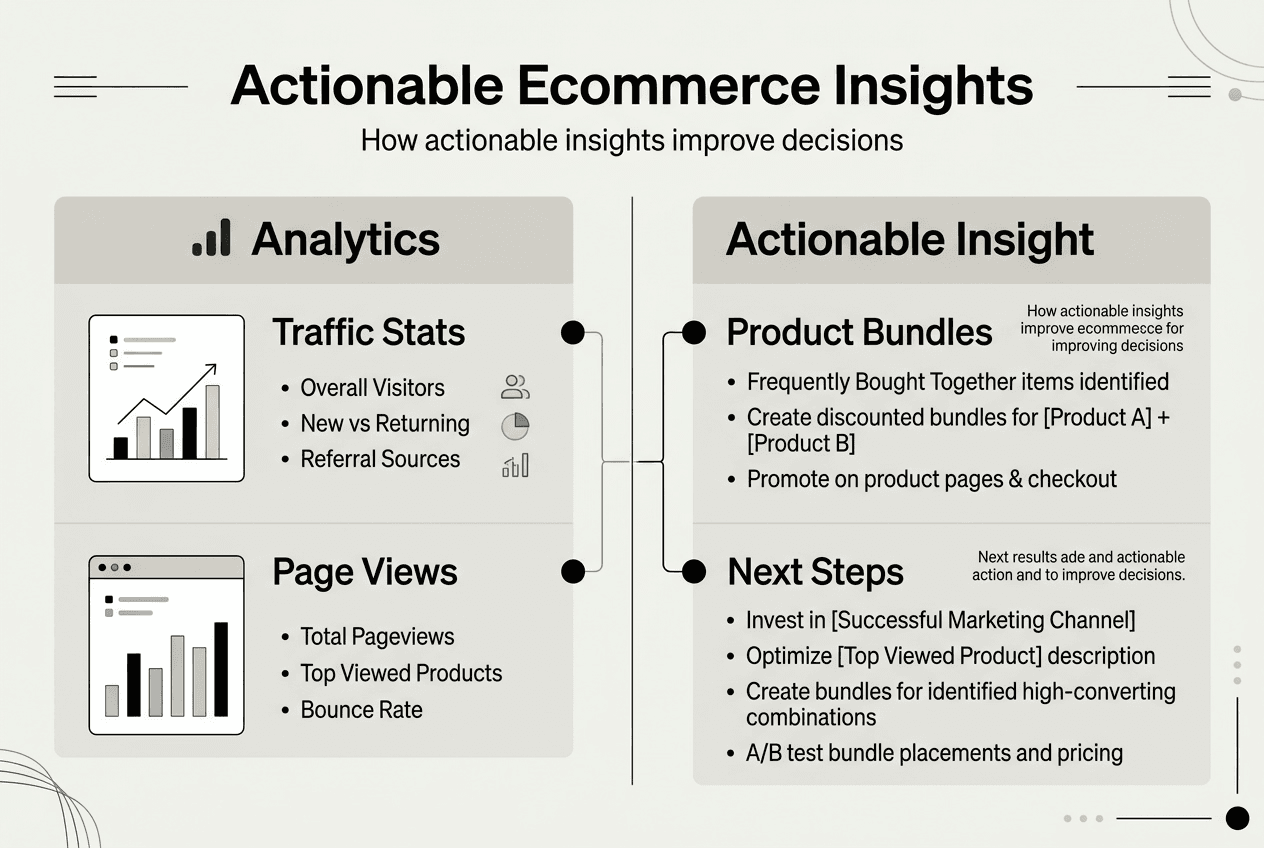
Actionable ecommerce insights are specific, clear data points that lead directly to concrete decisions improving your sales or customer retention. Unlike raw numbers sitting in a spreadsheet, these insights answer critical questions: which products should you bundle together, which customer segments need immediate attention, or what personalized offers will prevent churn. The key distinction lies in their ability to guide immediate action rather than simply describing what happened.
Raw data tells you that 500 customers bought product A last month. General metrics show you that your conversion rate is 2.3%. Neither tells you what to do next. An actionable insight reveals that customers who buy product A also purchase products B and C within 14 days at a 40% rate, suggesting a profitable bundle opportunity. This specificity transforms observation into strategy.
Research confirms that improved discovery and personalization directly reduce friction in product selection and increase conversion momentum. When you apply insights that streamline how customers find complementary products, you’re not just analyzing data, you’re actively shaping buying behavior. This is why actionable insights matter more than vanity metrics.
Effective actionable insights share four essential characteristics:
- Relevant to your specific business goals and customer base
- Timely enough to act on before market conditions change
- Clear in their implications without requiring extensive interpretation
- Impactful with measurable effects on revenue or retention
For your actionable ecommerce analytics guide, focus on insights that connect directly to decisions you can implement this week, not abstract observations that require months of additional research. The faster you can move from insight to action, the more competitive advantage you gain in your market.
How actionable insights differ from general ecommerce analytics
General ecommerce analytics provide broad overviews like total traffic, average page views, or overall bounce rates. These metrics paint a picture of your store’s health but rarely suggest specific improvements. You might see that traffic increased 15% last month, yet still have no idea which marketing channel deserves more budget or which product pages need optimization. This gap between observation and action creates the frustration most managers experience.
Actionable insights dig deeper to answer why something happens and what you should do about it. They reveal that mobile users from Instagram abandon carts 30% more often on your checkout page specifically because of a payment form issue, or that customers who view your FAQ page before purchasing have 25% higher lifetime value. These insights point directly to fixable problems or exploitable opportunities.

| Characteristic | General Analytics | Actionable Insights |
|---|---|---|
| Scope | Broad overview metrics | Specific behavioral patterns |
| Direction | Describes what happened | Explains why and suggests action |
| Timing | Often historical summaries | Real-time or predictive |
| Implementation | Requires interpretation | Directly guides decisions |
| Impact measurement | Difficult to isolate | Clear cause and effect |
Recognizing non-actionable data helps you avoid wasting time on metrics that look impressive but don’t drive growth:
- Metrics too broad to connect to specific decisions or customer segments
- Data that’s outdated by the time you review it, missing the window for intervention
- Incomplete information lacking context about customer intent or behavior drivers
- Vanity metrics that feel good but don’t correlate with revenue or retention
Pro Tip: Combat data paralysis by creating a simple filter for every metric you review. Ask yourself: if this number changed by 20% tomorrow, would I know exactly what action to take? If the answer is no, that metric probably isn’t actionable enough to deserve your attention. Focus instead on insights that trigger immediate, specific responses.
The role of ecommerce insights becomes clear when you shift from passive reporting to active decision making. Research shows that discovery and personalization improvements directly impact conversion momentum, but only when insights translate into concrete changes in how you present products or target customers.
Examples of actionable ecommerce insights for product bundling and retention
Consider a mid-sized online retailer selling outdoor gear. Their analytics show that camping tents are a popular category, but that’s just general data. An actionable insight reveals that 65% of customers who buy a specific tent model also purchase a sleeping bag and camping stove within seven days, but only 15% discover all three products during their initial visit. This insight suggests creating a pre-built bundle that increases average order value while improving discovery and personalization for new customers.
For retention, imagine identifying a customer segment that makes three purchases in their first 60 days but then goes dormant. The actionable insight isn’t just that they stop buying. It’s that 70% of this segment abandons after receiving generic promotional emails instead of personalized recommendations based on their purchase history. This finding directly suggests implementing segmented email campaigns with product suggestions matching their buying patterns.
Here are five specific actionable insights you can apply immediately:
- Product affinity patterns showing which items are frequently purchased together within a specific timeframe, enabling strategic bundle creation that mirrors natural buying behavior
- Customer segment identification revealing groups with similar purchase frequencies and product preferences, allowing targeted retention campaigns before churn occurs
- Price sensitivity thresholds indicating the discount level that triggers purchases for different customer segments without unnecessarily eroding margins
- Seasonal buying windows pinpointing exact weeks when specific customer groups are most likely to purchase certain product categories
- Cross-category opportunities exposing unexpected product combinations that different customer segments buy together, opening new bundling possibilities
These insights work because they combine what (customers buy tents and sleeping bags together) with when (within seven days) and who (first-time camping equipment buyers). This specificity enables you to create bundles, adjust inventory, and time promotions precisely. Generic observations about popular products lack this actionable depth.
Pro Tip: Leverage real-time data to adjust bundles and offers dynamically throughout the year. A bundle that performs well in spring might need different products in fall as customer needs shift. Set up automated alerts when bundle performance drops below baseline so you can refresh offerings before revenue suffers.
Your market basket analysis guide and product bundling glossary provide frameworks for discovering these patterns in your own transaction data. The key is moving beyond simple correlation to understanding the timing, sequence, and customer context that makes insights truly actionable.
Tools and workflows to extract actionable ecommerce insights
Extracting actionable insights requires combining the right analytics tools with structured workflows that turn data into decisions. AI-powered platforms have transformed this process by automating pattern recognition that previously required data science expertise. These tools analyze thousands of transactions to surface hidden relationships between products, identify at-risk customer segments, and predict future buying behavior with surprising accuracy.
| Tool Category | Key Features | Best For |
|---|---|---|
| AI Analytics Platforms | Automated pattern recognition, predictive modeling | Uncovering hidden product associations |
| Customer Data Platforms | Unified customer profiles, segmentation | Understanding retention patterns |
| Business Intelligence Tools | Custom dashboards, data visualization | Monitoring key metrics |
| A/B Testing Software | Experiment management, statistical analysis | Validating insight-driven changes |
An effective workflow for generating actionable insights follows these essential steps:
- Collect comprehensive transaction data including product details, customer identifiers, timestamps, and purchase sequences across all channels
- Segment customers based on behavior patterns like purchase frequency, product preferences, and engagement levels rather than just demographics
- Analyze relationships between products, customer actions, and outcomes using tools that reveal correlations and causation
- Test insights through controlled experiments before full implementation to validate their real-world impact
- Implement changes systematically while measuring results against baseline performance to confirm improvement
- Monitor outcomes continuously and refine strategies based on what actually moves your specific metrics
Pro Tip: Prioritize tools with AI-driven personalization and predictive analytics capabilities for stronger actionable outcomes. These systems learn from your specific customer base rather than relying on generic industry benchmarks, making their insights more relevant to your unique market position.
Integrating insights with your marketing and product bundling strategies closes the loop between analysis and revenue growth. When your ecommerce insights platforms comparison reveals that certain customer segments respond better to bundle offers, immediately incorporate that finding into your email campaigns and product page layouts. This rapid implementation cycle maximizes the value of each insight.
Your workflow for actionable insights should include regular review cycles, typically weekly for fast-moving products and monthly for strategic decisions. The goal isn’t perfection on the first try but continuous improvement based on measured results. As you analyze ecommerce sales data, focus on metrics that directly connect to the decisions you can control.
The most successful ecommerce managers treat insight extraction as an ongoing process rather than a one-time project. Market conditions shift, customer preferences evolve, and competitor actions change the landscape. Your actionable ecommerce analytics guide becomes more valuable when you revisit it regularly, updating your approach based on what’s working now rather than what worked six months ago.
Explore powerful ecommerce analytics solutions
Affinsy’s comprehensive glossary resources help you master the concepts driving modern ecommerce success. Our product bundling glossary breaks down strategies for creating profitable product combinations based on actual customer behavior, while the predictive analytics glossary explains how AI forecasts customer actions before they happen. The market basket analysis glossary details the techniques that reveal hidden product relationships in your transaction data.
These resources empower you to move beyond basic analytics into strategic decision making that directly impacts your bottom line. Whether you’re optimizing bundle offerings, preventing customer churn, or identifying cross-sell opportunities, understanding these foundational concepts accelerates your ability to extract and apply actionable insights. Explore these tools in 2026 to transform how you leverage your ecommerce data for measurable growth.
Frequently asked questions
What differentiates actionable ecommerce insights from other data?
Actionable insights provide specific direction for decisions, while general data simply describes what happened without suggesting next steps. An actionable insight tells you which products to bundle and why, whereas raw data only shows that certain items sold well. The key difference is that actionable insights connect directly to revenue-impacting decisions you can implement immediately.
Which ecommerce metrics are most actionable for small to mid-sized retailers?
Product affinity patterns, customer segment behavior, and purchase sequence timing deliver the most actionable value for smaller retailers. These metrics directly inform bundling decisions, retention campaigns, and inventory planning without requiring massive data volumes. Focus on insights that connect to decisions within your control rather than broad market trends you can’t influence.
How often should ecommerce managers review insights for best results?
Review high-impact insights like bundle performance and customer segment behavior weekly to catch trends early. Strategic insights around seasonal patterns or long-term customer value work better on monthly cycles. The key is matching review frequency to how quickly you can act on findings, avoiding both analysis paralysis and missed opportunities.
Can product bundling insights improve customer retention?
Yes, bundling insights significantly boost retention by creating more value in each transaction and increasing customer satisfaction. When bundles match natural buying patterns, customers perceive your store as understanding their needs, building loyalty. Customers who buy bundles also tend to have higher lifetime value because they engage with more of your product catalog.
What tools best support uncovering actionable ecommerce insights?
AI-powered analytics platforms that integrate with your existing ecommerce system provide the strongest foundation for insight extraction. Look for tools offering automated pattern recognition, customer segmentation, and predictive modeling without requiring data science skills. The best solutions combine ease of use with depth of analysis, making sophisticated insights accessible to marketing managers and store owners.
Recommended
- Workflow for Actionable Ecommerce Insights in 2026 - Affinsy Blog | Affinsy
- Actionable Ecommerce Analytics Explained: Boost Revenue - Affinsy Blog | Affinsy
- Best ecommerce insights platforms – Expert Comparison 2025 - Affinsy Blog | Affinsy
- Ecommerce Analytics Trends 2026: Unlocking Growth Through AI - Affinsy Blog | Affinsy
- How to Boost Retail Sales: Elevate Your Store’s Profitability – Spaceman