
TL;DR:
- Segmentation boosts revenue by enabling personalized marketing and targeted product offers.
- Using simple frameworks like RFM and behavioral analysis quickly delivers measurable results.
- Focus on 4 to 7 dynamic segments rather than overly complex or static groups for best impact.
Segmented email campaigns generate 760% more revenue than generic blasts, yet most mid-sized e-commerce brands and SaaS businesses still send the same message to every customer on their list. That gap between what’s possible and what’s actually happening is where growth gets left on the table. The brands pulling ahead in 2026 aren’t spending more on ads. They’re spending smarter by knowing exactly who their customers are, what they want, and when to reach them. This article walks you through the frameworks, evidence, and practical steps to make customer segmentation your most powerful growth lever.
Table of Contents
- The fundamentals: What is customer segmentation and why it matters
- How customer segmentation works: Methods and frameworks
- Evidence of impact: Real business results from segmentation
- Common pitfalls and best practices: What most brands miss
- From insight to profit: Using segmentation for bundling and upsell strategies
- Our take: Why the smartest brands keep segmentation simple and dynamic
- Ready to level up your customer segmentation?
- Frequently asked questions
Key Takeaways
| Point | Details |
|---|---|
| Segmentation boosts ROI | Tailoring messaging to distinct customer groups dramatically increases marketing engagement and sales. |
| Start simple, scale smart | Adopting frameworks like RFM delivers quick wins for mid-sized brands seeking better resource allocation. |
| Actionable data fuels profit | Dynamic, behavior-based segments enable higher-value bundles, personalized upsells, and lasting retention. |
| Avoid over-segmentation | Limiting to 4-7 segments and prioritizing data quality prevents complexity from undermining results. |
The fundamentals: What is customer segmentation and why it matters
Customer segmentation is the practice of dividing your customer base into distinct groups based on shared characteristics, behaviors, or value. Instead of treating every buyer the same, you identify patterns that let you speak to each group with relevance and precision. For e-commerce brands, that might mean separating first-time buyers from repeat customers. For SaaS businesses, it could mean grouping users by feature adoption or subscription tier.
The business case is straightforward. Targeted marketing and personalization through segmentation improve resource allocation, customer experience, and revenue outcomes across both e-commerce and SaaS models. When you know which customers are most valuable, you stop wasting budget on low-intent audiences and start investing where it counts.
Understanding why segment online customers matters is the first step toward building a strategy that actually converts. Here’s what segmentation consistently delivers:
- Higher email and campaign engagement because messages match what each group actually cares about
- Improved customer retention by identifying at-risk buyers before they churn
- Increased average order value (AOV) through relevant product recommendations and bundles
- More efficient ad spend by targeting lookalike audiences based on your best segments
- Faster product development decisions by understanding which features or products resonate with which groups
For SaaS businesses, segmentation also powers smarter onboarding flows, feature upsells, and renewal campaigns. For e-commerce, it drives personalized promotions, win-back sequences, and loyalty programs.
“Segmentation isn’t just a marketing tactic. It’s the operating system behind every revenue decision that scales.”
The e-commerce segmentation guide from Affinsy goes deeper on how to structure this for online retail specifically. And Salesforce’s research on customer segmentation confirms that businesses using segmentation consistently outperform those relying on broad targeting across every key metric.
How customer segmentation works: Methods and frameworks
Knowing the ‘why’ lays the foundation, but knowing ‘how’ segmentation is structured unlocks real business results. There are several frameworks available, but two stand out for e-commerce and SaaS brands: RFM analysis and behavioral segmentation.
RFM is the foundational methodology for e-commerce segmentation. It scores customers on three dimensions: Recency (how recently they purchased), Frequency (how often they buy), and Monetary value (how much they spend). The result is a clear picture of who your best customers are and who’s drifting away.
Common RFM segments include:
- Champions: Bought recently, buy often, spend the most. These are your VIPs.
- Loyal customers: Buy regularly with solid spend. Great for upsell campaigns.
- At-risk customers: Haven’t bought in a while despite past frequency. Prime for win-back sequences.
- New customers: First purchase only. Need nurturing to become repeat buyers.
For SaaS businesses, segmentation strategies shift toward behavioral and firmographic data, such as login frequency, feature usage, plan tier, and company size. A user who logs in daily and uses five core features is a very different retention risk than one who logs in once a month.

Here’s a quick comparison of the two main frameworks:
| Framework | Best for | Data needed | Key output |
|---|---|---|---|
| RFM | E-commerce | Transaction history | Purchase-based segments |
| Behavioral | SaaS and e-commerce | Usage and event data | Engagement-based segments |
| Firmographic | B2B SaaS | Company attributes | Account-based segments |
To get started with RFM, follow these steps:
- Export your order history (date, customer ID, order value)
- Calculate recency, frequency, and monetary scores for each customer
- Assign scores on a 1 to 5 scale for each dimension
- Group customers by combined score into named segments
- Map each segment to a specific campaign or offer strategy
The RFM analysis framework guide walks through this process in detail, including scoring formulas. You can also explore the segmentation types guide to compare additional approaches.
Pro Tip: Don’t try to build a perfect segmentation model on day one. Start with RFM using just three to four segments. Once you see results, layer in behavioral signals to refine further.
Evidence of impact: Real business results from segmentation
With a grasp of methods, let’s put segmentation’s value to the test using hard numbers from real brands.
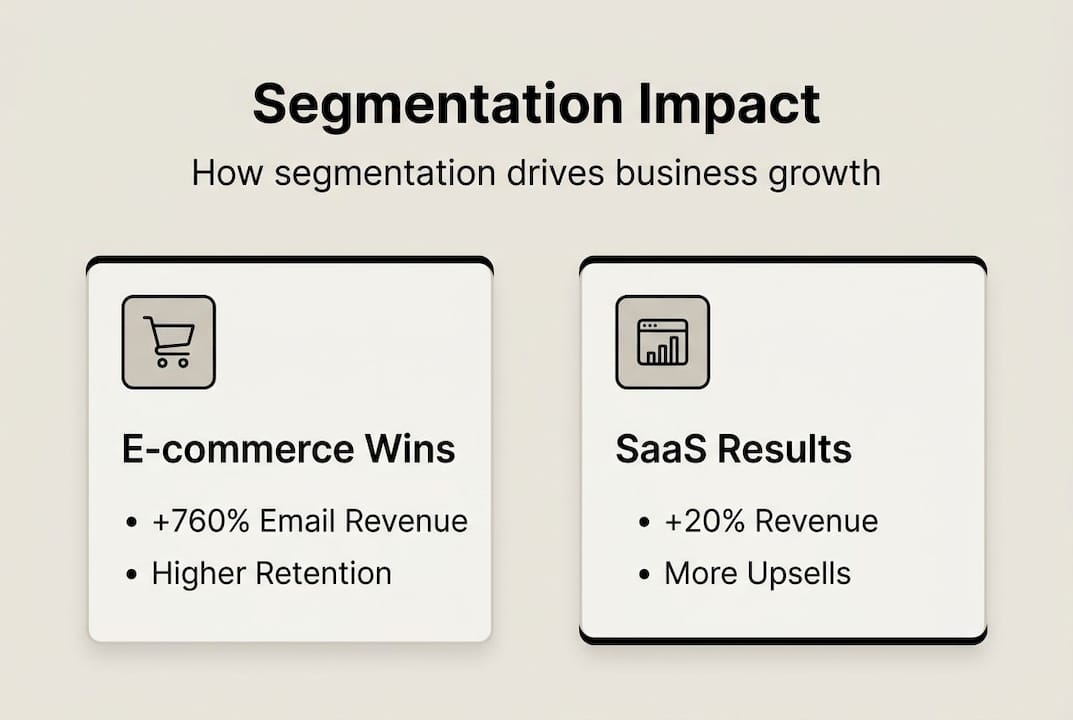
The data is consistent across industries. Segmented campaigns yield 760% more email revenue, McKinsey found a 20% revenue increase in retail banking from personalization, and Bain research shows a 5% retention increase can drive 25% to 95% profit growth. These aren’t outliers. They’re repeatable outcomes for brands that execute segmentation well.
Here’s how the before-and-after numbers typically look:
| Metric | Before segmentation | After segmentation |
|---|---|---|
| Email open rate | 18% | 29% |
| Revenue per campaign | Baseline | Up to 7x higher |
| Customer churn rate | 35% | 22% |
| AOV from targeted offers | Baseline | 15 to 30% increase |
Notable wins from brands that invested in segmentation:
- A mid-sized apparel brand reduced churn by 28% after launching an RFM-based win-back sequence targeting at-risk customers
- A SaaS company increased trial-to-paid conversion by 19% after segmenting free users by feature usage depth
- An online retailer saw a 34% lift in repeat purchase rate within 60 days of launching segment-specific email flows
The AI segmentation ROI research shows that even small businesses see meaningful returns quickly when they start with clean data and simple frameworks.
The key insight here is that boosting retention with segmentation doesn’t require a massive data science team. You need organized transaction data, a clear framework, and the discipline to act on what you find. You can also explore real segmentation examples to see how other brands have structured their approaches.
Common pitfalls and best practices: What most brands miss
While the benefits are clear, success isn’t guaranteed. Let’s see where leaders succeed and laggards stumble.
The most common mistake is over-segmentation. More than 10 segments leads to 60% failure rates in segmentation programs, because teams can’t create enough differentiated content to serve each group meaningfully. You end up with analysis paralysis instead of action.
Other frequent failure points include:
- Static segments: Building segments once and never updating them. Customers move between groups constantly.
- Poor data quality: Duplicate records, missing purchase dates, and inconsistent product naming corrupt your scores.
- Demographic over-reliance: Grouping by age or location tells you far less than grouping by purchase behavior or product affinity.
- No action plan: Identifying segments without mapping them to specific campaigns, offers, or workflows.
Best practices that separate high-performing programs from the rest:
- Start with 4 to 7 segments and expand only when you’ve proven ROI on the initial set
- Refresh segment assignments monthly or after major purchase events
- Prioritize behavioral data over demographic data wherever possible
- Tie every segment to at least one specific action: an email flow, an ad audience, or a product recommendation rule
- Use segmentation best practices as a reference when auditing your current approach
You can also review common segmentation mistakes to avoid to pressure-test your existing strategy.
Pro Tip: Quality beats quantity every time in segment design. Five well-defined segments you can act on will always outperform fifteen segments you can’t resource properly.
From insight to profit: Using segmentation for bundling and upsell strategies
Here’s how to turn actionable segments into profit by driving smarter bundling and upsell moves.
Segmentation doesn’t just improve messaging. It transforms your product strategy. When you know which customers buy which products together, you can create bundles based on segment-specific affinities that feel natural and relevant rather than random.
Here’s a practical process for building affinity-based bundles by segment:
- Identify your top segments using RFM scores (start with Champions and Loyal customers)
- Analyze purchase patterns within each segment to find frequently co-purchased products
- Design bundle offers that combine those products at a slight discount to increase perceived value
- Match bundle promotions to the right segment via email, on-site recommendations, or paid retargeting
- Measure AOV lift for each bundle by segment and iterate based on what converts
For example, if your Loyal customer segment consistently buys a skincare cleanser alongside a moisturizer, bundle those two with a small discount and target that exact group. You’re not guessing. You’re acting on what the data already tells you.
For SaaS, the same logic applies to feature upsells. If a behavioral segment shows heavy usage of your core plan features but no engagement with premium add-ons, that’s your upsell window. Offer a targeted trial of the premium tier to that specific group.
You can analyze customer purchase patterns to identify these co-purchase signals in your own data. The RFM bundling strategies resource also covers how to structure these offers by segment tier.
Pro Tip: Integrate your segment data with your email platform or ad tool so bundle offers trigger automatically when a customer moves into a high-value segment. Real-time triggers consistently outperform scheduled batch campaigns.
Our take: Why the smartest brands keep segmentation simple and dynamic
Most advice in this space pushes brands toward complex machine learning models and multi-dimensional clustering. We’ve seen that approach fail more often than it succeeds, especially for mid-sized teams without dedicated data scientists.
The brands that win consistently do something different. They start simple. Simple RFM outperforms complex clustering in the early stages because it produces segments you can act on immediately, not segments you spend six months validating.
The second thing winning brands do is treat segments as living groups, not static buckets. A customer who was at-risk last month might be a loyal buyer this month. Your campaigns should reflect that movement in real time, not six months later when you rebuild the model.
Demographics are a starting point at best. Behavior is the real signal. What someone buys, how often they return, and what they ignore tells you far more than their age or zip code ever will.
For DTC and e-commerce brands specifically, RFM for DTC retention is the fastest path to measurable results. Start there. Prove the ROI. Then layer in complexity only when your team has the bandwidth to act on it.
Ready to level up your customer segmentation?
If you’ve made it this far, you already understand that segmentation isn’t optional for brands serious about growth. It’s the foundation everything else is built on.
Affinsy makes it straightforward to move from raw transaction data to actionable customer segments without needing a data science background. Start by exploring the customer segmentation glossary to sharpen your vocabulary and strategy. Then dig into market basket analysis to understand how product affinities connect to your segmentation work. And when you’re ready to build bundles, the product bundling glossary gives you the framework to do it right. Affinsy’s free tier lets you start analyzing up to 20K line items today, no credit card required.
Frequently asked questions
What is the ideal number of customer segments for a mid-sized business?
Aim for 4 to 7 well-defined segments to balance precision and manageability. Over 10 segments leads to 60% failure in most segmentation programs because teams can’t execute meaningfully across too many groups.
How quickly can segmentation improve marketing ROI?
Brands often see measurable ROI from RFM-driven segmentation in as little as 90 days. Starting with RFM gives you quick wins because the framework is action-ready from day one.
Which is more effective: demographic or behavioral segmentation?
Behavioral segmentation outperforms demographics in driving engagement and revenue because it reflects what customers actually do, not just who they are on paper.
How does segmentation enable better product bundling?
Segmentation uncovers product affinities by group, letting you create targeted bundles and upsells that boost average order value by matching offers to the specific buying patterns of each segment.
Recommended
- Why segment customers: boost e-commerce sales in 2026 - Affinsy Blog | Affinsy
- Customer segmentation explained: boost retention 2026 - Affinsy Blog | Affinsy
- 5 customer segmentation types for e-commerce success - Affinsy Blog | Affinsy
- 7 Effective Customer Segmentation Examples for E-commerce - Affinsy Blog | Affinsy