
TL;DR:
- Customer analysis tools collect behavioral and transactional data to optimize marketing and retention strategies. They emphasize event tracking, identity resolution, and real-time insights to move beyond basic web metrics. Implementing the right platform based on data maturity is key to leveraging customer behavior for growth.
Customer analysis tools are software platforms designed to collect, analyze, and visualize user behavior and customer data to improve marketing effectiveness, sales performance, and retention in e-commerce. Companies that effectively implement user behavior analytics achieve 20–30% faster growth compared to those relying solely on basic web traffic metrics. That gap exists because pageviews and bounce rates tell you what happened, not why. The most effective platforms combine event tracking, identity resolution, and AI-powered segmentation to turn raw transaction data into decisions you can act on today.

1. What are the best customer analysis tools built around?
The strongest customer analysis tools share a common architecture: they capture behavior at the event level, stitch that data to individual profiles, and surface patterns through dashboards built for non-data-scientists. Basic web metrics mask the real story of what customers do. Event tracking captures clicks, scroll depth, and feature usage that pageview counts simply cannot show. That qualitative depth is what separates tools that drive retention from tools that just report traffic.
2. Key features to look for in customer insights tools
Not every platform delivers the same capabilities. Before you commit to any solution, evaluate it against these six criteria.
- User behavior analytics. Look for event tracking, session recordings, and heatmaps. These three features together show you what customers click, where they stop, and why they leave.
- Identity resolution and Customer 360 profiles. Analyzing devices instead of users skews every retention metric you track. A platform that stitches anonymous sessions to known profiles gives you accurate customer journeys.
- Real-time data and AI-powered insights. Real-time feeds let you act on drop-offs as they happen. AI layers surface patterns you would not find manually.
- Privacy-first, first-party data collection. Shifting away from third-party tracking is not optional in 2026. Platforms built on first-party event data stay compliant and maintain data accuracy as regulations tighten.
- Customizable dashboards and reporting. Marketing managers and data analysts need different views of the same data. Flexible dashboards reduce the gap between raw output and business decisions.
- Integration with your existing stack. A tool that does not connect to your e-commerce platform, email system, or data warehouse creates silos instead of solving them.
Pro Tip: Start your evaluation by mapping the three decisions you make most often with customer data. Then check whether each tool candidate surfaces those answers without custom engineering.
3. How behavioral analytics tools turn clicks into revenue
Behavioral analytics is the practice of recording and interpreting every action a customer takes across your site or app. The best platforms in this category go well beyond session counts.
Advanced event tracking and funnel analysis show you exactly where customers exit a purchase flow. That precision lets you fix the right step instead of guessing. Session replay and heatmaps add qualitative context that numbers alone cannot provide. Watching a real session where a customer repeatedly clicks a non-clickable element tells you more than a 60% cart abandonment rate ever could.
“Bridging quantitative data (the ‘what’) with qualitative data (the ‘why’) is key to successful behavioral analysis. Using one without the other leads to incomplete insights.”
AI-powered anomaly detection inside behavioral platforms flags unusual drop-off spikes before they compound into revenue loss. The trade-off worth knowing: cloud-based platforms deploy faster and require less technical overhead, while enterprise data warehouse solutions offer deeper customization but demand developer resources and longer setup cycles. Open-source options sit in between, giving you data ownership at the cost of self-managed infrastructure. Match the tool category to your team’s actual capacity, not your aspirational one.
4. How customer analysis tools support segmentation and personalized marketing
Accurate segmentation starts with accurate profiles. Identity resolution that stitches anonymous behavior to known user profiles is the foundation of any reliable segmentation strategy. Without it, you are grouping devices, not people.
Once profiles are clean, cohort analysis and behavioral segmentation become genuinely useful. Cohort analysis groups customers by the action they took and the date they took it, then tracks how each group behaves over time. That view reveals which acquisition channels produce customers who actually return, not just customers who buy once.
Personalized marketing built on behavioral segments outperforms batch-and-blast campaigns because the message matches the customer’s actual stage in the purchase cycle. Retention strategies benefit most from this approach. A customer who bought twice in 90 days needs a different message than one who has not purchased in six months.
- Define your segments by behavior, not just demographics. Purchase frequency, product category affinity, and recency are stronger predictors of future behavior than age or location alone.
- Use RFM (Recency, Frequency, Monetary) scoring to rank customers by value. This method surfaces your highest-value segment and your at-risk segment simultaneously.
- Connect segment data to your email and ad platforms. Segmentation that stays inside your analytics tool never reaches the customer.
- Audit segment accuracy quarterly. Customer behavior shifts, and segments built on stale data produce campaigns that miss the mark.
Pro Tip: RFM segmentation works best when you run it on at least 12 months of transaction history. Shorter windows overweight seasonal spikes and undercount loyal customers who buy infrequently.
For a deeper look at how customer behavior analysis connects to e-commerce growth, the mechanics of behavioral modeling are worth understanding before you pick a platform.
5. Deployment and data management considerations
Implementation timelines vary more than most vendors admit. Professional Customer 360 setups built on data warehouses typically deploy in weeks, not months, when the underlying data is clean and accessible. Dirty or fragmented order data extends that timeline significantly.
| Consideration | Entry-level platforms | Enterprise platforms |
|---|---|---|
| Historical data included | 90 days (standard) | Configurable, often unlimited |
| Deployment time | Days to 2 weeks | Weeks to 3 months |
| Data ownership | Vendor-hosted | Self-hosted or hybrid |
| Advanced reporting | Paid upgrade required | Included or configurable |
| Privacy compliance | Basic GDPR/CCPA tools | Full audit trails, DPA support |
Standard entry-level platforms include 90 days of historical data. Advanced reporting requires a paid upgrade. That limit matters if you want to run year-over-year cohort comparisons or seasonal trend analysis. Cloud-hosted solutions reduce your infrastructure burden but put data ownership in the vendor’s hands. Self-hosted options give you full control but require engineering capacity to maintain. Neither is universally better. The right choice depends on your team’s technical resources and your compliance obligations.
E-commerce professionals building toward smarter retail analytics should factor data portability into every vendor conversation. If you cannot export your full event history, switching tools later becomes expensive.
6. When to move to predictive analytics
Predictive analytics belongs in your stack when reactive reporting no longer answers the questions your business is asking. Reviewing past performance tells you what happened. Predictive modeling tells you what is likely to happen next, and that difference changes how you allocate budget and inventory.
- Pricing decisions. Top teams simulate customer responses to pricing changes before committing. That foresight prevents margin erosion from discounts that did not need to be that deep.
- Product bundling. Predictive models identify which product combinations drive the highest attach rates. Market basket analysis, when run on historical transaction data, surfaces these associations automatically.
- Churn prevention. Models trained on behavioral signals flag at-risk customers before they cancel or lapse. That window gives your retention team time to act.
- Inventory planning. Demand forecasting built on customer behavior patterns reduces overstock and stockout events simultaneously.
Most organizations are rich in data but poor in foresight. The gap between teams that use predictive analytics in retail and those that do not shows up in margin, not just revenue. Predictive tools require clean Customer 360 data as their input. If your profiles are fragmented, fix identity resolution first. Predictive models built on bad data produce confident wrong answers.
Compatibility with your existing data infrastructure matters as much as the model’s accuracy. A predictive layer that cannot read your transaction history or write back to your CRM creates more work than it saves. Evaluate team expertise honestly before committing to a platform that requires data science skills your team does not have. E-commerce growth strategies that combine AI visibility with shopper intent data show how behavioral signals extend well beyond the analytics platform itself.
Key takeaways
The most effective customer analysis approach combines event-level behavioral data, clean identity resolution, and predictive modeling built on first-party transaction history.
| Point | Details |
|---|---|
| Behavioral data beats web metrics | Event tracking captures the “why” behind drop-offs that pageviews and bounce rates cannot explain. |
| Identity resolution is non-negotiable | Stitching anonymous sessions to known profiles is the foundation of accurate segmentation and retention metrics. |
| Privacy-first data collection | First-party event data keeps you compliant and accurate as third-party tracking continues to erode. |
| Match tool complexity to team capacity | Enterprise platforms offer depth; entry-level tools deploy faster. Choose based on actual resources, not aspirational ones. |
| Predictive analytics requires clean inputs | Fix fragmented customer profiles before layering on predictive models, or the outputs will mislead you. |
What I have learned from watching teams pick the wrong tools
The most common mistake I see e-commerce teams make is selecting a platform based on its feature list rather than its fit with their actual data maturity. A tool with 200 report types is useless if your transaction data is fragmented across three systems and nobody has time to clean it.
Tracking too many metrics leads to analysis paralysis. The teams I have seen grow fastest pick one or two conversion goals, build funnel and cohort views around those goals, and ignore everything else until those metrics move. That discipline is harder than it sounds when a platform surfaces 40 dashboards by default.
The identity resolution question is the one most teams skip. They assume their analytics platform knows who their customers are. It usually does not. It knows which device visited which page. That distinction sounds technical, but it changes every retention metric you report to leadership.
My honest recommendation: start with your transaction data. It is the most reliable signal you have. Build your segmentation on purchase behavior before you add behavioral event data on top. The sequence matters. Teams that reverse it end up with rich behavioral data attached to profiles they cannot trust.
— Mateusz
How Affinsy helps e-commerce teams act on customer data
Affinsy applies AI-powered analytics directly to your historical transaction data, without requiring a data science team to run it.
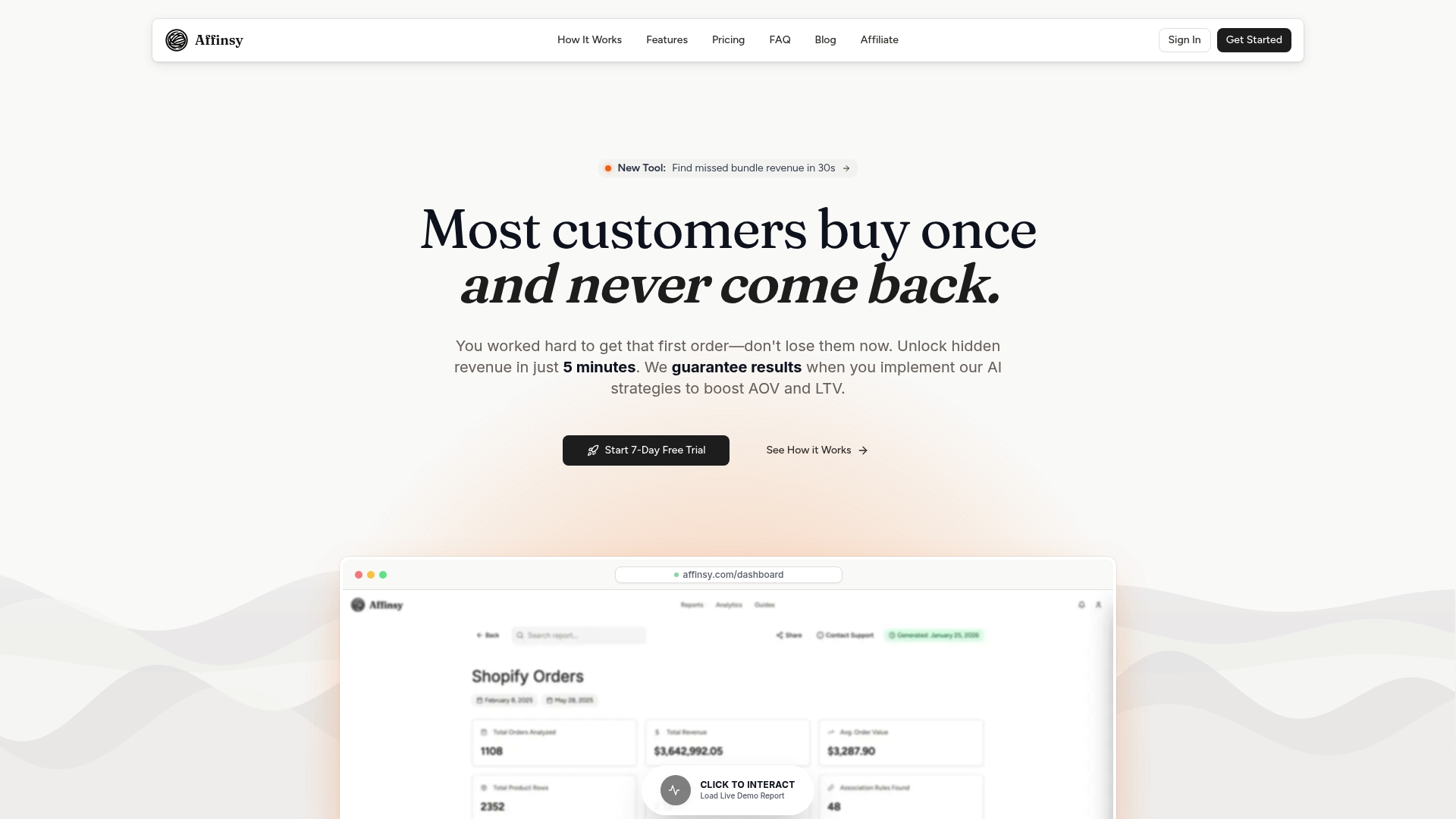
The platform’s market basket analysis identifies which products customers buy together, so you can build bundles and cross-sell sequences that reflect actual purchase behavior rather than gut instinct. Its RFM-based customer segmentation ranks customers by recency, frequency, and spend, giving marketing managers a clear view of who to retain, who to reactivate, and who to reward. Affinsy connects via CSV upload, API, or MCP, so you can feed it data from Shopify, WooCommerce, BigCommerce, Stripe, or any platform that exports order records. The permanent free tier covers up to 20,000 line items with no credit card required.
FAQ
What are customer analysis tools used for?
Customer analysis tools collect and interpret behavioral and transactional data to help e-commerce teams improve marketing targeting, increase retention, and grow revenue. They translate raw customer data into segments, funnels, and predictive signals that drive specific business decisions.
How does identity resolution improve customer segmentation?
Identity resolution stitches anonymous browsing sessions to known customer profiles, so your segments reflect real people rather than individual devices. Without it, behavioral data skews every retention and lifetime value metric you track.
What is the difference between behavioral analytics and predictive analytics?
Behavioral analytics tells you what customers have already done. Predictive analytics uses that history to forecast what they are likely to do next, such as churn, repurchase, or respond to a price change.
How much historical data do customer analytics platforms typically include?
Standard entry-level platforms include 90 days of historical data. Advanced reporting features and longer data windows typically require a paid upgrade.
When should an e-commerce team prioritize RFM segmentation?
RFM segmentation is most valuable when you have at least 12 months of transaction history and need to separate high-value customers from at-risk ones quickly. It is the fastest path from raw order data to a retention-ready customer list.
Recommended
- E Commerce Analysis Report Guide for 2025 Success - Affinsy Blog | Affinsy
- Guide to E-Commerce Data Analysis for Increased Sales - Affinsy Blog | Affinsy
- Best ecommerce insights platforms – Expert Comparison 2025 - Affinsy Blog | Affinsy
- 7 Essential E-Commerce Data Analysis Tips for Higher Sales - Affinsy Blog | Affinsy