
TL;DR:
- Most e-commerce and SaaS businesses underutilize transaction data, leading to revenue leaks and inefficiencies.
- Reliable analytics foundation, cohort analysis, and automation are essential for identifying bottlenecks and optimizing sales.
- Continuous testing, ownership, and updated attribution models improve decision-making and revenue growth.
Most e-commerce and SaaS businesses are sitting on a goldmine of transaction data they never fully use. Revenue leaks silently through funnel gaps, misattributed campaigns waste budget, and customer churn accelerates before anyone notices the pattern. A data-driven optimization program starts with trustworthy instrumentation, a KPI framework that balances leading and lagging indicators, and a repeatable cadence for turning insights into experiments. This guide walks you through each layer, from laying the analytics foundation to automating cart recovery and refining attribution, so you can stop guessing and start growing with evidence behind every decision.
Table of Contents
- establishing your sales analytics foundation
- diagnosing sales bottlenecks with cohort and funnel analysis
- connecting insights to automated sales actions
- optimizing SaaS pipelines: velocity, data quality, and bottleneck priorities
- refining attribution for better channel optimization
- Why most sales teams get analytics wrong—and how to fix it
- Take your analytics-driven sales to the next level with affinsy
- frequently asked questions
Key Takeaways
| Point | Details |
|---|---|
| Build your analytics foundation | Reliable instrumentation and a structured KPI framework are essential for meaningful sales optimization. |
| Diagnose with cohort and funnel tools | Cohort and funnel analysis uncover hidden leaks and help target interventions that improve retention and conversion. |
| Automate actionable experiments | Connect sales insights to automated workflows like cart-abandonment recovery to quickly boost revenue. |
| Optimize SaaS pipeline for velocity | Focus on pipeline velocity, CRM data quality, and stage bottlenecks to increase ARR and deal speed. |
| Upgrade channel attribution | Adopt multi-touch and ML attribution models for smarter marketing spending and channel optimization. |
establishing your sales analytics foundation
Before you optimize anything, you need to trust your numbers. That sounds obvious, but most teams skip directly to dashboards before confirming their tracking is even firing correctly. Bad data does not just produce bad reports; it produces confident wrong decisions, which is far more damaging.
A solid analytics instrumentation setup captures events at every meaningful touchpoint: product views, add-to-cart actions, checkout steps, payment confirmations, and post-purchase behavior. If any of those fire inconsistently, your funnel data is already compromised.
Once your tracking is reliable, build a KPI framework that includes both leading indicators (add-to-cart rate, email open rate, trial signups) and lagging indicators (monthly revenue, customer lifetime value, churn rate). Leading indicators tell you what is about to happen. Using only lagging indicators is like steering a car by looking in the rearview mirror.
Here is how the two indicator types compare in practice:
| KPI type | Examples | When it signals change** | Action window** |
|---|---|---|---|
| Leading | Add-to-cart rate, trial signups | Days to weeks | Fast: adjust within the period |
| lagging | Revenue, churn, LTV | weeks to months | slow: inform next quarter’s strategy |
Key tools most e-commerce and SaaS teams rely on:
- Google Analytics 4 (GA4) for funnel event tracking and audience segmentation
- A CRM (HubSpot, close, salesforce) for pipeline and contact-level data
- Revenue dashboards (looker, metabase, or native platform reports) for exec-level summaries
- Transaction exports for deeper analysis in tools like sales data analysis platforms
Pro tip: schedule a monthly data audit. Pull three random order records and trace them end-to-end through your analytics stack. If the numbers do not reconcile, you have a tracking gap worth fixing before it compounds.
The reporting cadence matters as much as the tools. A weekly review of leading indicators keeps your team responsive. A monthly review of lagging indicators informs strategy. Without a set cadence, even the best dashboards collect dust. Teams that adopt data-driven ecommerce strategies consistently outperform those relying on gut feel alone.
diagnosing sales bottlenecks with cohort and funnel analysis
Once your analytics foundation is ready, it is time to pinpoint exactly where sales are being lost. Top-line revenue growth can mask serious underlying problems. A 15% revenue increase means nothing if it is driven entirely by ad spend increases while organic retention collapses.

cohort analysis is a key methodology for diagnosing retention and attribution problems that aggregate metrics simply hide. Instead of asking “how much did we make this month?” cohort analysis asks “how do customers acquired in January behave differently from those acquired in March?” That question unlocks root causes.
Here is a stepwise process to apply cohort and funnel analysis effectively:
- Define your cohorts by acquisition channel, campaign, or signup month.
- Map the funnel stages specific to your business (visit, signup, first purchase, repeat purchase).
- calculate retention curves for each cohort across 30, 60, and 90-day windows.
- Compare conversion rates at each funnel stage across cohorts to surface outliers.
- isolate the specific stage with the sharpest drop and treat it as your intervention priority.
Typical funnel benchmarks worth knowing:
| funnel stage | typical conversion rate | red-flag threshold |
|---|---|---|
| Product page to add-to-cart | 8-12% | Below 5% |
| Cart to checkout initiated | 60-70% | Below 45% |
| checkout to purchase | 50-65% | below 35% |
| First purchase to second purchase | 20-30% | Below 15% |
When you see a cohort from one paid channel retaining at half the rate of another, that is not a marketing problem. That is an audience-product fit problem. Your decision making ecommerce process should route that finding directly to the product and acquisition teams simultaneously.
Pro tip: never use a single cohort window. A cohort that looks strong at 30 days can collapse at 90 days, signaling a onboarding problem rather than an acquisition problem. Always compare at least two time horizons.
Funnel diagnostics paired with cohort comparisons give you the precision to prioritize exactly where intervention ROI will be highest, rather than spreading effort evenly across the entire customer journey. Better campaign optimization starts with knowing which audience segments are worth doubling down on.
connecting insights to automated sales actions
Having identified the bottlenecks, the next step is turning that diagnosis into automatic revenue recovery. The most powerful part of funnel optimization is not the analysis. It is what you build in response to it.
cart-abandonment workflows are the most documented example of connecting drop-off data to a concrete automated action. When you know exactly which funnel stage a user exited, you can send precisely targeted recovery messages rather than generic “you left something behind” emails.
Core automations to build once your funnel tracking is reliable:
- Cart abandonment sequences triggered at 1 hour, 24 hours, and 72 hours with progressively stronger incentives
- Browse abandonment messages for high-intent product page visitors who never added to cart
- Post-purchase upsell triggers fired immediately after confirmation based on what was purchased
- Win-back campaigns for churning cohorts identified through 60-day inactivity signals
- Trial expiration flows for SaaS users who have not activated key features before their window closes
GA4 Enhanced ecommerce-style funnel tracking is a prerequisite for any of this to work at scale. Without step-level event data, you cannot segment users by where they dropped, which means your automations fire to the wrong people at the wrong time.
The businesses that recover the most revenue through automation are not the ones with the most sophisticated tools. They are the ones that mapped their funnel precisely enough to know why each exit happened.
Pro tip: review your automation performance monthly, not annually. A cart recovery sequence that converts at 8% in Q1 may drop to 3% by Q3 if your offer or product mix has shifted. Your optimization checklist should include a quarterly automation audit as a standing item.
Cross-selling is another high-leverage automation layer. When transaction data reveals strong product associations, you can trigger cross-selling strategies automatically based on purchase history rather than relying on manual merchandising.
optimizing SaaS pipelines: velocity, data quality, and bottleneck priorities
Sales automation in e-commerce maps directly to pipeline management in SaaS. The diagnostic logic is identical; only the vocabulary changes. Where e-commerce tracks add-to-cart rates, SaaS tracks MQL-to-SQL conversion. Where e-commerce recovers abandoned carts, SaaS recovers stalled proposals.
Pipeline velocity is the synthesized KPI that captures SaaS pipeline health in a single number. The formula is straightforward:
Pipeline velocity = (Number of opportunities x Average deal size x Win rate) / Sales cycle length in days
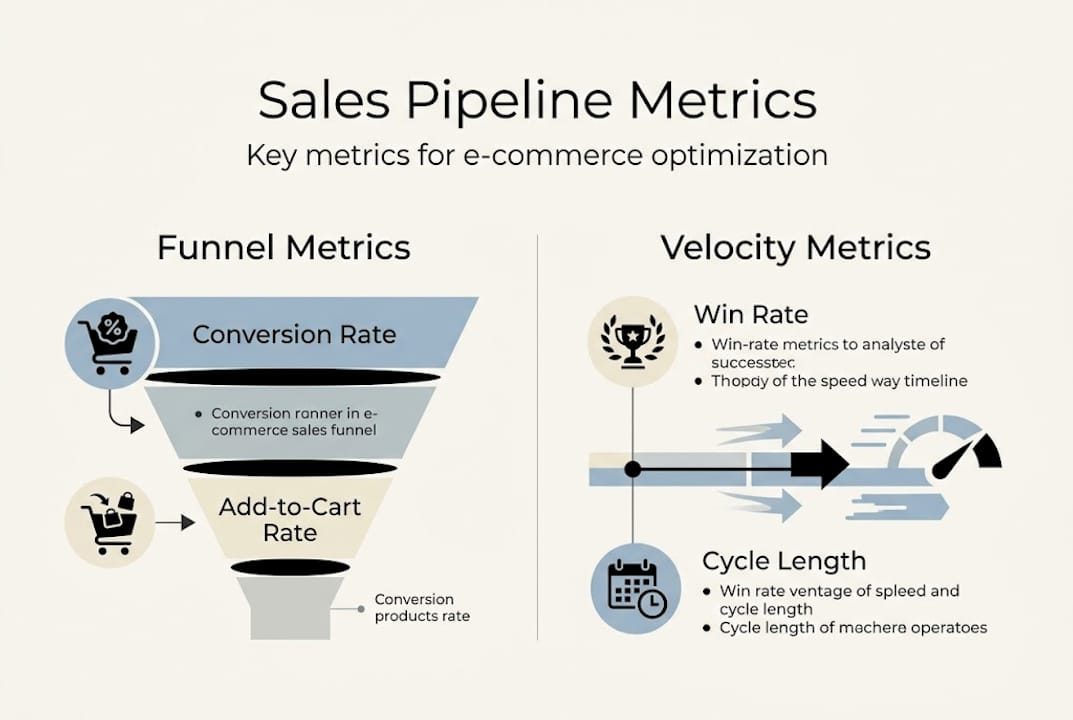
A drop in velocity can be caused by any one of those four variables. That is what makes it useful: it tells you something is wrong. The decomposition tells you exactly what.
Pipeline health metrics like win rate and sales cycle length are treated as essential by RevOps teams precisely because CRM data quality determines whether those metrics mean anything. If 40% of your opportunities have no close date entered, your velocity calculation is garbage.
| CRM data quality issue | impact on metrics | Fix |
|---|---|---|
| Missing close dates | distorts sales cycle length | mandate field on stage progression |
| No deal size entered | underestimates pipeline value | enforce on opportunity creation |
| stale stage assignments | inflates pipeline confidence | Auto-flag deals with no activity in 14 days |
| No contact linked | breaks attribution | require contact before lead is MQL’d |
Here is a stepwise SaaS pipeline optimization approach:
- audit CRM data quality before pulling any pipeline report.
- calculate pipeline velocity by segment: inbound, outbound, and partner-sourced.
- identify the stage with the worst conversion rate (often MQL to SQL or proposal to close).
- run a cohort review of lost deals at that stage for the past 90 days.
- Design one targeted intervention, measure for 30 days, then iterate.
Unlocking your revenue potential in SaaS comes down to fixing the single biggest stage conversion problem before spreading attention across the entire pipeline.
refining attribution for better channel optimization
After optimizing funnel stages, the next high-leverage move is making sure you know which channels actually drove results. Most teams are still using last-click attribution in 2026. That is a serious problem.
Last-click attribution assigns 100% of the credit for a conversion to the final touchpoint before purchase. In practice, a customer may have discovered your brand through an organic blog post, clicked a retargeting ad three times, opened two emails, and then converted via a branded search. Last-click gives all the credit to Google search and zero to the content, the retargeting, or the emails.
Multi-touch attribution distributes credit across all touchpoints in the conversion path, weighted by their relative contribution. This is systematically more accurate, and it directly changes where you allocate budget.
Action steps to upgrade your attribution:
- audit your current model and document which channels are over-credited vs. under-credited
- switch to a data-driven attribution model in GA4, which uses ML to weight touchpoints based on actual conversion patterns
- compare channel performance under both models side by side before shifting budget
- adjust your marketing strategies guide spending based on the new model’s output, not the old one
- re-evaluate channel ROI quarterly since touchpoint patterns shift with seasonality and campaign mix
Last-click does not just misattribute credit. It actively trains your team to defund the channels that do the heaviest lifting in awareness and consideration.
ML-based attribution is now accessible through GA4 without custom modeling. For businesses with complex, multi-channel funnels, it is the most practical step up from last-click. Your data-driven decision retail practice becomes sharper when the budget follows accurate signals rather than whoever happened to be last in line.
Pro tip: before switching attribution models, export a baseline report under your current model. You will need it to explain budget shift recommendations to stakeholders who are anchored to historical numbers.
Why most sales teams get analytics wrong—and how to fix it
Here is the uncomfortable truth: most analytics programs are reporting programs wearing an optimization costume. Teams spend hours building dashboards, perfecting visualizations, and presenting metrics in weekly meetings. Then they change nothing.
The trap is mistaking data visibility for data action. A dashboard that shows you conversion rates is not the same as a process that requires someone to own and fix a declining conversion rate. Without assigned ownership and a mandate to run experiments, analytics becomes a spectator sport.
The teams that actually improve through analytics share one habit: they treat each insight as a hypothesis, not a conclusion. When cohort data shows a retention drop at day 45, the correct response is not “noted.” It is “we believe day-45 churn is caused by X. Here is the experiment we will run to test that. Here is who owns it and when we will review results.”
AI sales optimization tools accelerate the identification of these patterns, but they cannot replace the operational cadence that turns insight into action. The fastest-improving teams are not the ones with the most sophisticated tools. They are the ones with the clearest accountability loops.
Take your analytics-driven sales to the next level with affinsy
Everything covered in this guide, from funnel diagnostics to cohort analysis and attribution modeling, depends on clean, structured transaction data. That is exactly where affinsy starts.
Affinsy analyzes your historical order data to surface product associations, customer segments, and behavioral patterns that most analytics tools miss entirely. You can learn more about predictive analytics and customer segmentation in the affinsy glossary to see how these capabilities connect to the strategies in this guide. If you are on WooCommerce, the free order exporter plugin makes it simple to get your data into affinsy without any developer work. Start with the permanent free tier, no credit card required, and see what your transaction data has been trying to tell you.
frequently asked questions
What are the most critical metrics for e-commerce sales optimization?
Key metrics include funnel conversion rates, cohort retention, and cart-abandonment recovery rate, each exposing a distinct type of revenue leak in your sales process. funnel diagnostics connect those metrics to concrete recovery actions rather than leaving them as passive observations.
How does cohort analysis help improve sales strategies?
Cohort analysis groups customers by acquisition source or time period and compares their behavior, revealing retention and conversion problems that top-line revenue growth masks. This makes it possible to identify which channels or campaigns produce genuinely high-value customers versus short-term revenue spikes.
Why is sales pipeline velocity crucial for SaaS optimization?
Pipeline velocity combines opportunity count, average deal size, win rate, and sales cycle length into one number, giving you a synthesized KPI that shows whether your pipeline is accelerating or stalling before it shows up in closed revenue.
How can I improve channel attribution accuracy for marketing campaigns?
Switching from last-click to multi-touch or ML-based attribution redistributes credit across the full customer journey, preventing over-investment in intent-capture channels like branded search while undervaluing awareness and nurture channels. Multi-touch models are now accessible natively in GA4.
What is the optimal reporting cadence for data-driven sales optimization?
A weekly review of leading indicators paired with a monthly review of lagging indicators gives teams the responsiveness to catch early signals while maintaining strategic perspective. A repeatable cadence with assigned owners for each metric is the most consistently overlooked driver of sustained improvement.
Recommended
- AI Sales Optimization Strategies for E-commerce in 2026 - Affinsy Blog | Affinsy
- Understanding Data-Driven Campaign Optimization for E-Commerce - Affinsy Blog | Affinsy
- Data-Driven Marketing Strategies Guide to Boost AOV - Affinsy Blog | Affinsy
- E-commerce optimization checklist for AI-powered growth 2026 - Affinsy Blog | Affinsy
- Why optimize online stores? Boost revenue, retain customers