
TL;DR:
- E-commerce brands often plateau because their outdated bundling strategies fail to leverage data-driven optimization. AI-powered bundle analysis enhances sales, reduces inventory issues, and personalizes offers by examining customer behavior and purchase patterns. Regular data review and cross-team collaboration are essential for ongoing success in effective bundle creation.
Most e-commerce brands hit a revenue ceiling not because their products are wrong, but because their bundling strategy is stuck in 2015. You pick a few popular items, slap a discount on them, and call it a bundle. The result? Flat average order values, customers who buy once and disappear, and a catalog of slow-moving inventory that nobody wants to touch. The good news is that AI-driven bundle optimization changes that equation entirely, and you don’t need a data science team to make it work.
Table of Contents
- Understanding ecommerce bundle optimization
- Preparing for successful bundle optimization
- Step-by-step process to optimize ecommerce bundles
- Common pitfalls and best practices
- Verifying results: how to measure and iterate
- Beyond the data: what truly makes bundle optimization succeed
- Take your ecommerce bundling to the next level
- Frequently asked questions
Key Takeaways
| Point | Details |
|---|---|
| Bundle optimization boosts AOV | Strategically built bundles consistently increase average order value and customer loyalty. |
| Data and AI drive smarter decisions | Using analytics and AI ensures your bundles reflect real customer behavior, not hunches. |
| Continuous testing is vital | Regular experimentation and adjustment are key to keeping bundles relevant and high-converting. |
| Clear value wins conversions | Effective communication of bundle benefits directly influences success rates at checkout. |
Understanding ecommerce bundle optimization
Strategic bundling is one of the highest-leverage moves available to a growth-focused e-commerce brand. Done right, it lifts your average order value (AOV), reduces customer churn, and moves inventory faster without resorting to deep discounts. Done wrong, it clutters your storefront and trains customers to wait for deals.
What is product bundling in its most basic form? It’s grouping two or more products into a single offer, usually at a combined price that feels like a better deal than buying each item separately. Bundle optimization takes that concept further. It uses transaction data, customer behavior patterns, and AI to identify which products genuinely belong together, at what price point, and for which customer segments.
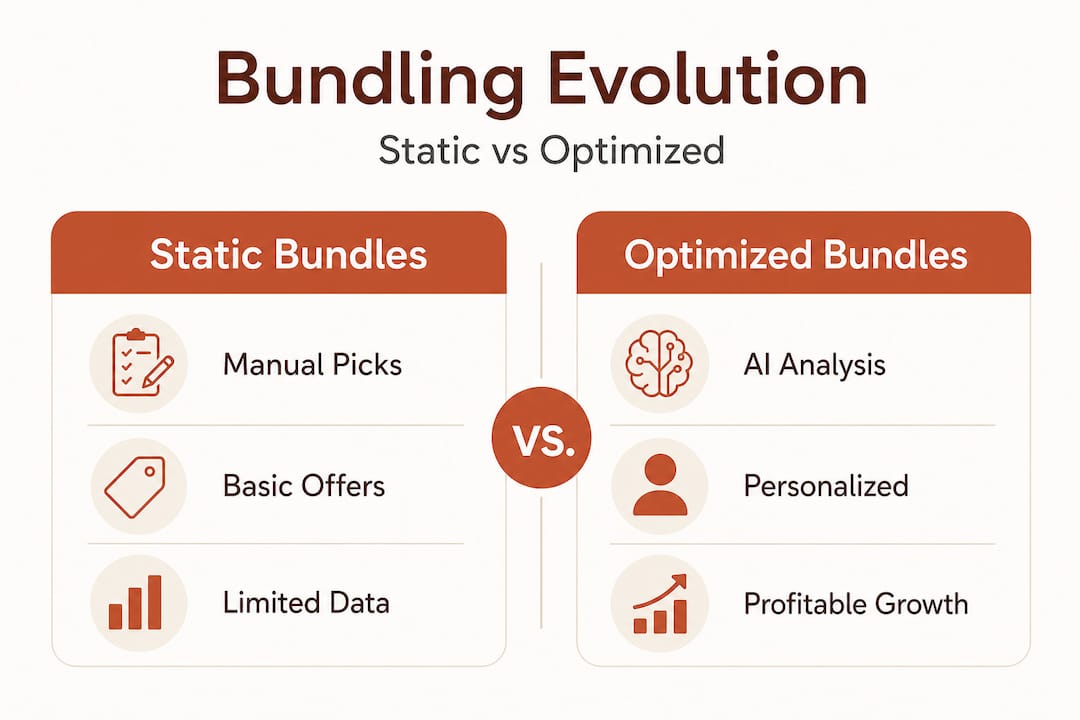
Here’s the core difference between static and optimized bundling:
| Dimension | Static bundles | Optimized (AI-driven) bundles |
|---|---|---|
| Product selection | Gut feel or manual curation | Market basket analysis and purchase pattern data |
| Pricing | Fixed discount applied broadly | Dynamic pricing based on margin and customer segment |
| Personalization | One-size-fits-all | Tailored by customer segment and purchase history |
| Review cadence | Set and forgotten | Continuously monitored and iterated |
| Inventory impact | Often ties up slow movers | Informed by inventory turnover data |
Legacy bundling approaches create two specific problems that compound over time. First, you miss genuine upsell opportunities because you’re not looking at what customers actually buy together. Second, you create inventory inefficiencies by forcing slow-moving products into bundles that don’t sell, which ties up working capital and clutters fulfillment.
Optimized bundles address both. Key business benefits include:
- Increased AOV: Customers spend more per transaction when bundle value is clear and relevant.
- Improved retention: Well-matched bundles create positive experiences that drive repeat purchases.
- Better inventory turnover: Data shows which complementary products move together, reducing overstock on slow movers.
- Higher conversion rates: Relevant bundles reduce decision fatigue and accelerate purchase decisions.
The shift from static to optimized bundling isn’t just a technology upgrade. It’s a fundamental change in how you think about product relationships and customer needs.
Preparing for successful bundle optimization
Before you optimize a single bundle, you need to get your house in order. Jumping straight into AI tools without the right data foundation is like running paid ads without knowing your customer acquisition cost. The output will be noisy and potentially misleading.
Three categories of data are non-negotiable for effective bundle optimization:
- Order history: At minimum 90 days of transaction data, ideally 12 months, so you capture seasonal patterns and repeat purchase cycles.
- Customer segmentation data: Who are your high-value customers? What do first-time buyers look like versus loyal repeat purchasers? RFM segmentation (recency, frequency, monetary value) is the most practical framework here.
- Inventory data: Current stock levels, reorder points, and margin by SKU. You can’t optimize bundles without knowing which products you actually want to move.
On the tools side, you’ll need an analytics platform capable of running market basket analysis (MBA), which identifies statistically significant product association rules from transaction data. You’ll also need a reliable way to export order data from your platform. Whether you’re on Shopify, WooCommerce, BigCommerce, or a custom stack, your export file is the raw material everything else depends on.
| Data category | What to gather | Why it matters |
|---|---|---|
| Order history | Product IDs, quantities, timestamps | Reveals which products are bought together |
| Customer data | Segments, lifetime value, purchase frequency | Enables personalized bundle targeting |
| Inventory data | Stock levels, SKU margins, reorder rates | Prevents bundling products you can’t fulfill |
| Product data | Categories, price points, attributes | Helps define logical bundle groupings |

From a team alignment perspective, bundle optimization sits at the intersection of marketing, inventory management, and data analysis. Marketing owns the messaging and offer design. Inventory owns what can realistically be bundled. Data analysis owns the pattern recognition and performance tracking. Getting all three stakeholders into the same conversation early prevents the classic scenario where marketing launches a bundle that operations can’t actually fulfill.
Smarter bundling tips from practitioners consistently point to one often-skipped step: audit your existing bundles before you start optimizing. Look at current bundle attach rates (what percentage of orders include a bundle), average margin per bundle, and return rates. You’ll almost always find one or two bundles that are quietly cannibalizing your margins or inflating returns.
Pro Tip: Before building new bundles, pull a 90-day report on your existing ones. Sort by margin per bundle, not just by units sold. A bundle moving 500 units at negative margin is worse than no bundle at all.
Step-by-step process to optimize ecommerce bundles
Here’s the sequenced process that turns raw transaction data into bundles that genuinely perform.
-
Identify underperforming and high-affinity products. Pull your order history and flag products that frequently appear in the same cart but aren’t currently bundled. Also flag products with high individual sales but low repeat purchase rates. These are your prime bundling candidates.
-
Run market basket analysis. MBA (market basket analysis) uses association rules to quantify how often products are purchased together. The key metrics are support (how often a product pair appears across all orders), confidence (how often product B is bought when product A is bought), and lift (whether the co-purchase is meaningfully above random chance). Focus on high-lift pairs with solid support. These are the associations your data is actually validating.
-
Segment customers before designing bundles. A bundle that converts beautifully for a first-time buyer might be completely irrelevant to a customer in their fifth purchase cycle. Use your RFM segments to match bundle design to customer behavior. High-value repeat buyers often respond better to premium or add-on bundles. New customers respond better to starter or value bundles that reduce decision risk.
-
Set bundle pricing strategically. Bundle pricing strategies vary significantly in their mechanics and margin impact. Pure bundling (products only available as a bundle), mixed bundling (products available individually or as a set), and tiered bundling (buy more, save more) each have different use cases. The data should guide which model fits each product set, not the other way around.
-
Test bundle composition and pricing. Run A/B tests on bundle construction before a full rollout. Test different product combinations within the same category, different discount levels, and different presentation formats (product image stacks vs. lifestyle photography). Improve AOV with bundling consistently when you run tests rather than assumptions.
-
Monitor, iterate, and automate. After launch, track bundle attach rate, AOV lift, margin per bundle, and return rates weekly for the first month. After that initial period, shift to monthly reviews. Research shows that bundling saves time and money when the process becomes systematic rather than ad hoc.
Pro Tip: Once you’ve validated a bundle through manual analysis, use AI to automate suggestions at scale. Feed your order data into an analytics platform that can continuously surface new high-lift product pairs as your catalog and customer base evolve. This keeps your bundle strategy fresh without requiring a monthly manual audit.
Common pitfalls and best practices
Even brands with strong data foundations make predictable mistakes in their bundle programs. Here are the most damaging ones, and how to avoid them.
Pitfall 1: Bundling slow-movers with best-sellers too aggressively. It’s tempting to move dead inventory by attaching it to a bestseller at a discount. But this dilutes the value of your bestseller, trains customers to expect discounts, and often results in higher return rates when customers receive something they didn’t actually want. Analytics improves bundle performance specifically because it tells you what customers genuinely value together, not just what you need to clear.
Pitfall 2: Overcomplicating bundle choices. The “paradox of choice” is well-documented in consumer psychology. When customers face too many bundle variations, decision fatigue sets in and they buy nothing. Keep your active bundle catalog focused: three to five core bundles per product category is usually more effective than 20 variations.
Best practices to build in from the start:
- Validate every bundle with at least 30 days of data before scaling it.
- Communicate bundle value explicitly at every customer touchpoint: product pages, cart, email, post-purchase sequences.
- Align bundle offers with your inventory position. If stock on a bundle component drops below a threshold, auto-pause the bundle rather than overselling.
- Track bundle performance separately from overall category performance so you can isolate the true lift from bundling.
“The best bundles feel like they were designed specifically for the customer receiving them. That level of relevance only comes from data, not intuition.”
Verifying results: how to measure and iterate
Once your optimized bundles are live, measurement is where the real learning happens. Too many brands launch a bundle, check sales once, and declare it a success or failure based on a gut read.
The KPIs that matter most for bundle optimization:
- AOV growth: Compare AOV for orders that include a bundle vs. those that don’t. This is your primary measure of bundle value.
- Attach rate: What percentage of total orders include at least one bundle? Rising attach rate signals growing customer acceptance.
- Repeat purchase rate: Do customers who buy bundles return more often than those who don’t? This validates the retention hypothesis behind bundling.
- Margin per bundle: Revenue growth is hollow if margin is shrinking. Track net margin per bundle, not just revenue.
Steps to increase AOV through bundles work best when you establish a clear before-and-after baseline. Here’s a practical comparison framework:
| Metric | Pre-optimization baseline | Post-optimization target | How to measure |
|---|---|---|---|
| AOV | Current average | 10-20% lift | Order analytics, segmented by bundle vs. non-bundle |
| Bundle attach rate | % of orders with bundles | Increase by segment | Orders containing bundles / total orders |
| Repeat purchase rate | % of customers buying again | Higher for bundle buyers | Cohort analysis by first purchase type |
| Return rate | Returns per bundle | Equal or lower than single items | Returns tagged to bundle SKU |
For A/B testing bundle changes, follow this sequence:
- Define one variable to test per experiment (product composition, price, or presentation).
- Split traffic evenly between control and variant for a minimum of two weeks.
- Use statistical significance thresholds before declaring a winner. A 95% confidence interval is the right bar for decisions involving pricing changes.
- Document every test result, including failed experiments. Failed tests teach you what your customers don’t want, which is equally valuable.
Beyond the data: what truly makes bundle optimization succeed
Here’s an uncomfortable truth that most analytics-first guides won’t tell you: the brands consistently winning with bundle optimization are not the ones with the best models. They’re the ones with the most honest customer feedback loops.
AI and market basket analysis are genuinely powerful. They surface patterns in transaction data that no human analyst could find at scale. But transaction data only captures what customers bought. It doesn’t capture what they almost bought, what they returned because it felt wrong in context, or what they wished was in the bundle but couldn’t find. That gap between “bought” and “actually wanted” is where most bundle programs quietly fail.
The brands we see master product bundling strategies at a high level consistently do one thing differently: they run regular qualitative customer interviews or post-purchase surveys alongside their quantitative analytics. When a bundle underperforms in the data, they ask customers why rather than just pivoting to the next AI recommendation.
The second overlooked driver is cross-team empathy. Marketing wants high-conversion bundles. Inventory wants to move slow-movers. Finance wants margin protection. These goals conflict, and the teams that resolve those conflicts through shared data rather than internal politics build more durable bundle programs.
Finally, there’s the mindset gap. Most e-commerce teams treat bundle optimization as a project with a start and end date. The teams that see it as a continuous experiment program with regular small bets consistently outperform those running large annual bundle redesigns. Small, frequent tests keep your bundle catalog aligned with a market that’s constantly shifting.
Take your ecommerce bundling to the next level
Ready to move from theory to actual bundle performance gains? Affinsy gives you the AI-powered analytics infrastructure to run everything covered in this guide, without needing a data science background or a custom data stack.
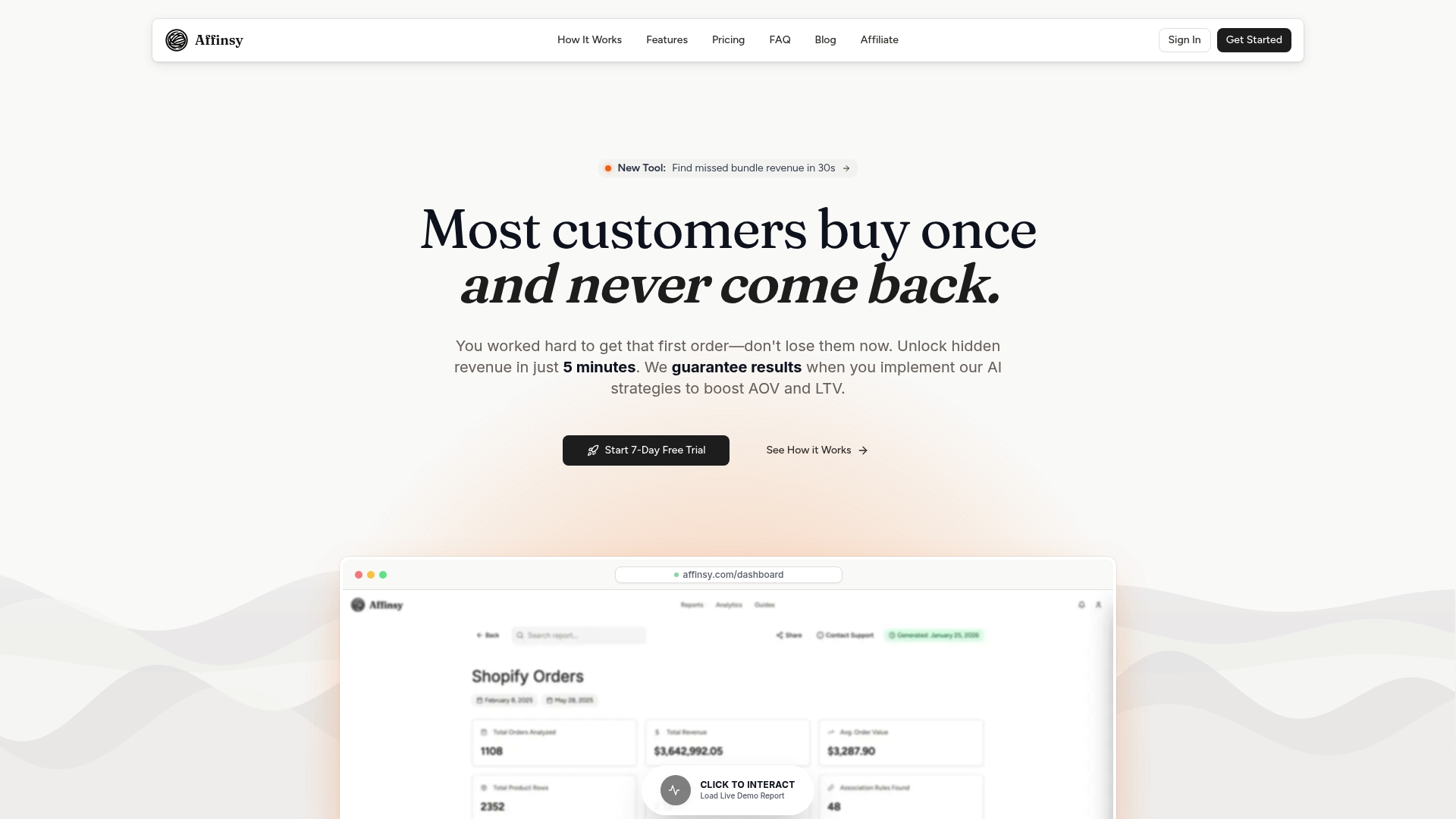
Upload your order export via CSV or connect through the API, and Affinsy surfaces market basket analysis results, RFM customer segments, and high-lift product associations within minutes. The platform also includes predictive analytics capabilities to forecast which bundles will perform before you commit to a full rollout. WooCommerce users can get started immediately with the WooCommerce order exporter to get data into the platform fast. Explore the full analytics glossary to get fluent in the metrics that drive bundle performance. The free tier supports up to 20K line items with no credit card required.
Frequently asked questions
What is ecommerce bundle optimization?
Ecommerce bundle optimization is the process of strategically grouping products using data and AI tools to maximize sales, margin, and customer retention, rather than relying on manual or intuition-based selection.
How does AI improve e-commerce bundling?
AI analyzes large volumes of customer behavior and sales data to surface high-performing product combinations that human analysts would likely miss, increasing both AOV and conversion rates.
What data is essential for bundle optimization?
Order histories, customer segmentation data (ideally using RFM frameworks), and inventory details are the three core inputs needed to generate accurate and actionable bundle recommendations.
How often should we review and adjust e-commerce bundles?
Review bundle performance monthly for the first quarter after launch, then shift to quarterly reviews once bundles are stable, adjusting whenever significant inventory changes or seasonal trends emerge.
What are common mistakes to avoid in bundle optimization?
The most damaging mistakes are ignoring analytics when building bundles, creating too many variations that trigger decision fatigue, and forcing slow-moving inventory into bundles with bestsellers without validating customer demand first.
Recommended
- Master Product Bundling Strategies for E-Commerce Success - Affinsy Blog | Affinsy
- Master Product Bundling on Shopify for Increased Sales - Affinsy Blog | Affinsy
- 7 Smart Bundle Pricing Strategies for E-commerce Success - Affinsy Blog | Affinsy
- Ecommerce Reporting Guide: Optimize Store Growth Easily - Affinsy Blog | Affinsy