
TL;DR:
- Upselling offers higher-value versions of products during the shopping process to increase average order value. Effective strategies include tiered upgrades, bundles, post-purchase offers, and checkout add-ons, with placement and pricing carefully aligned to customer intent. Limiting upsell touchpoints to two per session and keeping prices within 25 to 50 percent of the original enhances acceptance and minimizes cart abandonment.
Upselling is the practice of offering customers a higher-value version of a product they are already buying, and it is one of the most direct ways to grow average order value (AOV) without acquiring new traffic. Effective ecommerce upselling ideas increase AOV by 10% to 30% when offers are relevant, well-timed, and priced within a reasonable range of the original item. Unlike cross-selling, which suggests complementary products, upselling moves the customer up a tier within the same product category. The best results come from matching offer type to funnel stage: product pages for tier upgrades, cart pages for small add-ons, and post-purchase pages for complementary items.
1. What are the top ecommerce upselling ideas for 2026?
The strategies below cover the full purchase funnel. Each one works best in a specific context, so read the placement and pricing sections after this list before deploying them.
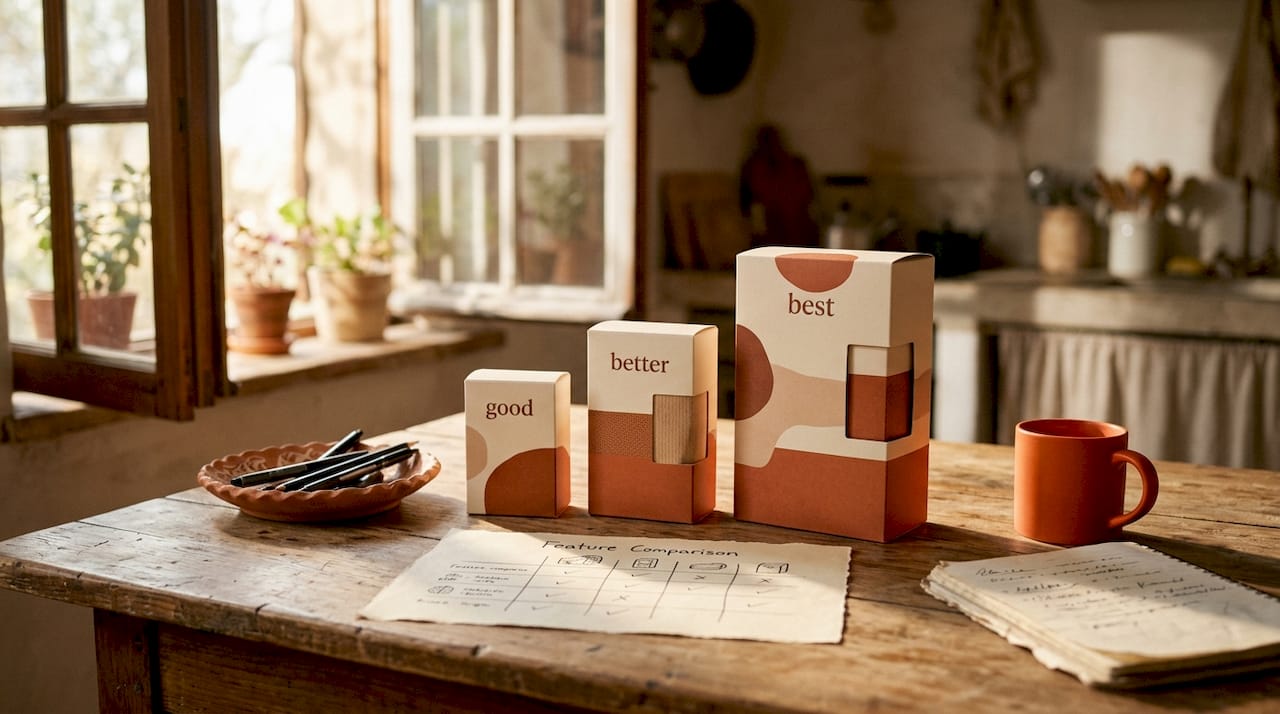
Tiered product upgrades (good, better, best)
Present three versions of a product side by side on the product detail page. The middle tier typically wins the most clicks because of the “compromise effect” in consumer psychology. Label the middle or top tier as “Most Popular” to reduce decision friction. This is the most common upselling technique for ecommerce stores selling configurable products like electronics, software plans, or apparel.
Product bundles with a discount incentive
Product bundling lifts AOV by 20–35%, with best-in-class implementations reaching 55%. The discount does not need to be large. A 10–15% saving on a curated bundle is enough to shift behavior. Bundles work especially well on product pages and in cart drawers where the customer can see the value comparison clearly.
Pro Tip: Use market basket analysis on your transaction history to find which products customers already buy together. Those natural pairs make the strongest bundles because the demand already exists.
Post-purchase one-click upsells
Post-purchase upsells achieve 15–25% acceptance rates when shown immediately after order confirmation. The customer has already committed to buying, so purchase anxiety is at its lowest. One-click acceptance, with no re-entry of payment details, is the key mechanic. Present a single relevant offer, not a menu of options.
Order bumps at checkout
An order bump is a small checkbox offer shown on the checkout page, typically priced under $20. It works because the customer is already in payment mode and the cognitive cost of adding a low-priced item feels minimal. Common examples include a travel-size version of a product, a digital guide, or an extended warranty.
Free shipping progress bars
A progress bar showing how close the customer is to a free shipping threshold is one of the most frictionless upselling techniques for ecommerce. It does not feel like a sales push. It feels like helpful information. Stores typically set the threshold 15–25% above their current AOV to pull the average up without making the gap feel unreachable.
Subscription and quantity upsells
Offer a “subscribe and save” option on consumable products. Customers who switch to subscriptions have higher lifetime value and lower churn. Quantity upsells (“buy 3, save 15%”) work on the same logic. Both formats are most effective on product pages where the customer is already evaluating the item.
Gift wrapping and personalization add-ons
Gift wrapping and personalized message options convert well during seasonal peaks and for products in the gifting category. Price them at $3–$8 to keep the decision easy. These add-ons also improve the perceived value of the order without requiring inventory changes.
Order protection and shipping insurance
Shipping insurance converts well at checkout because it addresses post-purchase anxiety directly. Typical pricing is $1–$5. Clear, plain-language messaging (“We’ll replace it if it’s lost or damaged”) drives acceptance better than legal-sounding copy.
Digital add-ons and content upgrades
For stores selling physical products, a related digital guide, video course, or printable template can add margin with zero fulfillment cost. A kitchen store selling a cast iron skillet might offer a seasoning and care guide for $5. The offer feels like a natural complement, not a hard sell.
Urgency-driven offers with real scarcity
Showing genuine low-stock alerts (“Only 4 left at this price”) creates urgency without manipulation, provided the scarcity is real. Manufactured urgency erodes trust quickly. Use this tactic only when inventory data supports the claim. Pair it with a clear expiration on a discount to reinforce the time constraint.
2. Where and when to place upsell offers for maximum impact
Placement determines whether an upsell feels helpful or intrusive. Optimal upsell placement matches customer intent at each funnel stage.
| Funnel stage | Best offer type | Typical acceptance rate |
|---|---|---|
| Product detail page | Tier upgrades, bundles | 8–15% |
| Cart page | Small add-ons under 25% of cart value | 15–25% |
| Checkout | Order bumps, shipping insurance | Varies by price point |
| Post-purchase | Complementary products, one-click upsells | 15–25% |
The cart page is the right place for low-cost add-ons, but only when the offer price stays below 25% of the current cart total. A $200 cart can absorb a $30 add-on. The same $30 offer on a $40 cart feels disproportionate and triggers abandonment.
Showing more than two upsell touchpoints in a single session increases cart abandonment significantly. The Baymard Institute links 69% cart abandonment to friction and unwanted additions. The practical rule is one pre-purchase upsell and one post-purchase upsell per session. That ceiling keeps revenue per session high without pushing customers away.
Post-purchase is the highest-converting placement for complementary offers. Upselling post-purchase requires immediate presentation after order confirmation. Delayed upsells in follow-up emails see sharply lower engagement. The window is the confirmation page itself, not a campaign sent the next day.
Pro Tip: Test your upsell sequence by mapping every touchpoint a customer sees from product page to confirmation. If you count more than two offer moments, cut the weakest one before running traffic.
3. How to price ecommerce upsells without losing the sale
Pricing is the most common place upselling strategies fail. Customers accept upsells when the price jump feels proportional to the value gain.
Keep the upsell price within 25–50% of the original product price to minimize friction. A customer buying a $60 item will consider a $75 or $80 upgrade. The same customer will hesitate at $120. The gap between the base product and the upsell is the key variable, not the absolute price.
Use side-by-side comparison layouts to make the value difference visible. List the features the upgraded version adds in a short, scannable format. Customers who can see exactly what they gain for the extra cost convert at higher rates than those who see only a price difference.
Social proof labels like “Most Popular” or “Best Value” reduce the cognitive effort of choosing. They work because they signal that other customers have already made the same decision. Place the label on the tier you want to sell most, which is usually the middle or second-highest option.
Avoid showing a steep price jump without a clear explanation. A $40 item next to a $90 upsell with no feature breakdown will lose the sale. The customer needs a reason, not just a price tag.
4. How to match upselling strategies to your product category
The right upselling technique depends on what you sell. Generic advice applied to the wrong category produces weak results.
Consumables (supplements, coffee, skincare): Subscription upsells and quantity discounts are the strongest plays. Customers already plan to repurchase, so locking in a recurring order benefits both sides.
Gifting products (candles, jewelry, stationery): Bundle completions and gift wrapping add-ons perform well. Customers in gift-buying mode are more willing to spend slightly more to make the gift feel complete.
High-consideration items (electronics, furniture, appliances): Warranties and order protection address the anxiety that comes with large purchases. These upsells work because they reduce risk rather than add cost. Frame them as protection, not an extra expense.
Digital goods (courses, templates, software): Content add-ons and feature upgrades are the natural fit. A customer buying a single course template is a strong candidate for a full template library at a bundled price.
General stores with mixed categories: Combine cross-sell strategies with tier upgrades and use transaction data to identify which product pairs appear most often in the same order. That data tells you where bundle and upsell opportunities already exist in customer behavior.
Pro Tip: Run a market basket analysis on six months of order data before building any bundle or upsell offer. The patterns in your own transaction history are more reliable than industry benchmarks.
Key takeaways
The most effective upselling strategies combine relevant offers, precise placement, and proportional pricing to lift AOV without adding friction to the purchase experience.
| Point | Details |
|---|---|
| AOV lift potential | Well-executed upselling increases average order value by 10–30% across most ecommerce categories. |
| Post-purchase is highest converting | One-click upsells shown immediately after order confirmation achieve 15–25% acceptance rates. |
| Two touchpoints maximum | Limit upsell offers to one pre-purchase and one post-purchase moment per session to avoid abandonment. |
| Price within 25–50% of original | Keep the upsell price delta proportional to minimize hesitation and maximize acceptance. |
| Match tactic to category | Consumables suit subscriptions; high-consideration items suit warranties; gifting suits bundles. |
What I’ve learned from watching upsells succeed and fail
The most common mistake I see is treating upselling as a revenue extraction tool rather than a customer service tool. Stores that pile on three or four offer moments in a single session are not upselling. They are annoying their best customers.
The stores that do this well share one habit: they start with post-purchase upsells before touching the pre-purchase funnel. Post-purchase is the safest testing ground because the sale is already complete. You learn what offers resonate without risking cart abandonment. Once you have a winning offer there, you can work backward into the cart and product page with confidence.
Relevance matters more than discount depth. A perfectly matched upsell with no discount converts better than a poorly matched one with 20% off. I have seen stores obsess over discount levels while ignoring whether the offer actually makes sense for the customer. The offer has to feel like the obvious next step, not a random suggestion.
Segment your customers before you personalize offers. First-time buyers and repeat customers have different risk tolerances and different product familiarity. An upsell that works on a loyal customer who knows your catalog will confuse a first-time buyer who is still evaluating whether they trust you. Treat them differently from day one.
Finally, measure acceptance rates by placement, not just by offer. An offer with a 12% acceptance rate on the product page might hit 22% post-purchase. The offer itself is not the variable. The moment is.
— Mateusz
How Affinsy helps you find the right upsell offers
Knowing which products to upsell is harder than knowing how to upsell them. Affinsy solves the “which products” problem by running market basket analysis on your historical transaction data to surface the product pairs and groups customers already buy together.
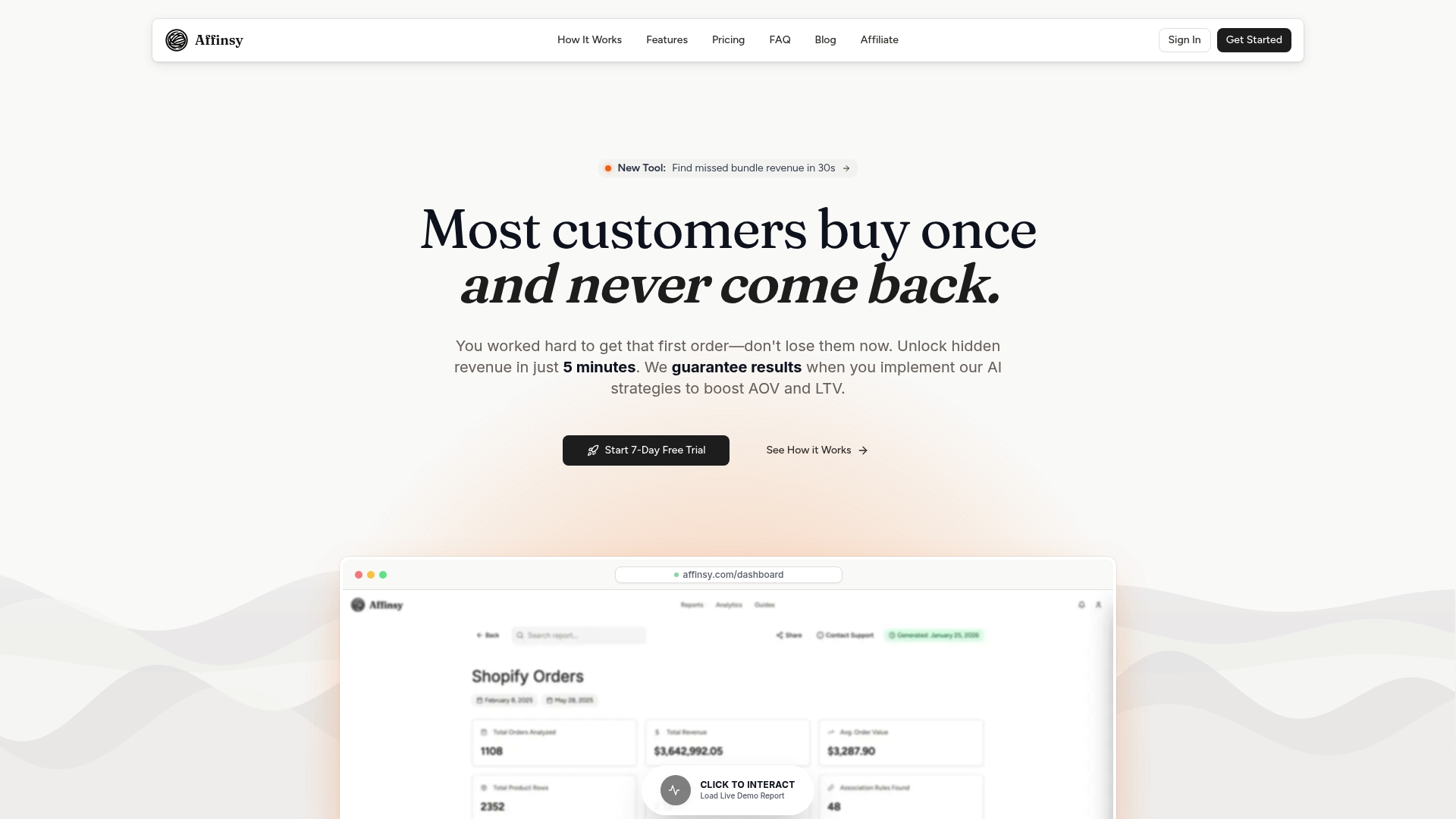
You export your order data from Shopify, WooCommerce, BigCommerce, or any platform that produces transactional records, then upload it via CSV or connect through the API. Affinsy identifies the associations and segments that drive your AOV, so your upsell and product bundling decisions are grounded in real purchase behavior, not guesswork. The free tier covers up to 20,000 line items with no credit card required, making it a practical starting point for stores at any scale.
FAQ
What is the difference between upselling and cross-selling?
Upselling offers a higher-tier or upgraded version of the product a customer is already buying. Cross-selling suggests a different, complementary product to add to the order.
What is a good acceptance rate for an ecommerce upsell?
Post-purchase one-click upsells average 15–25% acceptance when shown immediately after order confirmation. Cart-page add-ons typically see 15–25% take rates as well, depending on offer relevance and price.
How many upsell offers should I show per session?
Limit upsell offers to two per session. One pre-purchase and one post-purchase is the recommended structure. Exceeding two touchpoints raises cart abandonment risk significantly.
How much should an upsell cost relative to the original product?
Keep the upsell price within 25–50% of the original product price. Larger price jumps reduce acceptance rates sharply unless the value difference is made explicit through side-by-side feature comparisons.
Do upselling strategies work the same way on Shopify as on other platforms?
The core principles apply across all platforms. Shopify upselling ideas rely on the same timing, placement, and pricing rules as any other ecommerce environment. The difference is in the tools available for implementation, not in customer psychology.
Recommended
- How to Build Product Bundles That Boost AOV in 2026 - Affinsy Blog | Affinsy
- How to Maximize Average Order Value for E-Commerce Stores - Affinsy Blog | Affinsy
- Proven cross-selling tips to boost e-commerce sales in 2026 - Affinsy Blog | Affinsy
- Boost Your AOV: The Power of Market Basket Analysis for Upsells & Cross-sells - Affinsy Blog | Affinsy