
TL;DR:
- Product bundling groups related products to increase revenue and offer perceived savings, driven by data insights. Successful strategies involve pairing high-traffic anchor products with complementary or slow-moving items, maintaining margins, and placing bundles at key customer touchpoints. Using data-driven analysis and optimized pricing ensures bundles boost profit without eroding margins or customer trust.
Product bundling is the practice of grouping related products into a single offer, sold together at a price that delivers perceived savings to the buyer while increasing revenue per transaction for the seller. Businesses that execute this well see an average revenue increase of 30%, driven by higher average order value and faster sell-through of slow-moving inventory. Knowing how to build product bundles correctly, from selecting the right combinations to pricing them without destroying your margins, is one of the highest-leverage moves available to e-commerce operators in 2026. This guide walks you through every step, including tools like the Shopify Bundles app, AI-powered analytics platforms, and proven pricing frameworks.
How to build product bundles: choosing the right combinations
The most common mistake in creating product bundles is picking products based on gut feel rather than purchase data. The right bundle starts with your anchor product, a high-traffic, high-velocity item that already drives consistent sales. You pair it with a complementary product that solves a related problem or completes the customer’s intended outcome.

Pairing an anchor product with a slow-moving item is more effective than bundling only your best sellers together. It increases total order value and clears inventory that would otherwise sit in your warehouse. A skincare brand, for example, might bundle a bestselling moisturizer with a slower-moving eye cream. The customer gets a logical skincare routine; you move two units instead of one.
The five bundle types worth knowing are:
- Starter bundles: An entry-level product plus one accessory, designed to reduce the friction of a first purchase
- Slow-mover bundles: A fast seller paired with a product that has high inventory but low organic demand
- Gift bundles: Curated sets with elevated packaging, priced at a premium for seasonal or occasion-based buying
- Replenishment bundles: Consumable products grouped in multiples, often with a subscription option
- Complete solution bundles: Every product a customer needs to accomplish a specific task, sold as one SKU
AI-powered analytics identifies which combinations customers already gravitate toward, removing the guesswork entirely. The practical advantage is narrower than it sounds, and more useful: it lets you check a proposed bundle against what customers already do, instead of shipping it and finding out. That number reflects how much signal is buried in your transaction history that manual analysis simply misses.
One trap to avoid is the cannibalization problem. Track attach rates before launching a bundle. If customers already buy two products together at full price, discounting them as a bundle does not create new revenue. It just reduces the margin on a sale you were already making.
Pro Tip: Run a market basket analysis on your last 90 days of orders before building any bundle. You will find product pairs with high co-purchase frequency that you have never consciously promoted together. Those are your highest-probability bundle candidates.
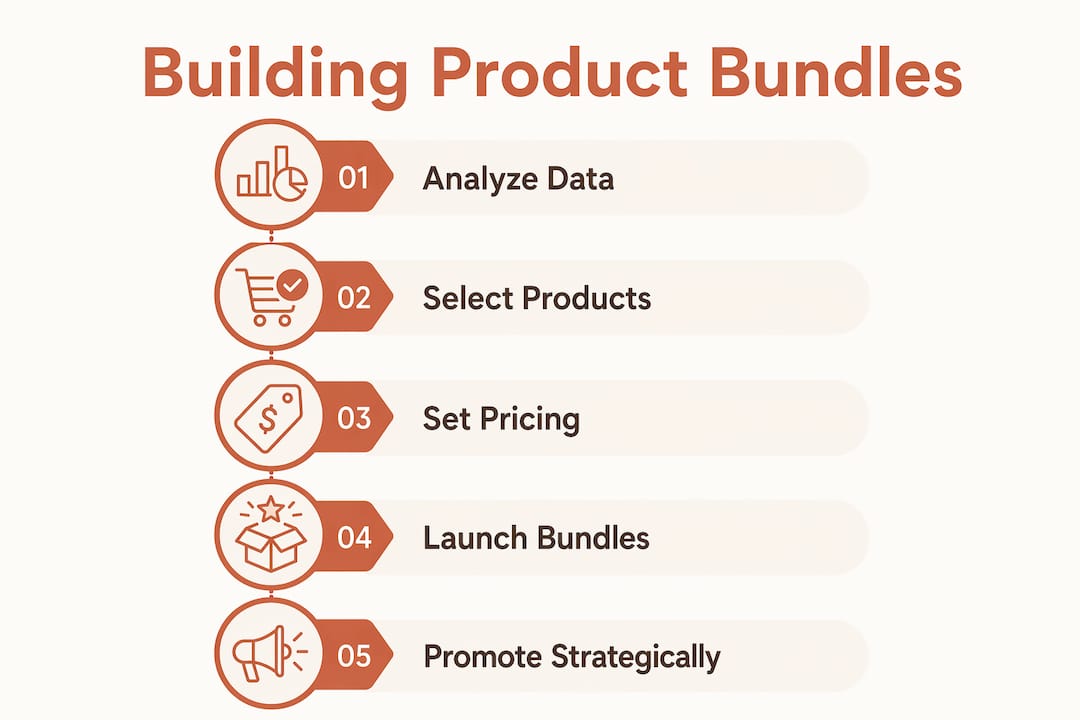
How to price bundles without eroding your margins
Bundle pricing follows a straightforward formula: add the combined cost of goods sold for all items in the bundle, apply your target gross margin, and set that as your price floor. Nothing in your bundle strategy should push you below that floor.
The optimal discount range is 10 to 20% off the sum of individual retail prices. Discounts below 10% rarely generate enough perceived value to change buying behavior. Discounts above 20% tend to increase attach rates modestly while cutting significantly into contribution margin. The math rarely works in your favor beyond that threshold.
| Discount depth | Customer perception | Margin impact | Recommended use |
|---|---|---|---|
| 5% or less | Negligible savings | Minimal erosion | Rarely effective |
| 10–15% | Clear value signal | Manageable | Standard bundles |
| 16–20% | Strong incentive | Monitor closely | Seasonal or gift sets |
| 21%+ | High appeal | Significant erosion | Avoid unless clearing stock |
Maintaining a gross margin floor of 30% after all variable costs is the standard benchmark for bundle profitability. Dropping below it means you are generating revenue without generating profit, which is a common trap when teams optimize for AOV without checking contribution margin.
Two pricing tactics that work reliably are anchoring and decoy pricing. Anchoring means showing the individual prices of each item before presenting the bundle price. When a customer sees $45 + $30 crossed out and replaced with $62, the savings feel concrete. Decoy pricing means offering three bundle tiers where the middle option is clearly the best value, nudging buyers away from the cheapest option without requiring any persuasion.
Pro Tip: Always display the “if bought separately” price next to your bundle price. This single change increases bundle conversion rates because it makes the savings tangible rather than implied.
Step-by-step: creating product bundles on Shopify and other platforms
Shopify gives you three native paths to build bundles. The first is creating a manual product with a bundle-specific title, description, and price, then managing inventory manually. The second uses product variants to represent bundle configurations. The third combines collections with automatic discounts triggered at checkout.
For most stores, the Shopify Bundles app is the fastest starting point. Here is the standard setup process:
- Install the Shopify Bundles app from the Shopify App Store
- Navigate to “Create bundle” and select your anchor product
- Add complementary products and set the quantity for each
- Configure the bundle price or percentage discount
- Set inventory tracking to deduct from individual product stock automatically
- Write a bundle-specific product description focused on the customer outcome
- Add bundle-specific images showing all products together
- Publish and test the checkout flow end to end
The native Shopify Bundles app breaks checkout for products that include subscription or pre-order purchase options. This is a documented limitation, not a configuration error. If your catalog includes either of those product types, you need a third-party solution.
Third-party apps worth evaluating include Fast Bundle and Fly Bundles. Both support mix-and-match configurations that Shopify’s native app does not handle, including build-your-own bundles where customers select from a defined product pool. That flexibility matters because customizable bundles increase conversion rates by over 15% compared to fixed configurations. Customers who feel in control of their purchase are more likely to complete it.
A few additional considerations for your implementation:
- Use lifestyle photography that shows all bundle products in use together, not individual product shots placed side by side
- Write the bundle title around the customer outcome, not the product list (“The Morning Routine Kit” outperforms “Cleanser + Toner + Moisturizer”)
- Test your checkout flow on mobile before launch, since bundle pages with multiple product images often load slowly on lower-end devices
- For WooCommerce, BigCommerce, or Stripe-based stores, the same logic applies: export your order data and analyze co-purchase patterns before building your bundle catalog
Where and how to promote bundles for maximum sales lift
Placement determines whether a bundle gets seen by buyers in the right frame of mind. Bundles placed at the product page, cart, and post-purchase stages each capture a different type of buyer intent. Product page placement catches customers who are still deciding. Cart placement catches customers who have committed to buying but may add more. Post-purchase placement catches customers whose credit card is already out.
Naming your bundles after customer outcomes rather than product contents is one of the most underused tactics in e-commerce. “The Weekend Refresh Kit” converts better than “Face Wash + Scrub + Mask” because it sells a result, not a list. Customers buy outcomes. The product names belong in the description, not the headline.
For marketing channels, the highest-performing tactics for bundle promotion are:
- Email campaigns targeting customers who have purchased one item in the bundle but not the other, using personalized subject lines that reference their previous purchase
- On-site recommendations on product pages using “frequently bought together” widgets, which surface bundle options without requiring the customer to navigate away
- Social media ads featuring the bundle price versus individual prices side by side, with a clear savings callout in the creative
- Post-purchase upsells offered immediately after checkout, where conversion rates are highest because purchase intent is at its peak
Limit the number of bundle options you present at any one location to three or fewer. Choice paralysis is real. When customers face more than three bundle configurations simultaneously, decision fatigue reduces conversion across all of them. Present your strongest offer clearly and let the data tell you whether to add more options later.
AI-driven personalization takes this further by surfacing different bundles to different customer segments based on purchase history. A customer who buys premium products should see a different bundle than a customer who consistently buys at the lowest price point. Affinsy’s market basket analysis surfaces exactly these patterns from your transaction data, so your bundle recommendations match actual buying behavior rather than assumptions.
Key takeaways
Effective product bundling requires data-driven product selection, disciplined margin management, and placement that matches buyer intent at each stage of the purchase journey.
| Point | Details |
|---|---|
| Start with transaction data | Run a market basket analysis on recent orders to find high-frequency co-purchase pairs before building any bundle. |
| Anchor to a fast seller | Pair your highest-traffic product with a slower-moving item to increase order value and clear inventory simultaneously. |
| Hold the 30% margin floor | Never discount a bundle below a 30% gross margin; the 10 to 20% discount range is the proven sweet spot. |
| Match placement to buyer intent | Present bundles at the product page, cart, and post-purchase stages to capture buyers at different levels of commitment. |
| Name for outcomes, not contents | Bundle titles that describe a customer result outperform titles that list product names. |
Why most bundle strategies fail before they start
The honest problem I see most often is that merchants build bundles based on what they think customers want, then wonder why attach rates stay flat. I have reviewed enough transaction datasets to say with confidence: the products you assume go together are rarely the ones customers actually buy together. The data almost always surprises you.
The second failure mode is pricing by feel. A 25% discount sounds generous, but if your margins are already thin, you are essentially paying customers to buy from you. I have seen stores where bundle revenue was up 40% quarter over quarter while contribution margin was down. That is not a win. Measuring attach rate combined with contribution margin per order is the only way to know whether your bundles are actually working.
The shift I find most interesting right now is the move toward customizable bundles. Fixed bundles are easier to build and manage, but the 15 to 20% conversion lift from letting customers build their own is hard to ignore. The operational overhead of mix-and-match is real, but third-party apps have made it manageable for most mid-size stores. If you are running a catalog with more than 50 SKUs, a build-your-own option is worth testing seriously.
My advice: start with one bundle, measure it for 30 days against a clear margin target, and iterate from there. The stores that build data-driven bundles consistently outperform those that launch ten bundles at once and call it a strategy.
— Mateusz
How Affinsy helps you build smarter bundles faster
Affinsy analyzes your historical transaction data to surface the product combinations your customers already gravitate toward, before you spend time building bundles that miss the mark. The platform’s market basket analysis identifies high-frequency co-purchase pairs and segments customers by behavior, so your bundle strategy is built on evidence rather than intuition. You connect via CSV upload or API from any platform, including Shopify, WooCommerce, BigCommerce, and Stripe. No data science skills required. Affinsy’s free tier covers up to 20,000 line items with full product access and no credit card required. If you want to see which products in your catalog belong together, start with your data and let the patterns tell you.
FAQ
What is product bundling in e-commerce?
Product bundling is the practice of selling two or more related products together as a single offer, typically at a price lower than buying each item separately. It increases average order value and improves sell-through of slower-moving inventory.
How do I choose which products to bundle together?
Start by running a market basket analysis on your recent order history to identify products customers already buy together. Pair a high-traffic anchor product with a complementary or slower-moving item rather than grouping only your best sellers.
What discount should I offer on a bundle?
The proven sweet spot is 10 to 20% off the combined individual retail prices. Discounts below 10% rarely shift buying behavior, while discounts above 20% tend to erode contribution margin without a proportional increase in volume.
Does the Shopify Bundles app support customizable bundles?
No. Shopify’s native Bundles app supports fixed bundle configurations only and does not handle mix-and-match or build-your-own options. It also breaks checkout for products with subscription or pre-order purchase options, which requires a third-party app like Fast Bundle or Fly Bundles.
How do I measure whether a bundle is actually profitable?
Track attach rate alongside contribution margin per order, not just average order value. A bundle that increases AOV while reducing margin per transaction is generating revenue without generating profit, which is a common outcome when discount depth is not monitored against your margin floor.
Recommended
- What is product bundling? Boost e-commerce AOV by 50% - Affinsy Blog | Affinsy
- 7 expert tips for smarter product bundling in 2026 - Affinsy Blog | Affinsy
- Retail analytics boost bundling AOV 50% in 2026 - Affinsy Blog | Affinsy
- How to increase Shopify AOV with data-driven bundling - Affinsy Blog | Affinsy