
TL;DR:
- Working with a DACH ecommerce agency requires understanding regional compliance, marketplace strategies, and complex ERP integration. These agencies now manage full commerce infrastructures, including AI automation, multi-channel sales, and legal adherence from the start. Successful partnerships depend on ongoing support, data collaboration, and selecting agencies with deep local expertise and operational reliability.
Working with a DACH ecommerce agency is not like hiring any other digital partner. Germany, Austria, and Switzerland carry a distinct mix of regulatory requirements, consumer expectations, and technical infrastructure that separates the DACH market from every other region in Europe. Businesses that try generic ecommerce solutions in DACH often hit a wall fast: compliance failures, poor payment conversion, and ERP integrations that collapse under real operational load. This guide breaks down what top ecommerce agencies in DACH actually do today, what separates the good ones from the rest, and how to evaluate which type of partner fits your growth stage.
Table of Contents
- Key takeaways
- What a DACH ecommerce agency actually does now
- Why multi-channel marketplace strategy matters
- Compliance, payments, and legal requirements
- AI and automation in agency service offerings
- Legacy ERP and B2B integration challenges
- My take on what businesses consistently get wrong
- How Affinsy complements your agency work
- FAQ
Key takeaways
| Point | Details |
|---|---|
| DACH agencies go beyond storefronts | Modern agencies manage full commerce infrastructure including ERP integration, compliance, and AI automation. |
| Multi-marketplace exposure multiplies sales | Retailers using multiple DACH marketplaces boost visibility up to tenfold compared to single-channel approaches. |
| Compliance must be built in from day one | GDPR, VAT invoicing, and button solution compliance baked into architecture avoids costly legal retrofits later. |
| AI is now standard, not a premium add-on | Leading agencies deploy AI chatbots and personalized marketing tools that handle the majority of routine customer interactions. |
| Legacy ERP integration defines B2B success | The biggest failure point in B2B ecommerce is backend integration, not frontend design or storefront aesthetics. |
What a DACH ecommerce agency actually does now
The job description has changed completely. A decade ago, hiring a DACH ecommerce agency meant getting a WooCommerce or Shopify store built and launched. That was the deliverable. Today, ecommerce has become infrastructure, and agencies that treat it as a one-time project are falling behind fast.
The best agencies in the DACH region now manage the full stack of commerce operations. That includes:
- AI-powered customer service automation. Chatbots now handle up to 80% of customer inquiries, freeing support teams to focus on complex cases. Agencies configure, train, and maintain these systems.
- Performance marketing integration. From Google Shopping to Meta to programmatic display, agencies connect ad spend directly to transaction data, so every euro has a traceable return.
- ERP and legacy system integration. Top agencies have deep experience connecting modern storefronts to SAP, proALPHA, Infor, and other enterprise systems that most DACH manufacturers and distributors rely on.
- Localization and accessibility compliance. Since June 2025, the Barrierefreiheitsstärkungsgesetz (BFSG) accessibility standard has been in effect, adding another mandatory compliance layer on top of existing GDPR requirements.
Pro Tip: When evaluating agency proposals, ask specifically how they handle BFSG and GDPR compliance within their platform builds. If the answer involves third-party plugins added after launch, that is a red flag for future legal and performance problems.
The shift from storefront design to commerce infrastructure management is not cosmetic. It reflects a structural change in how DACH retailers generate revenue, with 31% of Austrian companies generating roughly 20% of their revenue through ecommerce by 2023. The businesses scaling fastest are the ones treating their digital commerce setup as a living system, not a one-time build.
Why multi-channel marketplace strategy matters
Single-channel ecommerce is a ceiling, not a strategy. German marketplaces grew nearly 5% in 2024, outpacing the global average and now accounting for 27% of consumer traffic. That number tells you where buyers are spending time, and it is not always on brand-owned storefronts.
A skilled DACH ecommerce agency helps you build presence where your customers already shop. Here is what that looks like in practice:
- Marketplace selection and setup. Not every brand belongs on every platform. Agencies assess category fit on Amazon.de, Zalando, About You, Otto, and regional players before committing budget.
- Product feed optimization. Each marketplace has its own algorithm. Agencies manage title structures, image requirements, pricing rules, and keyword optimization for each platform independently.
- Brand storefront development. On platforms like Amazon and Zalando, agencies build and manage branded storefronts that create a cohesive experience even within a third-party environment.
- Cross-channel inventory and order management. Overselling on one channel while another sits understocked is a common and expensive problem. Agencies that prioritize order management systems early in client projects report dramatically better outcomes, with some OMS rollouts delivering 200% revenue growth.
- Performance reporting across channels. Consolidating data from five different platforms into one decision-ready dashboard is harder than it sounds. Good agencies make this standard, not optional.
Fashion is the leading category in DACH ecommerce, with 53% of online purchases coming from that segment. Zalando’s AI-powered virtual fitting rooms have shown return reductions of up to 40%. That level of category-specific innovation is what agencies in this region are building toward.
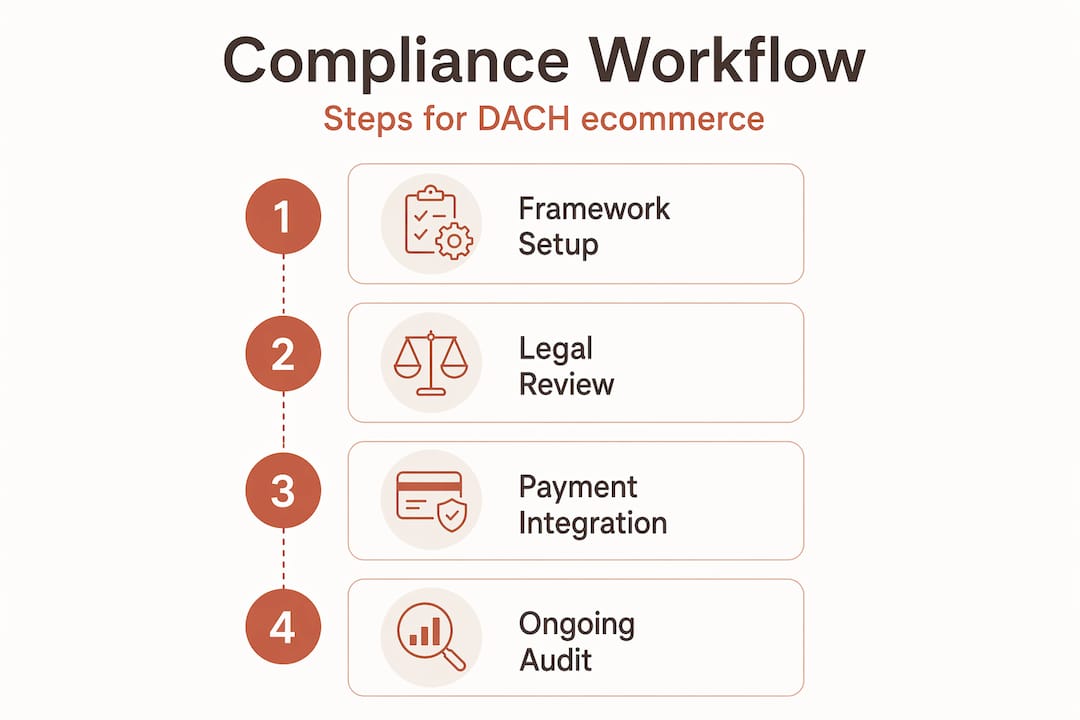
Compliance, payments, and legal requirements
This is where a lot of generic ecommerce agencies lose the plot. DACH online store services operate inside one of the most regulated ecommerce environments in the world, and compliance mistakes are expensive to fix after the fact.
A qualified DACH ecommerce agency addresses these areas by default, not as optional extras:
- GDPR implementation. Cookie consent, data processing agreements, right-to-erasure workflows, and data residency requirements all need to be built into the platform architecture from the start.
- Button solution compliance. German law requires the checkout button to include specific wording (like “Buy now” or “Order with payment obligation”) to create a legally binding purchase. Getting this wrong exposes you to warnings from competitors.
- VAT invoicing. Automated VAT invoicing for B2B and B2C transactions in Germany, Austria, and Switzerland requires handling three different tax systems simultaneously.
- SEPA payment integration. Direct debit is still a preferred payment method across the DACH region. A missing SEPA option is a real conversion killer. Up to 1 in 5 shoppers abandon purchases when their preferred payment method is unavailable.
Pro Tip: Ask your agency candidate whether compliance is handled at the framework level or through plugins. Plugin-based compliance degrades over time as updates break dependencies. Framework-level integration is what you want.
Compliance baked into the initial architecture means your platform does not slow down when a new regulation passes. It adapts. That is a meaningful operational advantage when you are managing a live store serving thousands of customers.
AI and automation in agency service offerings
AI is no longer a future capability agencies promise during sales pitches. It is in production across the top ecommerce agencies in DACH today, and its scope is wider than most business owners realize.

Here is a direct comparison of how AI-enabled vs. traditional agency services stack up on core ecommerce functions:
| Function | Traditional agency approach | AI-enabled agency approach |
|---|---|---|
| Customer support | Human agents or static FAQ | Chatbots handling up to 80% of inquiries automatically |
| Product recommendations | Manual merchandising rules | Real-time personalization based on browsing and transaction data |
| Marketing campaigns | Scheduled batch sends | Triggered, personalized campaigns based on customer behavior |
| B2B ordering workflows | Manual quote and order processes | Agentic AI workflows handling pricing, availability, and order routing |
| Analytics | Monthly static reports | Continuous automated analytics with real-time alerts |
The agentic B2B commerce workflows in the table above deserve special attention. Platforms like Intershop’s 2026 release simplify AI adoption in B2B commerce by reducing the need for custom development on every workflow. Agencies that understand how to deploy these tools can reduce your development overhead significantly while giving sales teams more capability than they had before. For readers interested in how AI retail solutions are being deployed in 2026, the landscape is moving fast.
Legacy ERP and B2B integration challenges
Ask any B2B manufacturer or distributor in Germany what their biggest ecommerce frustration is, and you will hear the same answer: backend integration. The storefront looks fine. The orders fall apart the moment they hit the ERP.
Leading B2B commerce engineering firms in the DACH region run teams of 200 or more engineers specifically to handle integrations with SAP, proALPHA, Infor, and other legacy systems. That scale tells you something about the complexity involved.
Here is a realistic picture of what these integrations typically require:
| Integration point | Common challenge | What good agencies do |
|---|---|---|
| SAP ERP | Real-time inventory sync latency | Middleware layers that buffer and reconcile data in near real-time |
| Warehouse management systems | Order status and fulfillment updates | Bi-directional API connections with error handling and logging |
| Customer pricing and contracts | B2B customers have individual pricing | Dynamic price retrieval from ERP based on customer account |
| Document generation | VAT-compliant invoicing and delivery notes | Automated document triggers tied to order status events |
The biggest failure points in B2B ecommerce are almost always operational, not visual. An agency that leads with storefront aesthetics in a B2B context is selling you the wrong solution. What you need is a partner who asks hard questions about your order flow, warehouse locations, and ERP version before they touch a design file. Trust signals like ISO 27001 certification and documented NPS scores matter here because they tell you whether an agency runs their own operations with the same discipline they promise to bring to yours.
For digital marketing for DACH ecommerce specifically, automating your retail analytics alongside agency work creates a feedback loop that improves both campaign performance and product decisions over time.
My take on what businesses consistently get wrong
I have seen many DACH ecommerce projects start with a strong agency selection process and then collapse during implementation, not because the agency was wrong for the job, but because the client underestimated what the job actually was.
The most common mistake is treating the agency relationship as a project rather than a partnership. You hire them, they launch the shop, everyone celebrates, and then three months later the compliance warning arrives or the ERP sync breaks and no one is sure whose responsibility it is. That gap between “project complete” and “business running well” is where the real value of a strong DACH ecommerce consulting firm shows up.
In my experience, the businesses that get the most out of their agency relationships are the ones that commit to ongoing infrastructure support from day one, not as a backup plan, but as the primary contract structure. Retainer-based engagements with clear ownership over compliance monitoring, marketplace performance, and technical ops deliver far better outcomes than project-based builds where accountability ends at launch.
The other thing I have learned: your agency is only as useful as the data you give them to work with. Transaction data that is siloed in your ERP and never flows into marketing or product decisions means your agency is flying partially blind. Connecting those dots is not glamorous work, but it is where margin gets found.
— Mateusz
How Affinsy complements your agency work
Your agency handles the commerce infrastructure. Affinsy handles the data intelligence that makes it smarter.
Once your agency has multi-channel orders flowing, Affinsy analyzes that transaction data to find what your customers actually buy together, which segments drive repeat revenue, and where cross-sell opportunities are being missed. You upload order data via CSV or connect through API, no complex integrations required. Understanding market basket analysis gives you the product pairing intelligence your agency needs to build better bundles, category pages, and email sequences. Add customer segmentation and you have the targeting data to make every paid campaign your agency runs work harder. Affinsy’s free tier covers up to 20,000 line items with no credit card required, making it a low-risk complement to any serious agency engagement.
FAQ
What does a DACH ecommerce agency specialize in?
A DACH ecommerce agency specializes in building and managing online commerce operations tailored to the regulatory, technical, and consumer requirements of Germany, Austria, and Switzerland. This includes GDPR compliance, multi-marketplace strategy, ERP integration, and AI-driven customer experience.
How do I choose a DACH ecommerce agency for B2B?
Prioritize agencies with documented experience integrating SAP, proALPHA, or Infor systems and ask specifically about their order management approach. The biggest risk in B2B ecommerce is backend integration failure, not frontend design quality.
Why can’t a generic digital agency handle DACH ecommerce?
Generic agencies lack the regional compliance knowledge, local marketplace relationships, and ERP integration experience that DACH ecommerce demands. Missing the button solution requirement alone can result in legal warnings from competitors under German law.
What role does AI play in DACH ecommerce agency services?
AI now handles up to 80% of customer inquiries through chatbots, powers personalized marketing campaigns, and enables agentic B2B workflows that automate pricing and ordering processes. It is a core capability at leading agencies, not an optional feature.
How much does it cost to work with a top DACH ecommerce agency?
Costs vary significantly based on scope, with project-based builds starting in the low five figures and retainer-based ongoing partnerships ranging from several thousand to tens of thousands of euros per month depending on channel complexity and integration depth.
Recommended
- Best ecommerce insights platforms – Expert Comparison 2025 - Affinsy Blog | Affinsy
- Best Top Ecommerce Analytics Platforms – Expert Comparison 2025 - Affinsy Blog | Affinsy
- Ecommerce Analytics Trends 2026: Unlocking Growth Through AI - Affinsy Blog | Affinsy
- 7-Step Ecommerce Growth Checklist for Smarter Sales - Affinsy Blog | Affinsy