
TL;DR:
- Product pair optimization increases revenue by strategically combining relevant products at key points in the customer journey. It boosts average order value, conversion rates, and customer retention through relevance and placement strategies. Using data-driven methods like affinity normalization and a continuous review process ensures effective and trustworthy pairing programs.
Optimizing product pairs is the practice of strategically combining complementary products to increase average order value, improve customer experience, and grow revenue from existing traffic. Customer acquisition costs have risen 60% since 2019, which means squeezing more value from every visit is no longer optional. Product pair optimization, known in analytics as cross-merchandising or affinity-based bundling, is one of the highest-return levers available to e-commerce professionals. Done right, it turns single-item buyers into basket-builders without adding a dollar to your ad spend.
Why optimize product pairs for e-commerce revenue?
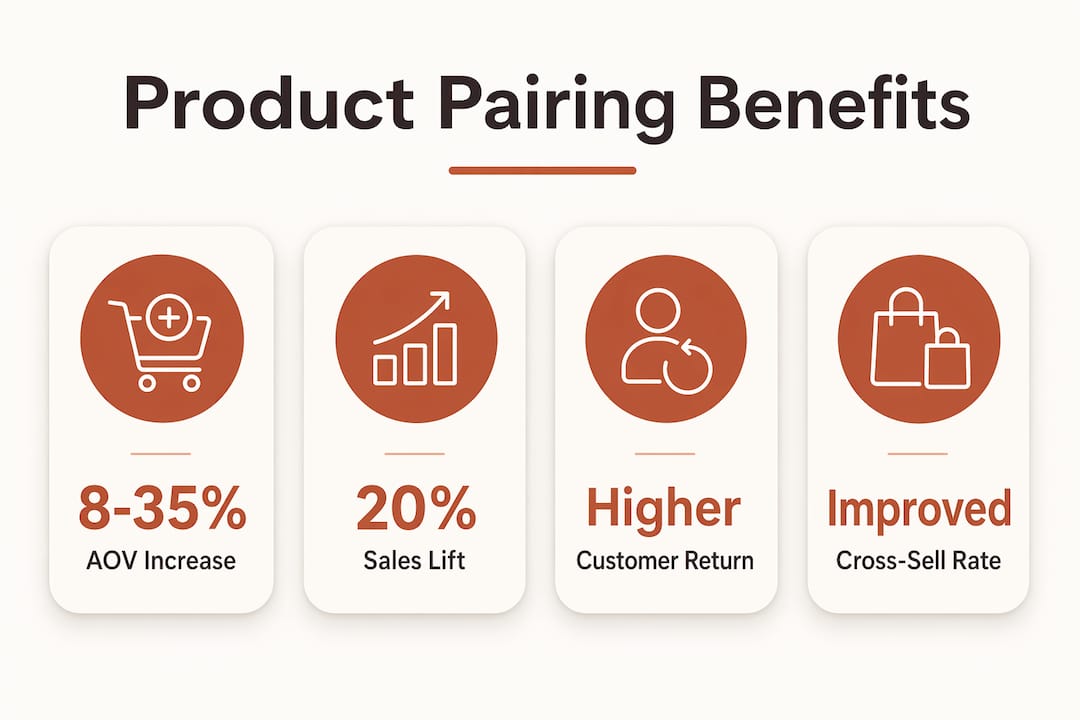
Product pair optimization directly increases average order value (AOV) by presenting customers with relevant, complementary products at the moment they are most likely to buy. AOV can increase by 8% to 35% when stores apply a 5–10% bundle discount alongside well-chosen pairings. That range is wide because relevance matters as much as the discount itself. A camera paired with a memory card converts. A camera paired with unrelated phone accessories does not.

The underlying mechanism is purchase psychology. Customers arrive with a primary intent and a limited mental budget for decisions. Showing them one or two logical additions reduces friction rather than adding it. Product adjacencies reduce decision-making effort, encouraging basket-building behavior by suggesting logical complementary sets without feeling pushy. That is the difference between a helpful recommendation and an annoying upsell.
What are the primary benefits of optimizing product pairs?
The business case for pairing products goes well beyond a single AOV bump. Here are the core advantages e-commerce teams see when they build a disciplined pairing program:
- Higher average order value. Bundled recommendations with a 5–10% discount consistently lift overall sales by up to 20%. The discount signals value; the pairing signals relevance.
- Improved conversion rates. Targeted content and UX optimization, including product recommendations, can increase conversion rates by 20–42%. Pairing removes the “what else do I need?” friction that causes cart abandonment.
- Stronger customer retention. Customers who buy complementary products in one session are more likely to return because their initial purchase works better. A skincare buyer who also picks up the matching serum gets better results and associates that outcome with your store.
- Lower churn and longer lifetime value. Effective optimization boosts activation by 17–30% and reduces churn by recovering customers who might otherwise disengage after a single purchase.
- Simplified decision-making. Presenting two or three curated options is faster for the customer than browsing an entire catalog. Fewer choices, better choices, and faster checkout all improve satisfaction scores.
The compounding effect matters here. A customer who buys two products instead of one is more likely to return, more likely to leave a positive review, and more likely to refer others. The benefits of product pairing extend well past the initial transaction.
How do AI and manual methods compare for pairing products?
The debate between AI-driven and manual product pairing is real, but the answer depends almost entirely on your data volume.
| Factor | AI pairing | Manual pairing |
|---|---|---|
| Data requirement | Needs sufficient transaction history | Works from day one |
| Add-to-cart rate | 3.8% in data-rich stores | 1.56% in data-rich stores |
| Best use case | Mature catalogs with purchase history | New stores or new product launches |
| Maintenance effort | Low once trained | High, requires ongoing curation |
| Risk | Cold start problem with thin data | Human bias and blind spots |
AI-picked pairings show a 3.8% add-to-cart rate versus 1.56% for manual pairings in stores with rich transaction data. That gap is significant. It reflects AI’s ability to surface non-obvious relationships that human merchandisers miss.
The cold start problem changes the equation for newer stores. AI pairing becomes unreliable below roughly 50 orders because there is not enough signal to distinguish real affinity from coincidence. Manual curation outperforms AI at this stage because an experienced merchandiser can apply category logic and supplier knowledge that no algorithm can replicate without data.
A hybrid approach works best for most mid-size stores. Use manual curation for new products and seasonal launches, then let AI take over once those products accumulate enough purchase history. This prevents the cold start problem from degrading the customer experience during critical launch windows.
One technical detail that separates good pairing programs from great ones: raw co-purchase counts are misleading. Affinity normalization adjusts co-purchase counts by total item frequency, removing the bias toward high-volume commodity items and surfacing truly complementary relationships. Without normalization, your “frequently bought together” widget will keep recommending your bestseller next to everything, which tells customers nothing useful.
Pro Tip: If you are using AI pairing, audit your top 10 recommended pairs monthly. Look for any pair where one item is a store bestseller appearing across unrelated categories. That is a normalization problem, not a genuine affinity signal.
What strategies make product pairing effective in practice?
Knowing why to pair products is one thing. Knowing how to do it well is another. These are the strategies that consistently move the needle:
-
Prioritize relevance above everything else. Bundle discount and placement in high-intent locations are bigger conversion drivers than whether you use AI or manual selection. A relevant manual pair outperforms an irrelevant AI pair every time. Start with category logic: accessories for electronics, care products for apparel, consumables for hardware.
-
Place recommendations where purchase intent peaks. The three highest-converting locations are the product page, the cart, and the post-purchase confirmation page. Product page placements catch customers in research mode. Cart placements catch them in buying mode. Post-purchase placements capture add-on sales with zero abandonment risk because the primary transaction is already complete.
-
Use bundle pricing and pricing opacity. Bundling focuses customer attention on total value rather than itemized costs. This protects your margins while delivering a perceived discount. A $79 bundle feels like a deal even when the individual items total $85, because customers rarely do the math. Price the bundle to reflect genuine value, not arbitrary discounting.
-
Limit bundle complexity. Two or three items per bundle is the practical ceiling for most product categories. Beyond three items, customers start questioning whether they need everything, and the cognitive load you were trying to reduce comes back. Keep it tight.
-
Refresh your pairs regularly. Seasonal trends, inventory changes, and new product launches all affect which pairs perform best. A quarterly review of your top 20 pairs catches stale recommendations before they drag down conversion rates.
Pro Tip: Test your cross-selling placement on the cart page first. It requires no product page redesign, it catches customers at peak intent, and you can measure the AOV lift within two weeks of launch.
What pitfalls should you avoid when pairing products?
Most pairing programs fail not because the concept is wrong but because execution breaks down in predictable ways.
- Recommending irrelevant products. This is the fastest way to erode customer trust. If a customer buying a yoga mat sees a recommendation for a blender, they question whether your store understands them at all. Relevance is non-negotiable.
- Showing too many options. More than three recommendations on a single page creates choice paralysis. Customers who cannot decide quickly default to buying nothing extra. Fewer, better options always outperform longer lists.
- Pairing budget items with expensive add-ons. A $15 phone case paired with a $200 accessory creates a price mismatch that feels tone-deaf. Match the price tier of your recommendations to the anchor product.
- Ignoring data freshness. Many stores update recommendations only daily, causing up to an 18-hour lag. When a product trends unexpectedly, that lag means missed revenue. The industry standard is real-time or near-real-time updates.
- Relying on raw co-purchase volume. Without affinity normalization, your recommendations skew toward bestsellers regardless of true complementarity. This makes your pairing widget redundant rather than useful.
The common thread across all these mistakes is a lack of ongoing measurement. Pairing programs that get set up and forgotten degrade over time. Treat your pairs as a living catalog, not a one-time configuration.
Key takeaways
Product pair optimization is the highest-return, lowest-cost method for increasing e-commerce revenue from existing traffic, combining relevance, placement, and bundle pricing to drive measurable AOV and retention gains.
| Point | Details |
|---|---|
| AOV uplift is real and measurable | A 5–10% bundle discount paired with relevant products can increase AOV by 8–35%. |
| AI beats manual only with enough data | AI pairing outperforms manual in data-rich stores, but manual curation wins during cold start phases. |
| Placement drives conversion | Product page, cart, and post-purchase are the three highest-converting locations for pair recommendations. |
| Relevance outranks method | A relevant manual pair converts better than an irrelevant AI pair every time. |
| Data freshness prevents revenue loss | Stale recommendations cause missed sales; real-time updates capture trending purchase patterns. |
What I have learned from watching pairing programs succeed and fail
The most common mistake I see e-commerce teams make is treating product pairing as a setup task rather than an ongoing discipline. They configure a “frequently bought together” widget, pick a few obvious pairs, and move on. Six months later, the pairs are stale, the data has shifted, and the widget is quietly dragging down trust without anyone noticing.
The teams that get this right treat pairing like a merchandising function, not a technical feature. They assign someone to review pair performance monthly. They test new pairs against control groups. They watch for the normalization problem where a bestseller colonizes every recommendation slot and makes the widget useless. These are not data science tasks. They are operational habits.
The AI versus manual debate also gets more attention than it deserves. Relevance is the variable that actually moves conversion. I have seen manually curated pairs in niche stores outperform AI recommendations in larger stores because the human merchandiser understood the customer’s workflow in a way the algorithm could not. The method is secondary. The quality of the match is primary.
What I find genuinely underappreciated is the post-purchase placement. Most teams focus on the product page and the cart. The confirmation page is almost always ignored, and it is the one moment when the customer has zero purchase anxiety. They already bought. A well-placed complementary offer on the confirmation page converts at rates that surprise most teams the first time they test it.
The other thing worth saying plainly: if you are not normalizing your co-purchase data, your AI recommendations are probably wrong in ways you cannot see. Raw volume bias is invisible until you look for it. Affinity normalization is not an advanced technique. It is a basic quality check that most platforms skip.
— Mateusz
How Affinsy helps you build smarter product pairs
Affinsy analyzes your historical transaction data to surface the product associations your customers are already making, ones that raw co-purchase counts and gut instinct both miss. The platform applies market basket analysis to identify true affinity pairs, not just volume-biased bestseller clusters. You can also use customer segmentation to tailor pairing recommendations by customer type, so a high-frequency buyer sees different suggestions than a first-time visitor. Affinsy connects via CSV upload, API, or MCP, and the permanent free tier covers up to 20,000 line items with no credit card required. If your pairing program is running on instinct rather than data, Affinsy gives you the analysis to change that.
FAQ
What does it mean to optimize product pairs?
Optimizing product pairs means selecting and presenting complementary products together to increase average order value and improve the customer purchase experience. The process combines data analysis, placement strategy, and pricing to maximize conversion.
How much can product pairing increase average order value?
Product pairing with a 5–10% bundle discount can increase AOV by 8–35% and lift overall sales by up to 20%, depending on product relevance and placement.
When should I use AI pairing versus manual pairing?
Use manual pairing when your store has fewer than roughly 50 orders or when launching new products. Switch to AI pairing once you have sufficient transaction history, as AI-driven pairs show a 3.8% add-to-cart rate compared to 1.56% for manual pairs in data-rich stores.
What is affinity normalization and why does it matter?
Affinity normalization adjusts co-purchase counts by total item frequency to remove bias toward high-volume products. Without it, your recommendations will default to bestsellers regardless of true complementarity, making your pairing widget less useful.
Where should product pair recommendations be placed for the best results?
The three highest-converting placements are the product page, the cart, and the post-purchase confirmation page. The confirmation page is the most underused, as customers have no purchase anxiety at that point and are receptive to relevant add-on offers.
Recommended
- E-commerce optimization checklist for AI-powered growth 2026 - Affinsy Blog | Affinsy
- Master Product Bundling Strategies for E-Commerce Success - Affinsy Blog | Affinsy
- 7 Smart Product Recommendation Ideas for E-Commerce Growth - Affinsy Blog | Affinsy
- How to Maximize Average Order Value for E-Commerce Stores - Affinsy Blog | Affinsy