
TL;DR:
- E-commerce personas are created from real customer data to target and engage specific behavioral archetypes effectively. Marketers should develop layered, privacy-compliant profiles that include negative and value-based segments to improve campaign precision and profitability. Regular updates and multi-team sharing ensure these personas remain relevant and drive sustainable growth.
E-commerce personas are semi-fictional customer profiles built from real behavioral, psychographic, and transactional data that help marketers target the right buyers with the right message. The industry term is “buyer persona,” though digital marketing teams increasingly use “shopper archetype” to emphasize behavioral patterns over demographics. The best examples of e-commerce personas go far beyond age and gender. They capture why someone buys, what triggers hesitation, and how much they are worth over time. Personas must be living documents grounded in recurring behaviors like product comparison habits and purchase triggers, not static stereotypes. Marketers who treat them as fixed profiles leave conversion gains on the table.
1. Examples of e-commerce personas: the four core behavioral archetypes
Four main behavioral archetypes dominate e-commerce buyer profiles: the Impulse Buyer, the Research-Driven Buyer, the Habitual Loyal Buyer, and the Price-Conscious Deal Hunter. These four types of online shoppers account for the vast majority of purchase decisions across product categories. Every e-commerce team should be able to name which archetype drives the most revenue in their store before building any campaign.
The Impulse Buyer (“Snap”)
Impulse Buyers prioritize visuals and urgency above all else. A countdown timer, a “only 3 left” badge, or a bold hero image triggers a purchase before rational evaluation kicks in. The marketing lever for this persona is friction removal: one-click checkout, autofilled payment details, and prominent social proof at the point of decision. Delay kills the sale.
The Research-Driven Buyer (“Thinker”)
Research-Driven Buyers require social proof, detailed product specifications, and clear trust signals before committing. They read reviews, compare alternatives, and check return policies. For this persona, thin product descriptions and missing size charts are conversion killers. Long-form content, comparison guides, and verified customer reviews are the tools that close the deal.

The Habitual Loyal Buyer
Habitual Loyal Buyers are repeat customers who value convenience and personalization above novelty. They respond to loyalty programs, personalized reorder reminders, and early access to new products. Losing this persona to a competitor usually happens because the brand stopped acknowledging them. Subscription options and “buy again” shortcuts are the highest-ROI features for this segment.
The Price-Conscious Deal Hunter
Deal Hunters prioritize discounts and show low brand loyalty when a better price appears elsewhere. They respond to flash sales, bundle deals, and coupon codes. The risk with this persona is that heavy discounting trains them to wait for sales, which compresses margins. The smarter play is to bundle value rather than cut price, pairing a discounted hero product with a full-price complement.
Pro Tip: Segment your email list by archetype before your next promotion. Send urgency-driven copy to Impulse Buyers and detailed comparison content to Thinkers. The same offer, reframed for each persona, consistently outperforms a single broadcast.
2. How to build layered personas: buyer, user, negative, and value-based
Effective persona development includes four layers: Buyer, User, Negative, and Value-Based personas. Most marketing teams only build the first layer and wonder why their targeting underperforms. The layered approach is what separates a functional persona from one that actually improves return on ad spend.
-
Buyer personas represent the person making the purchase decision. In B2C e-commerce, the buyer and user are usually the same person. In gift-driven categories like toys or luxury goods, they are often different.
-
User personas represent the person who actually uses the product. A parent buying educational software for a child is the buyer. The child is the user. Messaging that speaks only to the buyer misses the emotional trigger of “will my child love this?”
-
Negative personas represent customer segments you should actively exclude from campaigns. Negative personas exhibit frequent returns, high support needs, and low lifetime value. Running paid ads to this segment burns budget without building revenue. Identifying and suppressing these audiences in ad platforms is one of the fastest ways to improve campaign efficiency.
-
Value-based personas segment customers by lifetime value and profitability rather than behavior alone. Focusing marketing spend on high-value segments maximizes return on ad spend, while deal-first personas show low loyalty and profitability. A value-based lens tells you which behavioral archetype is worth acquiring at a higher cost per click.
The layered approach works because it forces your team to answer three questions at once: who buys, who uses, and who costs more than they are worth.
3. Shopper temperaments and designing content for each
Four shopper temperaments shape how buyers process information on a product page: Competitive, Spontaneous, Humanistic, and Methodical. These temperaments are not the same as behavioral archetypes. They describe how a person prefers to receive and evaluate information, regardless of whether they are an impulse buyer or a researcher.
| Temperament | Primary need | Content that converts |
|---|---|---|
| Competitive | Results and efficiency | Bold headline, key benefit, clear CTA |
| Spontaneous | Excitement and speed | Visuals, urgency cues, short copy |
| Humanistic | Trust and connection | Brand story, customer photos, reviews |
| Methodical | Proof and detail | Specs, certifications, comparison data |
The practical insight here is that balancing content hierarchy on a single product page allows each temperament to self-select the information they need. You do not need four separate landing pages. A well-structured page leads with a strong headline for Competitive shoppers, uses hero imagery for Spontaneous shoppers, includes a brand story block for Humanistic shoppers, and ends with a full specification table for Methodical shoppers.
Conversion pitfalls appear when teams design for only one temperament. A page built entirely for Methodical shoppers buries the headline and loses Spontaneous buyers in the first three seconds. A page built entirely for Spontaneous shoppers gives Methodical buyers nothing to verify, so they leave to research elsewhere.
Pro Tip: Run a five-second test on your top product pages. Ask participants what the page is about and what they should do next. If Competitive and Spontaneous temperaments cannot answer in five seconds, your page is losing fast-decision buyers before they scroll.
4. Building e-commerce personas with data and privacy in mind
Data-driven persona creation combines quantitative signals with psychographic context. RFM modeling categorizes customers into tiers like loyalist, high-value, or at-risk, giving each behavioral archetype a measurable revenue dimension. RFM stands for Recency, Frequency, and Monetary value. It tells you not just who a customer is, but how engaged and profitable they are right now.
The modern constraint on persona building is data privacy. Privacy-by-design practices require persona creation to aggregate behavioral patterns without storing identifiable personal information. Platforms that handle this well use anonymized cohort data to identify patterns rather than tracking individuals. The result is a persona that reflects real behavior without creating compliance risk.
Practical data sources for building e-commerce buyer profiles include:
- Transactional data: order history, average order value, purchase frequency, and product category affinity
- On-site behavioral data: pages visited, time on page, search queries, and cart abandonment points
- Psychographic surveys: post-purchase questions about motivations, values, and lifestyle
- Support ticket analysis: recurring complaints and questions that reveal friction points by segment
AI-powered analytics tools can process these inputs and surface patterns that manual analysis misses. The output is a persona that updates as customer behavior shifts, rather than one that reflects a survey taken two years ago. For a detailed walkthrough of combining these data types, the customer profiling guide from Affinsy covers the full process step by step.
5. Demographic and lifestyle personas: going beyond behavior
Behavioral personas are detailed archetypes enabling personalized experiences and long-term brand loyalty, unlike broad demographic segments. That said, demographic and lifestyle data add important context that behavioral data alone cannot provide. The two layers work together, not in competition.
Consider two example profiles that illustrate how demographic and psychographic data complement behavioral archetypes:
-
“Style-Conscious Sarah” is a 32-year-old urban professional who shops for apparel and home goods. Her behavioral archetype is Research-Driven. Her psychographic profile shows high brand affinity for sustainability and ethical sourcing. Marketing to Sarah with a generic discount email misses both her research orientation and her values. The message that converts her leads with environmental certifications and links to a detailed materials page.
-
“Budget-First Ben” is a 45-year-old suburban parent shopping for household essentials. His behavioral archetype is Price-Conscious. His lifestyle context shows he shops in bulk and values time efficiency. A flash sale on a single item does not move him. A bundle deal that saves time and money on a monthly restock does.
The customer segmentation guide from Affinsy explains how to layer demographic segments with behavioral data to build profiles that are specific enough to act on. Demographic data tells you who is in the room. Behavioral data tells you what they want. Psychographic data tells you why they want it. All three together produce a persona worth building a campaign around.
Understanding shopping behavior patterns at this level of detail is also what separates brands that grow through retention from those that constantly chase new acquisition.
6. Applying value-based segmentation to prioritize high-ROI personas
Not all personas deserve equal marketing investment. Value-based segmentation ranks customer segments by their actual and projected contribution to revenue. This is where digital marketing personas connect directly to budget decisions rather than staying abstract.
The practical method is to overlay RFM scores onto your behavioral archetypes. A Habitual Loyal Buyer with a high monetary score and recent purchase is your highest-priority segment. An Impulse Buyer who purchased once six months ago and never returned is a low-priority segment. The difference in acquisition cost tolerance between these two segments can be significant.
Value-based thinking also changes how you approach personalized email campaigns for each persona. High-value segments justify more personalized, higher-cost touchpoints. Low-value segments get automated flows with minimal manual effort. This is not about ignoring lower-value customers. It is about matching the cost of engagement to the expected return.
The why segment customers article from Affinsy breaks down how value-based segmentation translates directly into campaign budget decisions for e-commerce teams in 2026.
Key takeaways
Effective e-commerce personas combine behavioral archetypes, temperament layers, value-based segmentation, and privacy-compliant data to give marketers a targeting framework that improves both conversion and long-term profitability.
| Point | Details |
|---|---|
| Four core behavioral archetypes | Impulse, Research-Driven, Loyal, and Deal Hunter personas each need distinct messaging and triggers. |
| Layer your personas | Add buyer, user, negative, and value-based layers to improve targeting precision and protect margins. |
| Design for all four temperaments | Structure product pages so Competitive, Spontaneous, Humanistic, and Methodical shoppers each find what they need. |
| Use RFM to prioritize | Overlay RFM scores on behavioral archetypes to decide which personas justify higher acquisition spend. |
| Privacy-by-design is non-negotiable | Build personas from anonymized behavioral patterns to stay compliant and maintain customer trust. |
Why most persona projects fail before they start
Most e-commerce teams build personas once, file them in a shared drive, and never update them. That is the core failure. A persona built on last year’s purchase data does not reflect how your customers behave today, especially after a product line change or a shift in the competitive environment.
The second failure I see constantly is ignoring negative personas. Teams spend weeks defining their ideal customer and zero time defining who they do not want to acquire. Negative personas, the chronic returners, the coupon-only buyers, the high-support-cost segments, drain resources faster than any ad budget mistake. Excluding them from campaigns is one of the most profitable decisions a marketing team can make, and almost no one does it systematically.
The third failure is building personas in a silo. When the persona lives only in the marketing team’s documents, it never reaches the product team, the customer service team, or the merchandising team. The persona only creates value when it shapes decisions across the organization. That means sharing it, updating it in quarterly reviews, and tying it to actual revenue outcomes rather than leaving it as a character sketch.
My honest recommendation: treat your persona set as a living dashboard, not a document. Connect it to your RFM data so it updates automatically as customer behavior shifts. The brands that do this consistently outperform those that rely on annual persona refreshes.
— Mateusz
How Affinsy helps you act on your persona data
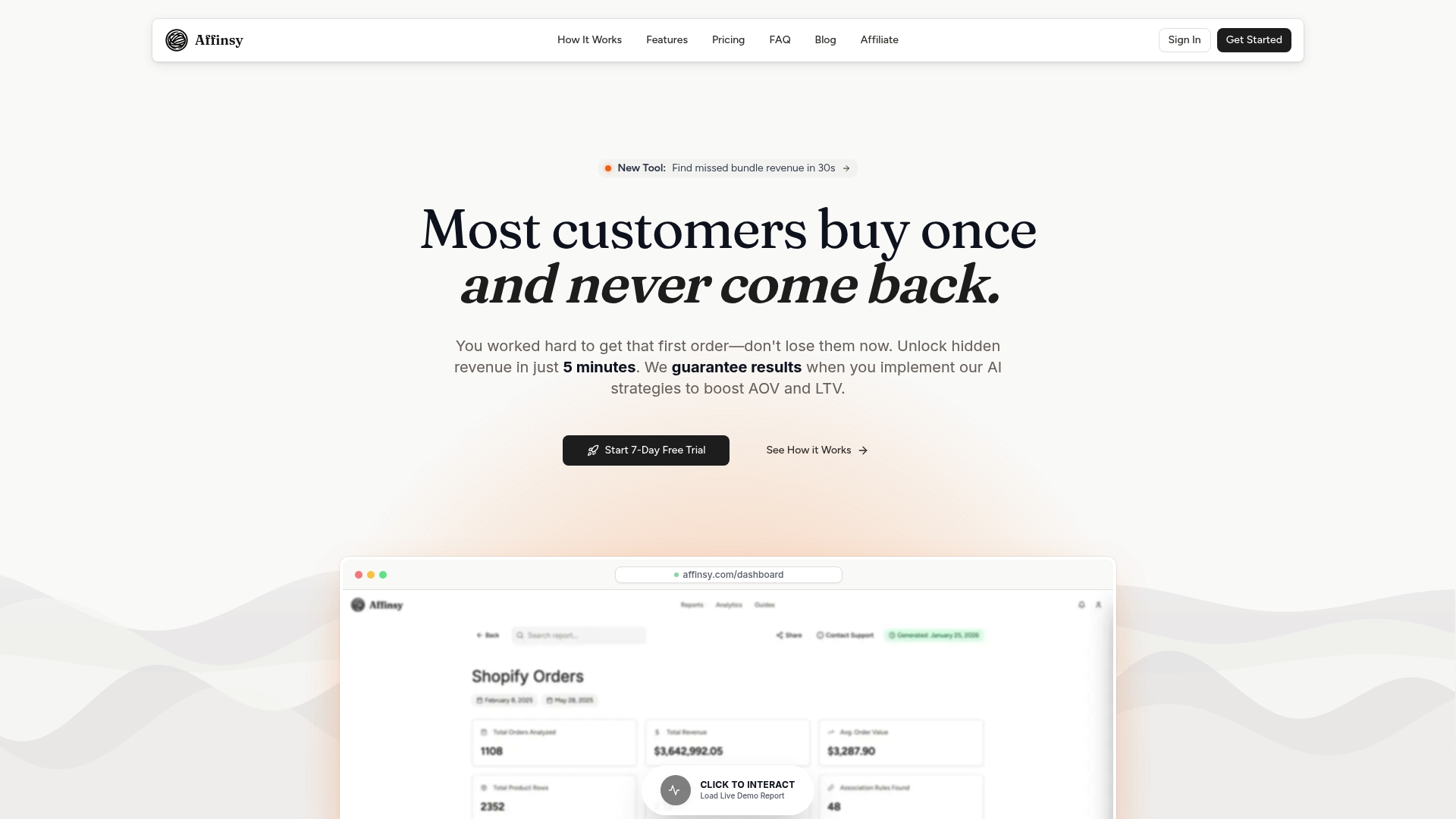
Affinsy turns your existing transaction data into the behavioral signals that make personas actionable. The platform’s market basket analysis identifies which products your Impulse Buyers and Loyal Buyers purchase together, giving you the cross-sell logic to match each persona’s actual behavior. The RFM-based customer segmentation engine overlays recency, frequency, and monetary scores onto your customer base, so you can rank personas by value and allocate budget accordingly. Affinsy connects via CSV upload, API, or MCP, with no data science skills required. The permanent free tier covers up to 20,000 line items with full product access and no credit card required.
FAQ
What are the main types of online shopper personas?
The four core behavioral archetypes are the Impulse Buyer, the Research-Driven Buyer, the Habitual Loyal Buyer, and the Price-Conscious Deal Hunter. Each requires distinct messaging, content formats, and conversion triggers.
How do negative personas improve marketing ROI?
Negative personas identify unprofitable customer segments, such as chronic returners or high-support-cost buyers, and excluding them from paid campaigns reduces wasted spend and improves overall return on ad spend.
What data do I need to build e-commerce buyer profiles?
The most effective profiles combine transactional data processed through RFM analysis with psychographic survey responses and on-site behavioral signals like search queries and cart abandonment rates.
How often should e-commerce personas be updated?
Personas should be treated as living profiles and reviewed at least quarterly. Behavioral patterns shift with product line changes, seasonal trends, and competitive moves, so static annual updates are not sufficient.
What is the difference between a buyer persona and a user persona?
A buyer persona represents the person making the purchase decision. A user persona represents the person who uses the product. In gift or family-purchase categories, these are often different people and require separate messaging strategies.