
TL;DR:
- Effective ecommerce customer segmentation combines behavioral, lifecycle, and demographic data to tailor marketing strategies. Focusing on 3 to 5 core segments like Champions, At-risk, and new buyers yields measurable results and avoids unnecessary complexity. Prioritizing data-driven insights over fictional personas ensures that campaigns target the right customers at the right time for maximum impact.
Ecommerce customer groups are categories of shoppers defined by shared characteristics such as demographics, behavior, lifestyle, location, and stage in the customer journey, enabling businesses to tailor marketing efforts with precision. The industry term for this practice is customer segmentation, and the best ecommerce customer groups examples draw from five core pillars: demographic, geographic, behavioral, psychographic, and lifecycle stage. Platforms like Drip, Klaviyo, and Adobe Commerce B2B all build their segmentation logic around these same categories because combining them consistently produces higher conversion rates than relying on a single dimension alone.
1. Demographic ecommerce customer groups examples
Demographic segmentation divides your audience by measurable personal attributes: age, gender, income, education, and family status. These are the fastest groups to build because the data is either collected at checkout or inferred from purchase patterns, and they directly shape how you position products and write copy.

Demographic segments like High-Income Urban Professionals and Suburban Families are two of the most actionable groups for gifting campaigns and premium product lines. A High-Income Professional buying a $400 skincare set responds to scarcity messaging and editorial photography. A Suburban Family buying the same brand responds to bundle pricing and “great for the whole household” framing. Same product, completely different message.
Common demographic groups for online stores include:
- Age 18 to 24 (Gen Z): Mobile-first, price-sensitive, heavily influenced by social proof and short-form video
- Age 25 to 44 (Millennials): Research-driven buyers who compare reviews before purchasing; respond well to loyalty programs
- High-income professionals (household income $100K+): Prioritize quality and convenience; less price-sensitive
- Suburban families: Value multi-unit packs, subscription savings, and family-size product variants
- Seniors (65+): Prefer clear navigation, larger text, and phone support options; growing fastest in health and home categories
Pro Tip: Do not treat gender as a binary targeting lever for product categories. Income and life stage are far stronger predictors of purchase behavior in most ecommerce verticals.
2. Behavioral customer groups with actionable ecommerce examples
Behavioral segmentation groups shoppers by what they actually do: how often they buy, what they buy, how much they spend, and how they engage with your site and emails. This is where segmentation moves from description to prediction.
RFM segmentation (Recency, Frequency, Monetary value) is the gold standard for behavioral grouping because it predicts future purchase behavior accurately and identifies your highest-value customers before they churn. RFM scores every customer on three axes, then places them into named groups that map directly to marketing actions.
The five behavioral segments every ecommerce store should define:
- Champions: Bought recently, buy often, and spend the most. Reward them with early access and referral incentives.
- Loyal customers: Buy regularly but not at the highest spend tier. Upsell with complementary products and subscription offers.
- Potential loyalists: Recent first or second-time buyers. The window to convert them into repeat customers is open right now.
- At-risk customers: Once-strong buyers who have gone quiet. At-risk customers are typically defined as those who exceed their average purchase cycle, such as 90 days without a purchase in cosmetics, making them the primary target for win-back sequences.
- Browse abandoners: Visited product pages but never added to cart. These shoppers need social proof and urgency, not a discount.
Pro Tip: Affinsy’s RFM segmentation engine scores your entire customer base automatically from a CSV export or API connection. You get named segments like Champions and At-Risk without writing a single formula.
You can also segment by email engagement patterns to layer behavioral signals on top of RFM. A customer who opens every email but never clicks is a different problem than one who clicks but never converts.
3. Psychographic and lifestyle-based customer groups
Psychographic segmentation groups customers by values, attitudes, interests, and lifestyle choices rather than who they are or what they buy. It is harder to build from transaction data alone, but it produces the strongest emotional resonance in campaigns.
Psychographic segments like Eco-Conscious Shoppers and Health and Wellness Enthusiasts are particularly powerful because they align with brand mission, not just product category. An eco-conscious shopper does not just buy sustainable products. They share them, advocate for them, and penalize brands that contradict their values. That behavior pattern has direct implications for your content strategy, packaging decisions, and return policy.
Key psychographic groups for ecommerce brands to consider:
- Eco-conscious shoppers: Prioritize sustainable packaging, carbon-neutral shipping, and ethical sourcing; heavily influenced by peer reviews and B Corp certifications
- Health and wellness enthusiasts: Buy supplements, organic food, fitness equipment, and clean beauty; respond to ingredient transparency and clinical claims
- Value seekers: Not necessarily low-income; they derive satisfaction from finding the best deal and will comparison-shop extensively before converting
- Status-driven buyers: Purchase brands as identity signals; respond to limited editions, collaborations, and exclusivity messaging
- Convenience maximizers: Subscribe-and-save users, one-click reorder customers; they will pay a premium to reduce friction
The insight that separates good psychographic segmentation from generic persona work: emotional and value-driven buyers like the Conscious Shopper rely less on traditional advertising and more on peer influence and community. That means your marketing channel mix shifts, not just your copy.
4. Geographic and localization ecommerce customer group examples
Geographic segmentation divides your audience by where they are: country, region, city, climate zone, or timezone. For ecommerce brands shipping physical products, this is not just a marketing variable. It directly affects inventory positioning, carrier selection, and promotional timing.
Geographic segmentation including climate and region-based groups allows targeted promotions and logistics planning that generic national campaigns cannot achieve. A winter outerwear brand running the same promotion in Miami and Minneapolis in November is wasting budget on one of those audiences.
| Geographic segment | Key characteristic | Marketing application |
|---|---|---|
| Cold-climate regions | Seasonal demand spikes for outerwear, heating, and comfort products | Launch winter campaigns 4 to 6 weeks earlier than national average |
| Warm-climate regions | Year-round demand for outdoor, garden, and cooling products | Promote seasonal items as lifestyle staples, not seasonal buys |
| Urban metro areas | Higher average order values, faster delivery expectations, apartment-sized product preferences | Prioritize same-day or next-day shipping messaging |
| Rural and suburban areas | Larger basket sizes, preference for bulk and multi-pack options | Emphasize free shipping thresholds and subscription savings |
| International markets | Currency, language, and duty considerations affect conversion | Localize pricing pages and checkout flows before running paid traffic |
Geographic data also feeds smarter inventory decisions. If 40% of your cold-weather product demand comes from three Midwest states, you stock your nearest fulfillment center accordingly rather than distributing evenly across your network.
5. Customer lifecycle and engagement level groups
Lifecycle segmentation maps customers to their stage in the relationship with your brand. Engagement segmentation layers on how actively they interact with your channels. Together, they tell you not just who to target but what to say and through which channel.
Lifecycle segments including new buyers, repeat customers, at-risk, and lapsed customers enable targeted nurture and retention campaigns that generic broadcast messaging cannot replicate. Each stage requires a different objective: acquisition, activation, retention, or reactivation.
| Segment | Definition | Recommended campaign type |
|---|---|---|
| New subscriber | Opted in but has not purchased | Welcome series with social proof and first-order incentive |
| First-time buyer | One purchase in the last 30 days | Post-purchase onboarding, cross-sell recommendations |
| Repeat customer | Two or more purchases | Loyalty program enrollment, VIP early access offers |
| At-risk customer | No purchase beyond their average cycle | Win-back sequence with personalized product reminder |
| Lapsed customer | No purchase in 6 to 12 months | Re-engagement offer with updated product catalog |
Engagement level adds a second dimension. A lapsed customer who still opens your emails is far more recoverable than one who has unsubscribed. Segmenting by both lifecycle stage and email or SMS activity lets you prioritize your win-back budget on the highest-probability returners rather than blasting your entire dormant list.
Loyalty program structures work best when they are mapped to lifecycle stages. A points program designed for repeat customers does nothing for a first-time buyer who has not yet decided whether to return.
6. B2B tiered customer groups in ecommerce
B2B ecommerce uses a distinct segmentation model built around pricing tiers and purchasing volume rather than personal demographics. Adobe Commerce B2B distributors, for example, structure their customer groups as Standard (60% of accounts), Volume Tier 1 (20%), Volume Tier 2 (12%), and Strategic (7%). Each tier unlocks different price lists, payment terms, and catalog access.
This tiered approach reduces administrative overhead by replacing individual negotiated contracts with rule-based pricing bands. A distributor with 500 wholesale accounts cannot manage 500 custom price lists. Four tiers with clear qualification criteria scale without adding headcount.
B2B personas also differ from B2C in what motivates them. B2B personas focus on preventing specific business losses, such as patient leakage for a medical equipment buyer, rather than on lifestyle or aspiration. If you sell to businesses, your segmentation criteria should center on the business risk your product eliminates, not the industry vertical your buyer works in.
7. How to categorize online shoppers: choosing the right starting point
Ecommerce platforms generally allow unlimited customer groups but recommend starting with 3 to 5 core segments to maintain focus and reduce complexity. That recommendation exists for a good reason. More segments mean more campaigns to build, more creative to produce, and more data to monitor. Complexity without data support dilutes results rather than improving them.
The practical starting framework for most ecommerce stores: build one behavioral segment (RFM-based), one lifecycle segment (new versus repeat versus lapsed), and one demographic or psychographic segment that reflects your actual best customer. Run those three for 90 days, measure lift, and expand only where you see clear signal.
Generic personas reduce effectiveness. Effective segmentation uses research-backed behavioral data and role-specific pain points rather than fictional composites built in a workshop. The difference between a useful segment and a useless one is whether it changes what you say and where you say it. If your “Millennial Mom” persona produces the same email as your “Gen Z Student” persona, you have not actually segmented anything.
You can read more about why segmentation drives sales and the specific behavioral triggers that make segments actionable in practice.
Key takeaways
Effective ecommerce customer segmentation requires combining behavioral, lifecycle, and demographic groups built on real transaction data, not fictional personas.
| Point | Details |
|---|---|
| Start with 3 to 5 segments | More segments without data support dilutes marketing impact and increases operational complexity. |
| Behavioral and RFM groups convert best | Champions, At-Risk, and Potential Loyalist segments map directly to revenue-generating campaigns. |
| Lifecycle stage changes the message | New buyers, repeat customers, and lapsed shoppers each need a different campaign objective and channel. |
| Psychographics drive emotional connection | Eco-conscious and wellness segments respond to mission-led content more than promotional offers. |
| Geographic data affects operations, not just marketing | Climate and region segments inform inventory positioning and fulfillment strategy alongside campaign targeting. |
Why most segmentation projects stall before they pay off
Most ecommerce teams I have worked with start segmentation projects with genuine enthusiasm and end up with a spreadsheet of 12 personas that nobody uses. The problem is almost never the data. It is the gap between building a segment and knowing what to do with it.
The segments that actually move revenue are the ones tied to a specific campaign trigger. “At-Risk customers who have not purchased in 90 days” is useful because it tells you exactly who to email, what to offer, and when to send it. “Millennial Mindful Shopper” is not useful until you attach a behavioral definition to it.
My honest recommendation: skip psychographic segmentation entirely until you have behavioral and lifecycle segments running and generating measurable lift. Psychographics are powerful for brand storytelling and content strategy, but they are hard to build from transaction data alone and easy to get wrong. Start with what your order history tells you directly. RFM scoring from even a basic CSV export will surface your Champions and your At-Risk customers within minutes, and those two groups alone justify the entire segmentation investment.
I have also seen brands over-invest in demographic targeting at the expense of behavioral signals. Knowing that your best customers are 35 to 44 year old women is less useful than knowing they buy every 47 days and their average order value is $120. The second fact tells you when to send a replenishment reminder. The first just tells you what stock photo to use.
The complete segmentation guide from Affinsy covers the full methodology if you want to go deeper on implementation sequencing.
— Mateusz
See your customer segments in Affinsy
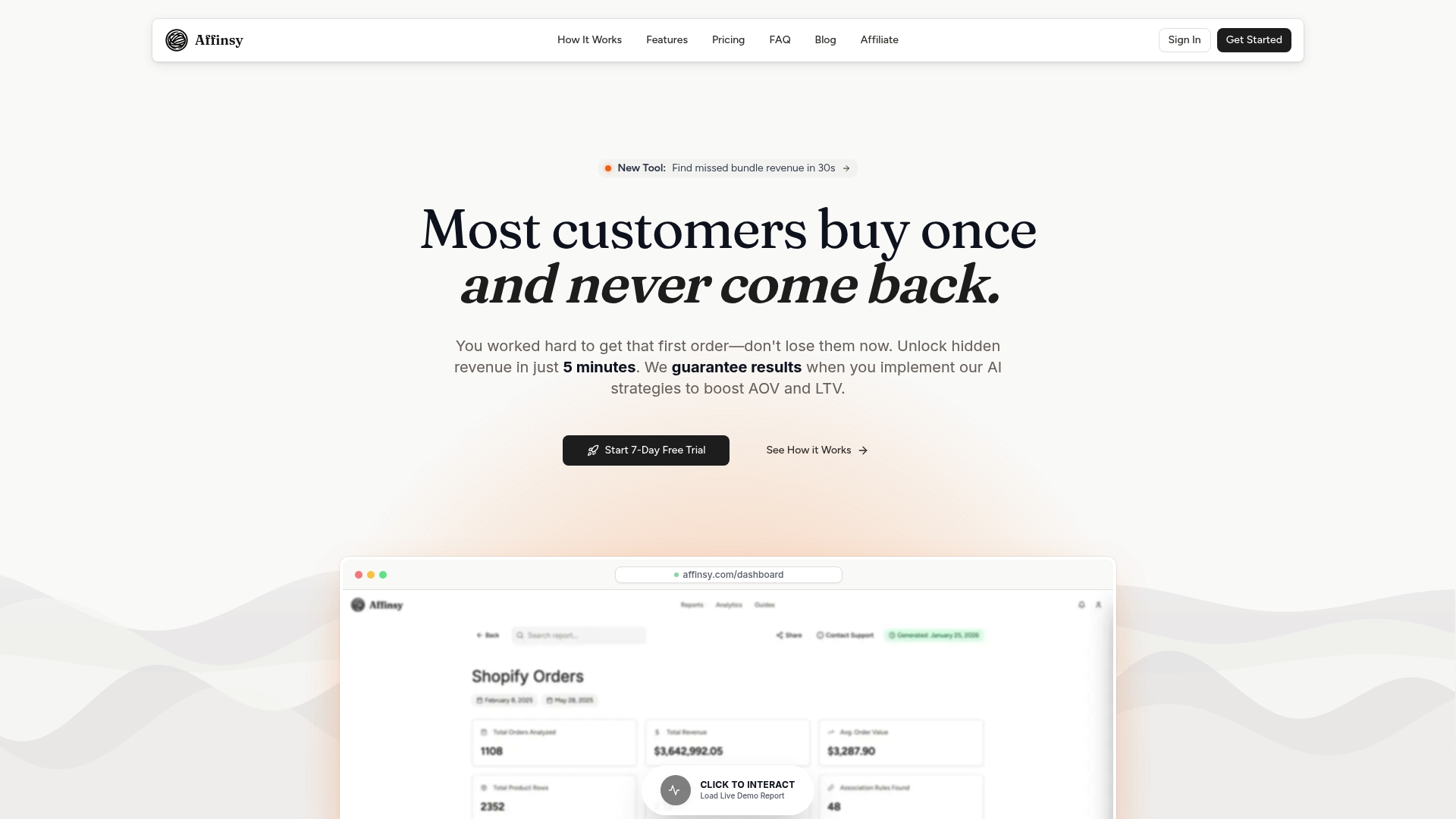
Affinsy analyzes your historical transaction data to surface RFM segments, product associations, and customer behavior patterns without requiring a data science team. Export your order data from Shopify, WooCommerce, BigCommerce, or Stripe, then upload via CSV or connect through the API. Your Champions, At-Risk customers, and Potential Loyalists appear automatically. The customer segmentation glossary explains every metric and segment definition in plain language, and the market basket analysis tool shows which products your best segments buy together. The permanent free tier covers up to 20K line items with no credit card required.
FAQ
What are the main types of ecommerce customer segments?
The five core types are demographic, geographic, behavioral, psychographic, and lifecycle stage. Most ecommerce brands combine at least three of these for higher targeting precision and conversion rates.
How many customer groups should an online store start with?
Start with 3 to 5 core segments. Ecommerce platforms support unlimited groups, but operational best practice limits initial segmentation to a manageable number to maintain campaign focus and reduce complexity.
What is RFM segmentation in ecommerce?
RFM stands for Recency, Frequency, and Monetary value. It scores customers on three purchase behavior dimensions to identify high-value groups like Champions and at-risk groups who need win-back campaigns.
What is an example of a psychographic customer group?
Eco-Conscious Shoppers and Health and Wellness Enthusiasts are two widely used psychographic segments. These groups respond to mission-led campaigns and peer influence more than traditional promotional advertising.
How do lifecycle segments differ from behavioral segments?
Lifecycle segments define where a customer is in their relationship with your brand, such as new buyer or lapsed customer. Behavioral segments define how they act, such as purchase frequency or cart abandonment, and the two are most effective when used together.