
TL;DR:
- Modern behavior modeling predicts customer actions with high accuracy, enabling data-driven decisions.
- Traditional models are slower and less adaptable compared to AI-driven, real-time prediction systems.
- Effective implementation requires ongoing model retraining, interpretability, bias management, and linking insights to actions.
Customer behavior used to feel like guesswork. You’d launch a bundle, run a retention campaign, and hope the data told a good story afterward. That era is over. Modern behavior modeling predicts purchase likelihood with 75 to 85% accuracy and flags churn risk above 80%, turning what once felt like intuition into a repeatable, data-driven system. This guide breaks down exactly what customer behavior modeling is, which methods work best, and how you can apply it today for smarter product bundling and stronger retention.
Table of Contents
- What is customer behavior modeling?
- Traditional models vs. data-driven modeling: What’s changed?
- Key methods and frameworks for modeling customer behavior
- Applying customer behavior modeling: Product bundling and retention in action
- Pitfalls, limitations, and must-haves for business impact
- Why most e-commerce teams misuse behavior modeling—and how to do better
- Start unlocking smarter decisions with customer behavior modeling
- Frequently asked questions
Key Takeaways
| Point | Details |
|---|---|
| Accurate predictions | Advanced models now predict e-commerce purchases and churn with up to 85% accuracy. |
| Modern vs traditional | Today’s data-driven models offer faster, more actionable insights than old psychological approaches. |
| Practical applications | Use behavior modeling to power smarter product bundling, A/B testing, and retention strategies. |
| Avoid bias & pitfalls | To maximize ROI, prioritize interpretability, regular updates, and ethical safeguards in your modeling. |
What is customer behavior modeling?
Customer behavior modeling is not a single tool. It’s a discipline. At its core, customer behavior modeling in e-commerce uses statistical algorithms, machine learning, and data analytics to analyze historical customer data including browsing patterns, transaction histories, demographics, and engagement metrics to predict future actions, preferences, purchasing decisions, churn risk, and lifetime value.
Think of it as building a detailed map of your customers’ decision-making patterns. Every click, every abandoned cart, every repeat purchase adds a data point. Over time, those points form patterns. Those patterns become predictions. And those predictions become revenue.
The key data inputs include:
- Browsing behavior: Pages visited, time on site, product views, and scroll depth
- Transaction history: What customers bought, how often, and at what price points
- Demographics: Age, location, device type, and account tenure
- Engagement signals: Email open rates, push notification responses, and social interactions
Here’s a quick look at how predictive outcomes translate to business impact:
| Predictive outcome | Business application | Potential impact |
|---|---|---|
| Purchase likelihood score | Targeted promotions | Higher conversion rates |
| Churn risk flag | Retention campaigns | Reduced customer loss |
| Next product prediction | Cross-sell recommendations | Increased AOV |
| Lifetime value estimate | Budget allocation | Better acquisition ROI |
| Segment classification | Personalized messaging | Stronger engagement |
“Models that combine transaction history with behavioral signals consistently outperform single-source approaches, delivering more reliable predictions across the full customer lifecycle.”
If you want a deeper look at how this connects to revenue strategy, the customer behavior analysis guide covers the analytical foundations in practical detail.
Traditional models vs. data-driven modeling: What’s changed?
Classic frameworks like the Engel-Kollat-Blackwell (EKB) model or the Black Box model were built for a slower world. They focused on psychological and sociological factors to explain why customers made decisions. Useful theory, but limited in practice when you’re managing thousands of SKUs and millions of customer touchpoints.
Traditional models focus on psychological and sociological factors but lack real-time data. Contemporary AI and machine learning shifts to dynamic, data-driven prediction that fuses behavior science with high-volume signals for superior accuracy.
The core differences are significant:
- Focus: Traditional models explain behavior after the fact. AI models predict it before it happens.
- Speed: Manual analysis takes days or weeks. Automated models update in near real time.
- Adaptability: Static frameworks don’t respond to seasonal shifts or market changes. Machine learning models retrain and adjust continuously.
- Precision: Broad psychological segments give way to granular individual-level predictions.
Here’s a side-by-side comparison of the two approaches:
| Dimension | Traditional models | AI-driven models |
|---|---|---|
| Data inputs | Surveys, focus groups | Transaction logs, clickstreams |
| Update frequency | Periodic | Continuous |
| Strengths | Conceptual clarity | Predictive accuracy |
| Weaknesses | Slow, hard to scale | Can be opaque (black box) |
| Best use case | Academic research, strategy | Real-time personalization |
The practical gap is clear. If you’re managing a mid-to-large e-commerce operation, traditional frameworks simply can’t keep up with the volume and velocity of modern customer data. You need models that work at scale, in real time, and with your actual transaction data. Explore the e-commerce glossary to get familiar with the key terms before you start evaluating tools.

Pro Tip: Not every decision needs a neural network. For high-stakes choices like pricing changes or customer segmentation policies, use interpretable models like logistic regression so your team can explain and defend the output.
Key methods and frameworks for modeling customer behavior
Understanding the landscape of modeling methods helps you choose the right tool for each problem. Here are the essential approaches and how they apply in practice:
-
Logistic regression: Predicts binary outcomes like “will this customer buy in the next 30 days?” It’s fast, interpretable, and easy to explain to non-technical stakeholders. Great for churn flags and purchase propensity scoring.
-
Decision trees and random forests: Map out branching decision paths based on customer attributes. Random forests combine hundreds of trees to reduce error. Useful for segmentation and identifying which behavioral signals matter most.
-
Neural networks and deep learning: Handle complex, non-linear patterns across large datasets. Powerful for recommendation engines and next-product prediction, but harder to interpret. Use with caution when business explainability matters.
-
RFM modeling combined with behavioral triggers: RFM (Recency, Frequency, Monetary value) is a proven segmentation framework. Layering in behavioral signals like email engagement, site visit frequency, and cart activity makes it significantly more accurate for both retention and bundling decisions.
-
Unsupervised learning (clustering): Groups customers by behavioral similarity without predefined labels. Useful for discovering new segments you didn’t know existed, like a group of high-frequency browsers who rarely convert.
The predictive analytics strategies that consistently outperform rely on combining these methods rather than betting on one. And as behavioral analytics for sales shows, the real lift comes when you connect model outputs directly to campaign triggers.
“The best modeling frameworks prioritize interpretability for business decisions, combine RFM with live behavioral signals, and include ethical safeguards to prevent proxy discrimination in ML outputs.”
Two critical requirements that teams often overlook: continuous retraining and data governance. A model trained on last year’s data will drift as customer habits change. And without proper governance, you risk building models that inadvertently encode bias based on demographic proxies.
Pro Tip: Use interpretable models for critical business decisions. Save black-box approaches for recommendation engines where the output is a suggestion, not a policy.
Applying customer behavior modeling: Product bundling and retention in action
This is where theory meets revenue. Two of the highest-impact applications for behavior modeling are product bundling and customer retention. Both rely on the same underlying data, but the execution looks different.
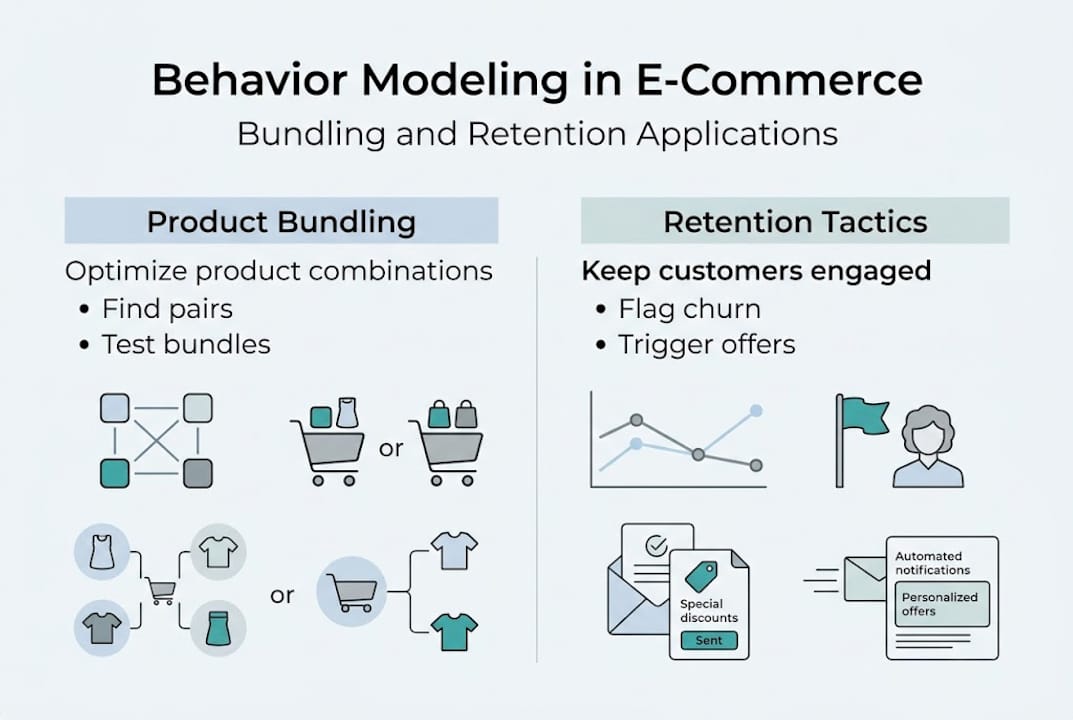
For product bundling, the process starts with your transaction data. Analyze purchase history, cart abandonment patterns, complementary products bought together, and browsing sequences to identify natural bundle candidates. The goal is to surface combinations that customers already gravitate toward, then make those combinations easier and more rewarding to buy.
Once you have bundle candidates, test pricing in the 5 to 20% discount range based on your margins. Run A/B tests to compare bundle performance against individual product sales. Track average order value (AOV), bundle attach rate, and inventory turnover. The result is higher AOV, faster inventory clearance, and a more satisfying purchase experience.
For retention, the modeling approach shifts to churn prediction. You’re looking for customers whose behavior signals disengagement: declining purchase frequency, reduced email engagement, longer gaps between site visits. When a customer’s churn risk score crosses a threshold, you trigger an intervention. That might be a personalized discount, a reactivation email, or a loyalty reward.
Application to e-commerce extends to dynamic bundling based on real-time data, retention campaigns triggered by churn flags, and personalization at scale through next-best-experience recommendations.
The scale of customer expectations makes this urgent. A significant share of both B2C and B2B buyers expect brands to anticipate their needs, with 63% of B2C buyers and 76% of B2B buyers reporting this expectation. Behavior modeling is how you meet that bar.
Top use cases worth prioritizing:
- Dynamic bundling: Surface bundles based on real purchase co-occurrence data, not gut feel
- Churn prevention: Flag at-risk customers before they leave and trigger automated interventions
- Personalized recommendations: Deliver next-product suggestions based on individual behavior patterns
- Loyalty segmentation: Identify your highest-value customers and treat them accordingly
- Win-back campaigns: Re-engage lapsed customers with offers calibrated to their past behavior
For detailed tactics, the product bundling tips and master bundling strategies guides go deep on execution. And for the retention side, the retention strategies resource covers the full lifecycle approach.
Pitfalls, limitations, and must-haves for business impact
Even well-built models fail when teams don’t manage them properly. Here are the most common mistakes and how to avoid them.
The biggest pitfalls:
- Not retraining models: Customer behavior shifts with seasons, trends, and market conditions. A model that isn’t regularly updated will degrade in accuracy over time, sometimes without obvious warning signs.
- Overusing black-box models: Neural networks and ensemble methods can deliver impressive accuracy, but if your team can’t explain why a decision was made, you lose the ability to audit, improve, or defend it.
- Ignoring data bias: If your historical data reflects past biases in targeting or product availability, your model will learn and amplify those biases. This creates both ethical risk and business risk.
- Treating models as finished products: A model is not a one-time deployment. It’s an ongoing system that requires monitoring, testing, and iteration.
The essential safeguards:
- Regular model audits to check for accuracy drift and bias
- Cross-functional review teams that include marketing, data science, and legal or compliance
- Clear documentation of model inputs, outputs, and decision logic
- Ethical review processes before deploying models that affect customer experience or pricing
The 2026 analytics trends show that businesses investing in responsible, auditable modeling are outperforming those chasing raw accuracy metrics. Governance isn’t a constraint on performance. It’s a prerequisite for it.
Responsible modeling checklist:
- [ ] Models are retrained on a defined schedule (monthly or quarterly minimum)
- [ ] Interpretable models are used for customer-facing decisions
- [ ] Bias audits are conducted before and after deployment
- [ ] Data inputs are documented and reviewed for quality
- [ ] Model performance is tracked against business outcomes, not just accuracy scores
Pro Tip: The best results come from blending interpretable models for decision-making with automated systems for scale. Use logistic regression to set the rules, then let automation execute them at volume.
Why most e-commerce teams misuse behavior modeling—and how to do better
Here’s an uncomfortable pattern we see repeatedly: a team invests in a sophisticated modeling tool, achieves impressive accuracy scores in testing, and then watches real-world performance fall flat. The model was right. The business impact wasn’t there. Why?
The problem is almost never the algorithm. It’s the gap between predictive accuracy and actionable insight. A model that correctly predicts 82% of churners is only valuable if your team knows what to do with that prediction, when to act, what message to send, and how to measure whether the intervention worked. Without that operational layer, accuracy is just a number.
We’ve also seen teams over-rotate toward complexity. They deploy deep learning models because they sound impressive, then struggle to explain why a customer was flagged for churn or why a bundle was recommended. When something goes wrong, and it will, they can’t diagnose it. Interpretable models like logistic regression or decision trees give you something to work with when the output surprises you.
The teams that consistently win with behavior modeling share a few traits. They treat modeling as an iterative process, not a one-time project. They combine domain expertise (what your merchandising team knows about product relationships) with data science (what the transaction logs reveal). And they measure success in business outcomes like retention rate, AOV, and revenue per customer, not model accuracy alone.
The personalized customer experiences that drive real loyalty come from this blend. Data tells you what’s happening. Your team’s judgment tells you what to do about it. Neither works as well without the other.
The most durable competitive advantage in e-commerce isn’t having the most sophisticated model. It’s having a team that can translate model outputs into decisions, test those decisions quickly, and learn from the results. That’s the capability worth building.
Start unlocking smarter decisions with customer behavior modeling
Behavior modeling is only as valuable as your ability to act on it. Affinsy is built for exactly that: turning your existing transaction data into clear, actionable insights without requiring a data science team.
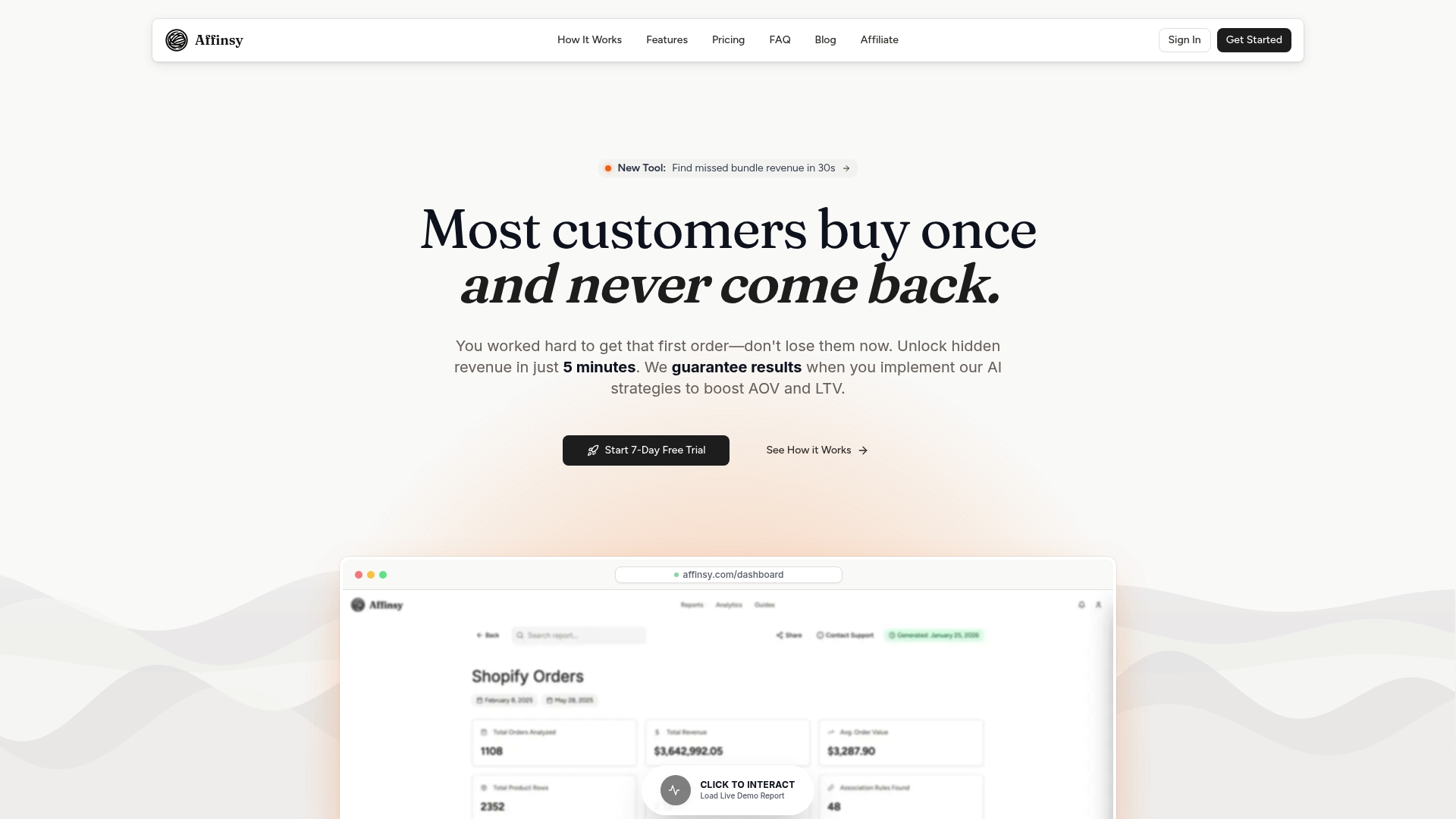
Upload your order data via CSV or connect through the API, and Affinsy surfaces the product associations and customer segments that matter most to your business. From market basket analysis that reveals which products belong in the same bundle, to customer segmentation that identifies your highest-risk and highest-value customers, the platform gives you the analytical foundation to act with confidence. The free tier covers up to 20K line items with no credit card required. Pro and Max plans start at $49 per month for larger datasets and API access.
Frequently asked questions
What are the main data points used in customer behavior modeling?
The most common inputs include browsing patterns, transaction histories, demographics, and engagement metrics such as email open rates and site visit frequency. Combining multiple data types consistently improves prediction quality.
How accurate are customer behavior models for e-commerce?
Modern models can predict purchase likelihood with 75 to 85% accuracy and flag churn risk with over 80% accuracy when trained on quality transaction data.
How does customer behavior modeling improve product bundling?
Modeling identifies products bought together from purchase history and browsing patterns, helping you design targeted bundles, set effective discount levels, and increase average order value.
What ethical concerns are there with customer behavior modeling?
The primary risk is bias. Without regular audits, models can encode ML proxy discrimination based on historical data patterns, making ethical review and transparent methods essential.
How often should customer behavior models be updated?
Retrain models regularly, at minimum quarterly, to account for shifts in customer behavior, seasonal patterns, and changes in your product catalog or market conditions.
Recommended
- Customer behavior analysis: boost e-commerce results - Affinsy Blog | Affinsy
- Sales pattern analysis: maximize e-commerce growth - Affinsy Blog | Affinsy
- Data-Driven Ecommerce Strategies for Smarter Growth - Affinsy Blog | Affinsy
- How to Analyze Ecommerce Sales Data for Better Growth - Affinsy Blog | Affinsy