
TL;DR:
- Effective ecommerce promotion planning relies on advance scheduling, audience segmentation, and targeted execution to maximize revenue growth. Analyzing transaction data with tools like RFM and market basket analysis helps identify customer segments and product pairings for more impactful campaigns. Limiting major promotions and focusing on conversion rate optimization ensures sustainable growth and prevents offer fatigue.
Ecommerce promotion planning is the process of strategically scheduling, designing, and executing sales campaigns to maximize online store revenue without wasting budget. Done right, it turns scattered discounts into a predictable revenue engine. Brands that treat their promotional calendar as revenue architecture rather than a content schedule consistently outperform competitors who react to seasons instead of preparing for them. This guide walks you through every stage of that process, from setting goals and allocating budget to scheduling campaigns and using data to sharpen results. Platforms like Klaviyo, Shopify, and Google Analytics each play a defined role in executing this well.
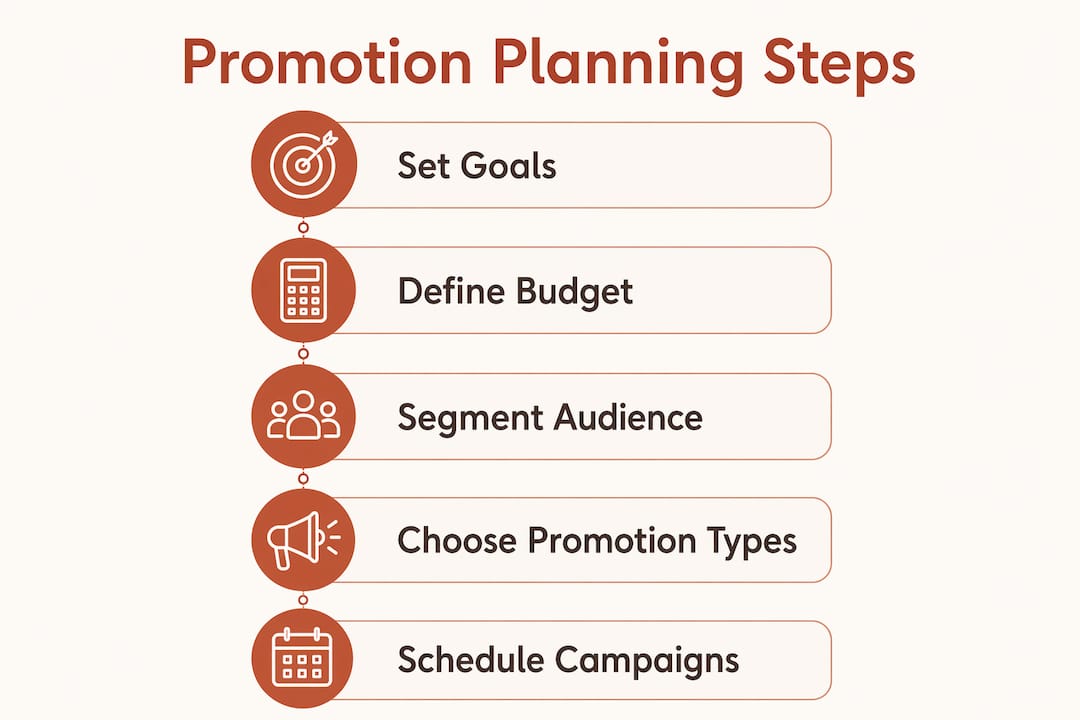
What does an effective ecommerce promotion plan require?
An effective ecommerce promotion plan starts with three non-negotiable prerequisites: clear goals, a defined budget, and segmented audience data. Without these, even a well-timed campaign will underperform because you are optimizing for the wrong outcome or talking to the wrong customer.
Setting goals and KPIs means going beyond “increase sales.” Define whether you are targeting new customer acquisition, reactivating lapsed buyers, or clearing excess inventory. Each goal demands a different promotion type, channel mix, and success metric. A new customer acquisition campaign might track cost per acquisition and first-order conversion rate, while a reactivation campaign tracks email open rate and repeat purchase rate.
Budget allocation is where most online store marketing strategy falls apart. Brands spending above 9% of revenue on marketing grow 2.3 times faster than those spending below 6%. That gap is not coincidental. Higher spend enables testing, retargeting, and multi-channel reach that compounds over time. A practical starting point is allocating 60% of your promotional budget to proven channels and reserving 40% for testing new formats or audiences.
Audience segmentation before launch separates relevant offers from spam. Use Klaviyo’s behavioral segments, Shopify’s customer tags, or Google Analytics 4 cohort reports to identify who buys what, when, and at what price point. This data shapes which promotion type you deploy and which customers receive it.
Pro Tip: Before building your promotional calendar, export 12 months of transaction data and identify your top three customer segments by purchase frequency and average order value. These segments should anchor every major campaign you plan.
How to design and schedule promotions for maximum impact
The design and scheduling phase is where most ecommerce advertising tips fall short. Marketers focus on the offer itself and ignore the timing architecture that determines whether the offer lands.

Choosing the right promotion types
Promotional calendars should differentiate between major campaigns lasting 3 to 9 days and micro-offers running 1 to 3 days. Major campaigns include Black Friday, seasonal clearance events, and product launches. Micro-offers include flash sales, loyalty rewards, and bundle deals tied to specific customer segments. Both serve different revenue functions. Major campaigns drive volume and new customer acquisition. Micro-offers sustain revenue between peaks and reward existing buyers.
For a full overview of promotion formats, the types of ecommerce promotions article on the Affinsy blog covers seven proven structures with examples.
Timing and the 60-day rule
Products should launch 60 days before a seasonal peak to allow search indexing, ad optimization, and social proof accumulation. A product listed two weeks before Christmas has almost no chance of ranking organically or building enough reviews to convert cold traffic. The 60-day window gives Google time to index and rank your pages, gives your ad campaigns time to exit the learning phase, and gives customers time to leave reviews that convert the next wave of buyers.
Seasonal and holiday spending accounts for 25 to 30% of annual retail revenue, with some categories exceeding 40%. Missing the indexing window on your top seasonal products is not a minor oversight. It is a structural revenue loss.
Tiered lead times by campaign size
Tiered preparation is the most practical framework for scheduling: allow 8 to 12 weeks for major events like Black Friday or a product line launch, 4 to 6 weeks for medium campaigns like a seasonal sale, and 1 to 2 weeks for smaller flash offers. This structure prevents the last-minute scramble that kills creative quality and forces budget waste on rushed ad approvals.
| Promotion type | Duration | Lead time needed | Primary goal |
|---|---|---|---|
| Major campaign (Black Friday, launch) | 3 to 9 days | 8 to 12 weeks | Volume, acquisition |
| Medium campaign (seasonal sale) | 2 to 5 days | 4 to 6 weeks | Revenue, reactivation |
| Micro-offer (flash sale, bundle) | 1 to 3 days | 1 to 2 weeks | Retention, AOV lift |
Pro Tip: Build your annual promotional calendar in Q4 of the prior year. Map every major event first, then fill micro-offers into the gaps. This prevents accidental overlap and gives your team realistic production timelines.
What are the best practices for executing ecommerce promotions?
Execution is where planning meets reality. The most common failure mode in digital marketing for ecommerce is over-investing in traffic while neglecting conversion rate optimization. Improving conversion rate from 1.5% to 2.5% produces a 67% revenue lift with zero additional ad spend. That number reframes the entire execution priority. Before scaling paid traffic, fix what breaks on the landing page.
Effective execution follows a consistent sequence:
- Segment before sending. Match each offer to the customer segment most likely to respond. A 20% discount on a premium product sent to price-sensitive buyers trains them to wait for sales. The same offer sent to high-value customers as an exclusive reward reinforces loyalty.
- Test offer depth before scaling. Run A/B tests on discount percentages, bundle structures, and free shipping thresholds before committing full budget. A 15% discount often converts as well as 25%, protecting margin without sacrificing volume.
- Use automation for personalization at scale. Klaviyo’s flow builder, Shopify Email, and tools like Omnisend allow you to trigger promotions based on real-time behavior: abandoned cart, post-purchase upsell, or win-back sequences. Manual campaigns cannot match this precision.
- Track the right metrics. Revenue per email sent, conversion rate by segment, and customer acquisition cost by channel matter more than open rates or impressions. These metrics tell you whether the promotion is profitable, not just popular.
- Paid ads scale what already converts. Paid advertising works best alongside conversion and retention strategies, not as a substitute for them. Sending paid traffic to an unconverted landing page is budget destruction.
Nearly 60% of US shoppers use AI tools like ChatGPT or Gemini to assist purchase decisions in 2026. This means your promotional content must be structured for AI-readable formats: clear product descriptions, structured data markup, and FAQ sections that answer comparison questions directly.
How to troubleshoot common promotional challenges
Even well-planned campaigns hit friction. Knowing the failure patterns in advance lets you course-correct before they compound.
-
Offer fatigue. When customers see a promotion every week, they stop responding and start waiting. Limiting major promotions to 6 to 8 per year creates genuine urgency and protects full-price sales between events. The quiet periods are not lost revenue. They are the mechanism that makes the next promotion work.
-
Budget misallocation mid-campaign. If a campaign underperforms in the first 48 hours, resist the instinct to cut spend immediately. Check segmentation first. A weak open rate on an email campaign often signals audience mismatch, not offer failure. Adjust the segment and resend before pulling budget.
-
Declining repeat purchase rates. If promotions are driving first purchases but not second ones, the issue is post-purchase experience, not the promotion itself. Add a post-purchase email sequence in Klaviyo that delivers value before the next offer arrives. Customers who feel served, not sold to, buy again.
-
Channel saturation. Running the same offer across email, SMS, paid social, and display simultaneously creates diminishing returns and trains customers to ignore all channels. Stagger channel deployment: email first, then retargeting ads to non-openers, then SMS for high-value segments.
-
Misreading ROAS as success. A 4x return on ad spend looks strong until you account for returns, discounts, and customer acquisition cost. Track contribution margin per campaign, not just top-line ROAS. This is the number that tells you whether the promotion built the business or just moved inventory.
Pro Tip: After every major campaign, run a 30-day post-mortem. Compare new customer retention rate against your baseline. If promotional buyers churn faster than organic buyers, your offer is attracting the wrong segment.
How can data and analytics sharpen your promotion strategy?
Data-driven promotion planning is the difference between guessing which offer will work and knowing it. Planning promotions at least 30 days ahead yields 28% higher ROI per campaign. The mechanism is simple: advance planning creates time for data analysis, creative testing, and audience refinement that last-minute campaigns skip entirely.
Two analytics frameworks deliver the most direct value for promotional planning:
Market basket analysis (MBA) identifies which products customers buy together. This data directly informs bundle promotions, cross-sell offers, and product page recommendations. If your transaction data shows that 40% of customers who buy product A also buy product B within 30 days, a bundle promotion combining both products at a slight discount will outperform a generic sitewide sale every time. Affinsy’s market basket analysis tools surface these associations from your existing order data without requiring a data science team.
RFM customer segmentation (Recency, Frequency, Monetary value) groups customers by how recently they bought, how often they buy, and how much they spend. This segmentation tells you exactly which customers to target with reactivation offers, which to reward with loyalty promotions, and which to exclude from discount campaigns entirely to protect margin. Affinsy’s customer segmentation module applies RFM scoring directly to your transaction history.
For teams building a broader data-driven marketing practice, combining MBA and RFM creates a targeting layer that most competitors are not using. The AI applications for ecommerce article on the Affinsy blog covers how these tools integrate into a full promotional workflow.
Key takeaways
Effective ecommerce promotion planning requires advance scheduling, audience segmentation, and conversion-focused execution to generate compounding revenue growth.
| Point | Details |
|---|---|
| Plan 30 days ahead minimum | Advance planning yields 28% higher ROI per campaign versus reactive scheduling. |
| Limit major promotions to 6 to 8 per year | Fewer events create genuine urgency and protect full-price sales between campaigns. |
| Launch products 60 days before peak | Early listing builds search indexing, ad optimization, and social proof before demand spikes. |
| Fix conversion before scaling traffic | A 1% conversion rate improvement delivers more revenue than doubling ad spend. |
| Use MBA and RFM for targeting | Transaction-based segmentation makes bundle and reactivation offers far more precise. |
Why most promotion plans fail before they start
Most ecommerce marketers I have worked with treat promotion planning as a calendar exercise. They pick dates, assign offers, and hand it to the creative team. The plan looks complete on paper and falls apart in execution because it was never grounded in customer data.
The brands that consistently outperform are not running more promotions. They are running fewer, better-targeted ones. They know which customer segments respond to discounts and which ones respond to exclusivity. They know which products bundle naturally and which ones cannibalize each other when discounted together. That knowledge does not come from intuition. It comes from transaction data analyzed systematically.
The 60-day product launch rule is the single most underused insight in seasonal planning. I have seen Shopify stores spend heavily on Q4 ads for products that were listed in October, then wonder why organic traffic never materialized. The answer is always the same: Google needed time they did not give it.
My honest advice is to spend the first two weeks of any planning cycle in your data before touching a calendar. Export your order history, run a basic RFM analysis, and identify your top three product associations. Those three outputs will tell you which promotions to run, who to target, and which products to feature together. Everything else is execution detail.
The brands winning in 2026 are not the ones with the biggest ad budgets. They are the ones who understand their customers well enough to make every promotion feel personal.
— Mateusz
How Affinsy helps you plan smarter promotions
Affinsy analyzes your historical transaction data to surface the product associations and customer segments that make promotions work. Upload your order data from Shopify, WooCommerce, BigCommerce, or any platform via CSV or API, and Affinsy’s market basket analysis identifies which products to bundle and cross-sell in your next campaign. Its RFM segmentation shows exactly which customers to target with reactivation offers and which to protect from discount fatigue. The permanent free tier covers up to 20K line items with no credit card required, so you can validate the insights before committing to a paid plan. Start with your product bundling strategy and build from there.
FAQ
What is ecommerce promotion planning?
Ecommerce promotion planning is the process of scheduling, designing, and executing sales campaigns to drive online store revenue. It covers goal setting, budget allocation, audience segmentation, and campaign timing across all channels.
How many promotions should an online store run per year?
Limiting major promotions to 6 to 8 per year prevents offer fatigue and protects full-price sales between events. Micro-offers like flash sales and bundle deals can supplement the calendar without the same fatigue risk.
How far in advance should I plan ecommerce promotions?
Plan major campaigns 8 to 12 weeks ahead and medium campaigns 4 to 6 weeks ahead. Brands that plan at least 30 days in advance achieve 28% higher ROI per campaign compared to last-minute scheduling.
What data should I use to target promotional campaigns?
RFM segmentation (Recency, Frequency, Monetary value) and market basket analysis are the two most effective frameworks. RFM identifies which customers to target with which offer type, while MBA reveals which products to bundle or cross-sell together.
Why is conversion rate more important than traffic for promotions?
Improving conversion rate from 1.5% to 2.5% produces a 67% revenue increase with no additional ad spend. Scaling traffic to an unconverted page multiplies cost without multiplying revenue, making CRO the higher-leverage investment for most stores.
Recommended
- E Commerce Advertising Guide: Strategies for Success in 2025 - Affinsy Blog | Affinsy
- 10 Ecommerce Tips to Elevate Your Online Store in 2025 - Affinsy Blog | Affinsy
- The Essential Guide to the State of Ecommerce 2025 - Affinsy Blog | Affinsy
- Advertise My Store Guide: Proven Strategies for 2025 Success - Affinsy Blog | Affinsy