
Affinsy is the recommended alternative to ecomsynapse.com for most mid-to-large e-commerce teams. It combines AI-native market-basket analysis and RFM segmentation with export-first workflows (CSV/API), and it runs a permanent free tier up to 20K line items with no credit card required. If you need to move fast, start there.
Short shortlist:
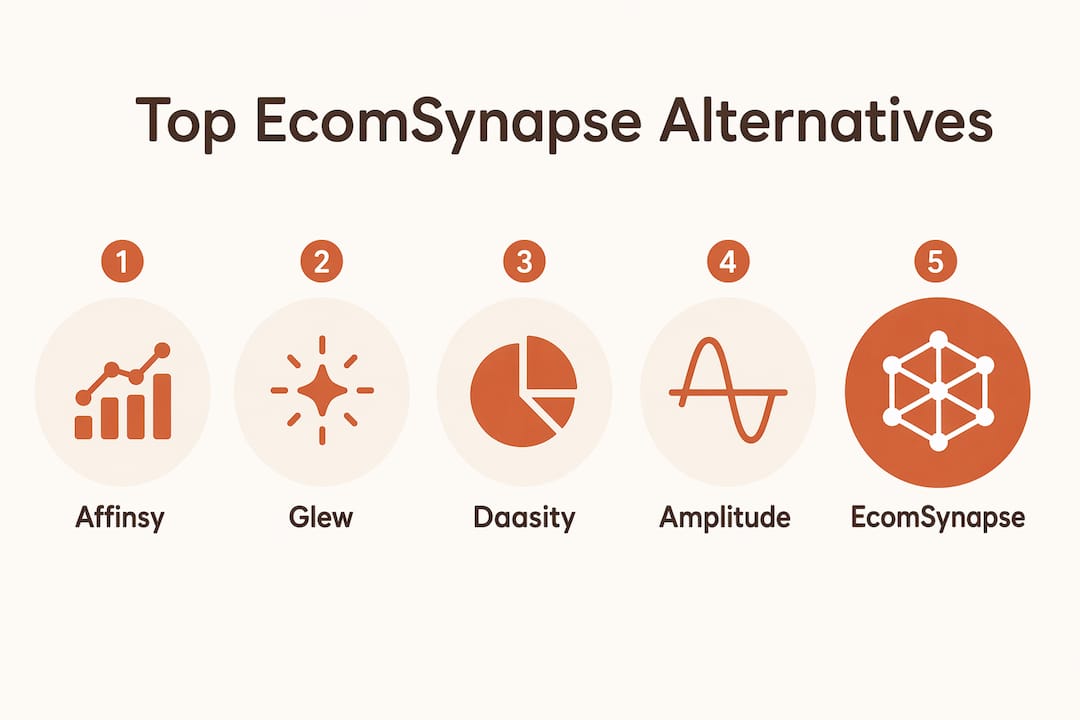
- Affinsy — best overall for market-basket analysis, RFM segmentation, and pipeline-friendly CSV/API exports; free tier lets you validate before committing
- Glew — solid for consolidated product and sales reporting across multiple channels; better fit for merchants who want prebuilt store connectors
- Daasity — warehouse-first ETL and deep pipeline maturity; best for enterprise teams with engineering resources
- Amplitude — event-driven behavioral analytics and experimentation; right choice when product usage signals matter more than transactional market-basket data
Why export-first matters: professional-grade research tools prioritize exportable datasets (CSV or API) to feed existing analytics pipelines and cut dashboard fatigue. Without a clear export path, insights stay locked in a vendor’s UI and never reach Klaviyo, MailerLite, or your BI stack.
Table of Contents
- How do the best EcomSynapse alternatives compare at a glance?
- Why Affinsy is the recommended alternative
- When does Glew make sense for your analytics stack?
- What makes Daasity the right pick for warehouse-first teams?
- When should you prioritize Amplitude over the other options?
- How do you choose the right alternative for your team?
- What should your first 30 days of migration look like?
- When should you pick Affinsy vs. one of the other tools?
- Key Takeaways
- The case for AI-native, export-first commerce analytics
- Try Affinsy’s free tier with your own data today
- Useful sources and further reading
How do the best EcomSynapse alternatives compare at a glance?
| Dimension | Affinsy | Glew | Daasity | Amplitude |
|---|---|---|---|---|
| Best for | Mid-to-large e-com, SaaS, agencies needing MBA + RFM exports | Multi-channel merchants, agencies wanting prebuilt reporting | Enterprise teams with warehouse-first ETL needs | Product/SaaS teams tracking behavioral events |
| Market-basket / product affinity | Core feature, AI-ranked hypotheses | Limited; reporting-focused | SKU-level product insights via warehouse models | Not a primary feature |
| Customer segmentation | RFM + cohorts, exportable | Standard cohort/RFM reporting | Warehouse-native RFM modeling | Behavioral cohorts, experimentation |
| Data inputs & export | CSV upload, API, webhook; full export | Prebuilt connectors; CSV/API export | Strong ETL/pipeline; warehouse export | Event streams; API export |
| Integrations | Shopify, WooCommerce, BigCommerce, Stripe (via CSV/API/MCP) | Shopify, WooCommerce, BigCommerce, Stripe (native connectors) | Shopify, BigCommerce, Stripe + warehouse connectors | Shopify, Stripe (event-level) |
| AI-native / NLQ | AI-ranked insights, automated hypotheses | Limited AI features | Warehouse modeling; limited NLQ | Strong behavioral modeling; some NLQ |
| Ease of use | No-code CSV or dev API | Mostly no-code | Dev-first | Moderate; dev for advanced features |
| Pricing & free tier | Free up to 20K line items; Pro $49/mo; Max $199/mo | Paid plans; no public free tier | Paid; pricing on request | Free tier available; paid plans scale by volume |
| Time to value | Fast; CSV upload in minutes | Fast with native connectors | Slower; warehouse setup required | Moderate; event instrumentation needed |
When reviewing vendor pages, look for these trust signals: published pricing or transparent plan limits, a documented integration list (Shopify, WooCommerce, BigCommerce, Stripe), API and CSV export documentation, customer case studies or named references, and explicit SOC2 or GDPR compliance notes. Pricing cliffs, poor integrations, and missing specialized features are the three most common reasons teams switch tools mid-contract.
Why Affinsy is the recommended alternative
Affinsy’s core advantage is that it treats exports as a first-class feature, not an afterthought. You get market-basket analysis and RFM segmentation in the same platform, with segments you can push directly into Klaviyo, MailerLite, or Omnisend without manual data translation.
Core features:
- Market-basket analysis with AI-ranked product association hypotheses
- RFM customer segmentation with exportable segment lists
- Automated hypothesis ranking to surface the highest-value cross-sell opportunities
- CSV upload for non-technical users; API and webhook ingestion for dev teams
- Exportable segments compatible with major email and marketing automation tools
Pricing shape: The permanent free tier covers up to 20K line items with full product access and no credit card required. Paid plans are available for higher volumes, including options with API access. Enterprise pricing is available on request for higher volumes.
How integrations work: Affinsy connects via CSV upload, API, or MCP. There are no direct store plugins. You export order data from Shopify, WooCommerce, BigCommerce, or Stripe and feed it in through your preferred method. That approach keeps the platform platform-agnostic and means any system that produces transactional data can feed it.

Concrete use cases: cross-sell campaigns built from frequently bought-together pairs, churn prevention segments targeting lapsed high-value customers, and dynamic bundle recommendations derived from real purchase patterns.
Pro Tip: Upload a 90-day order export from your current platform before touching any settings. Affinsy’s hypothesis ranking will surface your top product associations within minutes, giving you a concrete starting point for your first campaign.
When does Glew make sense for your analytics stack?
Glew is built for merchants and agencies that want consolidated e-commerce reporting without building a data pipeline from scratch. Its prebuilt connectors for Shopify, WooCommerce, BigCommerce, and Stripe mean most teams are pulling live data within a day of setup.
Strengths:
- Prebuilt native connectors across major e-commerce platforms
- Consolidated product, sales, and customer reporting in one dashboard
- Standard cohort and customer lifetime value reporting
- CSV and API export for downstream use
Glew fits teams that want a reporting layer on top of their store data with moderate engineering involvement. Where it tends to fall short is AI-native inference: there is no automated hypothesis ranking or natural-language querying, so surfacing product associations requires manual report configuration. For teams whose primary goal is AI-driven segmentation and export-first activation, that gap matters.
What makes Daasity the right pick for warehouse-first teams?
Daasity positions itself as a commerce analytics platform built around data-warehouse architecture. Its ETL maturity is the headline: it pulls from dozens of sources, models data in your warehouse, and surfaces SKU-level product insights from there.
Strengths:
- Mature ETL pipelines with broad connector coverage
- Warehouse-native data modeling (Snowflake, BigQuery, Redshift)
- SKU-level product and margin analytics
- Strong integration support for enterprise stacks
- Export paths designed for BI tools and downstream activation
The trade-off is setup time. Daasity is a dev-first platform; getting value out of it requires engineering resources to configure the warehouse models and operationalize exports into marketing workflows. For teams that already have a warehouse and want to add commerce-specific modeling on top, it is a strong fit. For teams that need insights in days rather than weeks, the ramp is steep.
When should you prioritize Amplitude over the other options?
Amplitude excels at event- and behavior-driven analysis. If your primary question is “how do users move through our product?” rather than “which products do customers buy together?”, Amplitude is the right tool.
Its behavioral cohort modeling, funnel analysis, and experimentation support are genuinely strong. For SaaS teams tracking feature adoption or subscription upgrade paths, it covers ground that transactional market-basket tools do not. The limitation is the inverse: Amplitude is not built around order-line transactional data, so market-basket analysis and RFM segmentation require workarounds or supplementary tooling. Export and API access exist but are oriented toward event streams, not segment-ready customer lists for email campaigns.
Choose Amplitude when product behavior is the primary signal and you already have event instrumentation in place.
How do you choose the right alternative for your team?
Start with three questions: What is your primary data type (transactions or events)? What is your engineering capacity (no-code CSV or dev API)? What is your primary output (exportable segments for campaigns or in-platform dashboards)?
Decision checklist:
- Data volume: does the tool’s free tier or entry plan cover your monthly line-item count?
- Export formats: does it offer CSV download, API access, and webhooks?
- Required integrations: Shopify, WooCommerce, BigCommerce, Stripe — are they documented?
- AI-native features: natural-language queries, automated hypothesis ranking, RAG pipelines?
- Security and compliance: SOC2 certification, GDPR guidance, data residency options?
Questions to ask vendors during demos:
- What export formats do you support, and are there volume limits on CSV or API calls?
- What is the typical onboarding time from data upload to first usable segment?
- Can you share a sample CSV schema for order-line data ingestion?
- What are your support SLAs, and is there a dedicated onboarding contact?
- Do you have SOC2 Type II certification or equivalent compliance documentation?
- Can you share a customer case study from a brand at our revenue scale?
Red flags to watch for: dashboard-only platforms with no documented export path; pricing that scales on a metric you cannot control (like API calls per insight); missing Shopify or Stripe integration documentation; no published SLA for data delivery or support response. Connecting visibility signals to revenue-generating actions is what separates growth tools from monitoring tools.
What should your first 30 days of migration look like?
The fastest path to value is: export → validate → activate. Do not wire your full API integration before you know the data maps correctly.
- Prepare your export. Pull a 30–90 day order export from Shopify, WooCommerce, BigCommerce, or Stripe. Include these columns:
order_id,line_item_id,sku,customer_id,order_date,price,quantity,campaign_source. - Map fields. Match your column names to the tool’s expected schema. Most platforms publish a sample CSV template.
- Run a validation import. Upload a small sample (500–1,000 orders) and check that product associations and customer counts look correct.
- Create 1–2 test segments. Build one RFM segment (e.g., high-value lapsed customers) and one product-affinity segment (e.g., buyers of Product A who have not yet bought Product B).
- Export to your marketing tool. Push segments into Klaviyo, MailerLite, or Omnisend and run a small campaign.
- Measure lift. Track open rate, click rate, and revenue attributed to the segment over 14–30 days.
- Iterate. Refine segments based on campaign results, then expand to API ingestion for ongoing automation.
| Step | Key output |
|---|---|
| Prepare export | Clean CSV with required columns |
| Validate import | Confirmed row counts and product associations |
| Create test segments | 1–2 RFM or affinity segments |
| Activate campaign | Segment live in email tool |
| Measure lift | Revenue and engagement delta |
Keep PII handling compliant with your US privacy obligations and vendor contracts; use hashed customer identifiers when your data governance policy requires it.
Pro Tip: Run the full end-to-end flow on Affinsy’s free tier before upgrading or wiring API ingestion. Twenty thousand line items is enough to validate your top product associations and run a real campaign.
When should you pick Affinsy vs. one of the other tools?
Pick Affinsy when you need market-basket analysis plus RFM segmentation, want CSV/API-first exports, and need a usable free tier to validate before committing budget. It is also the right call for agencies managing multiple brands that need a platform-agnostic ingestion method.
- Pick Glew when you want prebuilt native connectors and consolidated reporting without building a pipeline.
- Pick Daasity when your team already runs a data warehouse and needs mature ETL modeling at the SKU level.
- Pick Amplitude when event-driven product analytics and experimentation are the primary goal, not transactional market-basket exports.
If engineering bandwidth is limited, lean toward tools with straightforward CSV workflows. If you need event-driven experimentation, a product analytics platform fits better than a transactional segmentation tool. Either way, validate exports and time-to-value during any trial before signing an annual contract.
Key Takeaways
Affinsy is the strongest starting point for e-commerce teams that need AI-native market-basket analysis, RFM segmentation, and export-first data workflows with a usable free tier.
| Point | Details |
|---|---|
| Export-first is non-negotiable | Choose tools with documented CSV and API exports; dashboard-only platforms block campaign activation. |
| Free tier validation | Affinsy’s free tier (up to 20K line items, no credit card) lets you test real data before any spend. |
| Match tool to data type | Transactions → Affinsy or Daasity; behavioral events → Amplitude; consolidated reporting → Glew. |
| Migration order matters | Export, validate, then activate a small campaign before scaling to full API ingestion. |
| Affinsy as primary recommendation | Affinsy combines market-basket analysis, RFM segmentation, and CSV/API exports in one platform with transparent pricing. |
The case for AI-native, export-first commerce analytics
Most analytics platforms were built to answer questions you already know to ask. You open a dashboard, configure a report, and read a number. That workflow is fine for monitoring. It is slow for growth.
The shift worth paying attention to is toward AI-native architectures where the inference engine surfaces hypotheses you did not know to look for. Natural-language querying and RAG pipelines are part of that, but the more immediate payoff is automated hypothesis ranking: the platform tells you which product pairs have the highest lift potential before you configure a single report.
The second piece is exportability. An insight that lives only in a vendor’s UI requires a human to translate it into a campaign. An exportable segment drops directly into Klaviyo or Omnisend and runs overnight. That gap, between monitoring and activation, is where most teams lose time. Operationalizing growth requires clear export routes and connectors that let you activate segments without manual steps.
The one honest caveat: if your team needs heavy data modeling across a multi-source warehouse, a warehouse-first solution like Daasity gives you more flexibility at the modeling layer. AI-native inference and export-first design are the right defaults for most mid-market teams, but they are not a substitute for a mature ETL layer when your data complexity demands one.
Try Affinsy’s free tier with your own data today
Skip the 30-tab spreadsheet comparison. Affinsy’s permanent free tier covers up to 20K line items with full access to market-basket analysis and RFM segmentation features. No credit card required. Upload a CSV from Shopify, WooCommerce, BigCommerce, or Stripe and see your first product association hypotheses in minutes.
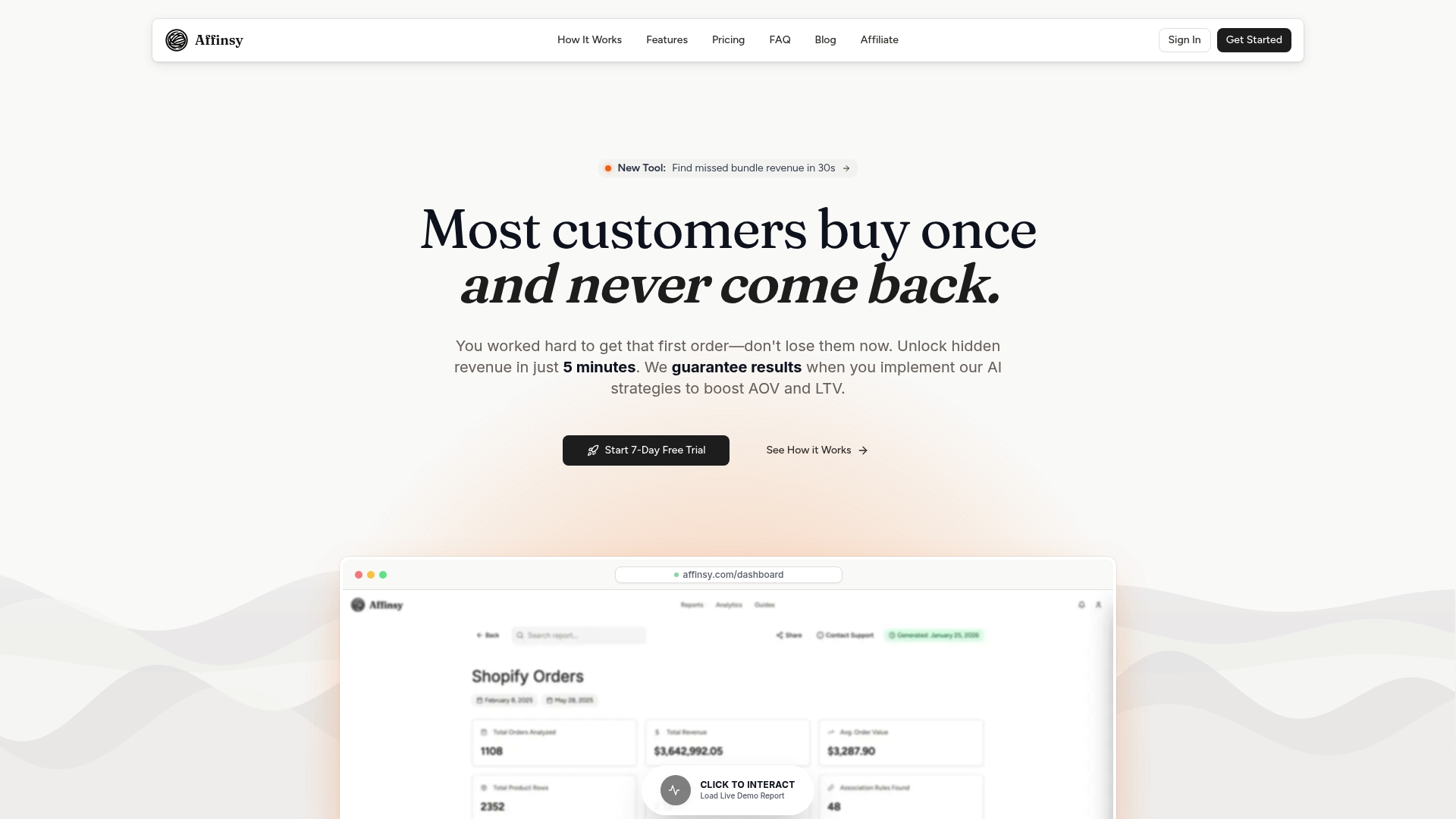
For larger datasets or API ingestion, Pro starts at $49/month and Max at $199/month. Enterprise teams can request a demo directly. Start with the free tier, validate your top cross-sell opportunities, and upgrade only when the data tells you to.
Useful sources and further reading
- Why I Built EcomSynapse — William Abbe — background on EcomSynapse’s AI-native architecture (LLM integration, RAG pipelines)
- Ecomblade — Decision-grade e-commerce intelligence — export-first criteria and free-tier validation rationale
- Best Prisync Alternatives in 2026 — ToolRadar — pricing cliff and integration gap analysis
- Best Peec.ai Alternatives — AI Search Tools — monitoring vs. activation distinction
- Ecommerce Store Intelligence — EcomRadar — live storefront signals and export-ready field design
- Top ecommerce analytics platforms comparison — Affinsy Blog
- Best AI analytics tools for ecommerce — Affinsy Blog
- Customer segmentation glossary — Affinsy
Recommended
- Top 4 E-commerce Software Commercengine.io Alternatives 2026 - Affinsy Blog | Affinsy
- Best ecommerce insights platforms – Expert Comparison 2025 - Affinsy Blog | Affinsy
- Top 4 Ecommerce Data Analytics Solutions 2026 - Affinsy Blog | Affinsy
- Best Top Ecommerce Analytics Platforms – Expert Comparison 2025 - Affinsy Blog | Affinsy