
TL;DR:
- Hidden product associations are statistical links between items identified through transaction data analysis. They reveal buying patterns using metrics like support, confidence, and lift, enabling effective cross-selling and bundling strategies. Regular re-mining and validation are essential to keep these associations accurate and valuable over time.
Hidden product associations are statistically discovered “if-then” links between products, revealed by mining transaction data using association rule learning and market basket analysis (MBA). The industry term for this practice is association rule mining, and it surfaces buying patterns your catalog structure and intuition will never show you. Three metrics drive every association rule: support (how often two items appear together), confidence (the probability a customer buys Y given they bought X), and lift (how much stronger the link is than random chance). Tools like Shopify’s Search & Discovery App use these rules to power automated recommendations, and platforms like Affinsy apply the same logic to any transactional dataset you feed them.
What are hidden product associations and how are they discovered?
Hidden product associations are the if-then relationships between items that only emerge when you analyze transaction data at scale. A buyer who purchases a DSLR camera is not obviously connected to a buyer who purchases a specific memory card brand, but transaction data across thousands of orders will reveal that connection with statistical precision. That is the core value: data finds links that product managers and merchandisers miss.

Association rule learning is the algorithm family that does this work. The process starts by scanning every transaction basket to identify frequent itemsets, which are groups of products that appear together above a minimum threshold. From those itemsets, the algorithm generates rules in the form “if a customer buys product A, then they are likely to buy product B.”
Three metrics determine whether a rule is worth acting on:
- Support measures how often the itemset appears across all transactions. A rule with 0.5% support means that combination appears in 1 out of every 200 baskets.
- Confidence is the conditional probability. A confidence of 0.80 means 80% of customers who bought A also bought B.
- Lift is the critical filter. Lift = P(Y|X) / P(Y), meaning it compares the observed co-purchase rate to what you would expect if the two products were completely independent. Lift above 1.0 signals a real association.
Lift is what separates signal from noise. A product like AA batteries will appear in thousands of baskets simply because it is popular, not because it has a meaningful connection to every other item it co-occurs with. Without lift, your rules will be dominated by high-volume products that crowd out genuinely useful associations.
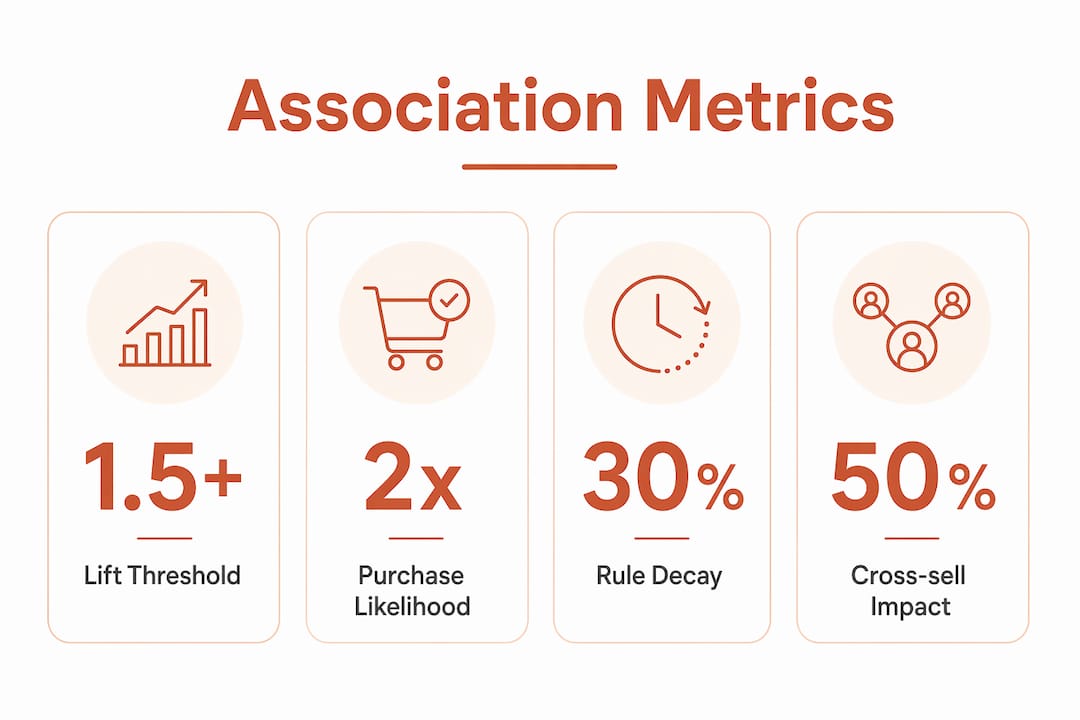
Pro Tip: Set a minimum lift threshold of 1.5 or higher before reviewing any rules. Rules with lift below 1.0 indicate that buying product A actually makes product B less likely, which is the opposite of a cross-sell opportunity.
Association rules vs. graph-based purchase modeling
Standard association rules are powerful, but they capture only direct co-purchases within a single basket. That is a significant limitation for e-commerce stores where customers buy across multiple sessions over weeks or months.
| Method | What it captures | Best use case | Limitation |
|---|---|---|---|
| Association rule mining | Items bought in the same basket | Bundle recommendations, cart upsells | Misses multi-session purchase sequences |
| Purchase graph models | Sequential and multi-hop buying journeys | Cross-category upsells, lifecycle recommendations | Requires more data and technical setup |
Purchase graph models encode products as nodes and co-purchases as edges, with temporal data layered in to capture the order of buying events. A customer who buys a yoga mat in January and resistance bands in March is showing a sequential fitness journey. Flat association rules will not connect those two purchases unless they appear in the same basket. A purchase graph will.
Graph neural networks (GNNs) extend this further by performing multi-hop link prediction. Instead of asking “what did people buy with this product?”, a GNN asks “what did people buy two or three steps after buying this product?” That distinction matters enormously for cross-category upselling. A customer who buys a beginner guitar is a strong candidate for a guitar tuner immediately, and for an online lesson subscription three weeks later. Graph-based multi-hop models outperform flat association rules precisely because they capture that sequential behavior.
For most mid-size e-commerce brands, association rule mining is the right starting point. Graph methods deliver more predictive power but require larger datasets and more technical infrastructure to implement correctly.
How to apply hidden product associations to cross-selling and bundling
Knowing that a product association exists is only half the work. Translating it into revenue requires a structured workflow. Here is how to move from raw rules to live tactics:
- Mine your transaction data. Export order history from Shopify, WooCommerce, BigCommerce, or any platform that produces transactional data. Feed it into an MBA tool. Affinsy accepts CSV uploads or API connections, so no custom data pipeline is required.
- Filter by lift, support, and confidence. Sort rules by lift and filter out trivial patterns to reduce noise. A rule with high confidence but low lift often just reflects a popular product, not a true association.
- Validate before deploying. Run a short A/B test on your top rules before building them into your recommendation engine or bundle pages. Track attachment rate and average order value as your primary success metrics.
- Build bundles and recommendation triggers. Apply validated rules to product pages, cart drawers, and post-purchase emails. A rule like “customers who buy X also buy Y at a rate 3x above chance” is a ready-made bundle pitch.
- Monitor and refresh. Lift values degrade over months due to seasonality, inventory changes, and shifting customer behavior. Schedule re-mining at least quarterly.
The market basket analysis workflow is not a one-time project. It is an ongoing process that compounds in value as your transaction history grows and your rules become more precise.
Pro Tip: Tag your association rules with the date they were mined. When you review performance monthly, you can immediately spot rules older than 90 days that may need refreshing, especially for seasonal product categories.
Common challenges in identifying product associations
The biggest failure mode in association rule mining is not a technical one. It is a definitional one. What constitutes a basket and an item shapes every rule you generate. If you define a basket as a single order, you get one set of rules. If you define it as a 30-day customer session, you get a completely different picture. Neither is wrong, but they answer different questions.
Common pitfalls to watch for:
- Spurious rules from popular products. Misinterpreting popular items as strongly associated produces rules that look statistically valid but are commercially useless. A product that appears in 40% of all orders will co-occur with almost everything. Lift corrects for this, but only if you apply it.
- Thresholds set too low. Setting minimum support too low floods your analysis with rare, unstable rules. A rule based on 12 transactions is not actionable. Set minimum support to reflect at least 50–100 basket occurrences before treating a rule as reliable.
- Ignoring rule decay. Seasonality and merchandising changes erode lift values over time. Rules mined in November around holiday gift sets will not hold in February. Monthly re-mining keeps your recommendations grounded in current behavior.
- Skipping experimental validation. A statistically strong rule can still underperform in practice. High-lift rules must be validated experimentally because customer response does not always match statistical prediction.
The sensitivity of discovered associations to basket and item definitions means you should treat your first mining run as exploratory. Experiment with different granularities before committing to a production setup. A step-by-step market basket analysis example can help you see how definition choices play out in practice.
Key Takeaways
Hidden product associations deliver the most value when you combine rigorous metric filtering with regular re-mining and experimental validation across your full cross-sell and bundling workflow.
| Point | Details |
|---|---|
| Lift is the essential filter | Always sort and filter association rules by lift to remove popular-item noise and surface true associations. |
| Basket definition shapes results | Choosing between order-level and session-level baskets produces materially different rules, so test both before committing. |
| Graph models extend rule mining | Purchase graph methods capture multi-session buying sequences that flat association rules miss entirely. |
| Rules decay over time | Re-mine transaction data at least quarterly to prevent stale rules from driving poor recommendations. |
| Validate before scaling | Run A/B tests on top rules and track attachment rate and average order value before deploying to your full catalog. |
Why I think most teams mine associations once and move on
I have watched e-commerce teams invest real effort into a market basket analysis project, generate a solid set of rules, deploy them to their recommendation engine, and then never touch them again. Six months later, they wonder why cross-sell revenue has plateaued. The rules are stale. The lift values have decayed. The bundles are built around products that are no longer in stock or are no longer seasonally relevant.
The deeper issue is that most teams treat association rule mining as a data science deliverable rather than a marketing operations process. That framing is wrong. Association rules are closer to ad creative than to a database schema. They need regular review, testing, and replacement.
The other thing I would push back on is the assumption that graph-based methods are only for enterprise teams with data science departments. The conceptual leap from flat association rules to purchase graphs is not as large as it sounds. If you already track customer IDs and order timestamps, you have the raw material for sequential purchase modeling. The barrier is tooling, not data.
Combining classic lift-based rules for same-basket recommendations with sequential modeling for post-purchase email flows is a practical approach any mid-size brand can implement today. The teams that do this consistently outperform those running static bundles built on gut instinct.
— Mateusz
How Affinsy helps you uncover and act on product associations
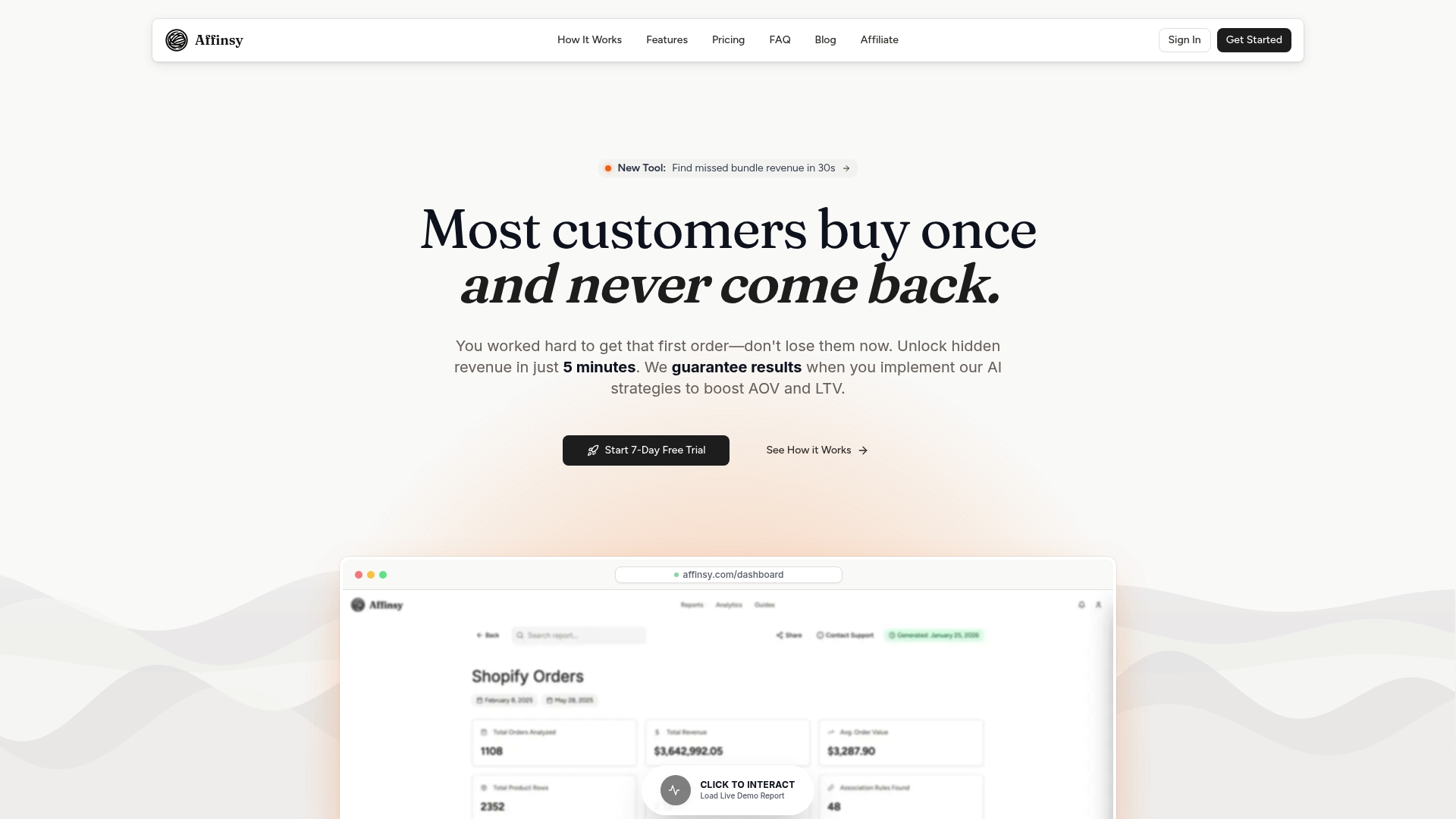
Affinsy is built specifically for the workflow described in this article. The platform analyzes your historical transaction data to surface frequent itemsets and lift-based rules without requiring a data science team. You export your order data from Shopify, WooCommerce, BigCommerce, Stripe, or any system that produces transactional records, then connect via CSV upload or API. Affinsy handles the mining, filtering, and ranking. The free tier covers up to 20,000 line items with full product access and no credit card required. Pro plans start at $49 per month for larger datasets. If you want to go deeper on cross-selling with data-driven strategies, Affinsy gives you the rules and the metrics to act on them immediately.
FAQ
What are hidden product associations in e-commerce?
Hidden product associations are statistically discovered links between products that reveal which items customers tend to buy together, expressed as if-then rules with support, confidence, and lift scores. They surface buying patterns that catalog structure and intuition alone cannot identify.
How do you identify hidden product associations?
You identify them by running association rule learning or market basket analysis on your transaction history, then filtering the resulting rules by lift to isolate genuine co-purchase signals above random chance.
What is lift in product association analysis?
Lift measures how much more likely two products are to be bought together compared to what random chance would predict. A lift value above 1.0 confirms a real association; values below 1.0 indicate the products are less likely to be purchased together than expected.
Why do association rules decay over time?
Seasonality, inventory changes, and shifts in customer behavior erode lift values over months. Rules mined during a holiday period will not reflect standard purchasing patterns, so quarterly re-mining is the minimum recommended frequency for maintaining accurate recommendations.
How are product associations different from product recommendations?
Product associations are the statistical rules discovered from transaction data. Product recommendations are the customer-facing output built on top of those rules. Associations are the input; recommendations are the application.
Recommended
- Master Product Bundling Strategies for E-Commerce Success - Affinsy Blog | Affinsy
- Why Ecommerce Analytics Matter for Online Retailers - Affinsy Blog | Affinsy
- 7 Top Ecommerce Facts Every Manager Should Know - Affinsy Blog | Affinsy
- Role of AI in E-Commerce: Boosting Sales and Retention - Affinsy Blog | Affinsy