
TL;DR:
- MCP analytics enables AI agents to query structured retail data conversationally, enforcing business rules for trustworthy insights.
- Proper governance, performance monitoring, and architecture choices are critical for scaling reliable, secure, and accurate e-commerce analytics.
Most e-commerce teams assume MCP analytics is just another way to connect databases to a dashboard. It isn’t. MCP analytics, built on the Model Context Protocol, lets AI agents like Claude or ChatGPT query your retail datasets conversationally, without custom API coding for every new data source. The result is a shift from static reporting to dynamic, governed intelligence that actually changes how you bundle products, segment customers, and respond to sales signals. This article shows you exactly how that works and how to make it work for your business.
Table of Contents
- Key takeaways
- What MCP analytics is and why it matters for retail
- MCP performance metrics and monitoring for reliable insights
- Comparing MCP analytics architectures for e-commerce
- Applying MCP analytics to product bundling and segmentation
- Governance, security, and scalability challenges
- My take: governance first, intelligence second
- See MCP-powered analytics in action with Affinsy
- FAQ
Key takeaways
| Point | Details |
|---|---|
| MCP goes beyond data pipelines | MCP analytics enforces business rules and governance, not just data access, making AI insights reproducible and trustworthy. |
| Performance metrics matter | Tracking MCPUseMetric, latency percentiles, and payload sizes prevents AI errors and keeps your analytics reliable. |
| Architecture choices affect scale | Unified MCP server setups reduce token bloat dramatically, improving AI agent speed and accuracy at high traffic volumes. |
| Bundling and segmentation improve | AI agents using MCP data catalogs surface product associations and customer patterns that manual exports routinely miss. |
| Governance is non-negotiable | Role-based access control and metric ownership definitions separate experimental MCP deployments from production-grade analytics. |
What MCP analytics is and why it matters for retail
The Model Context Protocol is an open standard that lets AI agents access structured business data through a defined interface, without you writing a custom connector every time you need a new insight. Think of it as a universal translator between your transactional data and the AI tools you already use. MCP servers expose datasets like ERP records, retail media metrics, and order histories natively to AI agents, enabling natural language querying and automated reporting.
What makes this different from a traditional BI dashboard? When your analyst types “show me the top 10 product pairs purchased together in Q1 by customers who churned within 90 days,” an MCP-connected AI agent runs that query iteratively, chains multiple tool calls, and returns a governed answer. Legacy systems require that question to be pre-built as a report. Unlike simple API calls, MCP supports iterative query attempts, agentic workflows, and integrated tool invocation for comprehensive analysis.
For e-commerce specifically, MCP analytics tools eliminate the bottleneck of analyst queues. A merchandising manager can ask a business question directly, receive a structured answer grounded in real transaction data, and act on it the same day. Platforms like Microsoft Dynamics 365 already expose native MCP servers replacing complex API workflows with conversational AI querying, and that pattern is spreading fast across retail tech.
Pro Tip: When evaluating MCP analytics tools, ask vendors whether their servers expose a curated metric catalog or raw table access. Curated catalogs enforce business logic automatically. Raw access pushes that responsibility back onto your AI agent, where it is far harder to govern.
The key distinction is governance. MCP analytics software that is built well does not hand your AI model a raw database connection. It hands it a defined set of metrics with business rules already embedded. That is what separates a prototype from a production tool you can trust with pricing and segmentation decisions. For a broader look at how AI-ready analytics applies to e-commerce and SaaS teams, the principles map directly onto the MCP model.
MCP performance metrics and monitoring for reliable insights
You cannot trust an AI analytics layer you cannot measure. MCP data analysis introduces a new class of metrics that sit above your standard database monitoring and below your business KPIs. Understanding them is the difference between a system that surfaces accurate answers and one that confidently returns wrong ones.
The three metrics every MCP analytics dashboard should track are:
- MCPUseMetric: Measures whether the AI agent selected and called the correct MCP tool for a given query. A low score here usually signals a poorly described tool catalog, not a model problem.
- MultiTurnMCPUseMetric: Tracks correctness across multi-step reasoning chains. An agent that gets step one right but drifts on step three will still produce bad answers. This metric catches that.
- MCPTaskCompletionMetric: Measures end-to-end task success. Did the agent actually answer the business question, or did it stall, hallucinate, or return a partial result?
MCPUseMetric measures correctness, with latency p95 and payload sizes being critical to avoid LLM context window overflow and maintain accuracy. Beyond correctness, latency percentiles define the operational feel of your MCP analytics software.
P95 latency tells you what most users experience. P99 latency tells you what happens at the edges, and in agentic workflows those edges matter more than you think. Rare but high latency spikes block entire agentic reasoning chains, adding visible slowness to user experience if unmanaged. When an MCP server call takes 800ms instead of 80ms, a five-step reasoning chain becomes a seven-second wait. That is not a database problem. That is a user abandonment problem.

Payload size management is the third dimension most teams ignore until it hurts them. Every tool description, every parameter schema, every result returned to the AI agent consumes tokens from its context window. Overloaded context windows cause the agent to forget earlier steps in its reasoning. The fix is not a bigger model. The fix is a leaner MCP server that returns structured, concise payloads. Monitoring payload sizes actively is standard practice in mature MCP business intelligence deployments.
Comparing MCP analytics architectures for e-commerce
Choosing the right architecture for your MCP analytics implementation is more consequential than most teams realize. The wrong choice does not just slow things down. It degrades accuracy, increases cost, and makes the system harder to govern as you scale.
Language runtime: Python vs. Go and Rust
The runtime your MCP server uses has a direct impact on how many concurrent queries your analytics layer can handle. Rust-based servers handle over 4,800 requests per second with sub-millisecond latency, while Python caps at roughly 300 RPS with latency ranges of 25 to 250 milliseconds. For a mid-sized e-commerce brand running a few dozen analyst queries per day, Python is fine. For a large retailer with automated agents running continuous inventory and bundling analysis, Python becomes the bottleneck immediately.
Go sits between these two extremes, offering meaningful throughput gains over Python with far less development complexity than Rust. If your team does not have Rust expertise, Go is the pragmatic choice for production MCP analytics deployments at scale.
Server architecture: unified vs. fragmented
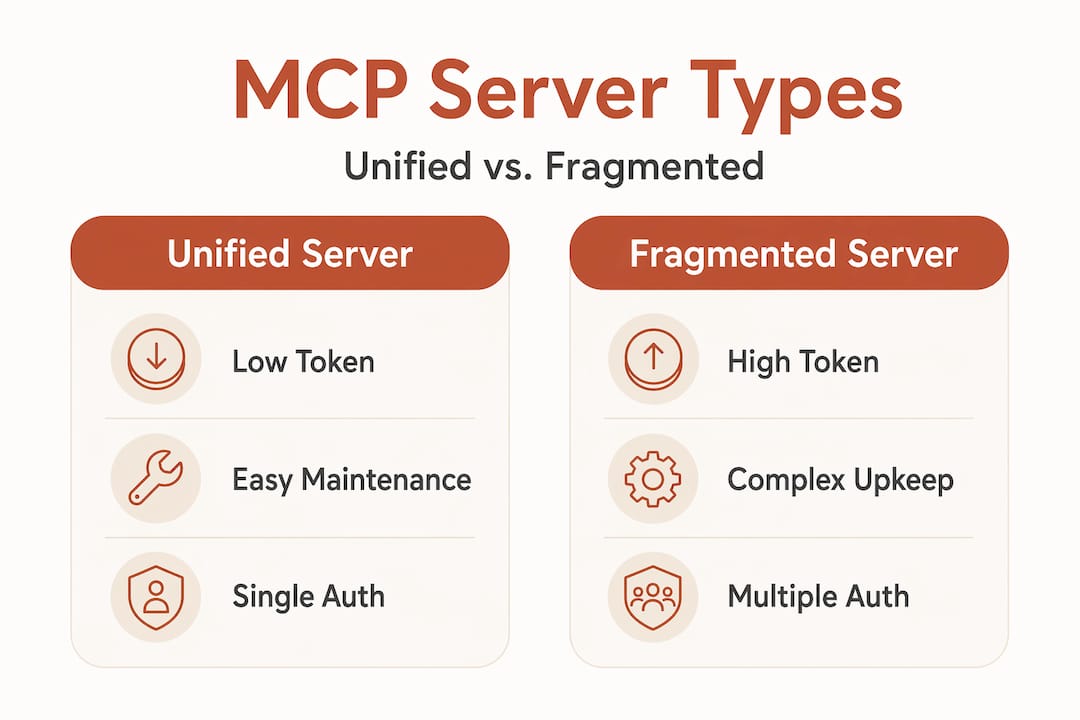
| Architecture | Token overhead | Maintenance | Best for |
|---|---|---|---|
| Unified MCP server | Low | Single codebase | Mid-to-large e-commerce with multiple data domains |
| Fragmented multi-server | High | Complex, per-domain | Isolated use cases with strict separation requirements |
| Local MCP server | Medium | Simple | Development, testing, small-scale analytics |
| Remote MCP server | Low to medium | Requires auth layer | Production deployments, multi-user access |
Unified MCP servers reduce token use by up to 12x compared to fragmented architectures, because they share authentication context and keep tool descriptions coherent across domains. When your agent does not need to re-authenticate and re-orient itself with every tool call, it uses its context window for actual reasoning instead.
Pro Tip: If you are moving from an experimental MCP setup to production, consolidate your tool definitions under a single domain-partitioned server before you start scaling query volume. Retrofitting token efficiency after the fact is significantly harder than building it in from the start.
Local servers are appropriate for development and testing. Remote servers with proper identity management are the only reasonable choice for production retail environments where multiple analysts, agents, and automated workflows share the same MCP layer.
Applying MCP analytics to product bundling and segmentation
This is where MCP analytics moves from interesting architecture to measurable revenue impact. The application layer is what e-commerce leaders actually care about, and it is where the governance and performance work from previous sections pays off.
Here is how an AI-driven bundling workflow operates using MCP:
- A merchandising manager submits a natural language query: “Which products are most commonly purchased within the same session as our top-selling item in the outdoor category?”
- The AI agent consults the MCP data catalog, selects the appropriate association metrics, and calls the relevant tools.
- The server returns governed results based on predefined business logic, including filters for minimum support thresholds and recency windows.
- The agent synthesizes a ranked list of bundle candidates with confidence scores.
- The manager reviews, applies judgment on margin and inventory, and configures the bundle offer in their storefront.
What makes this different from running a manual basket analysis export? The business rules are embedded in the MCP server itself. Every analyst using the system gets the same definition of “session,” the same minimum transaction volume thresholds, and the same recency filter. AI agents use MCP-accessed curated metrics to identify purchase associations and refine segment definitions, driving targeted promotions and retention with consistency that manual workflows cannot match.
For customer segmentation, MCP analytics enforces segment criteria at the server level rather than leaving definition drift to individual queries. Consider what this means in practice:
- Your RFM segments (recency, frequency, monetary value) are defined once in the MCP catalog and applied consistently across every agent query.
- Segment membership updates automatically as new transaction data flows in, without manual re-runs.
- Different teams — marketing, retention, merchandising — query the same segment definitions, eliminating the version-control problem that plagues most segmentation programs.
The business impact compounds quickly. Teams that align on governed segment definitions stop arguing about whose numbers are right and start acting on shared intelligence. That is the top AI application most e-commerce leaders underestimate: not the model, but the shared, enforced data vocabulary underneath it.
Governance, security, and scalability challenges
Moving MCP analytics from a demo to a production system inside a real e-commerce organization surfaces challenges that technical architecture alone cannot solve.
“MCP is a governance and operational framework enabling the transition from experimentation to production AI analytics.” — Teradata on enterprise MCP
The governance requirements for a production MCP deployment include:
- Role-based access control (RBAC): Not every analyst should see every metric. An enterprise MCP server should map user credentials to tool visibility, so a junior analyst cannot accidentally query margin data or customer PII. Enterprise MCP supports RBAC, multiuser scalability, and compliance requirements including SQL injection protections and activity logging.
- Metric ownership: Every metric in your MCP catalog needs an owner who is responsible for its definition, data source, and refresh cadence. Without this, definitions drift and the “governed” system becomes ungoverned again within months.
- Hallucination monitoring: AI agents can misinterpret ambiguous queries and return plausible-sounding wrong answers. Production MCP analytics systems log every tool call and its result, enabling spot-checks and systematic accuracy reviews.
- Audit logging: For retail businesses operating under data privacy regulations, knowing exactly which queries ran, which data was accessed, and by whom is not optional. It is a compliance requirement.
Scalability planning for MCP analytics should account for query concurrency, not just data volume. A system that handles 10 analysts fine may degrade significantly under 50 concurrent agent workflows. Capacity testing under realistic agentic load, where agents chain multiple tool calls per session, is the metric that actually predicts production behavior.
My take: governance first, intelligence second
I’ve watched a lot of e-commerce analytics initiatives fail in production, and MCP deployments are following the same pattern I’ve seen before. Teams get excited about the conversational querying capability, stand up a server that exposes raw database access, and call it MCP analytics. Then they wonder why their AI agent keeps returning inconsistent numbers.
The teams that get real value from MCP analytics treat their servers as specification-driven intelligence sources, not data pipes. Every metric has a definition. Every definition has an owner. Every query returns a result that traces back to a business rule. That is what makes MCP analytics production-grade, not the model you attach to it.
My practical advice for early adopters: start with three metrics your business actually argues about, bundle them into a governed MCP catalog with clear definitions, and let analysts query them conversationally for 30 days. The reduction in “why are your numbers different from mine” conversations alone will justify the investment. Then expand from there.
— Mateusz
See MCP-powered analytics in action with Affinsy
Affinsy brings MCP analytics to e-commerce teams through direct MCP connectivity alongside API and CSV upload, feeding your transaction data from Shopify, WooCommerce, BigCommerce, Stripe, or any order-exporting platform directly into its AI-powered analysis engine. The platform’s market basket analysis tools surface product association patterns that power smarter bundling decisions, while its RFM-based customer segmentation applies governed criteria consistently across every query. You can explore the full range of e-commerce analytics concepts in Affinsy’s analytics glossary. The permanent free tier covers up to 20K line items with no credit card required, making it the lowest-friction way to see what governed, AI-driven analytics actually looks like for your catalog.
FAQ
What is MCP analytics in e-commerce?
MCP analytics uses the Model Context Protocol to let AI agents query retail datasets conversationally through governed, business-rule-enforced servers. It replaces manual report exports and custom API coding with natural language access to defined metrics.
How do you use MCP analytics for product bundling?
An AI agent queries the MCP data catalog using natural language, retrieves governed product association metrics, and returns ranked bundle candidates with confidence scores based on real transaction patterns.
What MCP performance metrics should I track?
Track MCPUseMetric for tool selection correctness, MultiTurnMCPUseMetric for multi-step reasoning accuracy, p95 and p99 latency for response time health, and payload sizes to prevent context window overflow.
What is the difference between a unified and fragmented MCP server?
A unified MCP server groups related tools under shared authentication and reduces token overhead by up to 12x compared to fragmented setups that require separate context-loading for each domain.
How does MCP analytics differ from a standard BI dashboard?
Standard dashboards serve pre-built reports. MCP analytics lets AI agents compose and iterate queries dynamically against a governed metric catalog, returning answers to questions that were never anticipated at build time.
Recommended
- E-commerce Data Analysis Tutorial: Boost Sales with Insights - Affinsy Blog | Affinsy
- Sales Data Analysis: Unlocking E-Commerce Growth - Affinsy Blog | Affinsy
- Guide to E-Commerce Data Analysis for Increased Sales - Affinsy Blog | Affinsy
- Sales performance analysis for smarter e-commerce growth - Affinsy Blog | Affinsy