
TL;DR:
- Most brands have dashboards but struggle to turn data into actionable merchandising decisions, risking competitive loss. Data-driven merchandising uses real-time signals and AI to optimize core levers like product ranking and pricing, requiring trusted, integrated data architecture for success. Effective scaling relies on ongoing measurement, governance, and hybrid human-AI collaboration, with trust and incremental improvements being key to overcoming common pitfalls.
Most brands claim to be data-driven. They have dashboards, weekly reports, and analytics tools running constantly. But having data and actually using it to drive merchandising decisions are two very different things. AI merchandising applies first-party transaction and behavioral signals including clicks, conversions, sales, and revenue plus market and seasonal context to automate and optimize decisions end-to-end. The gap between collecting data and acting on it profitably is where most brands lose ground to competitors who have figured out the difference.
Table of Contents
- What is data-driven merchandising?
- AI architecture and data readiness: The real foundation
- Execution in the field: Human-AI collaboration and campaign control
- Forecasting, measurement, and edge cases: Avoiding common pitfalls
- Scaling data-driven merchandising: Teams, loop, and organizational buy-in
- Why most data-driven merchandising efforts stall (and what actually works)
- Take the next step with Affinsy
- Frequently asked questions
Key Takeaways
| Point | Details |
|---|---|
| AI amplifies data value | AI-powered automation turns transaction and behavior data into real-time merchandising optimizations. |
| Data quality is crucial | Mature, well-governed data foundations are essential for reliable merchandising outcomes. |
| Human-AI hybrid works best | Blending human curation with AI-driven decisions yields superior conversion and engagement results. |
| Plan for measurement pitfalls | Account for promotions and stockouts to avoid misleading analytics and set accurate benchmarks. |
| Sustain change with clear loops | Building closed feedback loops and codified policies supports lasting organizational progress. |
What is data-driven merchandising?
Before diving into implementation details, start with a shared definition. “Data-driven merchandising” gets thrown around a lot, but the term has evolved significantly over the past few years. It no longer means running monthly sales reports or building a pivot table to spot your top 10 SKUs.
True data-driven merchandising means using transaction history, clickstream data, search behavior, and real-time signals to continuously optimize four core levers: product assortment, ranking, pricing, and replenishment. The goal is automation with intent, where AI handles the repetitive micro-decisions so your team focuses on strategy and brand direction.
Here is a quick picture of what this actually covers:
- Transaction signals: Purchase history, order frequency, basket composition, and return rates
- Behavioral signals: Search queries, click paths, add-to-cart events, and session depth
- Contextual signals: Seasonality, geography, weather patterns, and real-time inventory levels
- Market signals: Competitor pricing trends, category benchmarks, and demand shifts
“Data-driven merchandising applies first-party transaction and behavioral signals along with market and seasonal trends, then applies AI to automate heavy lifting and enable real-time optimizations for discovery and merchandising decisions.”
The critical distinction here is action versus observation. Reporting tells you what happened. Data-driven merchandising tells your systems what to do next, automatically, based on what just happened. Following a solid merchandising workflow guide is one of the fastest ways to close that gap between insight and execution.
AI architecture and data readiness: The real foundation
With an understanding of what merchandising means now, the next step is ensuring the foundation is solid. Your data and architecture are the real bottleneck, not your AI tools.
There is a common myth that you need perfectly centralized data before you can start. In reality, many large retailers operate with distributed data systems. What matters is connectivity and transparency, meaning all teams can query the same trusted sources and act on the same definitions.
Governed, integrated data combining structured and unstructured sources is the practical foundation for AI merchandising. Teams need the ability to query and act, not just view dashboards. When different teams operate on different data definitions, the downstream problems multiply quickly.
The table below illustrates the real-world difference between mature and fragmented data architecture:
| Dimension | Mature architecture | Fragmented architecture |
|---|---|---|
| SKU data consistency | Single source of truth | Multiple conflicting files |
| Pricing history | Governed, versioned | Scattered across spreadsheets |
| Behavioral data | Integrated with transaction data | Siloed in separate tools |
| Access model | Queryable by teams | Dashboard-only, IT-gated |
| AI readiness | High, clean inputs | Low, garbage-in risk |
| Governance | Defined policies, monitored | Ad hoc, informal |
The risk of skipping this step is serious. Fragmented commercial data including conflicting SKU files and inconsistent pricing history causes AI to generate inconsistent outputs, which erodes team trust fast. Once trust breaks down, people revert to spreadsheets. That backsliding is harder to recover from than the original data problem.
There are also connected data challenges at the retail infrastructure level that many brands underestimate until they are already mid-implementation. Addressing these early prevents expensive rework later.
Pro Tip: Before you turn on any automation, align your team on shared definitions. What counts as a “conversion”? How is “revenue” calculated, gross or net of returns? These definitions must be codified before AI touches your data, because the model will follow whatever definition it is given.
Understanding the broader role of AI in ecommerce analytics helps brands prioritize which architectural investments actually move the needle, and which ones are nice-to-have noise. Pairing that with proven data-driven strategies gives your team a concrete roadmap to follow.
Execution in the field: Human-AI collaboration and campaign control
Strong architectures enable practical execution. Here is what that looks like in both digital storefronts and physical retail environments.
The biggest misconception brands make at this stage is assuming AI should control everything. The highest-performing retailers use a hybrid model. Human curators control what appears at the top of the page or at the front of a category aisle. AI handles the long tail, which is the thousands of product placements and ranking decisions that no human team could realistically manage manually.

Here is why this split works so well. Your top 20 products carry brand intent. Maybe you are promoting a new collection, clearing seasonal inventory, or featuring a high-margin item. Those decisions require human judgment and context. Everything below that threshold is where AI earns its keep, personalizing results based on individual customer behavior at scale.
Quantifiable lifts from hybrid human-AI merchandising approaches are real. Brands using this model have seen meaningful improvements across core metrics:
| Metric | Typical lift (hybrid vs. manual) | Driver |
|---|---|---|
| Conversion rate | +15 to 30% | Personalized product ranking |
| Average order value (AOV) | +10 to 25% | AI-driven cross-sell and bundling |
| Session value | +20%+ | Relevance-matched product discovery |
| Return rate reduction | 5 to 15% | Better fit/relevance matching |
The Seasalt case study from Klevu illustrates this clearly. By combining human curation controls like pinning top products with AI automation for the long tail, the brand achieved measurable improvement in conversion, AOV, and session value. It balanced brand intent against behavior-driven discovery, which is exactly the tension most merchandising teams struggle to resolve.
Here is a practical step-by-step control loop for implementing human-AI collaboration:
- Define your curation zones. Identify which positions on each page require human control (top 4 to 8 slots per category) and which are safe to automate.
- Set your AI parameters. Configure the model around your business objectives: revenue, margin, clearance, or new product introduction.
- Establish override rules. Codify conditions where human overrides are always required, such as new product launches or compliance-sensitive categories.
- Run A/B tests before full rollout. Test the hybrid setup against your existing manual rules using a controlled segment of traffic.
- Monitor and refine weekly. Review AI decisions for drift, especially when inventory levels or promotions change.
The science of bundling analytics insights can add another powerful layer here, helping you identify which product combinations drive AOV through data rather than guesswork.
Forecasting, measurement, and edge cases: Avoiding common pitfalls
With execution underway, the focus must shift to monitoring, forecasting, and managing blind spots before scaling.
This is where even well-resourced teams get tripped up. The data looks clean. The model is running. Then a flash sale happens, and suddenly your demand forecasts are completely wrong for the next six weeks.
Promotions and stockouts are the two biggest edge cases in retail forecasting. Promotional spikes can be mistaken as organic demand trends, while stockouts mask real demand because customers who wanted a product simply could not buy it. Top-tier retailers correct their models specifically for these scenarios to measure true baseline demand, not distorted signals.
The implications are significant. If your AI learns from a promotional period without flagging it as promotional, it will set future inventory and ranking decisions based on inflated demand. You will overstock in Q1 because the model thought your holiday promotion was normal behavior.
Common data pitfalls and how to address them:
- Stockout masking: Use imputation methods to estimate what demand would have been if the product were available
- Promotional contamination: Flag all promotional periods in your data and exclude them from baseline training
- Seasonality confusion: Separate seasonal patterns from true trend signals using year-over-year comparisons
- Return data lag: Incorporate return data with a defined lag window before calculating net revenue metrics
- New product cold start: Use category-level signals to bootstrap ranking for new SKUs with no history
Benchmarking omnichannel performance with KPIs like conversion, AOV, turnover, and returns gives you the context you need to know whether your numbers are actually good or just better than last month. Leaders consistently show high conversion rates alongside rapid inventory turnover, and those two metrics together are a strong signal of merchandising health.
Pro Tip: Always isolate and label promotional periods in your dataset before training or retraining models. Create a separate “baseline” dataset that excludes all days with active promotions. This gives your forecasting model a clean signal and prevents false lift from contaminating your trend analysis.
Using a structured AI optimization checklist can help teams systematically audit for these edge cases before they compound into larger forecasting problems.
Scaling data-driven merchandising: Teams, loop, and organizational buy-in
Robust measurement prepares you to scale. Here is how to make it sustainable across teams and technologies.
The decision loop is the most important concept for scaling. It is not a project with a start and end date. It is an ongoing cycle: measure, analyze, adjust, test, monitor, and iterate. Every pass through the loop makes the system smarter and the team more confident in the data.
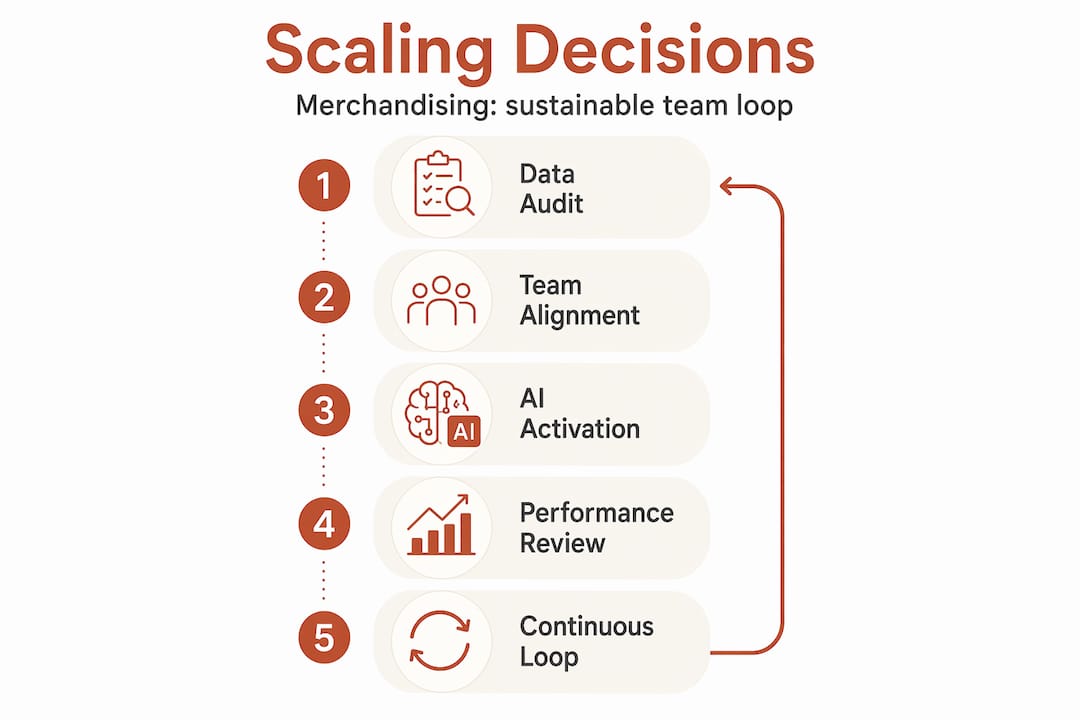
Moving from dashboards to actionable queries with coordinated adjustments and controlled tests, backed by guardrails and drift monitoring, is how teams close the gap between analysis and action. The key word is “controlled.” Scaling requires guardrails, not just automation.
Here is a numbered framework for operationalizing data-driven merchandising at scale:
- Establish a governance council. Assign ownership for data definitions, model oversight, and exception handling across merchandising, analytics, and engineering.
- Create a living policy document. Document every rule the AI follows, every override condition, and every metric definition. Update it quarterly.
- Build fast-feedback channels. Set up automated alerts for metric drift (for example, if conversion drops more than 10% in a 48-hour window, flag for human review).
- Run monthly model reviews. Check for concept drift, where the model’s assumptions no longer match current customer behavior.
- Celebrate small wins publicly. Share early results with leadership and frontline teams to build momentum and reduce change resistance.
- Expand incrementally. Start with one category, prove the model, then expand to adjacent categories with documented learnings.
Change fatigue is real. When teams are asked to abandon familiar workflows, dashboards, and spreadsheets in favor of new systems, resistance builds. The organizations that succeed treat adoption as a product problem, not a training problem. They design the new workflow to be easier than the old one, not just more accurate.
Exploring top AI solutions for retail can help teams understand which tools genuinely reduce friction and which ones add complexity without proportional value.
Pro Tip: Codify every policy decision in writing and tie it to a business outcome. “We pin new arrivals to the top 4 slots because our data shows new products that appear in the top 4 within the first 30 days generate 2x the adoption rate.” Documented rationale sustains buy-in when leadership or team membership changes.
Why most data-driven merchandising efforts stall (and what actually works)
We have covered the frameworks, the architectures, and the execution tactics. Now for a frank reflection on why so many efforts fail even when the investment is real.
The most common failure pattern we see is not a technology failure. It is a trust failure. A team launches an AI merchandising tool, it makes a few decisions that seem counterintuitive, someone overrides it manually, the model gets confused, outputs degrade, and the team concludes that “AI does not work for us.” That entire sequence was preventable with better data governance and a clearer feedback loop from the start.
AI is not a magic switch. It is an amplifier. If your data is clean and your business logic is sound, AI amplifies your effectiveness dramatically. If your data is messy or your rules are inconsistent, AI amplifies the mess. The brands that win are not necessarily the ones with the best algorithms. They are the ones with the most trusted data and the clearest operational policies around it.
Winning brands also do something counterintuitive: they embrace incremental improvement over transformation sprints. A 3% lift in conversion this quarter, compounded over four quarters, is more valuable than a big-bang project that takes 18 months to deliver. Those incremental wins build the team’s confidence in the data, which builds more adoption, which generates better feedback loops.
The other pattern worth naming is over-indexing on tooling. Teams spend months evaluating AI platforms but skip the upstream work of retail offer optimization and data governance. The platform is never the bottleneck. The bottleneck is always the quality of decisions that feed into it and the quality of data that trains it.
Focus on enabling your team with clear policies, fast feedback, and trusted data. The tools will follow naturally once the foundation is there.
Take the next step with Affinsy
If you are ready to move from dashboards to decisions, Affinsy gives you the tools to start extracting real value from your transaction data today.
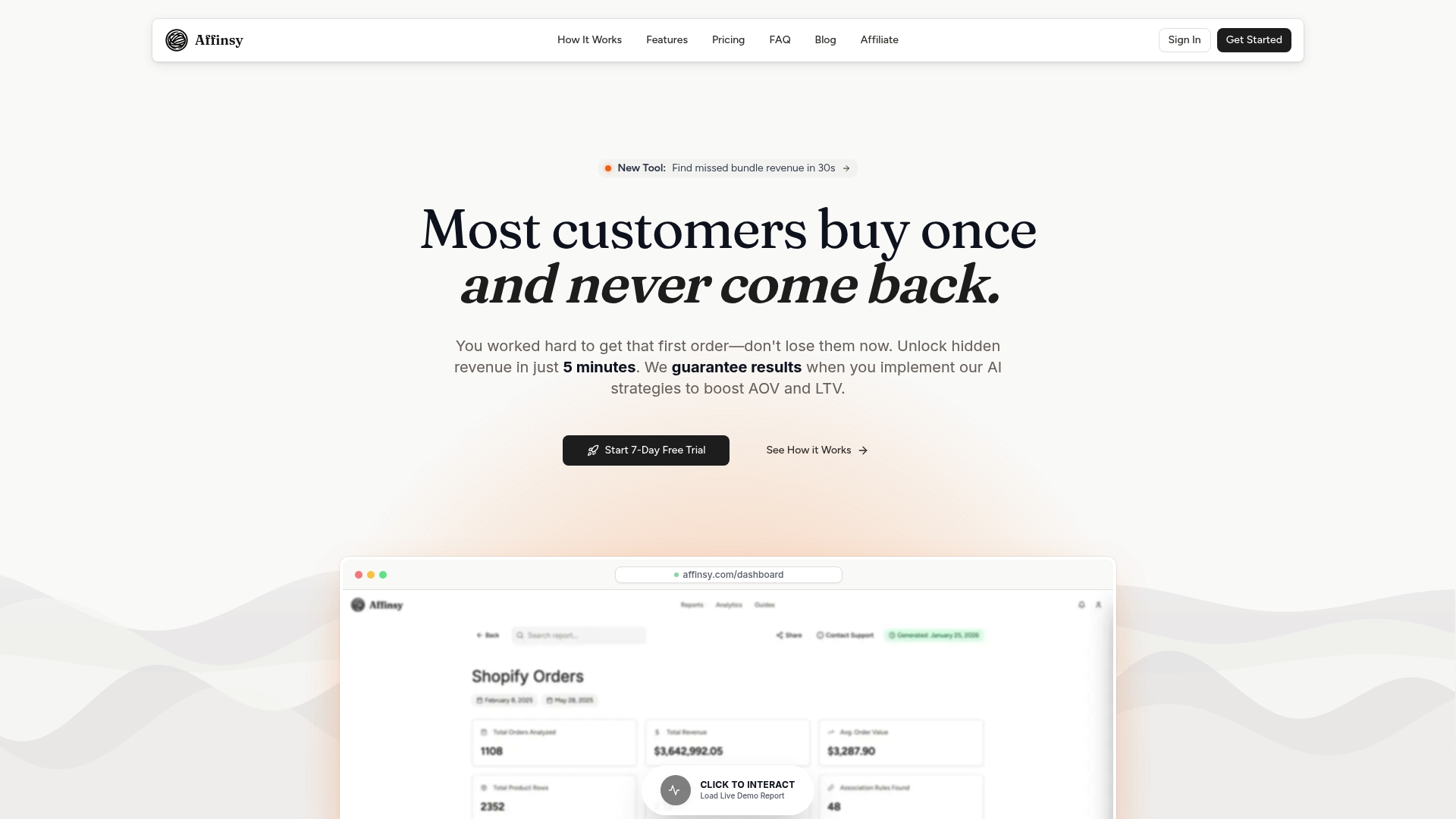
Affinsy’s AI-powered platform analyzes your historical order data to surface market basket analysis insights and customer segmentation patterns that directly support smarter merchandising. You can explore product bundling opportunities, identify high-value customer segments, and build cross-sell strategies grounded in what your customers actually buy together. Whether you upload a CSV or connect via API, you can get started with the Affinsy platform for free on up to 20K line items, no credit card required. For larger datasets and full API access, Pro and Max plans start at $49 per month.
Frequently asked questions
How does data-driven merchandising improve conversion rates?
By using AI to analyze transaction and behavioral signals, you can personalize product discovery and automate ranking decisions that lead to measurable lifts. Combining human curation with AI automation has been shown to improve conversion, AOV, and session value across digital storefronts.
What types of data are essential for reliable AI merchandising?
Consistent transaction data, behavioral signals like clicks and searches, and context signals like seasonality and inventory levels are all critical inputs. Governed, integrated data combining structured and unstructured sources is the practical standard for production-grade AI merchandising.
How do you prevent AI from making merchandising errors due to bad data?
Ensure upstream data consistency through governance policies and shared definitions across teams. Then implement automated feedback loops to monitor for drift and inconsistent outputs so humans can intervene before errors compound.
What KPI benchmarks do leading brands use for merchandising success?
Top brands benchmark conversion rates, average order value, inventory turnover, and return rates as their primary health indicators. Omnichannel performance benchmarks show that leaders combine high conversion rates with rapid inventory turnover as the clearest signal of effective merchandising.
Can promotions and out-of-stock products distort analytics models?
Yes, and this is one of the most underestimated risks in retail forecasting. Promotional spikes and stockouts create false signals unless your models are specifically trained to flag and correct for these edge cases during both training and inference.
Recommended
- Top AI applications for ecommerce sales & segmentation - Affinsy Blog | Affinsy
- Data-Driven Ecommerce Strategies for Smarter Growth - Affinsy Blog | Affinsy
- Demystifying AI in E-commerce: What Every Store Owner Needs to Know - Affinsy Blog | Affinsy
- AI Sales Optimization Strategies for E-commerce in 2026 - Affinsy Blog | Affinsy