
TL;DR:
- Many retail promotions fail to generate meaningful sales or margins due to lack of data-driven strategies.
- Effective offers require measurable ROI, sales lift, and improved customer retention, supported by real-time data.
- Implementing analytics and AI tools enables continuous optimization, precise targeting, and better margin protection.
Retail promotions are supposed to drive revenue, but far too many of them quietly drain margin instead. Research shows that 40-60% of promotions deliver low incremental ROI, meaning brands spend real money on discounts that customers would have made anyway. The gap between high-performing and underperforming retailers often comes down to one thing: whether their offer strategy is built on data or instinct. This guide walks you through the exact steps to shift from guesswork-based promotions to a disciplined, analytics-driven approach that protects margin, builds customer loyalty, and scales efficiently.
Table of Contents
- Understand what makes a retail offer effective
- Gather the right data and tools for offer optimization
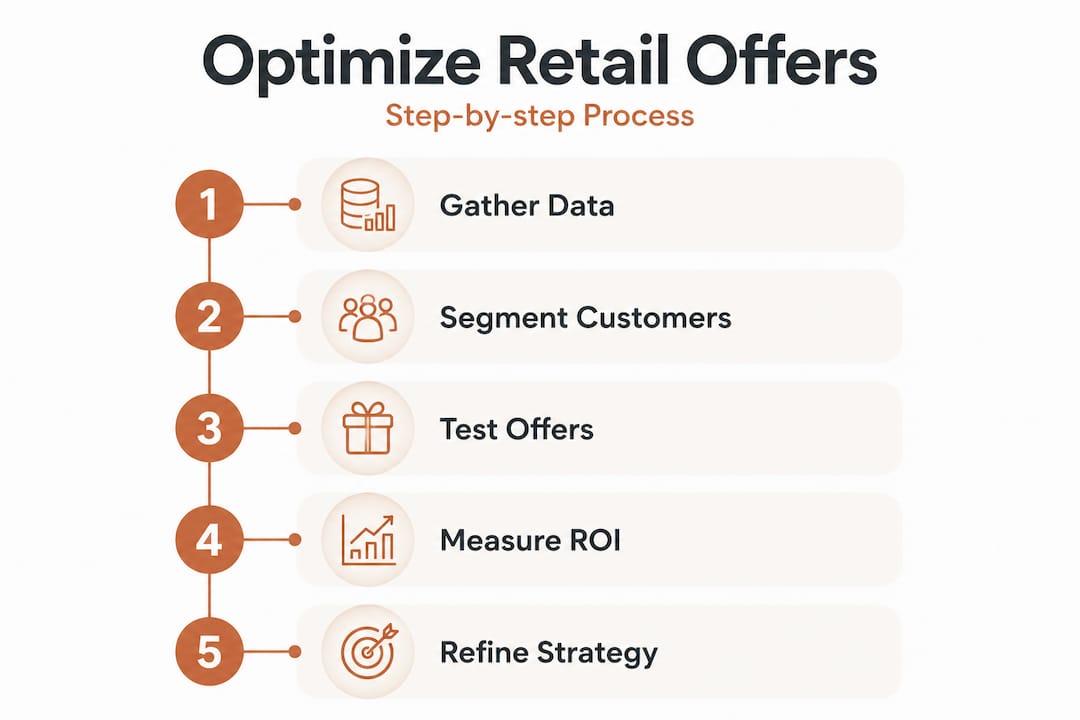
- Step-by-step process: Optimize your retail offers
- Measure, adjust, and maximize the ROI of your offers
- The new reality: Why offer optimization is now a technology-first game
- Take the next step: Tools and resources for smarter retail offers
- Frequently asked questions
Key Takeaways
| Point | Details |
|---|---|
| Data powers offer success | Effective optimization starts with solid transaction, inventory, and customer data. |
| AI boosts ROI fast | Agentic AI and automation cut planning cycles by up to 50% and lift annual margins significantly. |
| Personalization increases loyalty | Tailored offers reduce churn by at least 20% while growing repeat purchases and lifetime value. |
| Continuous measurement is critical | Weekly ROI checks prevent waste and identify the most profitable promotions quickly. |
| Blending mass and personalized offers wins | Hybrid strategies powered by analytics outperform one-size-fits-all tactics every time. |
Understand what makes a retail offer effective
Now that the risks are clear, let’s define what separates effective offers from typical, underperforming ones.
Most marketing managers assume that running a promotion automatically lifts sales. The data tells a very different story. According to BCG analysis, 20-50% of promotions generate no measurable sales increase, and between 20-30% actively dilute margins because the discount cost exceeds the incremental volume gained. That’s not a small rounding error. That’s a structural problem in how most retailers design and evaluate offers.
Effective offers share three measurable characteristics:
- Incremental ROI: The offer generates revenue above what would have occurred without the promotion, not just revenue that customers were already going to spend.
- Sales lift: There is a statistically meaningful increase in units sold, basket size, or purchase frequency compared to a control group.
- Customer retention impact: The offer improves customer lifetime value (CLV) or repeat purchase rates rather than attracting one-time deal seekers who never return.
Here’s the core problem with traditional approaches: most teams still rely on seasonal calendars, historical sales patterns from the same quarter last year, and category manager intuition. These inputs are not wrong exactly, but they are dangerously incomplete without real-time demand signals and customer-level data.
| Approach | Basis | Typical outcome |
|---|---|---|
| Traditional offer planning | Historical sales, intuition | High waste, margin leakage |
| Data-driven offer optimization | Transaction data, ML models | Targeted lift, margin protection |
| Agentic AI optimization | Real-time signals, automation | SKU-level precision, weekly recalibration |
The shift from traditional to optimized doesn’t require rebuilding your entire tech stack overnight. It starts with asking a better question: not “what discount should we run this week?” but “which customers respond to which offer types, and what margin can we afford to give up to win their loyalty long-term?”
Gather the right data and tools for offer optimization
Understanding what works is only useful if you have the right data and technology. Here’s how to set your foundation.
Data is the raw material of every effective promotion. Without the right inputs, even the best analytics platform will produce unreliable outputs. The four categories of data you need are:
- Transaction history: Order-level data including SKUs purchased, quantities, timestamps, and applied discounts. This is the non-negotiable starting point.
- Inventory positions: Current stock levels and sell-through rates. A promotion on a SKU you can’t fulfill is worse than no promotion at all.
- Competitor pricing: Real or near-real-time signals about what your competition is offering. Price elasticity models are far more accurate when competitive benchmarks are included.
- Customer profiles and segments: RFM (Recency, Frequency, Monetary) data so you can target offers by behavioral cohort rather than spraying discounts across your entire list.
Oracle’s retail lifecycle pricing documentation makes an important point here: lifecycle pricing optimization uses machine learning to handle promotions, markdowns, and targeted offers together, updating recommendations as real sales and inventory data changes week by week. This integrated view, where promotion decisions account for markdown implications simultaneously, is something manual planning tools simply cannot replicate.
Machine learning platforms that handle this kind of analysis are no longer reserved for Tier 1 retailers with large data science teams. Mid-sized brands are increasingly adopting automated retail analytics tools that operationalize these models without requiring dedicated ML engineers. If your team is already exporting transactional data from Shopify, WooCommerce, or BigCommerce, you’re closer to actionable analytics than you think.
| Data type | Why it matters | Recommended update frequency |
|---|---|---|
| Transaction history | Foundation for all models | Continuous or daily |
| Inventory positions | Prevents stockout-driven promotions | Daily |
| Competitor pricing | Enables elasticity calibration | Weekly |
| Customer RFM segments | Powers personalized targeting | Weekly or bi-weekly |
Pro Tip: When building your data pipeline, prioritize clean transaction history over everything else. A complete two-year order history with SKU-level detail gives most ML models enough signal to generate reliable offer recommendations. If your data is messy, spend time on data quality before buying any analytics platform.
Strong AI for sales segmentation becomes transformative once you have clean customer data. Segmenting customers by purchase frequency and average order value lets you assign different offer mechanics to different groups, so high-value customers get loyalty rewards while lapsed customers get win-back discounts rather than treating everyone identically.

Step-by-step process: Optimize your retail offers
With your data and tools in place, it’s time to transform theory into practice. Here’s the optimization process broken into manageable steps.
Retail offer optimization is not a one-time project. It’s an ongoing cycle of hypothesis, testing, measurement, and refinement. Here’s how to structure that cycle effectively:
-
Segment your customer base and inventory. Use RFM analysis to group customers by recency, frequency, and spending. Cross-reference segments with category affinities from your transaction data. A customer who buys premium skincare every six weeks responds very differently to a BOGO offer than a customer who buys clearance items sporadically.
-
Choose your offer mechanics deliberately. Match offer types to segment behavior and margin tolerance. BOGO works well for high-margin, high-velocity items. Threshold discounts (“spend $75, get 15% off”) drive basket size and work best for mid-frequency buyers. Bundles create perceived value without a straight price cut and are ideal for complementary product categories you’ve identified through market basket analysis.
-
Design A/B tests with control groups. Never run a promotion without a holdout. A control group of 10-15% of eligible customers who don’t see the offer gives you a clean measurement of true incremental lift. Without it, you’re measuring sales volume, not the effect of your promotion.
-
Apply price elasticity analysis before finalizing discounts. As retail promotion optimization research shows, combining price elasticity analysis, predictive analytics, and A/B testing together is what separates high-performing promotions from average ones. Knowing that demand for a specific SKU increases 12% for every 5% price reduction tells you exactly how far to discount for the margin outcome you want.
-
Track results at the offer variant level, not just campaign level. If you ran three discount depths, know which one performed. Aggregate reporting hides the insight.
-
Iterate and incorporate predictive modeling. Once you have results from three to five promotion cycles, feed outcomes into predictive analytics strategies to forecast which offer types will perform best in the next period. Predictive models improve with each data cycle, so the ROI on analytics investment compounds over time.
“The goal of promotion optimization is not to run fewer promotions. It’s to run smarter ones. The difference shows up in margin, not just in the sales report.”
Pro Tip: Run pilot tests with agentic AI tools on a limited product category first. Start with 50-100 SKUs, let the model run offer variations autonomously for four to six weeks, and compare ROI to your manually planned offers in the same category. The side-by-side comparison is almost always compelling enough to justify wider rollout. You can see how AI sales optimization techniques apply across different retail categories to understand where to start.
Measure, adjust, and maximize the ROI of your offers
The real value comes from what you do after launching offers. Continual measurement and adjustment ensure lasting gains.
Launching a promotion is the easy part. The discipline that separates high-performing retail teams is what they do with the data after launch. Most teams check total revenue and call it done. That’s where margin gets left on the table.
Measurement should happen at three levels:
- SKU level: Which individual products generated incremental volume? Which saw demand cannibalization from other categories?
- Offer type level: Did BOGO outperform threshold discounts in this segment? By how much?
- Customer segment level: Did lapsed customers re-engage? Did high-value customers increase basket size or just take the discount on a purchase they were already planning?
40-60% of promotions deliver weak incremental ROI precisely because teams don’t measure at this level of granularity. Agentic AI systems that recalculate ROI weekly at the SKU-store level catch underperforming offers before they run for an entire quarter, saving meaningful margin.
Here’s how manual and automated measurement approaches compare:
| Measurement method | Frequency | Granularity | Action speed |
|---|---|---|---|
| Manual spreadsheet tracking | Monthly or quarterly | Campaign level | Slow, reactive |
| Basic analytics dashboards | Weekly | Category level | Moderate |
| AI-driven automated tracking | Daily or weekly | SKU and segment level | Fast, proactive |
For retention specifically, the numbers are significant. Retailers using predictive analytics for retention have achieved 20% reductions in churn, 15% increases in repeat purchase rates, and 25% CLV uplift by identifying at-risk customers early and sending targeted offers before those customers go dormant. That’s the compounding effect of measurement tied directly to action.
When it comes to adjusting and discontinuing offers, use these triggers:
- Adjust: Incremental ROI is positive but below target. Try changing discount depth, offer mechanic, or targeting criteria before killing the promotion.
- Discontinue: Three consecutive measurement cycles show negative incremental ROI or margin dilution. There is no amount of creative adjustment that saves a structurally bad offer.
- Scale: Incremental ROI exceeds your threshold and customer acquisition cost is within target. Expand to adjacent segments or categories immediately.
Pro Tip: Use ecommerce retention optimization models to identify your highest-risk customer cohorts before building your quarterly promotion calendar. Aligning win-back offer timing to predicted churn windows is dramatically more effective than generic re-engagement blasts. If you’re also focused on increasing basket size, retail analytics for bundling shows how complementary product pairings from transaction data directly translate into higher AOV.
The new reality: Why offer optimization is now a technology-first game
Stepping back, it’s crucial to understand why many old-school tactics no longer work in 2026 and what leading teams are actually doing differently.
For years, the debate in retail marketing was simple: should you run mass promotions to maximize reach, or personalized offers to maximize relevance? Both camps had legitimate arguments. Mass promotions build brand awareness and drive volume. Personalized offers protect margin and improve loyalty.
That debate is now obsolete. Agentic AI integrates both approaches simultaneously, running mass and personalized promotions in parallel while modeling cannibalization in real time. Leading retailers using this kind of technology are reporting annual margin lifts exceeding $200 million, not from running more promotions, but from running the right ones at the right time to the right customers.
The uncomfortable truth is that the retailers still building promotion plans in quarterly planning meetings with static spreadsheets are not just behind on technology. They are structurally disadvantaged in a market where competitors can recalibrate offers weekly based on actual demand signals. The speed asymmetry alone is a competitive liability.
What the best teams have in common is not necessarily the most expensive technology. It’s a mindset shift: they treat every promotion as an experiment, not a commitment. They measure outcomes at the SKU level, not the campaign level. And they give their analytics systems enough trust to override intuition when the data is clear.
The path to becoming tech-first in offer optimization doesn’t require a full platform overhaul. It requires starting with clean data, running controlled tests, and building the measurement discipline that lets you learn from every promotion cycle. AI sales optimization insight increasingly points toward agentic systems as the next evolution, but the foundational work of data quality and testing rigor is still what separates organizations that benefit from those systems from the ones that don’t.
Take the next step: Tools and resources for smarter retail offers
Ready to act? Here are the top tools and resources for applying what you’ve learned, fast.
Affinsy gives marketing managers and data analysts a direct path from transaction data to actionable offer insights, without needing a data science team to interpret results. The platform analyzes historical order data through market basket analysis and RFM segmentation to surface the product associations and customer patterns that drive smarter bundling, cross-sell, and retention offers.
Whether you’re exploring market basket analysis for the first time, refining your product bundling strategies, or building out more sophisticated customer segmentation techniques, Affinsy’s free tier gives you full platform access on up to 20K line items with no credit card required. Upload a CSV from Shopify, WooCommerce, or any system that exports order data and start uncovering the offer opportunities already hidden in your transaction history.
Frequently asked questions
What data is crucial for optimizing retail offers?
Transaction history, inventory data, and customer segmentation form the backbone of effective offer optimization. Lifecycle pricing optimization with machine learning layers on top of these inputs to handle promotions, markdowns, and targeted offers in a coordinated way.
How often should retail promotions be reviewed or recalculated?
For best results, review and recalculate promotion ROI weekly. Weekly recalculation at the SKU level using agentic AI ensures underperforming offers are caught and adjusted before they erode margin over a full quarter.
How can predictive analytics improve customer retention in retail?
Predictive analytics helps identify at-risk customers before they churn, enabling targeted offer delivery at the right moment. Retailers applying these methods have seen 20% churn reductions alongside 15% gains in repeat purchases and 25% CLV uplift.
What is agentic AI’s role in retail offer optimization?
Agentic AI automates offer testing and recalibration at scale, modeling both mass and personalized promotions simultaneously. It integrates cannibalization analysis to ensure offers don’t simply shift demand between categories without generating genuine incremental growth.
What common mistakes do retailers make when optimizing offers?
The two most damaging mistakes are relying on intuition over analytics and failing to measure results at a granular level. Research shows 20-50% of promotions produce no real sales lift, largely because teams don’t have the measurement systems to detect and correct underperformers quickly.
Recommended
- How to Improve Cross-Selling With Data-Driven Strategies - Affinsy Blog | Affinsy
- Data-Driven Decision Making in Retail – Impact on Sales Growth - Affinsy Blog | Affinsy
- Data-Driven Marketing Strategies Guide to Boost AOV - Affinsy Blog | Affinsy
- Understanding Data-Driven Campaign Optimization for E-Commerce - Affinsy Blog | Affinsy
- Discount Strategies for Grocery Loyalty Success | BonusQR