
TL;DR:
- Retail SaaS platforms are cloud-based systems that centralize core functions to improve agility and efficiency. They now operate as unified ecosystems, connecting sales, inventory, and customer data in real time. These platforms reduce costs, accelerate deployment, and enable seamless omnichannel customer experiences through AI and modular architecture.
SaaS platforms in retail are cloud-based systems that centralize and automate core business functions, including order management, pricing, inventory, and customer analytics, to give retailers the agility to compete at scale. The role of SaaS platforms in retail has shifted from simple point solutions to what industry leaders now call a “unified operational fabric,” where every system talks to every other system in real time. Shopify, Pipe17, QuickLizard, and SymphonyAI represent the new generation of retail SaaS tools built around this philosophy. Retailers who still treat software as a collection of disconnected tools are leaving measurable money on the table.
How SaaS platforms improve retail operational efficiency
Operational efficiency is where SaaS solutions for retail deliver their most immediate and measurable impact. The numbers are hard to ignore.

Composable order management platforms like Pipe17 reduce total cost of ownership by up to 85% compared to traditional OMS systems. That figure reflects the elimination of expensive on-premise infrastructure, custom development, and the IT labor required to maintain legacy systems. For a mid-size retailer spending $500,000 annually on order management infrastructure, that translates to real budget freed for growth.
Speed matters just as much as cost. Specialized SaaS implementations like dynamic pricing and order management often go live in 21 days or fewer. Traditional ERP rollouts routinely take 12–18 months. That difference is not just a timeline preference. It determines how fast you can respond to market shifts.
The operational benefits of SaaS in retail include:
- Real-time inventory sync across physical stores, e-commerce channels, and marketplaces, eliminating overselling and stockouts
- Automated order routing that directs fulfillment to the nearest or most cost-effective warehouse without manual intervention
- No-code workflow automation that lets operations teams build integrations without engineering support
- Built-in compliance and security, where SaaS providers handle regulatory requirements internally, reducing your compliance overhead
Pro Tip: When evaluating SaaS solutions for retail operations, ask vendors specifically about their API rate limits and webhook reliability. These two technical details determine whether your real-time sync actually works at peak traffic volumes like Black Friday.
Composable architectures also protect your existing investments. Composable SaaS layers integrate via APIs over legacy ERP, WMS, and POS systems without requiring a full replacement. You enhance what you have rather than ripping it out.
How does SaaS enable omnichannel customer engagement?
Omnichannel retail is not a strategy. It is a technical requirement, and SaaS platforms are the infrastructure that makes it possible. Global social commerce will exceed $2.9 trillion in 2026. That scale means your customers are buying on Instagram, TikTok, and Pinterest as naturally as they shop your website. SaaS platforms connect those channels into a single operational view.
Here is how leading retailers use SaaS to build unified customer engagement:
- Connect social storefronts to inventory. SaaS integrations between platforms like Instagram Shopping and your OMS keep product availability accurate across every channel. A sold-out item disappears from your TikTok shop the moment it sells out on your website.
- Build unified customer profiles. Customer data platforms (CDPs) built on SaaS architecture pull purchase history, browsing behavior, and support interactions into one record. Your marketing team sees the full customer, not a fragment.
- Personalize at scale. With a unified profile, you can trigger personalized email sequences, SMS offers, and retargeting ads based on actual purchase behavior rather than demographic guesses.
- Eliminate data silos. BigCommerce and Shopify experts emphasize that bidirectional data flows between sales channels and back-end systems are what prevent the disconnected customer experiences that drive churn.
The practical result is that a customer who browses a product on TikTok, adds it to a cart on your website, and picks it up in-store gets a consistent experience at every step. SaaS makes that consistency technically achievable without a custom-built data pipeline. For more on how AI in omnichannel retail drives this kind of growth, the underlying principles apply directly to your SaaS stack decisions.
What AI and automation are doing to retail SaaS
Artificial intelligence is not a feature retailers add to their SaaS stack. It is becoming the operating layer that connects merchandising, supply chain, and store data into a single decision engine. The impact on pricing alone illustrates how significant this shift is.
AI-driven dynamic pricing tools like QuickLizard reprice millions of SKUs every 15 minutes using machine learning models that factor in competitor prices, demand signals, and margin targets simultaneously. Manual pricing reviews happen weekly at best. The gap between those two cadences is where margin is won or lost. You can learn more about how dynamic pricing works as a discipline before evaluating vendors.
The table below shows how AI-powered SaaS compares to traditional retail software on key operational dimensions:
| Capability | Traditional Retail Software | AI-Powered SaaS |
|---|---|---|
| Pricing updates | Manual, weekly or monthly | Automated, every 15 minutes or faster |
| Demand forecasting | Historical averages | Real-time ML models with external signals |
| Inventory replenishment | Rule-based reorder points | Predictive replenishment based on sell-through trends |
| Customer segmentation | Static demographic groups | Dynamic RFM and behavioral segments |
| Implementation timeline | 12–18 months (ERP) | 21 days or fewer (SaaS) |
Retail SaaS platforms now operate as fully managed ecosystems, freeing retailers from infrastructure maintenance and letting teams focus on customer experience instead. That shift is structural, not incremental. The retailers who treat AI-powered SaaS as a vendor upgrade rather than an operational model change will underperform those who do not.
Pro Tip: Avoid over-customizing AI-powered SaaS tools. Heavy customization creates technical debt that blocks you from taking vendor updates, which is where the real AI improvements ship. Configure within the platform’s native parameters first, and only customize when a genuine business requirement cannot be met otherwise.
Balancing standardization and customization is one of the most critical decisions in SaaS adoption. The retailers who get this right treat SaaS configuration as a competitive advantage and custom code as a last resort.
Composable vs. monolithic SaaS platforms: which fits your retail operation?
The architectural choice between composable and monolithic SaaS platforms is the most consequential decision a retail technology team makes. It determines your cost structure, your speed to market, and your ability to adapt as the industry changes.
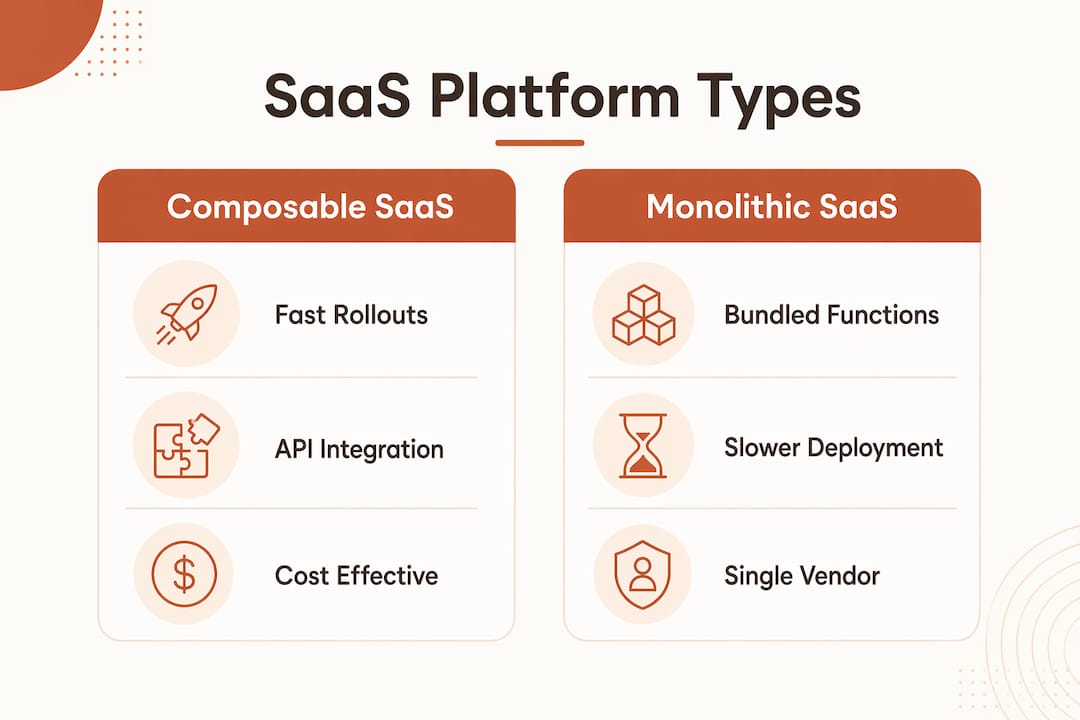
A monolithic platform bundles all retail functions, including e-commerce, OMS, CRM, and analytics, into a single system. The advantage is simplicity. One vendor, one contract, one support team. The disadvantage is rigidity. When you need a capability the platform does not offer natively, you either wait for the vendor’s roadmap or build a workaround.
A composable platform assembles best-of-breed SaaS tools via APIs. You choose a dedicated OMS like Pipe17, a pricing engine like QuickLizard, and a CDP from a specialist vendor, then connect them through a unified data layer. The SymphonyAI approach demonstrates this well: an AI intelligence layer sits atop existing ERP, WMS, and POS systems, adding capability without replacing infrastructure.
| Factor | Composable SaaS | Monolithic SaaS |
|---|---|---|
| Implementation speed | Fast, modular rollouts | Slower, full-system deployment |
| Cost of ownership | Up to 85% lower TCO | Higher due to licensing and maintenance |
| Customization flexibility | High, swap components as needed | Limited to vendor’s feature set |
| Integration complexity | Requires API management | Lower, built-in integrations |
| Upgrade risk | Lower, update components independently | Higher, upgrades affect entire system |
| Best for | Mid-to-large retailers with tech resources | Smaller retailers prioritizing simplicity |
The composable model wins on cost and flexibility for retailers with the technical resources to manage API integrations. The monolithic model wins on simplicity for teams without dedicated engineering support. The honest answer for most mid-size retailers is a hybrid: a core platform like Shopify or BigCommerce as the foundation, with specialized SaaS tools layered on top for pricing, analytics, and customer segmentation.
Key takeaways
SaaS platforms in retail deliver their greatest value when deployed as a unified, AI-powered operational layer rather than a collection of disconnected tools.
| Point | Details |
|---|---|
| Composable SaaS cuts costs sharply | Composable OMS platforms reduce total cost of ownership by up to 85% versus traditional systems. |
| Speed to deployment is a real advantage | Specialized SaaS tools go live in 21 days or fewer, versus 12–18 months for legacy ERP rollouts. |
| Omnichannel requires unified data flows | Bidirectional SaaS integrations across social, e-commerce, and in-store channels eliminate the silos that damage customer experience. |
| AI reprices faster than any team can | Dynamic pricing SaaS updates millions of SKUs every 15 minutes, capturing margin opportunities that manual processes miss. |
| Customization carries real risk | Heavy SaaS customization creates technical debt that blocks vendor updates and compounds over time. |
The uncomfortable truth about SaaS adoption in retail
I have watched retailers make the same mistake for years. They buy a SaaS platform, spend six months configuring it to replicate their old workflows exactly, and then wonder why the results look identical to what they had before. The platform is not the problem. The thinking is.
SaaS platforms in retail are not just faster versions of the software you already have. They represent a fundamentally different operating model, one where the vendor handles infrastructure, compliance, and core logic, and your team focuses entirely on what differentiates your brand. The retailers who extract the most value from tools like Shopify, QuickLizard, and SymphonyAI are the ones who let the platform’s native capabilities shape their processes, not the other way around.
The second mistake I see constantly is treating SaaS as a collection of point solutions rather than an ecosystem. A pricing tool that does not talk to your inventory system will optimize prices against stock levels it cannot see. A CDP that does not receive data from your OMS will segment customers based on incomplete purchase histories. The unified SaaS fabric concept is not marketing language. It is a description of how these tools actually have to work to deliver their promised value.
My practical advice: before you sign any SaaS contract, map every data flow the tool needs to function correctly. Identify which systems it must connect to, what data it needs to send and receive, and who on your team owns those integrations. If you cannot answer those questions before purchase, you will answer them expensively after. The AI applications in e-commerce space is moving fast, and the retailers building the right data foundations now will have a compounding advantage over the next three years.
— Mateusz
Turn your transaction data into a retail advantage with Affinsy
The SaaS platforms covered in this article generate enormous volumes of transaction data. Most retailers export that data and never analyze it deeply enough to act on it.
Affinsy is built specifically for that gap. It analyzes your historical order data using market basket analysis to surface which products customers buy together, which combinations drive repeat purchases, and which customer segments are most valuable to your business. You export your order data from Shopify, WooCommerce, BigCommerce, or Stripe, and feed it into Affinsy via API or CSV upload. No data science skills required. The permanent free tier covers up to 20,000 line items with full product access and no credit card needed. Pro plans start at $49 per month for larger datasets and API access.
FAQ
What is the role of SaaS platforms in retail?
SaaS platforms in retail centralize and automate core functions including order management, pricing, inventory, and customer analytics through cloud-based software. They serve as the operational infrastructure that connects sales channels, fulfillment systems, and customer data into a unified view.
How does SaaS improve retail operational efficiency?
Composable SaaS platforms reduce total cost of ownership by up to 85% compared to traditional OMS systems and deploy in as few as 21 days. They automate inventory sync, order routing, and compliance management without requiring custom development.
What are the main challenges of SaaS in retail?
The primary challenges of SaaS in retail are integration complexity and over-customization. Heavy customization creates technical debt that blocks vendor updates, while disconnected point solutions create data silos that undermine customer experience.
How does SaaS support omnichannel retail?
SaaS platforms integrate with social commerce channels like Instagram and TikTok, synchronize inventory across all sales touchpoints, and feed unified customer profiles into CDPs. This infrastructure supports the $2.9 trillion global social commerce market projected for 2026.
What is a composable SaaS architecture in retail?
A composable SaaS architecture assembles best-of-breed tools via APIs rather than relying on a single monolithic platform. It layers AI and specialized capabilities over existing ERP, WMS, and POS systems, adding functionality without replacing core infrastructure.
Recommended
- Why Choose SaaS Analytics for Your Business in 2026 - Affinsy Blog | Affinsy
- Understanding Retail Analytics Guide 2025 for E-Commerce Success - Affinsy Blog | Affinsy
- The Essential Guide to the State of Ecommerce 2025 - Affinsy Blog | Affinsy
- Marketing analytics trends 2026: optimize ecommerce sales - Affinsy Blog | Affinsy