
TL;DR:
- SaaS analytics provides cloud-based, vendor-managed metrics tailored for subscription and e-commerce businesses, ensuring real-time insights and operational efficiency. Its multi-tenant, governed architecture enables faster deployment, lower costs, and trusted data across teams, significantly boosting decision-making. Adopting SaaS analytics leads to substantial ROI, reduced total ownership costs, and better cross-team alignment for growth and retention strategies.
SaaS analytics is defined as cloud-based, vendor-managed analytics built specifically to track the metrics that drive subscription and e-commerce businesses, including Monthly Recurring Revenue, churn, and authenticated user behavior. Unlike generic business intelligence tools, SaaS analytics platforms such as Qlik, GoodData, and Sleek Analytics are architected from the ground up to serve multi-tenant environments, embed directly into product interfaces, and deliver real-time insights without requiring an in-house data engineering team. The core case for why choose SaaS analytics comes down to three compounding advantages: lower infrastructure costs, faster time to insight, and analytics that actually measure what SaaS and e-commerce businesses care about. For business owners and analysts who need decisions grounded in data rather than instinct, this distinction is not academic. It is the difference between a dashboard that tells you page views and one that tells you which customer segment is about to churn.
Why choose SaaS analytics over traditional BI tools
The financial case for cloud analytics is direct. Analytics as a Service eliminates the need to own hardware or manage complex on-premise infrastructure, shifting those responsibilities entirely to the vendor. That shift removes capital expenditure from the equation and replaces it with a predictable subscription cost, which is far easier to justify at the board level.
The operational benefits are just as concrete:
- Faster deployment. Embedded analytics can ship in under a week with modern SaaS platforms, compared to six to twelve months of in-house engineering. That gap represents an enormous opportunity cost for any team waiting on data.
- Real-time decision speed. BI platforms for SaaS replace manual reporting and guesswork with live dashboards, letting teams respond to customer behavior shifts the same day they occur rather than the same quarter.
- Reduced maintenance burden. Vendor-managed cloud systems handle updates, security patches, and scaling automatically. Your analysts spend time on analysis, not infrastructure tickets.
- No specialist hiring required. On-premise BI stacks typically demand dedicated data engineers and DBAs. SaaS analytics platforms are designed for analysts and business owners who understand the business, not the server rack.
Pro Tip: When evaluating any SaaS analytics platform, ask the vendor for a documented time-to-first-insight benchmark. If they cannot answer in hours or days, not weeks, that is a red flag about their deployment model.
The advantages of cloud analytics compound over time. A team that ships its first dashboard in three days instead of three months has twelve extra weeks to iterate, test hypotheses, and act on findings before a competitor does.

How does embedded SaaS analytics differ from generic analytics tools?
The distinction matters more than most buyers realize before they sign a contract. Generic web analytics tools like Google Analytics measure page views, sessions, and traffic sources. Those metrics are useful for marketing teams. They are nearly useless for a SaaS product manager trying to understand why a cohort of enterprise customers stopped using a core feature.
SaaS analytics dashboards track revenue and authenticated product usage inside applications, not just anonymous page events. That means you can connect a specific user’s behavior to their subscription tier, their renewal date, and their support ticket history in a single view.
| Dimension | Generic analytics tools | Embedded SaaS analytics |
|---|---|---|
| Primary metric focus | Page views, sessions, traffic sources | MRR, churn rate, feature adoption, authenticated journeys |
| Data context | Anonymous visitor behavior | Identified user and tenant behavior |
| Integration depth | Tag-based, front-end only | API-first, embedded in product UI |
| Multi-tenant support | None by default | Native tenant data isolation |
| Revenue correlation | Indirect or manual | Direct, built-in subscription linkage |
The multi-tenant architecture point deserves particular attention. When you deliver analytics to customers inside your own product, each customer must see only their own data. Generic tools handle this with UI-level filters, which are fragile and create compliance risk. True embedded SaaS analytics platforms enforce tenant data isolation at the data layer, not the display layer. That is a structural security difference, not a cosmetic one.
What architectural features make SaaS analytics platforms scalable and trustworthy?
Scalability in SaaS analytics is not about adding more servers. It is about building the right architecture from the start. True SaaS analytics platforms feature three core structural traits that separate them from repackaged on-premise tools with a cloud login screen.
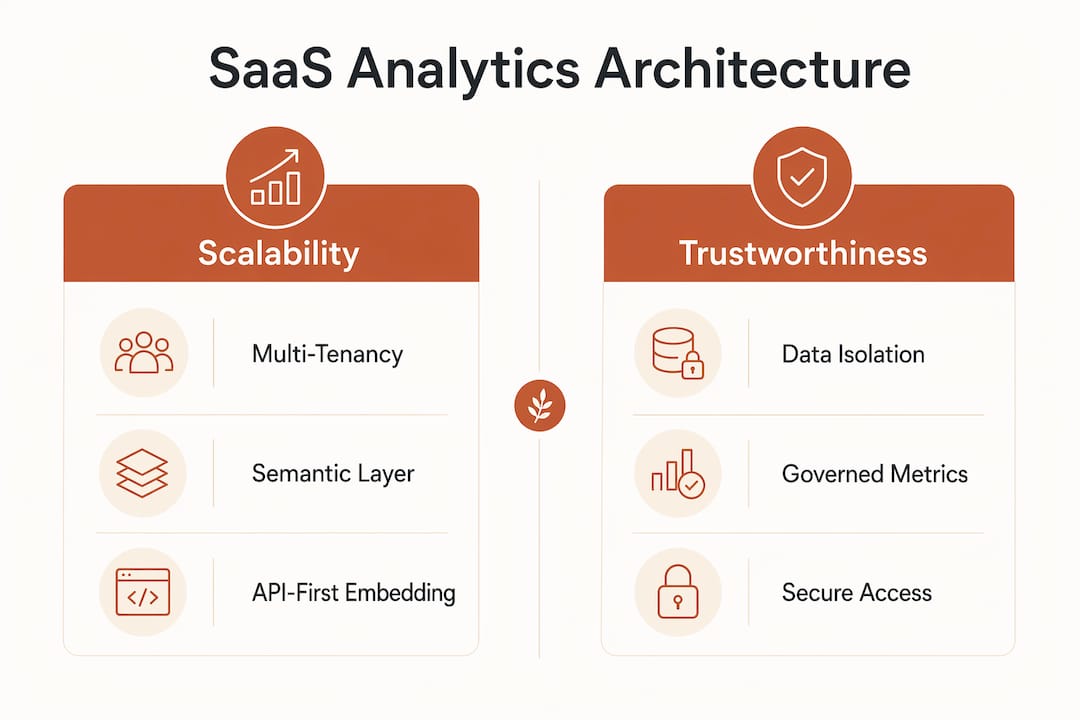
The first is native multi-tenancy. Each customer’s data lives in a logically isolated environment. As you add customers, the platform scales without requiring you to provision separate infrastructure for each one. This is what allows a single SaaS analytics deployment to serve thousands of tenants simultaneously without performance degradation.
The second is a governed semantic layer. This is the part most buyers overlook until they have a problem. A semantic layer defines metrics once, centrally, so that “active users” means the same thing in the marketing dashboard as it does in the product dashboard and the executive report. Shared metric definitions eliminate the trust-destroying situation where two teams present conflicting churn numbers in the same meeting. Beyond trust, semantic layers reduce compute costs by reusing cached query results instead of re-running expensive warehouse queries every time a dashboard loads.
The third is an API-first embedding model. Analytics that lives inside your product, rather than in a separate tab or external tool, gets used. API-first design means you can surface the right metric at the right moment in the user’s workflow, which drives adoption and creates a monetizable feature rather than a reporting afterthought.
Pro Tip: Before committing to any SaaS analytics platform, request a technical architecture diagram and ask specifically how tenant data isolation is enforced at the query layer. Vendors who cannot explain this clearly are likely using filter-based workarounds, not true multi-tenancy.
What practical impact does SaaS analytics have on business operations and growth?
The ROI numbers from independent validations are striking. Organizations adopting modern SaaS analytics platforms have achieved 45% lower total cost of ownership over three years alongside a 414% return on investment. That figure comes from an Enterprise Strategy Group economic validation, not a vendor marketing sheet. It reflects real infrastructure savings, reduced engineering hours, and faster decision cycles.
A separate case report found that migrating to a modern SaaS analytics stack produced 606% year-one ROI driven by 90% faster dashboard load times and significant recovery of engineering hours previously spent on manual reporting. Ninety percent faster dashboards means analysts stop waiting and start working. Recovered engineering hours mean your developers build product features instead of maintaining data pipelines.
| Business outcome | Reported impact |
|---|---|
| Total cost of ownership reduction | 45% over three years |
| Return on investment | 414% (Enterprise Strategy Group validation) |
| Year-one ROI from faster dashboards | 606% |
| Dashboard speed improvement | 90% faster load times |
The operational benefits extend beyond finance. Cross-team alignment is one of the most underrated advantages of cloud analytics for businesses. When every team, from product to marketing to customer success, pulls from the same governed metric definitions, conversations shift from “whose numbers are right” to “what do we do about it.” That shift alone recovers hours of meeting time every week and prevents the kind of strategic paralysis that comes from conflicting data. Data-driven decision making in retail and e-commerce shows the same pattern: teams that act on shared data outperform those working from siloed reports.
“The biggest SaaS analytics wins I have seen come not from better charts, but from the moment a company agrees on what a metric actually means before they build the dashboard.”
Practical use cases where the importance of SaaS analytics becomes undeniable include reducing customer churn by identifying at-risk cohorts before renewal dates, optimizing product launches by tracking feature adoption in real time, and improving marketing spend allocation by connecting campaign data directly to subscription revenue rather than just traffic.
Key takeaways
SaaS analytics delivers its highest value when multi-tenant architecture, governed metrics, and embedded deployment combine to give every team a single, trusted source of operational truth.
| Point | Details |
|---|---|
| Cost advantage is structural | Vendor-managed cloud eliminates hardware costs and shifts maintenance responsibility away from your team. |
| Deployment speed matters | Embedded analytics can ship in days versus months of in-house engineering, compressing time to first insight. |
| Metric governance drives trust | A governed semantic layer ensures every team uses identical definitions, eliminating conflicting reports. |
| ROI is independently validated | Economic studies report 414% ROI and 45% lower total cost of ownership over three years for modern SaaS analytics adopters. |
| Embedded beats standalone | Analytics built into your product UI drives higher adoption and creates a monetizable feature rather than a separate reporting tool. |
The metric problem nobody talks about before they buy
I have reviewed analytics deployments across dozens of SaaS and e-commerce businesses, and the failure pattern is almost always the same. The platform works. The data loads. The dashboards look good in the demo. Then, three months after launch, the sales team’s churn number does not match the product team’s churn number, and suddenly nobody trusts any of the dashboards.
The root cause is almost never the technology. It is the absence of a shared metric contract before deployment. Companies spend weeks evaluating visualization libraries and pricing tiers, and almost no time defining what “active user” or “churned customer” means across every team that will consume the data. Platforms like GoodData and Reveal BI have built governed semantic layers specifically to solve this problem, but the layer only works if someone owns the definitions before the first dashboard goes live.
My honest advice: treat metric definition as a pre-deployment deliverable, not a post-launch cleanup task. Assign a single owner for each core metric. Document the definition in writing. Get sign-off from every team that will use it. That process takes a few days and prevents months of trust erosion.
The second thing I would push back on is the instinct to build analytics in-house. I understand the appeal. You control everything. But the teams I have seen attempt this consistently underestimate the ongoing maintenance cost. The platform you build in year one needs to be rebuilt in year two when your data model changes. Buying a purpose-built SaaS analytics platform with native multi-tenancy and an API-first model is not a shortcut. It is the architecturally correct decision for any business that does not have analytics infrastructure as its core product.
— Mateusz
How Affinsy turns your transaction data into growth signals
If the case for SaaS analytics has you thinking about what your own transaction data could reveal, Affinsy is built exactly for that next step. Affinsy applies AI-powered analytics to historical order data from Shopify, WooCommerce, Stripe, and any platform that exports transactional records, uncovering the product associations and customer behavior patterns that standard dashboards miss.
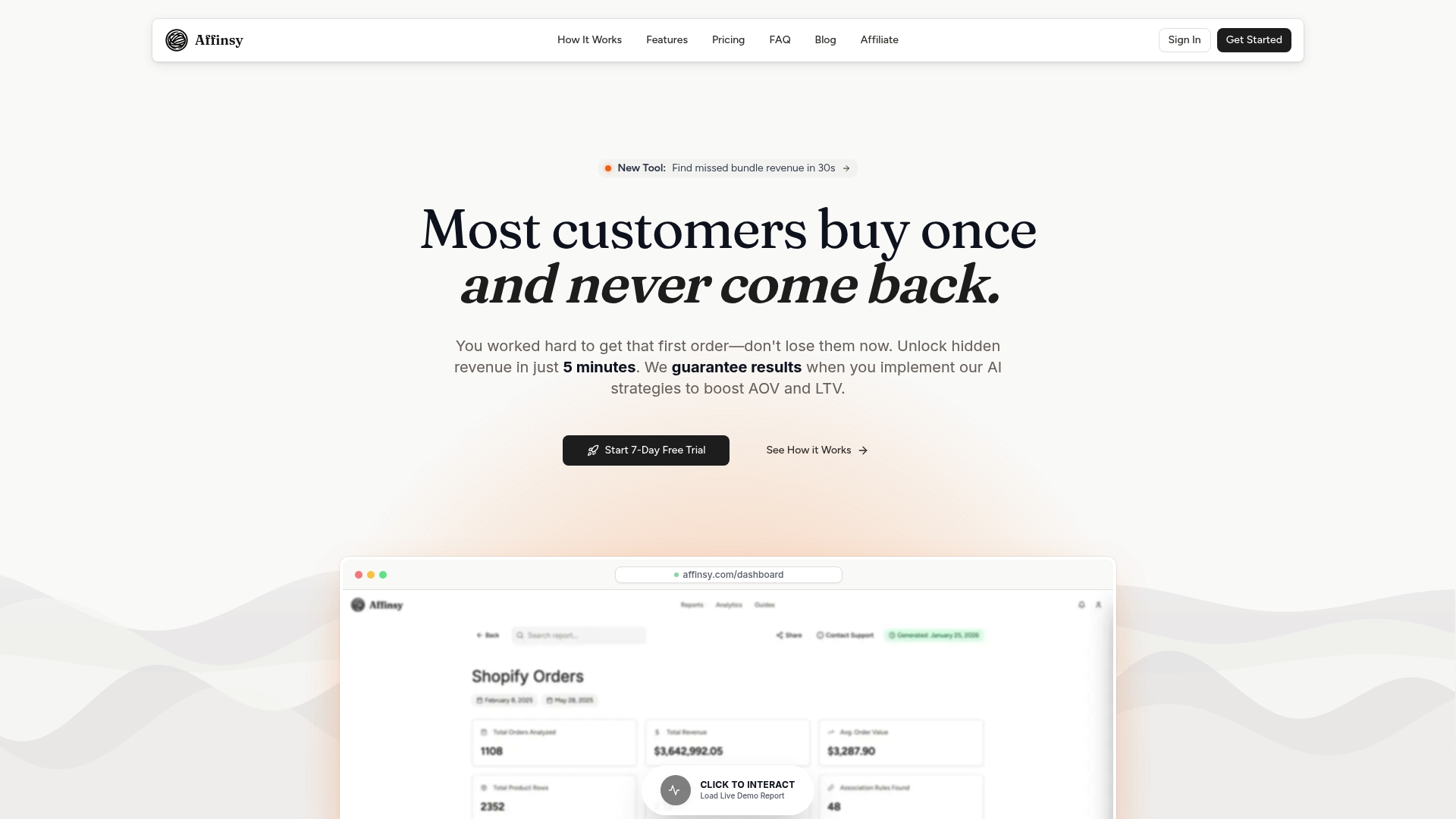
The platform’s market basket analysis identifies which products customers buy together, giving you a direct input for bundling and cross-sell strategies. Its RFM-based customer segmentation separates your highest-value customers from those at risk of lapsing, so your retention efforts go where they matter most. Affinsy’s free tier covers up to 20,000 line items with no credit card required, making it one of the lowest-friction ways to start extracting real intelligence from data you already own.
FAQ
What is SaaS analytics, exactly?
SaaS analytics is cloud-based analytics designed to track subscription and product metrics like MRR, churn, and feature adoption. It differs from generic BI tools by connecting revenue data directly to authenticated user behavior inside the product.
How does SaaS analytics reduce costs compared to on-premise tools?
Analytics as a Service eliminates hardware ownership and infrastructure maintenance by shifting those responsibilities to the vendor. Independent studies report a 45% reduction in total cost of ownership over three years for organizations that make the switch.
Why does multi-tenant architecture matter for SaaS analytics?
Multi-tenant architecture enforces data isolation at the query layer, not just the display layer. This means each customer sees only their own data, which is a security and compliance requirement for any SaaS business delivering analytics to end customers.
How quickly can a business deploy SaaS analytics?
Modern embedded analytics platforms can be deployed in under a week, compared to six to twelve months for in-house builds. That speed difference directly compresses the time between buying a platform and making better decisions with it.
Can small or mid-size businesses benefit from SaaS analytics?
Yes. The advantages of cloud analytics scale down as well as up. Platforms like Affinsy offer permanent free tiers for smaller datasets, and the absence of infrastructure costs means even a lean team can access the same analytical capabilities as a large enterprise without the capital investment.
Recommended
- Marketing analytics trends 2026: optimize ecommerce sales - Affinsy Blog | Affinsy
- SaaS Upsell Analytics: Grow Revenue from Existing Customers - Affinsy Blog | Affinsy
- Top 6 Subscription Analytics Tools 2026 - Affinsy Blog | Affinsy
- Customer Segmentation SaaS: Strategies That Drive Growth - Affinsy Blog | Affinsy