
TL;DR:
- Affinsy provides quick, AI-driven market-basket and customer segmentation insights without heavy replatforming. It targets mid-market e-commerce and SaaS teams seeking fast, actionable analytics, contrasting with enterprise lakehouses and managed AI platforms. Migration timelines range from five to nine weeks, with affordability and ease of use being key advantages.
For e-commerce and SaaS teams that need fast market-basket and RFM insights from transactional data, the best replacement is Affinsy — a specialist SaaS that delivers AI-driven bundling and segmentation without heavy replatforming. If you’re evaluating singdata.com alternatives because you need actionable analytics, not a data infrastructure project, Affinsy is where to start.
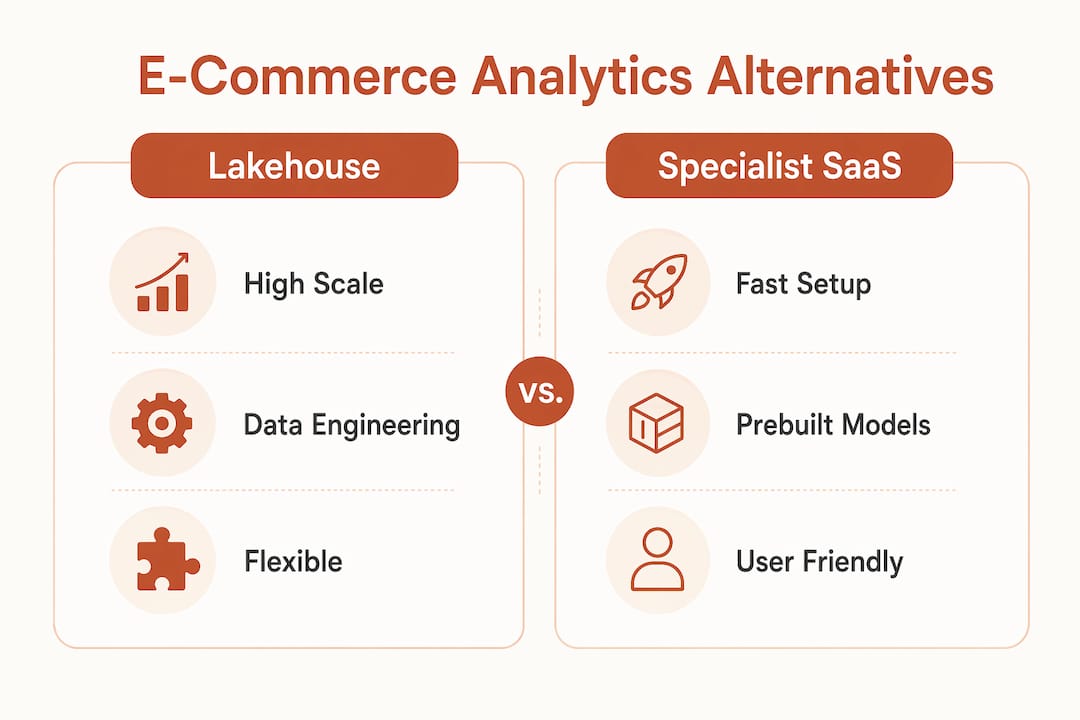
Two other categories appear on most shortlists. Enterprise lakehouse platforms (Databricks, Snowflake) suit organizations with in-house data engineering teams that need consolidated governance across multiple data sources. Managed enterprise AI data platforms (IBM watsonx.data) fit large enterprises with compliance-heavy environments and dedicated IT budgets. Neither is the right fit for a mid-market store owner who needs bundling insights by next week.
Quick next steps:
- Sign up for Affinsy’s free tier (no credit card, with a limited number of line items)
- Export a recent order sample from Shopify, WooCommerce, or Stripe as a CSV
- Run a short proof-of-concept: market-basket report and RFM segmentation, then export a segment to Klaviyo or Omnisend
Table of Contents
- How do the top singdata.com alternatives actually compare?
- How do you pick the right alternative for your team?
- What does a realistic migration away from a lakehouse actually look like?
- When does an enterprise lakehouse beat a specialist SaaS like Affinsy?
- What does Affinsy actually do, and how does it work?
- Which alternative should you choose, and what should you do this week?
- Key Takeaways
- Why Affinsy is the right call for this audience
- Affinsy’s free tier: what you get and how to start
- Research and further reading
How do the top singdata.com alternatives actually compare?
The table below maps the three solution categories across the dimensions that matter most for product bundling and customer segmentation work.

| Dimension | Affinsy | Enterprise lakehouse platforms (e.g., Databricks, Snowflake) | Managed enterprise AI platforms (e.g., IBM watsonx.data) |
|---|---|---|---|
| Best for / target customer | Mid-market e-commerce brands, SaaS companies, growth agencies | Enterprises with data engineering teams needing consolidated governance | Large enterprises with compliance-heavy, multi-cloud environments |
| Pricing model | Free tier (20K line items); Pro $49/mo; Max $199/mo; Enterprise on request | Consumption-based or enterprise licensing; costs scale with compute and storage | Enterprise licensing; pricing not publicly listed |
| Data inputs / integrations | CSV upload, API, MCP/webhook; export from any platform | Native connectors to cloud storage, databases, streaming sources | Multi-cloud connectors, data fabric architecture |
| Time to value / setup | Under 48 hours for initial reports from a CSV import | Weeks to months depending on schema complexity and team size | Months; requires IT and governance planning |
| AI analytics (MBA, RFM, prebuilt models) | Market basket analysis, RFM segmentation, automated hypotheses ranking — prebuilt, no data science skills needed | Custom ML pipelines; no prebuilt retail-specific models out of the box | AI governance and model management; vertical models vary by deployment |
| Scalability | Mid-market to large e-commerce and SaaS datasets | Petabyte-scale enterprise workloads | Petabyte-scale; multi-cloud and on-premise |
| Security & compliance | Data handled via API/CSV; enterprise tier includes access controls | SOC 2, ISO certifications; enterprise-grade governance | SOC 2, ISO, FedRAMP options; enterprise compliance |
| Support & onboarding | Self-serve onboarding; enterprise tier includes dedicated support | Enterprise SLAs; professional services available | Enterprise SLAs; IBM Global Services |
Feature callouts for bundling and segmentation:
- Affinsy produces product bundling suggestions and RFM segments you can export directly to Klaviyo, MailerLite, or Omnisend — no SQL, no data engineer required.
- Enterprise lakehouses give you the raw compute to build any model you want, but someone on your team has to build it.
- Managed enterprise AI platforms add governance layers that matter at scale, but the retail-specific analytics you need still require custom development.
According to G2 marketplace analysis, prebuilt models and exportable segments speed time-to-value for marketers and product teams — which is exactly where specialist SaaS platforms like Affinsy have a structural advantage over general-purpose lakehouses.
How do you pick the right alternative for your team?
Start with time-to-value. If you need bundling insights within a week, an enterprise lakehouse is the wrong tool regardless of its feature list.
Decision criteria, prioritized:
- Time-to-value — Can you run a real report on your own data within 48 hours of signing up?
- Integration surface — Does it accept CSV exports from Shopify, WooCommerce, BigCommerce, or Stripe without custom ETL?
- Prebuilt analytics — Does it ship with market-basket analysis and RFM segmentation, or do you need to build those models yourself?
- Total cost of ownership (TCO) — Factor in license fees, data egress, engineering hours, and the time cost of rebuilding analytics workflows. Platform whitepapers consistently recommend matching architecture to TCO before committing.
- Governance requirements — Do you need SOC 2, ISO, or FedRAMP? If yes, confirm certification scope before shortlisting.
- Support model — Is there a dedicated onboarding contact, or are you on your own with documentation?
Questions to ask every vendor on a shortlist call:
- What is your SLA for support tickets, and does it differ by tier?
- Can I import a sample CSV of 10,000 order rows today and see a market-basket report before I buy?
- How do I export a customer segment to Klaviyo or Omnisend?
- What does your onboarding process look like for a team with no dedicated data engineer?
- Are there data egress fees if I move data out later?
Red flags during evaluation:
- Pricing is only available after a sales call with no published tiers
- Setup timeline is quoted in months with no self-serve trial option
- No developer API or webhook support
- Segment export requires a custom integration or professional services engagement
Pro Tip: Run a hands-on proof-of-concept with your own data before committing. Marketplace comparisons surface features and user feedback, but they cannot tell you whether the platform handles your specific schema or export format.
What does a realistic migration away from a lakehouse actually look like?
Most teams underestimate this. Schema variability and historical record reconciliation are where migrations stall — not the data transfer itself.
Preflight inventory checklist:
- Map your transaction tables: order ID, line items, timestamps, customer IDs, SKUs
- Flag schema variability across data sources (e.g., Shopify orders vs. Stripe invoices have different structures)
- Decide how many months of historical data you actually need for meaningful MBA and RFM outputs (90 days is a practical minimum; 12 months is better)
- Tag any sensitive data fields (PII, payment data) that require masking before export
Migration phases and realistic timelines:
| Phase | Activity | Typical duration |
|---|---|---|
| Discovery | Audit data inventory, map integrations, flag schema issues | 1–2 weeks |
| Export / ETL | Export order data, normalize schema, prepare CSV or API payload | 1–2 weeks |
| Validation | Import sample dataset, verify row counts and field mapping | 3–5 days |
| POC | Run MBA and RFM reports, validate outputs against known business logic | 1–2 weeks |
| Rollout | Full dataset import, connect marketing export targets, train team | 1–2 weeks |
Total realistic timeline: 5–9 weeks for a mid-market team moving from a lakehouse-style provider to a specialist SaaS. Enterprise migrations with complex multi-source schemas run longer.
What drives cost:
- Data egress fees from your current provider (often the largest surprise cost)
- Engineering hours for schema normalization
- Specialized talent if your team lacks ETL experience
- Third-party tooling for data transformation
Pro Tip: Experienced architects emphasize TCO beyond license fees when budgeting migrations. A $49/month SaaS with zero egress fees and a self-serve CSV import can cost less in the first quarter than a single engineering sprint on a lakehouse migration.
When does an enterprise lakehouse beat a specialist SaaS like Affinsy?
The honest answer: when you have a data engineering team and need more than retail analytics.
| Scenario | Best fit | Why |
|---|---|---|
| Mid-market e-commerce, needs bundling insights fast, no data engineer | Affinsy | Prebuilt MBA and RFM, CSV import, under 48 hours to first report |
| Enterprise with 10+ data sources, custom ML models, compliance requirements | Enterprise lakehouse | Consolidated governance, custom pipelines, petabyte scale |
| SaaS company analyzing subscription and feature adoption patterns | Affinsy | Handles any transactional data via API or CSV, no vertical lock-in |
| Large enterprise needing multi-cloud data fabric and AI governance | Managed enterprise AI platform | Architecture built for that complexity |
A mixed approach is common in practice: teams run a specialist SaaS for immediate analytics while planning a longer-term lakehouse consolidation. That way, marketing gets bundling and segmentation insights now while the data team works on infrastructure.
When Affinsy is the right call:
- You need answers from your transaction data within days, not months
- Your team exports CSVs or has a developer who can hit an API
- You want segments that flow directly into your email or SMS marketing stack
When to look at enterprise platforms instead:
- You have petabyte-scale data and a dedicated data engineering team
- You need custom ML models beyond prebuilt retail analytics
- Regulatory requirements demand on-premise or FedRAMP-certified deployment
What does Affinsy actually do, and how does it work?
Affinsy analyzes historical transaction data to surface two things most e-commerce teams need most: which products are bought together (market basket analysis) and which customers are worth prioritizing (RFM segmentation). Both outputs are prebuilt. You don’t write SQL or configure a pipeline.
How data gets in:
- CSV upload — export your order history from Shopify, WooCommerce, BigCommerce, Stripe, or any platform that produces transactional data, then upload directly
- API — connect programmatically for automated, recurring analysis
- MCP/webhook — for event-driven ingestion
What you get out:
- Product association rules ranked by confidence and lift (MBA)
- Customer segmentation by recency, frequency, and monetary value (RFM)
- Automated hypotheses ranking so you know which bundling or retention move to test first
- Exportable segments ready for Klaviyo, MailerLite, or Omnisend
Pricing:
- Free tier: Up to 20K line items, full product access, no credit card required
- Pro: $49/month — larger datasets, API access
- Max: $199/month — highest volume, full API
- Enterprise: Custom pricing on request
Onboarding is self-serve for the free and Pro tiers. Import a 30-day order sample, run the MBA report, and you’ll have your first bundling hypotheses within hours. AI-driven analytics at this price point used to require a data science team.
“For marketers and product teams, the practical value of an analytics platform is often the ease of exporting customer segments to marketing tools and acting on the insights quickly.” — G2 marketplace analysis
Use-case example: A Shopify store exports 6 months of order data as a CSV. Affinsy surfaces that customers who buy Product A also buy Product C at a high rate. The marketing manager exports that segment to Klaviyo and launches a bundle campaign the same afternoon. That’s the loop: data-driven retail decisions without a data engineer in the room.
Which alternative should you choose, and what should you do this week?
By buyer profile:
- Startup / SMB: Start the Affinsy free tier today. Import a 30-day CSV. Run the MBA report. If it surfaces one bundle you didn’t know about, the tool has paid for itself.
- Mid-market e-commerce: Request a Pro trial, import 90 days of order data, and run both MBA and RFM. Export one segment to your email platform within the first week.
- Enterprise with a data team: Evaluate enterprise lakehouse platforms for consolidated governance, but run Affinsy in parallel for immediate retail analytics while the infrastructure migration is planned.
30-day action plan:
- Export 30–90 days of order data from your current platform (CSV is fine)
- Sign up for Affinsy’s free tier at affinsy.com
- Upload the CSV and run the market-basket report
- Review the top 5 product association rules and identify one bundle to test
- Run the RFM segmentation and export your “Champions” segment to Klaviyo or Omnisend
- Launch one targeted campaign to that segment
- Measure revenue lift at day 30
What to ask for in a trial:
- Confirm the sample import accepts your platform’s native CSV export format
- Request access to the prebuilt MBA and RFM reports before upgrading
- Ask about enterprise onboarding timelines and dedicated support availability if your dataset exceeds the free tier
Key Takeaways
Affinsy is the fastest path from raw transaction data to bundling and segmentation insights for mid-market e-commerce and SaaS teams in 2026, with a free tier that requires no credit card and delivers first reports within 48 hours.
| Point | Details |
|---|---|
| Best pick for most teams | Affinsy delivers prebuilt MBA and RFM analytics via CSV or API, with no data engineering required. |
| Enterprise platforms serve a different buyer | Databricks, Snowflake, and IBM watsonx.data fit teams with data engineers and petabyte-scale needs. |
| Migration takes 5–9 weeks | Discovery, ETL, validation, POC, and rollout each add time; egress fees are the biggest surprise cost. |
| Vendor questions matter | Always ask about sample import support, segment export targets, and SLA before committing. |
| Affinsy free tier | Up to 20K line items, full product access, no credit card — the lowest-friction way to validate the platform. |
Why Affinsy is the right call for this audience
Most articles comparing data platforms focus on architecture. This one is about something more practical: how fast can a marketing manager or store owner get from raw order data to a campaign they can send tomorrow?
Enterprise lakehouses are genuinely impressive. But they’re built for data engineers, not for the growth manager who needs to know which three products to bundle for a Black Friday promotion. The gap between “we have the data” and “we’re acting on the data” is where most mid-market teams lose months and budget.
What stands out about Affinsy is that it collapses that gap by design. The free tier removes the financial risk. The CSV import removes the technical barrier. The prebuilt MBA and RFM models remove the need for a data science team. And the direct export to Klaviyo or Omnisend means insights don’t sit in a dashboard — they become campaigns.
The conventional wisdom says you need a data warehouse before you can do serious analytics. For product bundling and customer segmentation at the mid-market level, that’s simply not true anymore.
Affinsy’s free tier: what you get and how to start
If you’ve been running your store on gut instinct about which products to bundle together, Affinsy gives you a concrete alternative in under 48 hours. The free tier covers up to 20K line items with full access to every feature — no credit card, no sales call required.
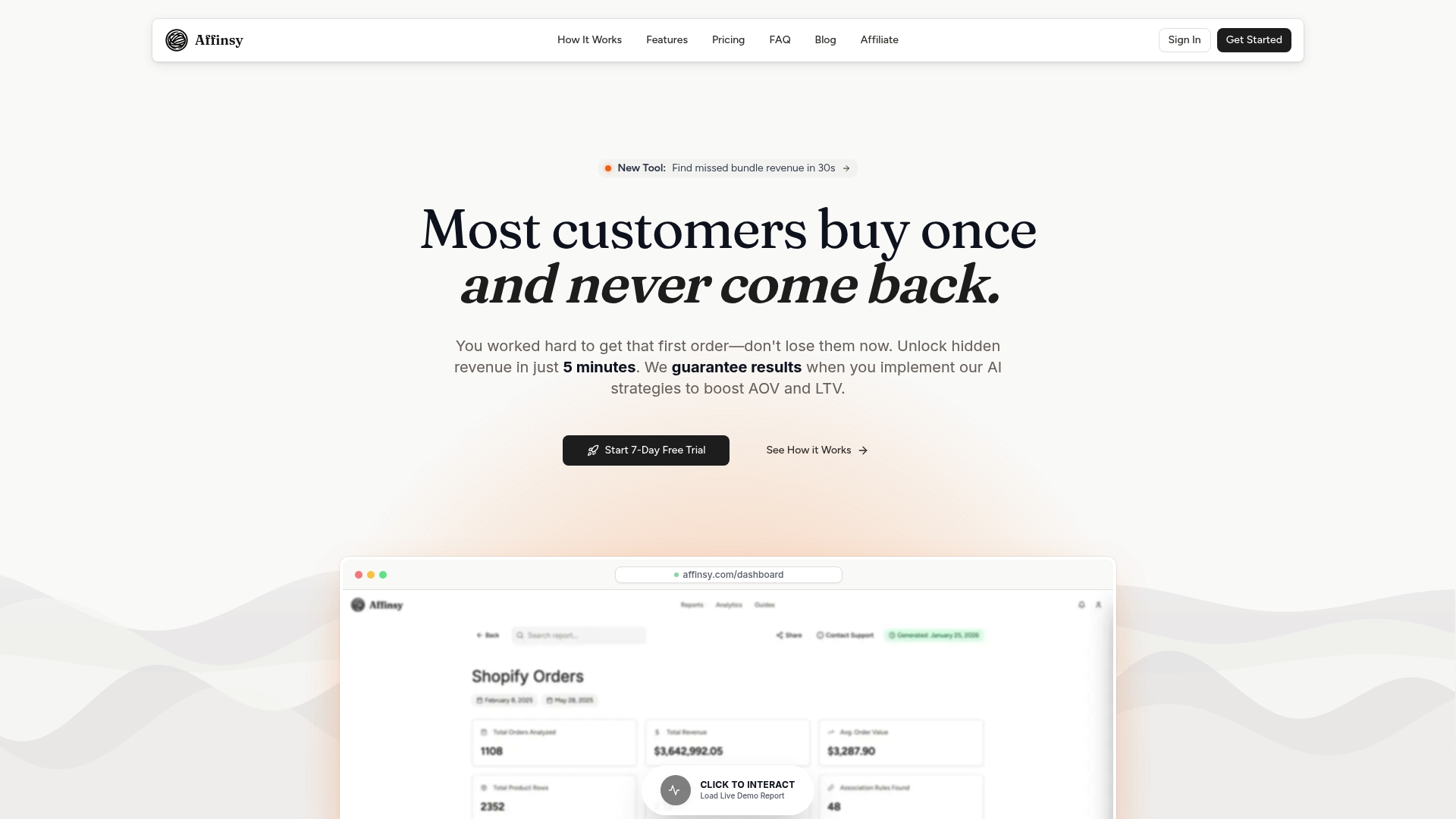
Sign up, upload a 30-day CSV export from Shopify, WooCommerce, BigCommerce, or Stripe, and run your first market basket analysis report. You’ll see which products co-occur most in customer orders, ranked by confidence and lift. Run the RFM segmentation alongside it, and you’ll have exportable customer segments ready for your email platform the same day. For teams exploring how AI examples in e-commerce translate into real revenue, this is a concrete starting point.
Enterprise teams can request custom onboarding and dedicated support through the Enterprise tier. Start your free trial at affinsy.com.
Research and further reading
- G2 Marketplace: Best Singdata Lakehouse Alternatives in 2026 — Aggregated vendor comparisons and user feedback for enterprise lakehouse and managed AI data platform alternatives; useful for building an initial shortlist and understanding the competitive landscape.
- Singdata.com — Singdata’s own documentation, including technical whitepapers on migration cost drivers, TCO analysis, and architecture trade-offs; read critically as vendor-origin material and validate benchmark claims independently.
- Tracxn: Singdata Company Profile — Third-party company profile covering competitor landscape, funding signals, and growth indicators; useful for gauging vendor stability and market maturity.
- Beamstart: Singdata News Coverage — Founding story and regional launch context; highlights multi-cloud and localized deployment positioning.
- Affinsy Blog: AI Analytics Trends in 2026 — Analysis of how AI-driven analytics drives measurable ROI for e-commerce teams; supports the business case for switching to a specialist analytics platform.
Recommended
- Best ecommerce insights platforms – Expert Comparison 2025 - Affinsy Blog | Affinsy
- Best Top Ecommerce Analytics Platforms – Expert Comparison 2025 - Affinsy Blog | Affinsy
- Top 4 Ecommerce Data Analytics Solutions 2026 - Affinsy Blog | Affinsy
- Top 4 E-commerce Software Commercengine.io Alternatives 2026 - Affinsy Blog | Affinsy