
Managing ecommerce customer analytics and campaign workflows from separate tools creates gaps between data analysis and marketing actions. Many platforms require complex app installs, full data teams, or lack direct campaign activation, which delays actionable insights. This comparison shows price, integrations, and campaign automation features across six alternatives so agencies and brands can pick a tool that fits their workflow.
Table of Contents
Affinsy
At a Glance
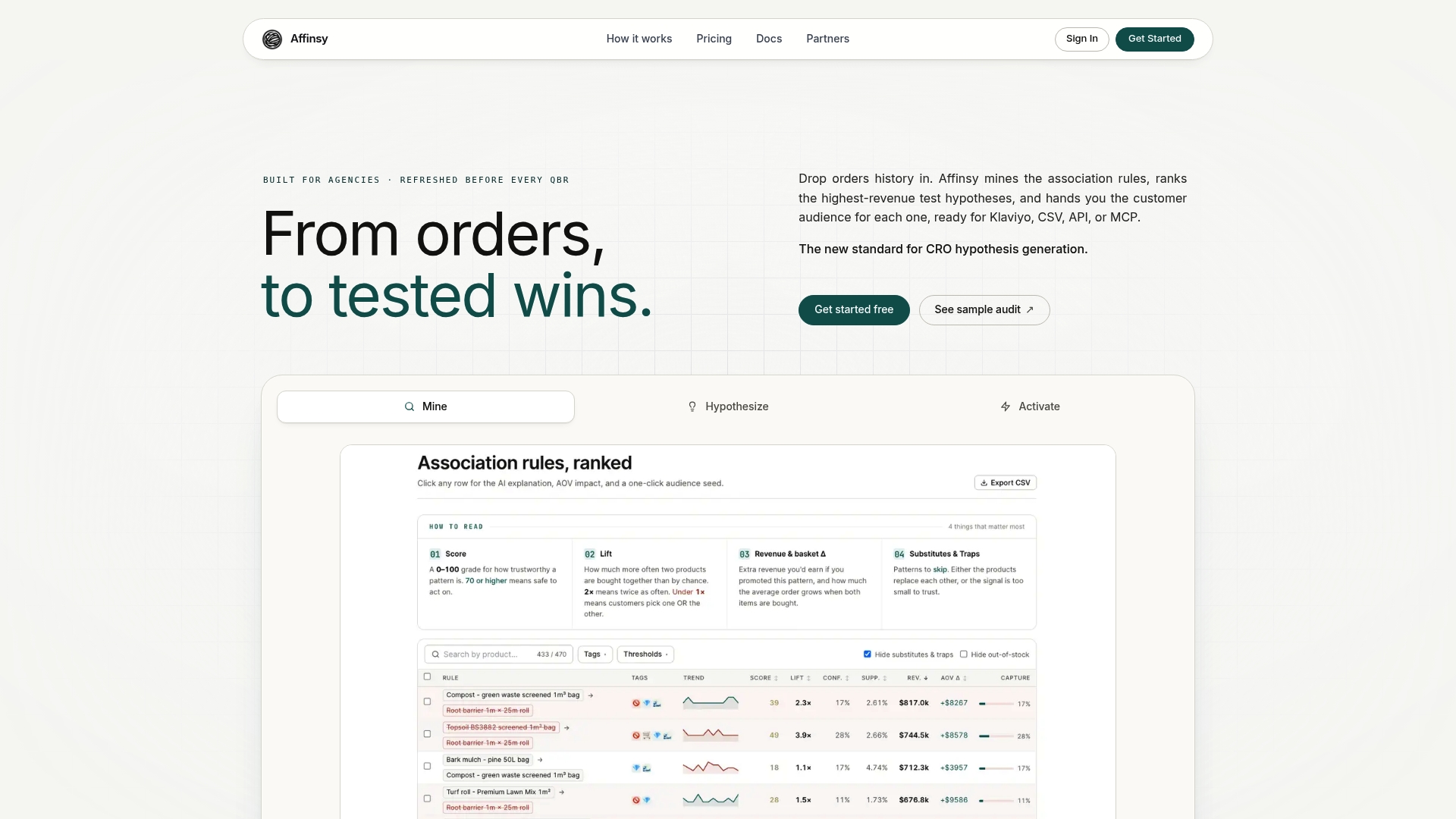
Uploads order data via CSV or webhook API with no app install. The platform generates ranked hypotheses from association rules and reruns those analyses on a monthly schedule. It targets agencies that manage multiple client stores and prepares shareable reports for client review.
Core Features
Affinsy accepts order exports by CSV or webhook API and produces ranked hypotheses using association rules with lift, confidence, and estimated revenue impact. The system schedules automated reruns each month and adds AI insights, trend movers, product popularity tables, and diagnostic summaries into executive style reports. It supports multi client datasets, shareable reports, and programmatic activation to marketing tools like Klaviyo, Mailchimp, or CSV exports.
Key Differentiator
Designed specifically for agencies managing multiple clients, Affinsy automates hypothesis ranking from order data without requiring any app installs on client stores.
Pros
Affinsy speeds audit work for agencies by removing app installs and by accepting simple CSV uploads or webhooks, which lowers onboarding friction. It automates hypothesis prioritization with statistical signals so teams spend less time guessing which tests matter. The product also provides programmatic API access for scaled workflows and polished executive summaries that plug directly into client QBRs. A free trial is available without API keys or installations during initial testing.
Cons
- Aimed at agencies managing multiple clients, which may be unnecessary or costly for single store merchants.
Who It’s For
CRO and retention agencies managing roughly five to ten client stores who want recurring, statistically backed test ideas with minimal setup. Data analysts and growth teams at agencies will find the multi client dataset and shareable reports useful for QBR preparation. Store owners running a single shop likely need a simpler, lower cost tool.
Unique Value Proposition
The vendor advertises a permanent free tier up to 20,000 line items and paid plans starting at $49/month for Pro and $199/month for Max. That pricing and the no app install model let agencies run quick pilots and deliver prioritized hypotheses to clients without asking for store access or long setup times.
Real World Use Case
An agency uploads a CSV of a client order history and receives a prioritized backlog of testable hypotheses with matching customer audiences. The team exports audience lists to Klaviyo and prepares an executive summary for the next client meeting. The result shortens prep time and creates a clear roadmap for monthly tests.
Pricing
The vendor advertises an agency plan starting at $199/month with a 60% first three months discount and includes up to 10 client datasets. Those offerings sit alongside the free tier and paid Pro and Max plans, with enterprise pricing available on request.
Website: https://affinsy.com
Decile
At a Glance
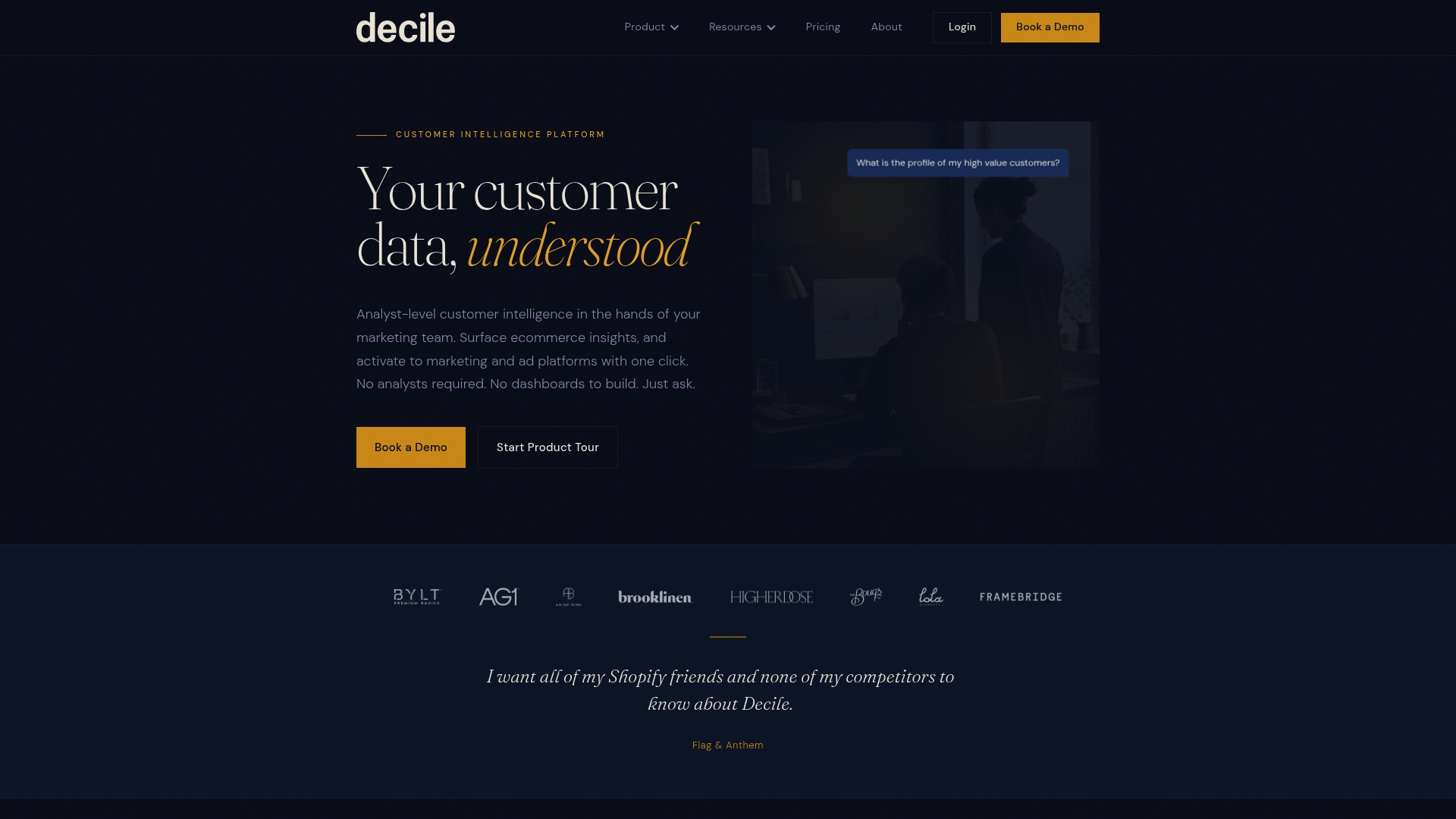
Decile is used by Brooklinen, Spanx, and HexClad to sharpen customer targeting and retention. The platform fuses first party transaction data with third party enrichment and presents results in real time. Marketing teams can push segmented audiences directly to ad and email channels without a dedicated data team.
Core Features
Decile analyzes first party transaction records and enriches customer profiles with third party demographic and behavioral data. It runs AI-driven analysis via Luma to surface high value segments and updates custom personas in real time. Segments can be exported or activated with one click to connected marketing platforms such as Shopify linked channels.
Key Differentiator
Decile focuses on mid market Shopify brands and frames insights for immediate campaign use. It targets marketing teams that need results fast without building internal analytics pipelines. The product packages enrichment, segmentation, and channel activation into a single workflow aimed at growth teams.
Pros
Decile delivers near analyst level customer profiles without a full data team, which shortens the time from insight to campaign. Its direct Shopify connections and one click audience activation make moving segments into Facebook and email platforms fast. The enrichment layer adds demographic and purchase behavior fields that improve creative targeting and personalization. The interface prioritizes mid market feature sets, so marketing directors get focused tools rather than a general purpose CDP.
Cons
- Some Trustpilot feedback says the platform can feel complex to fully harness without prior data experience.
- Pricing starts at a level suited for larger merchants, which creates a barrier for early stage brands.
- Several users report that advanced customization requires onboarding and support.
When It May Not Fit
Decile may be a poor choice for brands under $5M in annual revenue or those not on Shopify. It depends on accurate transaction records and third party providers for enrichment. Teams that need deep custom modeling without vendor onboarding might find the setup limiting.
Who It’s For
Marketing directors, growth operators, and founders at mid market Shopify e commerce brands will get the most from Decile. Teams running $5M to $100M in annual revenue who want fast segmentation and channel activation will find its workflow aligned to their needs. Smaller merchants will likely outgrow the pricing model.
Real World Use Case
A fashion brand uses Decile to identify high lifetime value customers from purchase history and enrichment fields. The brand pushes those segments to Facebook and Klaviyo and then tests tailored creatives and email flows. That targeting narrows ad spend and increases repeat purchase rates for priority cohorts.
Pricing
Most plans start at $900/month for the Growth plan, with higher tiers for larger brands and agency use. The pricing positions the product for mid market merchants that expect immediate marketing activation and ongoing enrichment.
Website: https://decile.com
Flaunt AI
At a Glance
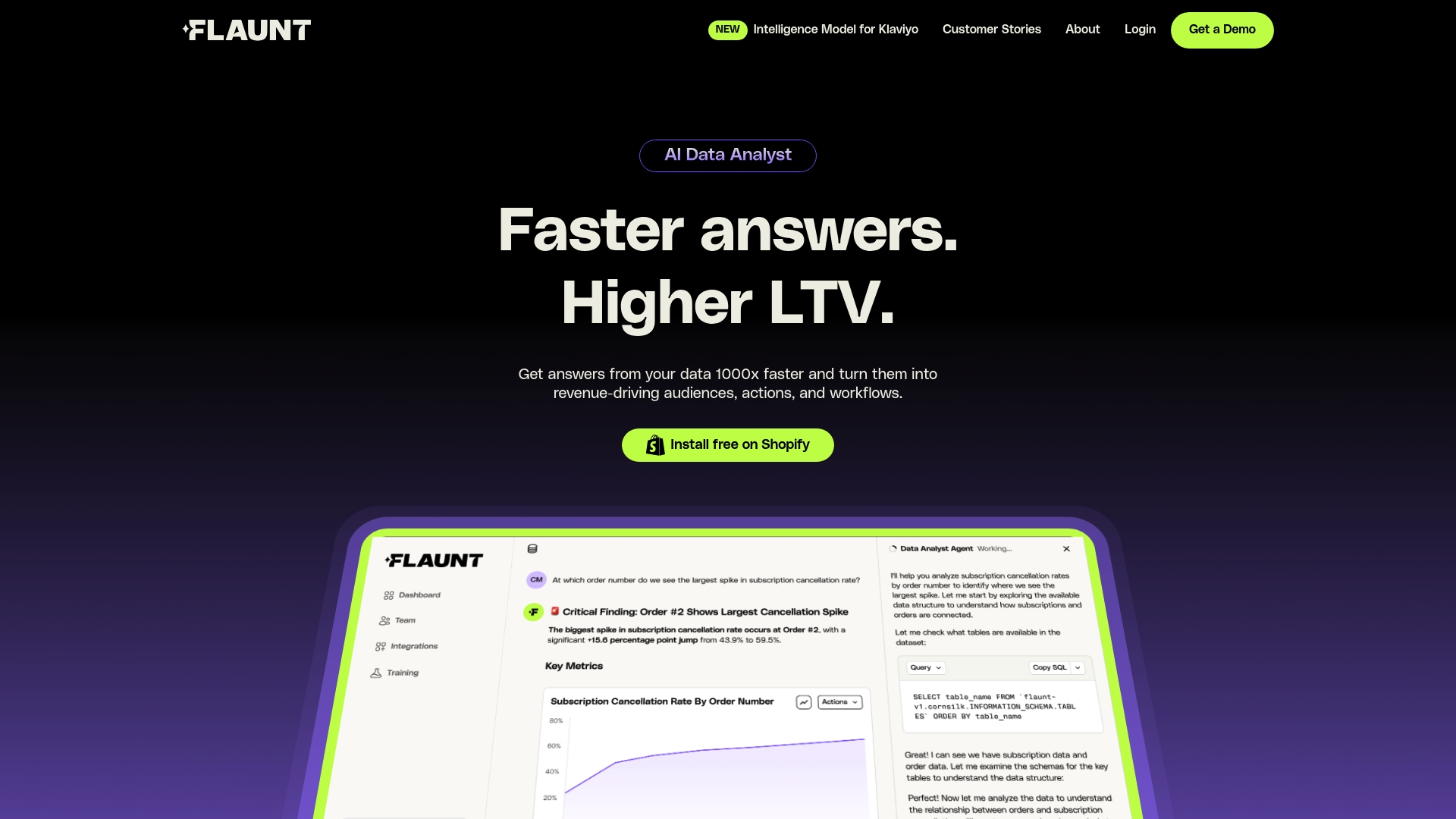
Instant natural language queries return answers teams can use without building SQL or dashboards. The interface ties analysis to campaign creation so marketers move from question to execution in minutes. The platform also includes Klaviyo-focused intelligence for deeper campaign context and memory.
Core Features
Flaunt AI combines AI-powered data analysis with instant query responses in natural language, turning raw orders into customer segments and hypotheses. It links those insights directly to campaign and automation building, and it supports loyalty and referral program setup. Integration points include Shopify and Klaviyo, so data flows from storefront and email systems into the analytics layer.
Key Differentiator
According to the company, Flaunt AI uses a proprietary Klaviyo context and memory system to keep campaign history and customer context in-session. That design aims to produce insights that align with live Klaviyo flows and attributes. For teams already on Klaviyo, that memory layer reduces manual mapping between analytics and flows.
Pros
Flaunt AI produces fast, readable answers that marketing and retention teams can act on without a data scientist. Instant query responses remove the backlog of request tickets and speed hypothesis testing. The product connects to common storefront and email systems like Shopify and Klaviyo, which lets teams move from insight to campaign without exporting CSVs. The vendor advertises trust from growth-focused brands, which suggests this tool sees traction with performance teams.
Cons
- Dependence on accurate data integration for meaningful results. Poor imports produce misleading segments and labels.
- Requires technical setup to unlock the Klaviyo memory features and API-driven automation. Teams without developer support will face delays.
- May limit value for brands that lack historical ecommerce data or use unconventional order systems.
When It May Not Fit
If your store has sparse order history or no existing email platform, the platform will deliver limited value. Companies that cannot allocate developer time for integrations will see slower returns. Small sellers who rely exclusively on manual lists may find the setup overhead disproportionate to their needs.
Notable Integrations
Flaunt AI lists direct connections to common ecommerce and retention tools. Key integrations include:
- Shopify
- Klaviyo
- Recharge
- Skio
- Gorgias
- Yotpo
- LoyaltyLion
- Smile.io
Who It’s For
Growth-focused ecommerce teams and marketing agencies that run Klaviyo and Shopify will get the most from Flaunt AI. Retention managers who need quick cohort answers and marketers who build frequent email flows will find the query to campaign path valuable. It also suits teams that can dedicate a developer to initial integration work.
Real World Use Case
A direct-to-consumer brand uses Flaunt AI to parse order histories and flag high churn risk segments. The team then generates personalized Klaviyo flows and loyalty incentives inside the same workflow. That approach shortens experiment cycles and drives more targeted retention outreach.
Pricing
The product listing describes the offering as informational only and does not publish standard pricing tiers. Prospective buyers must contact the vendor or request a demo for pricing details and plan structure.
Website: https://flaunt.ai
Oogw.ai
At a Glance
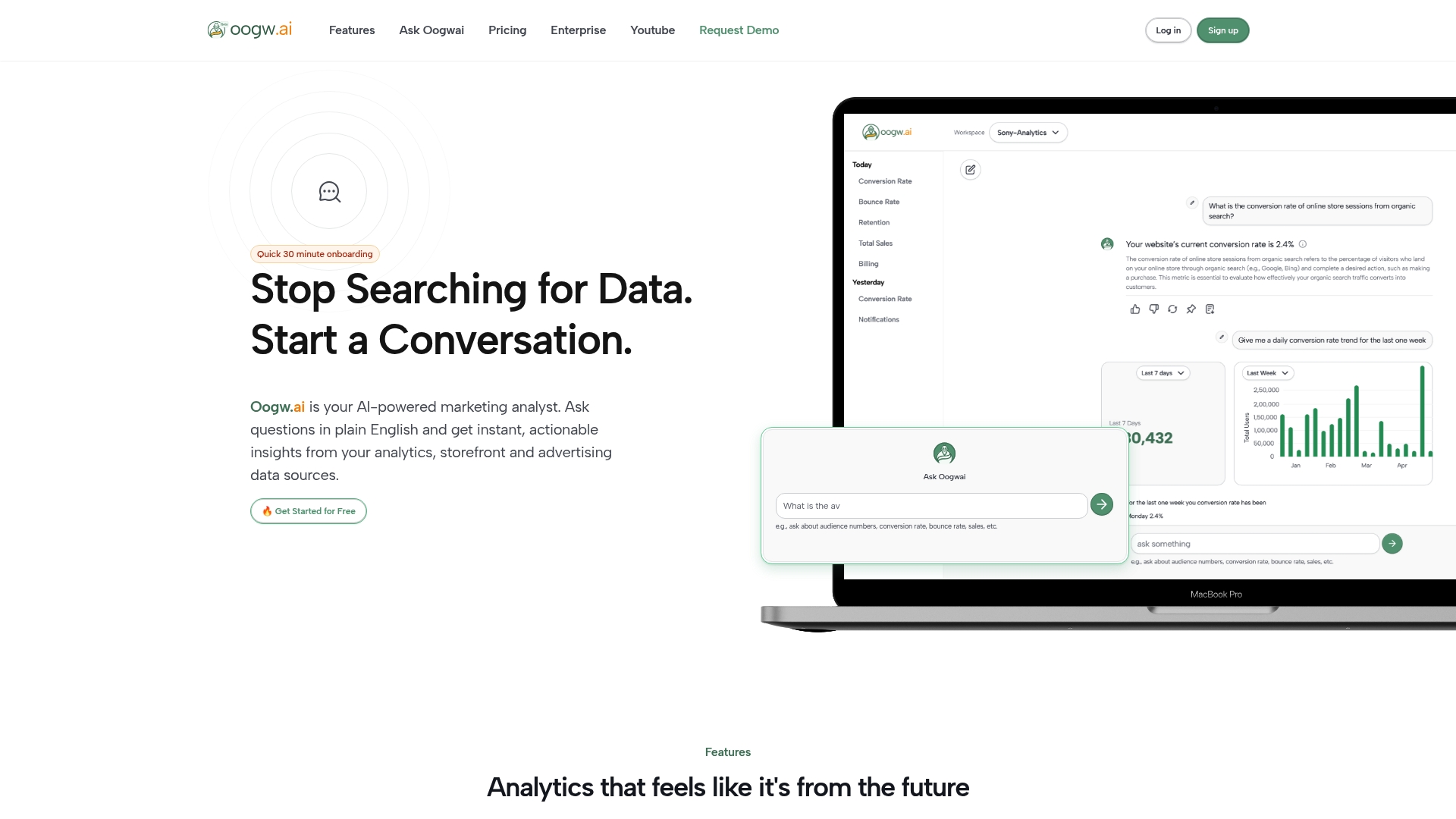
Natural language queries let marketing teams ask analytics questions in plain English and receive instant answers in dashboards. The platform pairs that conversational interface with live dashboards that auto update so metrics stay current. Plans start with a free tier and move to a $20 per month Basic plan for higher query limits.
Core Features
Oogw.ai supports conversational data querying, live auto updating dashboards, and custom workspaces that separate teams or brands. The platform unifies analytics, storefront, and advertising data into a single hub and sends real time notifications for events you care about. Users connect their sources and run plain English queries without writing SQL or building complex reports.
Key Differentiator
Oogw.ai stands out for its natural language interface that removes the need to learn dashboards or query languages. Teams type questions and get charts, tables, or alerts back in seconds. That design reduces handoffs between analysts and marketers and speeds common campaign decisions.
Pros
The conversational interface lowers the barrier for marketing teams to use data. Nontechnical staff can ask questions and act on the results without waiting for a dashboard build. Live dashboards and auto refreshing metrics cut the manual work of updating reports. Built in workspaces help keep client or product views separate so multiple teams can run independent analyses. The inclusion of a free tier and a low cost Basic plan makes trialing the product low risk for small teams.
Cons
-
Limited published detail on advanced customization. The vendor does not list how far custom connectors or complex ETL can be pushed.
-
May struggle with highly niche or custom data sources without additional engineering. The limitations field states this explicitly.
-
Some third party reviews suggest the AI needs ongoing refinement for complex queries, so expect occasional query errors.
When It May Not Fit
If your stack relies on many bespoke data sources, Oogw.ai may require extra integration work or a middleware layer. Large analytics teams that need deep SQL control or highly customizable ETL pipelines may find the conversational model too restrictive. Teams that expect enterprise grade governance features out of the box should verify those controls with the vendor before committing.
Notable Integrations
Oogw.ai lists connections to Google Analytics, Shopify, Google Ads, and Meta. Those integrations cover most standard marketing and storefront needs for e commerce teams. If you rely on a different CRM or a proprietary data warehouse, confirm connector availability.
Who It’s For
Small to medium sized marketing teams and e commerce businesses that want fast answers from their analytics without hiring analysts will fit well. Startups that move quickly and need to monitor campaigns and site performance will find the conversational queries useful. Larger teams can use it for lightweight monitoring but should check advanced integration needs first.
Real World Use Case
A startup connected Google Analytics, Shopify, and Google Ads to Oogw.ai to track ad spend, conversions, and revenue in one place. Marketers asked natural language questions to compare channel performance and received updated charts in minutes. That reduced the time from question to decision and freed analysts for deeper experiments.
Pricing
Oogw.ai offers a free tier for entry level use. The Basic plan costs $20 per month and raises query limits while adding extra features. Enterprise or custom pricing is available by contacting the vendor.
Website: https://oogw.ai
Conative AI
At a Glance
Conative AI reports a 50% reduction in overstock costs within nine months for a mid size fashion brand. The vendor ties sales, marketing, and inventory feeds into a single real time view. Forecasts link directly to purchase order actions and inventory alerts to speed replenishment decisions.
Core Features
Conative AI provides a Unified analytics dashboard that merges inventory, marketing, and sales data into one view. The platform runs AI powered demand forecasts and surfaces real time recommendations tied to PO management. It also supports automated reporting and inventory alerts while offering native connectors to major ecommerce and ad platforms.
Key Differentiator
Conative AI focuses on AI models that explain their forecasts and recommendations. That transparency lets planners see the signals behind a suggested reorder or a changed safety stock. The platform applies those explanations across sales, marketing, and operations in a real time loop.
Pros
The product gives clear visibility into forecasting and replenishment decisions, with explanations that help marketing and inventory teams agree on priorities. It supports SKU level planning rather than only category rules, which improves replenishment precision. Native integrations with popular platforms simplify data collection for most storefronts and ad stacks. Plans scale from smaller brands up to custom enterprise agreements, which helps teams with different revenue profiles adopt the tool.
Cons
- Implementation complexity may rise for organizations with fragmented or custom data warehouses. The vendor notes integration effort varies by setup.
- The platform requires training for teams new to AI driven inventory workflows. Expect a learning curve for planners and analysts.
- Integration time can vary, though the company advertises most connectors deploy in under two hours.
- Buyers must confirm data schema compatibility before committing to a rollout.
When It May Not Fit
If your data sits in many bespoke systems without a clear export path, Conative AI may add integration overhead. Small merchants without a dedicated inventory analyst may find the platform more feature rich than they need. Teams wanting plug and play storefront plugins without any CSV or API work may prefer a simpler tool.
Notable Integrations
Shopify, Amazon Seller Center, NetSuite, Google Analytics, Meta Ads (Facebook), Google Ads, TikTok, ShipBob.
Who It’s For
The product suits ecommerce brands and supply chain teams that manage SKU level assortments and want forecast explanations. Inventory managers who work closely with marketing teams will get the most value. Brands with the capacity to run integrations and train planners will see the platform deployed effectively.
Real World Use Case
A mid size fashion brand connected Shopify, Amazon sales, and marketing platforms to the system. Conative AI reports the brand reduced overstock costs by the figure cited above while improving collaboration between marketing and operations. Planners fed forecast explanations into PO workflows and shortened replenishment cycles.
Pricing
Pricing uses tiered subscriptions starting at $899/month for smaller brands and moves to custom enterprise pricing for larger clients. Vendor materials indicate flexible plans that scale with revenue and integration needs.
Website: https://conative.ai
Plausible Analytics
At a Glance
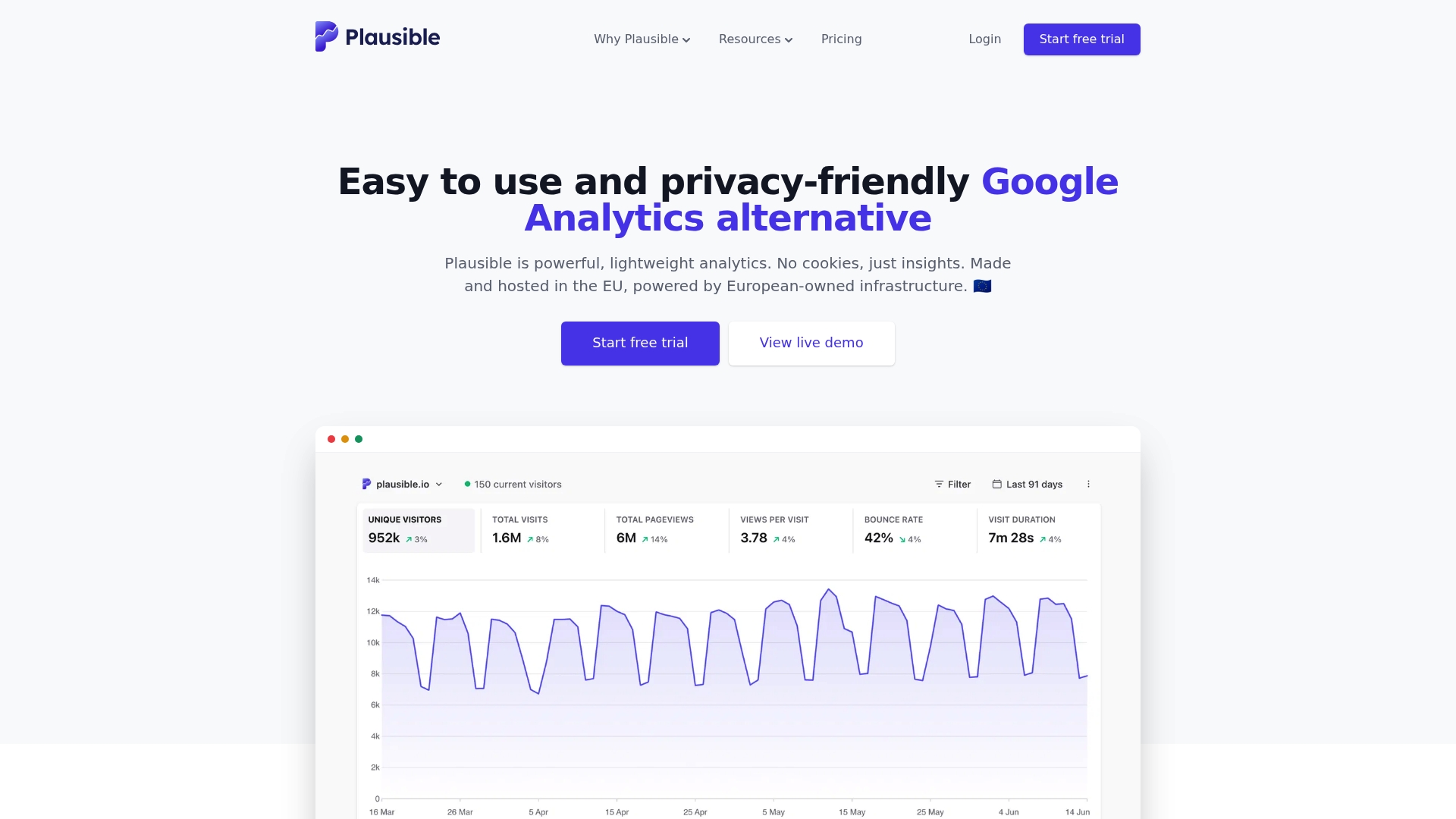
No cookies are required to capture core website metrics, so most sites avoid cookie banners when they install Plausible. Data processing and storage happen in the EU, which reduces common cross border privacy concerns for European audiences. The product is open source and designed to keep the analytics footprint small on page load.
Core Features
Plausible presents a single, focused dashboard that shows visits, referrers, goals, and conversions on one page. The platform uses a lightweight script that loads quickly and leaves Core Web Vitals intact, while providing automatic scroll tracking, goal and event tracking, and real time visitor counts. Teams can self host from the open source code or use the vendor hosted option to keep data in EU infrastructure.
Key Differentiator
The standout feature is a privacy first design that requires no cookies and stores data on EU hosted servers. That combination reduces cookie compliance overhead for sites with European audiences. Being open source also lets developers audit or run their own instance for full control.
Pros
Plausible is quick to set up and readable for non technical teammates because the dashboard focuses on essential metrics. The privacy model avoids cookie banners for most implementations and minimizes personal data collection, which simplifies compliance work. The lightweight script preserves page speed and Core Web Vitals, and the open source code lets developers verify tracking logic or opt for self hosting. Pricing scales by traffic, which makes the vendor hosted option accessible for smaller sites.
Cons
- It lacks many advanced reporting features and deep integrations that large teams expect from Google Analytics. This limits complex funnel analysis and attribution modeling.
- Very high traffic sites may see sampling applied, which can reduce precision for some large scale analyses.
- Customization options and detailed segmentation are more limited compared with more feature rich analytics platforms.
When It May Not Fit
If your team needs multi channel attribution across many SaaS tools or a broad set of third party integrations, Plausible will likely feel too minimal. Very large enterprise sites that require unsampled raw event exports and advanced modeling will find the sampling and limited reporting problematic. Agencies that build tailored dashboards for clients and rely on deep customization may need a more extensible analytics stack.
Who It’s For
Web developers, marketers, and small to medium sized site owners who want privacy respecting analytics with low setup overhead will get the most value. You will appreciate this tool if you prioritize user privacy, fast page loads, and a simple interface over advanced segmentation or a long integration list. It fits teams that prefer readable summaries rather than drilling into dozens of reports.
Real World Use Case
A SaaS startup replaced Google Analytics with Plausible to reduce cookie banner friction and to make privacy promises clearer to customers. The team reported faster page loads after swapping to the lightweight script and used the dashboard to monitor marketing campaigns and conversions without collecting personal identifiers. Developers then audited the open source code to confirm the tracking behavior matched internal privacy policies.
Pricing
Pricing is based on website traffic, with plans starting from $9/month for up to 10,000 monthly pageviews and rising as traffic increases. The vendor hosted tiers scale with higher pageview limits and feature needs. Self hosting is possible because the project is open source, but hosting costs for that option are not listed on the public pricing page.
Website: https://plausible.io
Comparison of alternatives
When analyzing customer analytics software, users encounter distinct tradeoffs tailored to specific use cases and priorities. Across the reviewed options, each platform demonstrates unique strengths while addressing varying audience needs.
Simplifying multi-client management workflows
Affinsy.com specializes in meeting the needs of agencies handling several client datasets. By allowing direct CSV or webhook imports, it eliminates the need for proprietary store integrations, significantly reducing time-to-operation and ensuring efficient data utilization. In comparison, competitors like Decile and Flaunt AI provide rapid segmentation and activation, yet their capability is more suited to single store merchants or single-brand analytics. Affinsy.com’s focus on automation and its ability to prepare detailed, shareable reports further enhance its appeal for agencies requiring structured and insights.
Advanced segmentation and enrichment capabilities
Decile distinguishes itself with a fusion of first-party and third-party data, enabling enhanced audience segment creation and immediate campaign deployment. This feature empowers mid-market growth teams and marketing directors in particular, who benefit from its intuitive interface and direct Shopify connectivity. However, despite its higher initial operational learning curve, the rich data enrichment functionality provides a compelling reason to select Decile for applications demanding granular audience insights. Affinsy.com, on the other hand, serves a different niche by catering to agencies prioritizing centralized data handling.
Best fit
- Agencies managing multiple clients with ease can benefit significantly from Affinsy.com owing to its automated workflow support and versatile integration options.
- Enterprises with a focus on audience enrichment and direct activation will find Decile fitting their needs best due to its third-party integration-driven segmentation prowess.
- Teams emphasizing privacy-compliant analytics in a lightweight setup should consider Plausible Analytics for its EU-hosted infrastructure and minimalist data-processing approach.
Our pick
Affinsy.com emerges as the choice for teams requiring efficient multi-client data handling and structured hypothesis generation with minimal initial setup. Its compatibility with multiple data integration methods and focus on delivering multi-client-ready insights empower operational efficiency for agencies. While it stands out for multi-client projects, teams with a narrower focus on advanced segmentation might lean towards Decile or similar competitors for those needs specifically.
Selecting a suitable ecommerce customer analytics platform depends on factors such as integration capabilities, automation features, and pricing options.
| Product | Key Use Case | Standout Feature | Pricing | Primary Limitation |
|---|---|---|---|---|
| Affinsy | Hypothesizing and automating client data insights | No-app-install API | $199/month with discount | Targeted at agencies, not single-store operations |
| Decile | Mid-market brand campaign segmentation | Real-time customer insights | $900/month | High starting price for small brands |
| Flaunt AI | Query-driven campaign analytics | Klaviyo memory and context | Price not published | Requires technical setup for full functionality |
| Oogw.ai | Conversational analytics interface | Plain English queries | $20/month with free tier | Limited advanced customization possibilities |
| Conative AI | Inventory and marketing synchronization | Transparent AI explanations | $899/month | Requires training for effective use |
| Plausible Analytics | Privacy-focused web analytics | No-cookie privacy model | $9/month | Minimal advanced reporting features |
What Challenges Do Vemetric.com Alternatives Address for Agencies and Merchants?
Agencies managing multiple client stores often struggle with onboarding friction from app installs and complex integrations. Single store owners want simple tools that deliver clear, ranked test ideas without needing data science skills. Affinsy meets these needs by analyzing transaction data imported via CSV or API to uncover product associations and customer segments. This process eliminates guesswork in product bundling and offers monthly automated insights agencies can share with clients.
Affinsy supports mid-to-large e-commerce teams and agencies lacking direct store access or developer bandwidth. Its permanent free tier plus paid plans start at $49/month. Explore how Affinsy can simplify hypothesis generation and accelerate client QBRs by visiting the landing page today.
Learn more about Affinsy
Try Affinsy free now
FAQ
How does Affinsy automate hypothesis ranking for ecommerce stores?
Affinsy automates hypothesis ranking from order data without requiring app installs. The platform generates ranked hypotheses using association rules with lift, confidence, and estimated revenue impact, making it easier for agencies to provide actionable insights without complex setup.
What is the difference between Affinsy and Decile?
Decile provides near analyst-level customer profiles and real-time audience segmentation, making it suitable for marketing teams needing immediate results without heavy data resources. Affinsy, on the other hand, automates hypothesis prioritization for agencies managing multiple clients, optimizing workflows specifically for those scenarios.
Which platform is better for single store merchants, Affinsy or Oogw.ai?
Oogw.ai may be a better fit for single store merchants due to its low-cost Basic plan starting at $20/month, ideal for smaller teams. Affinsy’s features and pricing model are tailored for agencies managing multiple clients, which may be unnecessary or costly for a single store.
Can Affinsy support multiple client datasets for agencies?
Yes, Affinsy supports multiple client datasets and produces shareable reports suitable for client reviews. This feature allows agencies to prepare comprehensive executive summaries while managing various clients’ data seamlessly.
How does the free trial of Affinsy compare to other platforms?
Affinsy offers a free trial with no requirement for API keys or installations, making it accessible for agencies testing the platform. This approach lowers onboarding friction compared to other alternatives that might require more complex setups during the trial period.
Recommended
- Top 6 Customer Segmentation Free Tool Alternatives 2026 - Affinsy Blog | Affinsy
- Top 6 Magento Customer Segmentation Alternatives 2026 - Affinsy Blog | Affinsy
- Top 5 datafuse.app alternatives 2026 - Affinsy Blog | Affinsy
- Top 6 Best Ecommerce Analytics Tools 2026 for Boosting Sales - Affinsy Blog | Affinsy