
TL;DR:
- Customer lifetime value (CLV) predicts the total net profit from a customer over their relationship, guiding profitable growth. Calculated by multiplying average order value, purchase frequency, and customer lifespan, then subtracting costs, CLV helps optimize acquisition and retention strategies. Businesses that treat CLV as a dynamic, cross-team metric improve margins and long-term customer relationships.
Customer lifetime value (CLV) is the total net profit a business expects to generate from a single customer across the entire duration of their relationship. It is the single most important metric for any ecommerce brand that wants to grow profitably rather than just grow fast. CLV combines three core inputs: average order value, purchase frequency, and customer lifespan. Platforms like Shopify and Salesforce have made CLV tracking more accessible, but most businesses still underuse it. In 2026, with customer acquisition costs rising across paid channels, the brands winning on margin are the ones treating CLV as a strategic compass, not a reporting footnote.
What is customer lifetime value and how is it calculated?
CLV is calculated as Average Order Value multiplied by Purchase Frequency, then multiplied by Average Customer Lifespan. That product gives you gross CLV. To get net CLV, you subtract the costs to serve that customer: fulfillment, support, returns, and any discounts applied. Net CLV is the number that actually matters for profitability decisions.

Here is a concrete example. A customer spends $80 per order, buys four times per year, and stays active for three years. Gross CLV equals $960. If your costs to serve total $200 over that period, net CLV is $760. That $760 figure is your real ceiling for how much you can spend acquiring and retaining that customer while staying profitable.
Calculating CLV accurately requires clean data. Duplicate customer records significantly underestimate CLV because they split one customer’s purchase history across multiple profiles. A customer who has bought eight times looks like two customers who each bought four times, which distorts both frequency and lifespan figures. CRM deduplication and customer identity resolution are not optional steps. They are prerequisites for any CLV calculation you can trust.
Pro Tip: Calculate CLV separately for each customer segment rather than averaging across your entire base. A segment buying premium products twice a year may have a higher CLV than a segment buying budget items monthly, and treating them identically will cause you to misallocate your retention budget.
Advanced CLV models also apply a discount rate to future revenue, accounting for the time value of money. A dollar earned in year three is worth less than a dollar earned today. Ignoring this leads to overestimating the present value of long-tenure customers, which can skew acquisition and retention investment decisions.
- Export clean, deduplicated transaction data from your platform (Shopify, WooCommerce, BigCommerce, or Stripe).
- Calculate average order value per customer segment.
- Determine purchase frequency over a defined period (12 or 24 months).
- Estimate average customer lifespan using churn rate data.
- Multiply the three figures, then subtract segment-specific costs to serve.
- Apply a discount rate if projecting CLV beyond 24 months.
Why CLV matters: strategy, budgets, and team alignment
CLV sets the upper limit for your customer acquisition cost (CAC). If your net CLV is $400, spending $380 to acquire a customer leaves almost no margin. Most financial models recommend keeping CAC at no more than one-third of net CLV, though this ratio varies by industry and growth stage. The point is that without a reliable CLV figure, your paid media budget is essentially a guess.
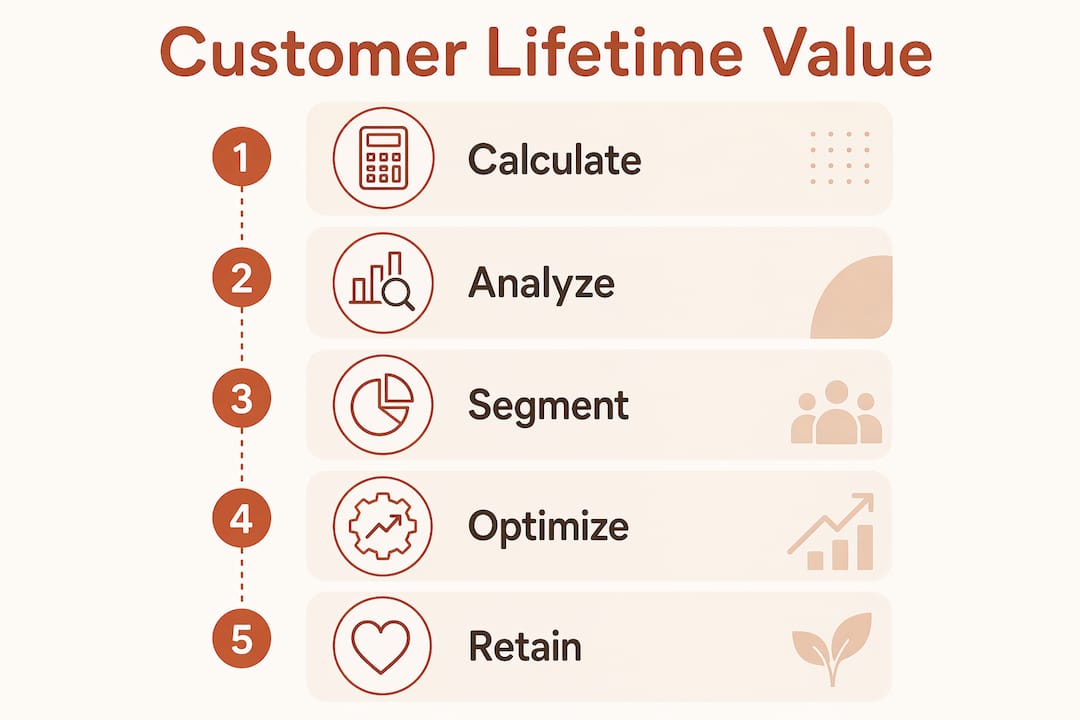
The strategic shift CLV creates is a move from transaction thinking to relationship thinking. A brand optimizing for first-order revenue will price, promote, and merchandise differently than a brand optimizing for three-year customer value. The latter invests in post-purchase experience, loyalty mechanics, and proactive service because those investments compound over time.
CLV functions as a shared metric across marketing, sales, service, and product teams, aligning everyone around sustainable customer relationships rather than siloed quarterly targets. This cross-functional alignment is where most mid-size ecommerce brands leave money on the table. Marketing optimizes for cost per acquisition, service optimizes for ticket resolution time, and product optimizes for feature adoption. None of those metrics individually tells you whether the customer will still be buying in year two.
The practical benefits of CLV-driven strategy include:
- Smarter ad spend: Bid higher on acquisition channels that historically produce high-CLV customers, even if their cost per click is higher.
- Tiered retention investment: Allocate loyalty program budgets proportionally to segment CLV, not equally across all customers.
- Accurate revenue forecasting: CLV multiplied by projected new customer volume gives finance a defensible long-range revenue model.
- Product development priority: Features that increase purchase frequency or reduce churn directly improve CLV and deserve prioritization.
“Tracking CLV shifts company focus to long-term customer relationships rather than single transactions, improving both engagement and profitability.” — BDC
Common challenges in measuring and interpreting CLV
The terms CLV and LTV (lifetime value) are often used interchangeably, but there is a meaningful distinction. CLV typically refers to the predicted future value of a specific customer, while LTV is sometimes used as a historical average across a customer base. Using aggregate LTV as a proxy for individual CLV leads to poor decisions because it masks the variance between your best and worst customer segments.
| Challenge | What goes wrong | How to fix it |
|---|---|---|
| Averaging across all customers | High-value segments subsidize low-value ones in your model | Calculate CLV by customer segment separately |
| Ignoring costs to serve | Gross CLV overstates profitability for high-return or high-support customers | Subtract fulfillment, returns, and support costs per segment |
| Skipping the discount rate | Future revenue is overvalued in long-horizon projections | Apply a 5-15% annual discount rate to years two and beyond |
| Dirty CRM data | Duplicate records split purchase histories and deflate CLV | Run deduplication before every CLV calculation cycle |
Segment-specific CLV provides far greater precision than aggregate averages. A DTC apparel brand might find that customers acquired through organic search have a 40% higher CLV than customers acquired through discount coupon sites. That insight alone justifies restructuring the entire acquisition mix, but it is invisible if you only look at blended averages.
Pro Tip: Run your CLV model quarterly, not annually. Customer behavior shifts faster than most brands update their models. A quarterly cadence catches churn acceleration early enough to act on it.
The variance problem is particularly acute in ecommerce because the top 20% of customers often generate 60-80% of total revenue. A single high-value segment pulling the average up can make your overall CLV look healthy while the majority of your customer base is barely profitable.
Practical customer retention strategies to improve CLV
Retention is the most direct lever for increasing CLV because it extends customer lifespan and purchase frequency simultaneously. Loyalty program members are 84% more likely to make repeat purchases. That statistic reflects a structural advantage: loyalty mechanics create switching costs and habitual buying patterns that compound over time.
The most effective retention strategies in 2026 combine personalization, proactive engagement, and AI-driven prediction. Generic email blasts and blanket discount codes are not retention. They are margin erosion dressed up as loyalty. Real retention looks like this:
- Predictive churn intervention: AI models flag customers whose purchase frequency is declining before they lapse. A timely, personalized offer at that moment costs far less than reacquisition.
- Omnichannel consistency: Customers who engage across email, SMS, and on-site personalization have higher purchase frequency than single-channel customers.
- Post-purchase experience: Proactive shipping updates, easy returns, and responsive support reduce the friction that causes customers to defect after one bad experience.
- Loyalty programs with tiered rewards: Tiered structures motivate customers to increase spend to reach the next tier, directly lifting average order value and purchase frequency.
- Personalized product recommendations: Predictive analytics in retail surfaces the right product to the right customer at the right time, increasing both conversion rate and basket size.
AI-driven analytics detect early signs of churn and behavior shifts, enabling timely interventions that extend customer lifespan. The brands using these tools are not just reacting to churn. They are preventing it by identifying at-risk customers weeks before those customers consciously decide to stop buying. Retention metrics like purchase frequency and churn rate feed directly back into CLV models, creating a continuous improvement loop rather than a static annual calculation.
Loyalty rewards programs structured around CLV data also allow brands to reward high-value customers disproportionately, which increases retention rates precisely where retention has the most financial impact.
Key takeaways
Customer lifetime value is the net profit ceiling that determines every acquisition and retention investment decision a profitable ecommerce brand makes.
| Point | Details |
|---|---|
| CLV formula | Multiply average order value by purchase frequency and customer lifespan, then subtract costs to serve. |
| CAC alignment | Keep customer acquisition cost well below net CLV to protect long-term margin. |
| Segment-level calculation | Calculate CLV by customer segment to avoid high-value customers masking unprofitable ones. |
| Data hygiene | Deduplicate CRM records before every CLV cycle to prevent underreporting purchase history. |
| Retention as a CLV lever | Loyalty programs and AI-driven churn prediction extend lifespan and purchase frequency simultaneously. |
Why most ecommerce brands are still getting CLV wrong
I have seen a consistent pattern across ecommerce businesses at every scale: they calculate CLV once, put it in a slide deck, and never act on it. The number becomes a vanity metric rather than a decision-making tool. That is the real problem, and it is not a data problem. It is a process problem.
The brands that actually use CLV well treat it as a living model. They recalculate it quarterly by segment, feed the results directly into acquisition bidding strategies, and use it to set retention program budgets. They also do something most brands skip entirely: they calculate CLV by acquisition channel. Knowing that your Google Shopping customers have a CLV 30% higher than your Meta customers changes how you allocate budget in ways that a blended ROAS target never could.
The other mistake I see constantly is treating CLV as a marketing metric rather than a company-wide metric. When your service team does not know which customers are in the top CLV tier, they cannot prioritize support accordingly. When your product team does not see CLV data, they build features for the loudest customers rather than the most valuable ones. Cross-team alignment on CLV is not a nice-to-have. It is the difference between a business that grows efficiently and one that grows expensively.
For smaller ecommerce operations, the practical starting point is simple: export your last 24 months of transaction data, segment customers into three to five groups by total spend, and calculate CLV for each group separately. You do not need a data science team. You need clean data and a spreadsheet. The insight that comes from that exercise will reshape how you think about every marketing dollar you spend.
— Mateusz
How Affinsy helps you act on CLV data
Understanding CLV is one thing. Building the data infrastructure to act on it consistently is another. Affinsy analyzes your historical transaction data to surface the customer segmentation patterns and product associations that drive CLV at the segment level.
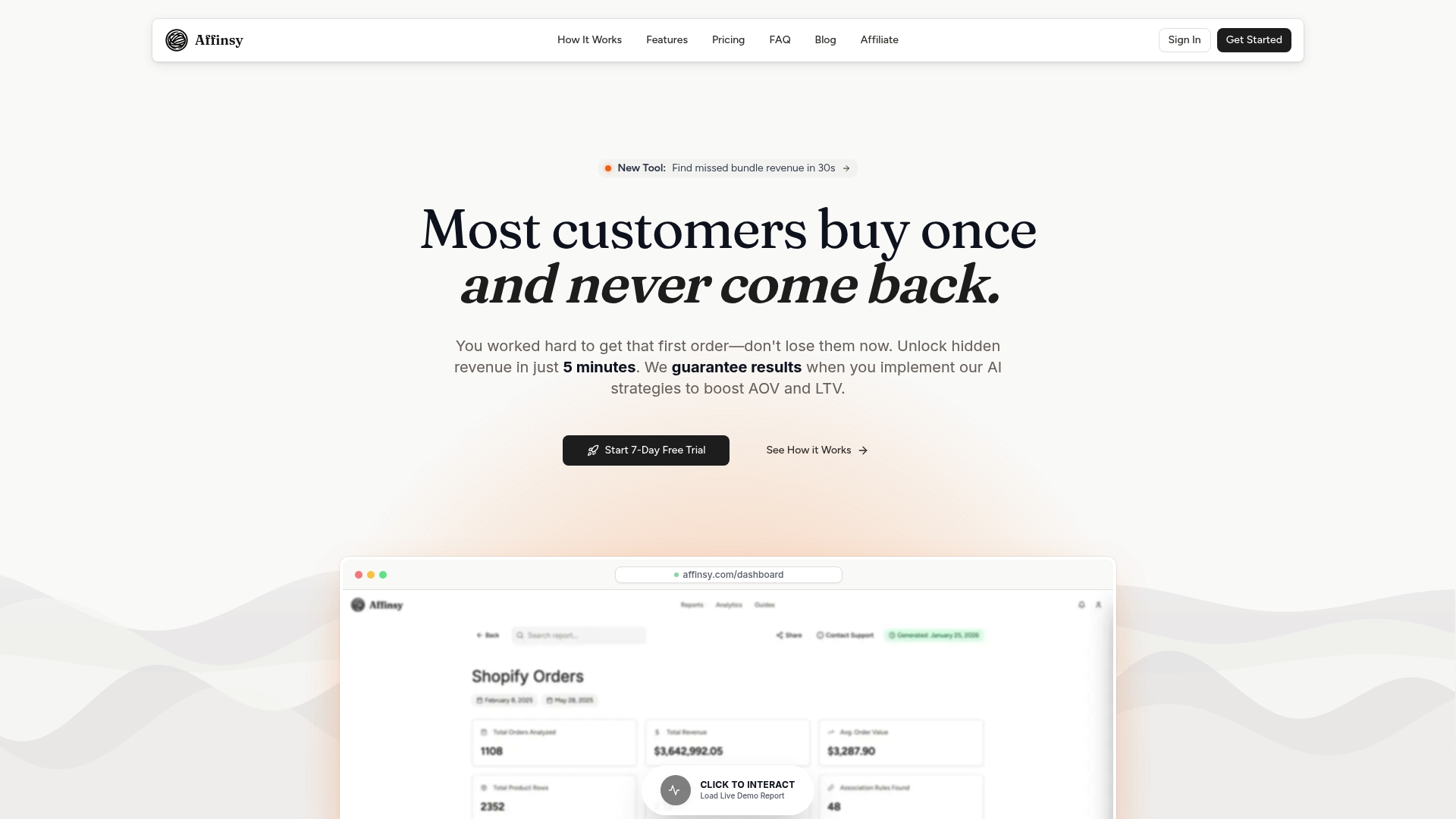
Using RFM customer segmentation, Affinsy identifies which customers are high-value, at-risk, or lapsing so you can allocate retention budgets where they generate the most return. The platform’s market basket analysis reveals which product combinations drive repeat purchases, giving your merchandising and cross-sell strategy a direct line to higher purchase frequency. You can connect via CSV upload or API from Shopify, WooCommerce, Stripe, or any platform that exports transaction data. The free tier covers up to 20,000 line items with no credit card required. Explore customer segmentation on Affinsy to see how segment-level CLV analysis works in practice.
FAQ
What is the customer lifetime value definition in simple terms?
Customer lifetime value is the total net profit a business expects to earn from one customer over the entire time they remain a customer. It combines average order value, purchase frequency, and customer lifespan, minus costs to serve.
How do you calculate CLV for an ecommerce store?
Multiply average order value by purchase frequency, then multiply that result by average customer lifespan. Subtract costs to serve (fulfillment, returns, support) to get net CLV. Run this calculation separately for each customer segment for accurate results.
What is the difference between CLV and LTV?
CLV typically refers to the predicted future value of a specific customer, while LTV is often used as a historical average across an entire customer base. Using blended LTV as a substitute for segment-level CLV masks variance and leads to misallocated budgets.
What affects customer lifetime value the most?
Purchase frequency and customer lifespan have the largest impact on CLV because they are multiplicative inputs. Retention strategies that reduce churn and loyalty programs that increase repeat purchase rates improve both factors simultaneously.
Why is CLV important for marketing budgets?
CLV sets the upper limit for customer acquisition cost. Without a reliable CLV figure, paid media budgets are set without a profitability ceiling, which is the primary cause of negative-margin customer acquisition in ecommerce.