
TL;DR:
- Analyzing customer data with methods like RFM segmentation and cohort analysis drives better marketing decisions and boosts profitability. Combining predictive modeling, behavioral, and market basket analysis provides a comprehensive understanding of customer behavior and purchase patterns. Ensuring data quality and validating insights with qualitative research is essential for accurate, actionable results.
Customer data analysis is the process of examining customer records to extract insights that drive marketing decisions and improve business performance. Organizations that analyze data systematically achieve 23 times higher customer acquisition and 19 times higher profitability than companies that rely on intuition alone. That gap is not a rounding error. It reflects the difference between guessing what customers want and knowing it. The most effective ways to analyze customer data fall into five core methods: RFM segmentation, cohort analysis, predictive modeling, behavioral analysis, and funnel diagnostics. Each method targets a different question, and combining them produces the clearest picture of customer behavior.
1. Ways to analyze customer data: start with RFM segmentation

RFM segmentation is the most practical starting point for any customer data analysis program. It scores every customer on three dimensions: Recency (how recently they purchased), Frequency (how often they buy), and Monetary value (how much they spend). The result is a ranked list of customer groups, from Champions who buy often and spend heavily, to At-Risk customers who were once active but have gone quiet.
The business value of RFM comes from its directness. A Champion segment warrants loyalty rewards and early access offers. An At-Risk segment warrants a win-back campaign with a time-sensitive discount. Each group gets a different message, which means your marketing budget goes where it produces the highest return.
RFM also integrates cleanly with Customer Lifetime Value (CLV) calculations. Once you know which segments generate the most long-term revenue, you can prioritize retention spend on the groups that matter most rather than spreading resources evenly across all customers.
- Champions: High recency, high frequency, high spend. Reward and retain.
- Loyal customers: Frequent buyers with moderate spend. Upsell opportunities exist.
- At-Risk: Previously strong scores, now declining. Trigger win-back sequences.
- Lost: Low scores across all three dimensions. Reactivation cost often exceeds value.
Pro Tip: Avoid over-segmentation early. Starting with too many micro-segments creates complexity without clarity. Build four to six RFM groups first, prove the model works, then refine.
For a step-by-step breakdown of applying RFM in e-commerce, the practical segmentation guide on the Affinsy blog covers score interpretation and campaign mapping in detail.
2. How cohort analysis tracks behavior over time
Cohort analysis groups customers by a shared characteristic, typically the month they first purchased or the campaign that acquired them, and then tracks that group’s behavior across subsequent periods. The method answers a question that aggregate metrics cannot: are customers acquired in march behaving differently six months later than customers acquired in september?
The most common cohort types are acquisition cohorts (grouped by first purchase date) and behavioral cohorts (grouped by a specific action, such as using a promo code). Retention curves built from acquisition cohorts show exactly when customers drop off, which points directly to where intervention is needed.
Cohort analysis also measures the real impact of product changes or marketing interventions. If you launched a loyalty program in april, a cohort comparison shows whether customers acquired after that date retain at a higher rate than those acquired before it. That is a direct revenue signal, not a correlation.
- Acquisition cohorts: Track revenue and retention by signup or first-purchase month.
- Behavioral cohorts: Group by action taken (e.g., downloaded a guide, used a coupon).
- Retention curves: Visualize the percentage of each cohort still active at 30, 60, and 90 days.
- Revenue per cohort: Compare average order value and purchase frequency across groups.
Pro Tip: Pair cohort retention data with CLV and churn metrics. A cohort with strong early retention but rapid late-stage churn signals a loyalty gap, not an acquisition problem.
3. What role predictive modeling plays in forecasting behavior
Predictive modeling uses historical customer data to forecast future actions. The most common applications are churn prediction, next-best-offer recommendations, and CLV estimation. These models do not replace judgment. They give marketing teams a probability score to act on before a customer churns or converts.
Logistic regression is the most widely used algorithm for customer behavior prediction. Research on large customer datasets shows logistic regression achieves roughly 90% accuracy in predicting customer behavior, outperforming decision trees and K-means clustering on the same data. That accuracy advantage matters when you are deciding which customers to target with a retention offer.
Machine learning models go further by compressing patterns across multiple data domains simultaneously. AI detects subtle purchase triggers and barriers that manual analysis misses entirely, particularly in large catalogs where product associations are not obvious. This is where tools like Affinsy add direct value: the platform runs market basket analysis and RFM segmentation on your transaction history to surface those non-obvious patterns without requiring a data science team.
- Churn prediction: Score customers by probability of lapsing within 30 or 60 days.
- Next-best-offer: Recommend the product most likely to convert based on purchase history.
- CLV estimation: Forecast total revenue per customer to guide acquisition and retention budgets.
- Purchase propensity: Rank customers by likelihood to buy a specific product category.
Pro Tip: Always validate predictive outputs with qualitative feedback. A model may flag customers as high-churn risk because they browse without buying, when the real issue is a UX friction point that a short survey would reveal.
For a deeper look at AI in e-commerce segmentation, the Affinsy blog covers how machine learning identifies purchase drivers from transactional data.
4. How behavioral and funnel analysis uncover conversion bottlenecks
Behavioral analysis tracks how customers interact with your website, emails, and product pages. It records clicks, scroll depth, session duration, and content consumption to build a picture of what customers do before they buy or leave. The data is descriptive by nature. It tells you what happened, not why.
Funnel analysis takes behavioral data and maps it to a sequence of steps, from awareness to purchase. Each step in the funnel has a conversion rate, and the drop-off points reveal where customers abandon the process. A checkout funnel that loses 60% of visitors at the payment screen is not a pricing problem until you investigate further. It could be a form length issue, a trust signal gap, or a mobile rendering bug.
Descriptive metrics need diagnostic analysis and qualitative feedback to explain the “why” behind observed behavior. Quantitative funnel data shows you where customers drop off. Exit surveys, session recordings, and customer interviews show you why. Combining both methods produces fixes that actually work.
- Click and scroll tracking: Identify which page elements attract attention and which get ignored.
- Session duration: Measure engagement depth, but interpret it in context (long sessions can mean confusion).
- Drop-off mapping: Pinpoint the exact funnel step where volume falls sharply.
- Exit intent surveys: Capture real-time reasons for abandonment at high-exit pages.
Pro Tip: High time-on-page is not always a positive signal. It can indicate that customers cannot find what they need. Cross-reference session duration with exit rate before drawing conclusions.
5. What are best practices for data quality and insight extraction
Data quality is the foundation every other method depends on. A predictive model built on duplicate records, mismatched customer IDs, or incomplete transaction logs will produce confident-sounding results that are wrong. Cleaning and unifying data before modeling is not optional preparation. It is the work itself.
A unified single customer view consolidates every interaction a customer has across channels into one profile. Without it, the same customer appears as multiple people in your data, and your segmentation reflects that fragmentation. The result is misguided campaigns sent to the wrong people at the wrong time.
The second major pitfall is confusing correlation with causation. Longer time on site can indicate confusion rather than engagement, and treating it as a positive signal leads to the wrong interventions. Qualitative validation, whether through surveys, interviews, or usability testing, is the check that keeps quantitative analysis honest.
Insights must map directly to business decisions like product changes, pricing adjustments, or UX improvements. Data that does not connect to a specific decision is a vanity metric. Deprioritize it.
- Deduplicate records: Merge customer profiles across channels before any analysis begins.
- Standardize identifiers: Use consistent customer IDs across your CRM, e-commerce platform, and email tool.
- Validate with qualitative data: Pair survey responses with behavioral metrics to confirm findings.
- Focus on decision-linked metrics: If a metric does not change a decision, it does not belong in your report.
Pro Tip: Clean and unify your data before running any segmentation or predictive model. A well-structured CSV export from your e-commerce platform, fed into an analytics tool, will outperform a messy database every time.
For practical guidance on turning raw data into decisions, the Affinsy blog covers the full process from data export to marketing action.
6. How to gather qualitative customer insights to complement your data
Quantitative analysis tells you what customers do. Qualitative research tells you what they think and feel. The two methods produce better results together than either does alone. Surveys, customer interviews, and usability tests fill the interpretation gaps that numbers leave open.
Surveys are the most scalable qualitative tool. A well-designed post-purchase survey with three to five questions captures intent, satisfaction, and friction points at the moment of highest engagement. Effective surveys for actionable insights require clear question framing, a single topic per question, and a response format that produces data you can segment and compare over time.
Customer interviews go deeper. A 30-minute conversation with five recently churned customers will reveal patterns that no dashboard can show. The goal is not to collect opinions. It is to identify the specific moments where your product or experience failed to meet an expectation.
Integrating qualitative findings with your RFM segments or cohort data creates a feedback loop. When your At-Risk cohort tells you in surveys that shipping speed is the main complaint, you have both the quantitative signal (declining purchase frequency) and the qualitative reason (logistics friction) to act on.
7. How to use market basket analysis to find hidden purchase patterns
Market basket analysis (MBA) is a technique that identifies which products customers buy together. It works by scanning transaction records for co-occurrence patterns and expressing them as association rules: customers who buy product A also buy product B at a statistically meaningful rate. The output drives cross-sell recommendations, bundle pricing, and product placement decisions.
MBA is particularly valuable for e-commerce brands with large catalogs. A store with 500 SKUs has thousands of possible product pairings. Manual review of those combinations is not feasible. MBA surfaces the high-confidence associations automatically, ranked by support (how often the pair appears) and lift (how much more likely the pair is than random chance).
Affinsy runs market basket analysis directly on your transaction history, whether you upload a CSV export from Shopify, WooCommerce, BigCommerce, or Stripe, or connect via API. The platform identifies product associations and customer segments without requiring SQL skills or a data science team. The free tier covers up to 20,000 line items with full product access and no credit card required.
For a full explanation of how MBA works and how to apply it, the market basket analysis glossary entry on Affinsy covers the core concepts and practical use cases.
Key takeaways
The most effective methods for customer data analysis combine RFM segmentation, cohort tracking, predictive modeling, and behavioral diagnostics to produce insights that connect directly to revenue decisions.
| Point | Details |
|---|---|
| Start with RFM segmentation | Build four to six customer groups first to avoid complexity and focus marketing spend. |
| Use cohort analysis for retention | Track acquisition cohorts over time to measure churn and the real impact of interventions. |
| Validate predictions qualitatively | Pair model outputs with surveys or interviews to avoid acting on misleading correlations. |
| Clean data before modeling | A unified customer view across channels is the prerequisite for accurate segmentation results. |
| Connect insights to decisions | Any metric that does not change a specific business decision is a vanity metric. Deprioritize it. |
Why I think most teams analyze customer data in the wrong order
Most marketing teams I have worked with start with the most complex method available to them. They build predictive churn models before they have clean data. They run machine learning on customer records that contain duplicates, missing values, and mismatched IDs. The model outputs look authoritative. The decisions they drive are wrong.
The order matters more than the method. Data hygiene first. RFM segmentation second. Cohort analysis third. Predictive modeling only after you have validated that your foundational segments make sense against real customer behavior. Skipping steps does not save time. It creates expensive mistakes that take months to diagnose.
The other mistake I see consistently is treating high engagement metrics as proof of success. Long session durations, high email open rates, and frequent page visits all feel like wins. They are not wins until you connect them to revenue. A customer who spends 12 minutes on your checkout page and does not convert is not engaged. They are stuck. Qualitative research is what tells you the difference.
The teams that get the most value from customer data are not the ones with the most sophisticated tools. They are the ones that ask the sharpest questions, keep their data clean, and validate every quantitative finding with at least one qualitative check. That discipline is harder to build than any model, and it is worth more.
— Mateusz
How Affinsy supports your customer data analysis workflow
Affinsy is built for marketing teams and analysts who want to run RFM segmentation and market basket analysis on their existing transaction data without writing code or hiring a data scientist.
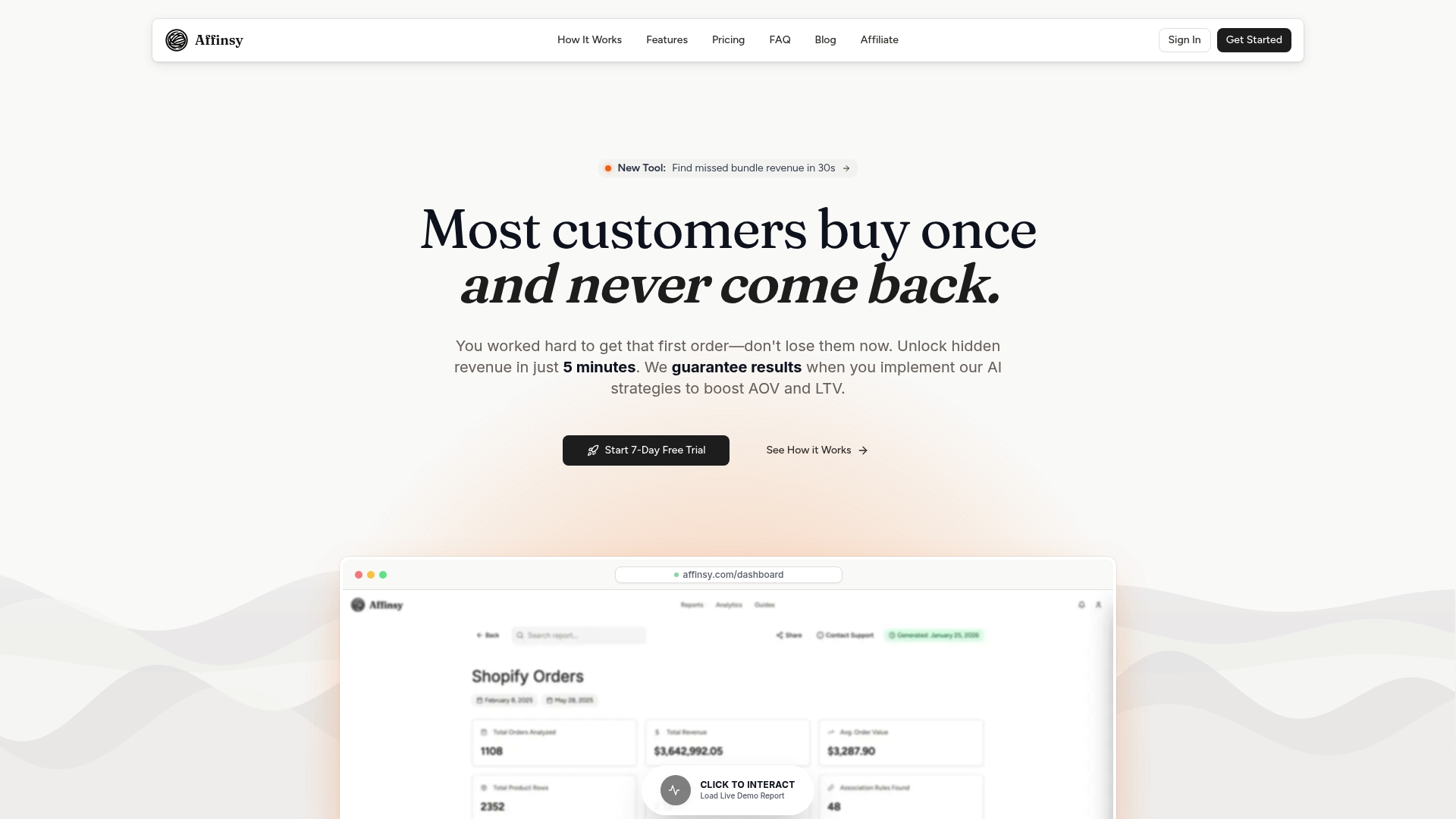
You export your order history from Shopify, WooCommerce, BigCommerce, Stripe, or any platform that produces transactional records, then upload via CSV or connect via API. Affinsy surfaces customer segmentation patterns and product associations that would otherwise require weeks of manual analysis. The free tier covers up to 20,000 line items with full product access and no credit card required. Pro plans start at $49 per month for larger datasets and API access. If you want to turn your transaction history into marketing decisions faster, Affinsy is the direct path from raw data to results.
FAQ
What are the most effective ways to analyze customer data?
RFM segmentation, cohort analysis, predictive modeling, behavioral analysis, and market basket analysis are the five most effective methods. Each answers a different question about customer behavior and works best when combined with the others.
What is RFM segmentation in customer data analysis?
RFM segmentation scores customers on Recency, Frequency, and Monetary value to group them into actionable tiers. It is the recommended starting point for customer analysis because it produces clear, decision-ready segments without requiring advanced modeling.
How accurate are predictive models for customer behavior?
Logistic regression models on large customer datasets achieve roughly 90% accuracy in predicting customer behavior, outperforming decision trees and K-means clustering on the same records.
Why does data quality matter so much for customer analysis?
Without a unified single customer view, the same customer appears as multiple profiles across channels, which distorts segmentation results and leads to misguided campaigns. Cleaning and deduplicating data before analysis is the single highest-leverage step most teams skip.
How do you identify ideal customers from your data?
Start with RFM scoring to identify your highest-value segments, then use cohort analysis to understand how those customers were acquired. Combining both methods with customer profiling guidance produces a clear picture of which acquisition channels and behaviors predict long-term value.
Recommended
- Guide to E-Commerce Data Analysis for Increased Sales - Affinsy Blog | Affinsy
- How to Analyze Ecommerce Sales Data for Better Growth - Affinsy Blog | Affinsy
- 7 Essential Sales Data Analysis Tips for Online Store Owners - Affinsy Blog | Affinsy
- 7 Essential E-Commerce Data Analysis Tips for Higher Sales - Affinsy Blog | Affinsy