
TL;DR:
- Customer retention strategies focus on keeping existing customers engaged and loyal over time.
- Most successful brands treat retention as a持续operating system, not just individual campaigns.
Customer retention strategies are the organized systems and repeatable workflows businesses use to keep existing customers buying, engaged, and loyal over time. For e-commerce and retail brands, these strategies matter more than most teams realize. Acquiring a new customer costs significantly more than keeping an existing one, yet most marketing budgets still tilt toward acquisition. The brands winning on profitability in 2026 treat retention as a core operating model, not an afterthought. Tools like Salesforce, HubSpot, and AI analytics platforms are central to how those systems run.
What are the most effective customer retention strategies?
Customer retention strategies explained at their core are not a list of campaigns. A true retention strategy defines target retention rates, budget allocation, segmentation rules, and campaign cadence as a unified operating model. That distinction separates brands that grow from brands that churn through their customer base.
The most proven tactics in e-commerce and retail right now include:
- Loyalty programs and gamification. 84% of loyalty program members are more likely to make repeat purchases. That number reflects a simple truth: customers who feel rewarded stay longer and spend more.
- Personalized onboarding. Customized onboarding sequences increase retention by 50%. Tailoring the first experience to a customer’s specific goals removes friction and accelerates their path to value.
- Predictive churn scoring. Planning interventions 60 days before predicted churn gives your team enough lead time to act before a customer mentally checks out. This is a top tactic for mid-to-large e-commerce brands with enough transaction history to model behavior.
- Smart dunning for involuntary churn. Failed payments are a silent revenue killer. Smart retry logic recovers 55–80% of failed payments, compared to just 15–25% with basic retry attempts. That gap is pure recovered revenue.
Pro Tip: Segment your loyalty program by purchase frequency, not just total spend. High-frequency, low-ticket buyers often have higher lifetime value than infrequent big spenders.
The difference between a strategy and a tactic matters here. A tactic is a single email campaign. A strategy is the system that decides which customers get that email, when, why, and what happens next based on their response.

How do e-commerce businesses implement retention systematically?
Systematic retention runs as a continuous loop, not a one-time project. Retention works best as a repeatable workflow cycle with segmentation, measurement, and continuous experimentation built in. Here is how to build that loop in practice.
- Segment your customer base. Divide customers by recency, frequency, and monetary value using RFM segmentation. This tells you who needs a win-back campaign, who is ready for an upsell, and who is at risk of churning. Customer segmentation is the foundation every other step depends on.
- Build lifecycle email flows. Map out a welcome series for new buyers, a cart abandonment sequence, a post-purchase nurture flow, a VIP rewards track, and a lapsed customer reactivation series. Each flow serves a different segment at a different stage.
- Score customer health continuously. Assign a health score to each account or customer profile based on engagement signals: purchase recency, email opens, support tickets, and product usage. Flag declining scores for proactive outreach before the customer cancels or stops buying.
- Automate touchpoints with CRM and AI tools. Platforms like HubSpot and Salesforce automate the delivery of personalized messages at scale. AI analytics layers on top to predict which customers need attention and what offer is most likely to work.
- Coordinate across teams. Retention is not solely customer support’s job. Sales, onboarding, and account management all touch the customer journey. Shared data and shared ownership produce better outcomes than siloed efforts.
Pro Tip: Define one activation milestone for new customers, the single action that predicts long-term retention, and redesign your onboarding to get every customer there as fast as possible. Remove any step that does not lead directly to that milestone.
Reducing customer effort is as important as adding value. Every extra click, form, or delay in the post-purchase experience increases churn risk. Speed to value is the metric that matters most in the first 90 days.
What metrics actually measure retention success?
Retention metrics tell you whether your system is working or just busy. The four core KPIs every e-commerce brand should track are retention rate, churn rate, repeat purchase rate, and customer lifetime value (CLV). Each one reveals a different layer of health.

Retention rate measures the percentage of customers who return within a defined period. Churn rate is its inverse and shows how fast you are losing buyers. Repeat purchase rate tracks how often customers come back, which is a direct signal of satisfaction and habit formation. CLV projects total revenue from a customer over their entire relationship with your brand. Rising CLV means your retention system is compounding value over time.
Beyond those four, cohort analysis is the most underused tool in retail analytics. Cohort analysis groups customers by the month or quarter they first purchased and tracks their behavior over time. It reveals whether retention is improving across new cohorts or whether a specific acquisition channel is bringing in low-quality buyers who churn fast.
Behavioral segmentation adds another layer. Tracking which products customers buy together, how long between purchases, and which channels they use before churning gives you the data to build predictive churn detection models that actually work. Cancel-flow analysis, studying the reasons customers give when they leave, lets you match retention offers to real objections rather than guessing.
| Metric | What it measures | Why it matters |
|---|---|---|
| Retention rate | % of customers who return in a period | Tracks overall loyalty health |
| Churn rate | % of customers lost in a period | Flags when the system is failing |
| Repeat purchase rate | Frequency of return purchases | Signals satisfaction and habit |
| Customer lifetime value | Total projected revenue per customer | Measures compounding retention ROI |
| Cohort retention | Behavior of customer groups over time | Identifies acquisition quality issues |
What advanced tactics maximize retention ROI?
The brands with the highest retention ROI go beyond basic loyalty programs. They engineer specific moments and fix structural leaks that most teams ignore.
- Fix involuntary churn first. Most retention teams focus entirely on voluntary churn, customers who choose to leave. Involuntary churn from failed payments is often larger and far easier to fix. Smart dunning with automatic card-updater services and intelligent retry timing recovers the majority of those payments with no customer interaction required.
- Engineer the activation milestone. Activation milestones correlate strongly with long-term retention. Define the single action that predicts whether a customer will stay, such as a second purchase, a product review, or using a specific feature, and build every onboarding touchpoint around reaching it faster.
- Build community as a switching cost. Customers embedded in a brand’s community, whether a private Facebook group, a loyalty tier with exclusive access, or a referral network, face a real cost when they consider leaving. Community is one of the few retention tools that gets stronger over time without proportional cost increases.
- Reward behavior, not just purchases. Points for reviews, referrals, and social shares extend loyalty program engagement beyond the transaction. Customers who interact with a brand in multiple ways churn at lower rates than those who only buy.
- Run cancel-flow experiments continuously. The exit survey is not just a data collection tool. A well-designed cancel flow that presents a reason-matched offer, such as a pause option for customers citing price, or a tutorial for customers citing confusion, recovers a meaningful share of would-be churners.
Pro Tip: The first 90 days post-purchase are the highest-risk period for churn. Assign your most personalized, high-touch sequences to that window and treat every customer in it as a priority.
The risk of relying only on customer support for retention is real. Support resolves problems after they occur. A retention system prevents problems from reaching that stage by detecting signals early and acting on them automatically.
Key Takeaways
Effective customer retention requires a repeatable system built on segmentation, predictive analytics, and cross-team coordination, not isolated campaigns.
| Point | Details |
|---|---|
| Strategy beats tactics | Define retention rates, budget, and segmentation rules before running any campaign. |
| Loyalty programs drive repeats | 84% of loyalty members are more likely to repurchase, making programs a top retention investment. |
| Onboarding is the highest-leverage window | The first 90 days carry the most churn risk; personalized onboarding reduces it by up to 50%. |
| Fix involuntary churn | Smart dunning recovers 55–80% of failed payments, a fast win most teams overlook. |
| Measure cohorts, not just averages | Cohort analysis reveals whether retention is improving over time and which acquisition channels bring loyal buyers. |
Why most retention programs underperform
Most e-commerce teams I have worked with build retention programs that look complete on paper but fail in practice. They have a loyalty program, a welcome email, and a win-back sequence. What they are missing is the connective tissue: shared data, defined ownership, and a feedback loop that improves the system over time.
The single biggest mistake I see is treating the first purchase as the finish line. The real work starts the moment a customer checks out. Getting customers to their activation milestone fast, that moment when they realize your product genuinely fits their life, is what separates brands with 60% repeat purchase rates from those stuck at 20%.
Cross-department collaboration is not a soft recommendation. It is a structural requirement. When sales, onboarding, and support operate on separate data, customers fall through the gaps. A customer who complains to support and then receives a generic upsell email from marketing the next day does not feel valued. They churn, and no one sees the connection.
Predictive analytics changes the game when combined with loyalty data. Knowing that a customer’s purchase frequency has dropped and that they have not opened an email in 45 days gives you a 60-day window to act. That window is the difference between a saved customer and a lost one. The brands building those models now are building a durable competitive advantage.
Start with your data. Export your transaction history, run RFM segmentation, and identify your highest-risk cohort. Then build one intervention workflow for that cohort and measure it. Iterate from there. Retention is not a project you finish. It is a system you improve.
— Mateusz
How Affinsy helps you build a data-driven retention system
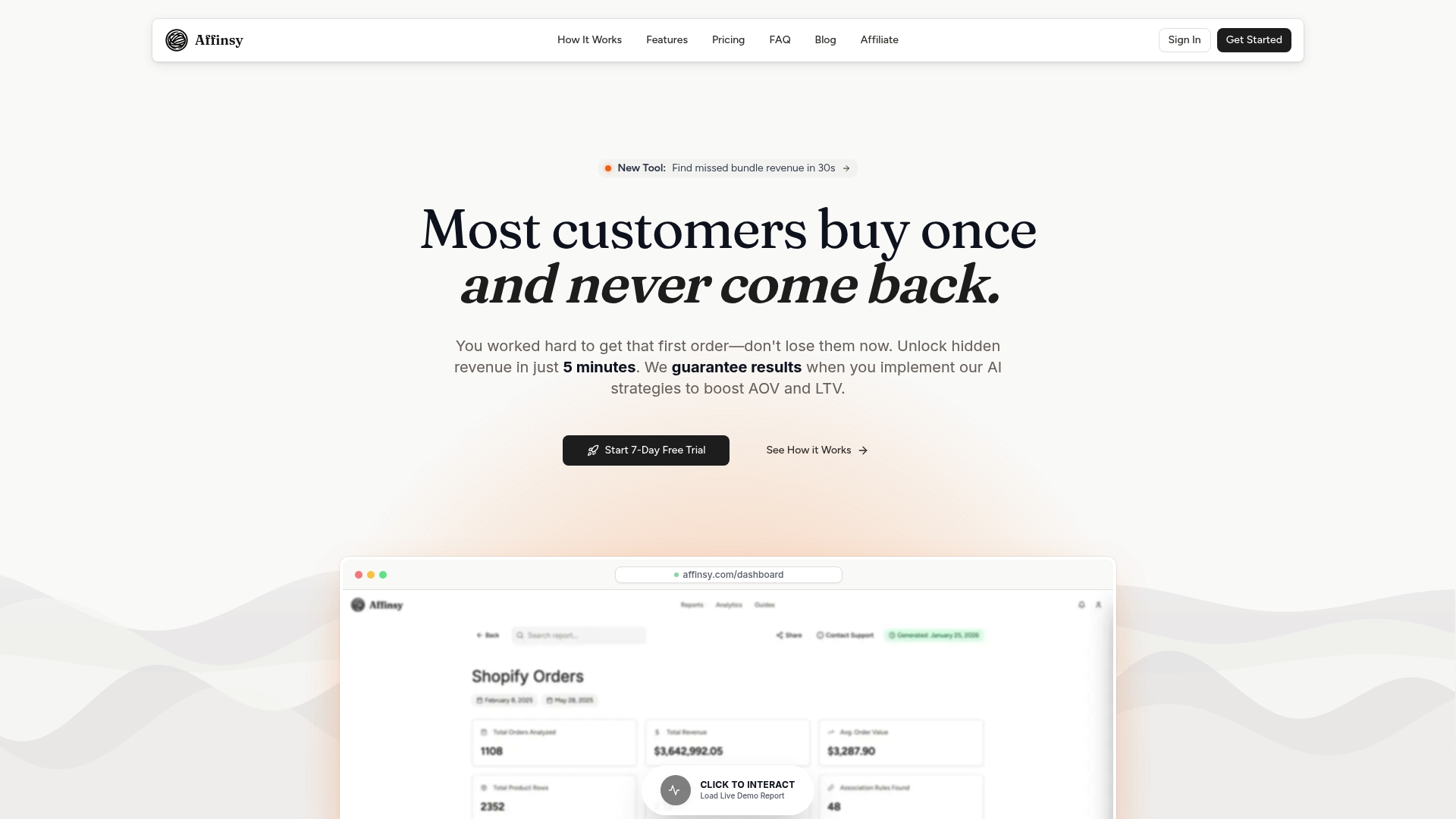
Affinsy gives e-commerce and retail brands the analytics foundation that retention systems run on. Upload your order data from Shopify, WooCommerce, BigCommerce, or any platform that exports transaction records, and Affinsy surfaces the customer segments and product patterns your retention campaigns need to be specific and effective.
The platform’s RFM-based customer segmentation identifies your highest-value customers, your at-risk buyers, and your lapsed segments automatically. Its market basket analysis reveals which products customers buy together, giving your cross-sell and post-purchase flows a factual basis instead of guesswork. Affinsy’s free tier covers up to 20,000 line items with no credit card required, so you can validate the insights before committing to a paid plan.
FAQ
What is a customer retention strategy?
A customer retention strategy is a repeatable system of workflows, segmentation rules, and campaigns designed to keep existing customers buying and engaged over time. It differs from a one-off tactic by defining target rates, budget, and measurement criteria upfront.
How do loyalty programs improve retention?
Loyalty programs increase repeat purchase likelihood because they give customers a tangible reason to return. Research shows 84% of loyalty program members are more likely to make repeat purchases compared to non-members.
What is the most important retention metric?
Customer lifetime value (CLV) is the most important retention metric because it measures the total compounding revenue a customer generates. Tracking CLV alongside churn rate shows whether your retention system is building or losing value over time.
When is churn risk highest for e-commerce customers?
Churn risk is highest in the first 90 days after the initial purchase. Customers who do not reach a clear activation milestone, a second purchase, a product review, or a key engagement action, during that window are far more likely to leave permanently.
How does predictive churn scoring work?
Predictive churn scoring uses historical transaction and engagement data to flag customers likely to stop buying before they actually do. Acting on those signals 60 days in advance gives retention teams enough time to intervene with targeted offers or personalized outreach.
Recommended
- How to optimize e-commerce retention for lasting growth - Affinsy Blog | Affinsy
- Top retention strategies for online retailers: boost loyalty - Affinsy Blog | Affinsy
- Customer segmentation explained: boost retention 2026 - Affinsy Blog | Affinsy
- Ecommerce Cohort Analysis Tips That Improve Retention - Affinsy Blog | Affinsy