
TL;DR:
- An e-commerce churn detection workflow uses predictive models and CRM automation to identify at-risk customers before they leave. Accurate predictions depend on 12–18 months of clean, comprehensive data, with timely interventions within 24–48 hours being most effective. Segmentation, explainable AI, and continuous model updates optimize retention efforts and maximize revenue recovery.
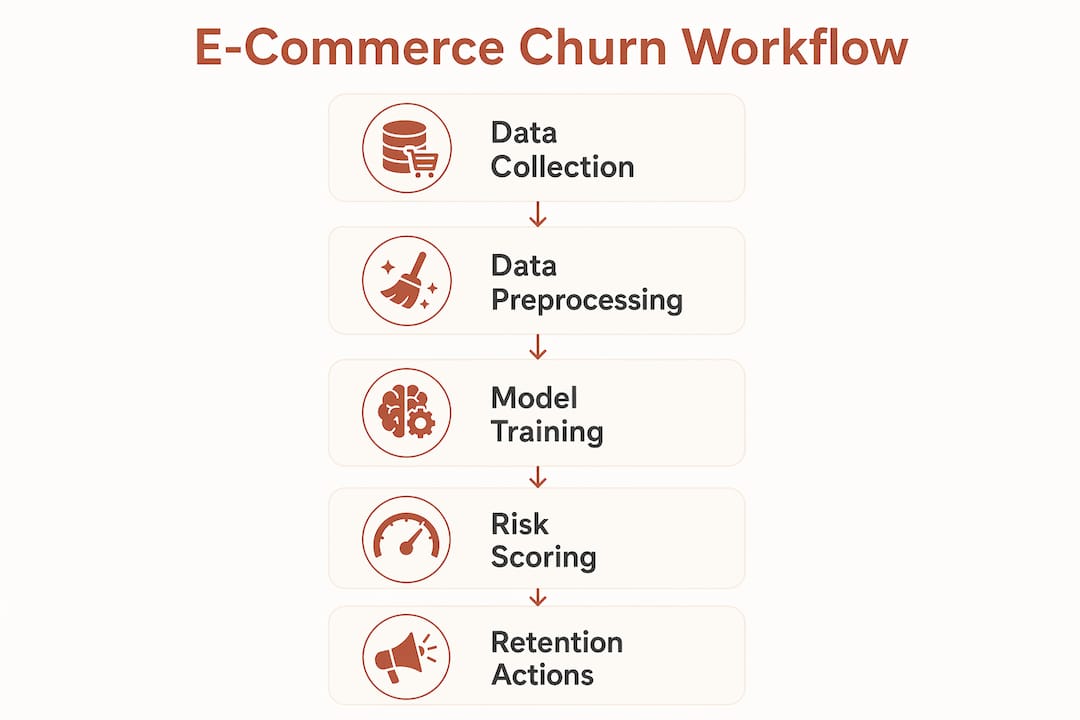
An e-commerce churn detection workflow is a systematic process that identifies customers at high risk of leaving your store and triggers targeted retention actions before they go. The industry term for this practice is predictive churn modeling, and it sits at the intersection of customer churn analysis, machine learning, and CRM automation. Models trained on 18 months of historical transaction data can predict churn 78% accurately within a 60-day window. That level of accuracy means you can act on real signals rather than guesswork. Tools like XGBoost for gradient boosting and SHAP for model explainability are now standard components of any serious workflow for churn detection. Pair those with personalized win-back campaigns and product recommendations, and you have a retention engine that compounds over time.
What data and tools does an e-commerce churn detection workflow require?
The quality of your churn detection workflow depends entirely on the quality and breadth of your input data. Three categories of signals matter most: behavioral data (page views, session frequency, search queries), transactional data (purchase history, order value, return rates), and operational signals (support tickets, email open rates, cart abandonment events). Missing any one of these categories creates blind spots that reduce model accuracy.
The data foundation you need
Historical depth matters as much as data type. Models need at least 12–18 months of transaction history to learn seasonal patterns and distinguish a genuine lapse from a normal buying gap. Data quality checks, including deduplication, null-value handling, and consistent customer ID mapping, must happen before any modeling begins. Garbage in, garbage out is not a cliché here. It is the single most common reason churn models underperform in production.
Choosing the right tools
| Tool Type | Purpose | Key Examples |
|---|---|---|
| Predictive modeling | Train and score churn probability | XGBoost, LightGBM, scikit-learn |
| Explainable AI | Interpret model outputs for teams | SHAP, LIME |
| CRM and automation | Trigger interventions and track outcomes | Klaviyo, HubSpot, Salesforce |
| Analytics and BI | Monitor KPIs and model performance | Looker, Tableau, Google Looker Studio |
| Data pipeline | Preprocess and feed data to models | Apache Airflow, dbt, Fivetran |
XGBoost paired with SHAP is the current benchmark combination. XGBoost with SHAP achieved a 0.932 AUC-ROC score in published research, with threshold optimization cutting false negatives by 15%. That matters because a false negative means a churning customer you never tried to save.
CRM integration is non-negotiable. Your model scores customers daily, but those scores are worthless unless they flow automatically into Klaviyo, HubSpot, or Salesforce to trigger the right campaign at the right moment. The CRM automation loop is what separates a research project from an operational retention system.
Pro Tip: Start with a minimum viable dataset: order history, email engagement, and session frequency. You can add behavioral signals later. Waiting for perfect data means never starting.
How do you execute a churn detection workflow step by step?
Building the workflow is a six-stage process. Each stage feeds the next, and skipping any one of them creates compounding errors downstream.
-
Data preprocessing. Merge transactional, behavioral, and operational data into a single customer-level table. Standardize date formats, fill missing values with medians or mode where appropriate, and remove duplicate records.
-
Feature engineering. Create the variables your model will actually use. The most predictive features are recency (days since last purchase), frequency (orders in the last 90 days), average order value trend, email engagement rate, and support ticket volume. RFM scoring is a proven starting framework for feature engineering.
-
Model training. Train a gradient boosting classifier, XGBoost being the most widely validated choice, on labeled historical data. Label customers who churned in the past as positive examples. Use an 80/20 train-test split and cross-validation to avoid overfitting.
-
Threshold tuning. The default 0.5 probability threshold is rarely optimal. Balancing threshold tuning against intervention costs is what optimizes resource use. If your retention outreach costs $5 per customer, you want a threshold that flags only customers where the expected lifetime value recovery exceeds that cost.
-
Risk band segmentation. Assign every customer to a Low, Medium, or High risk tier based on their churn probability score. A three-tier risk system makes operational workflows far simpler to manage and measure than a continuous probability score alone.
-
Daily scoring and CRM sync. Run the model on a daily batch or in near real-time. Push updated risk scores to your CRM. Trigger intervention workflows automatically when a customer moves from Medium to High risk.
Workflow timing reference
| Stage | Frequency | Owner |
|---|---|---|
| Data preprocessing | Weekly refresh | Data/analytics team |
| Feature engineering update | Monthly | Data analyst |
| Model retraining | Quarterly | Data scientist |
| Customer risk scoring | Daily | Automated pipeline |
| CRM sync and campaign trigger | Real-time or daily | Marketing automation |
| Performance review | Monthly | Growth or retention team |
Pro Tip: Set up an alert for when your model’s AUC-ROC drops more than 0.05 from its baseline. That signal usually means your customer behavior has shifted and the model needs retraining before it starts misfiring at scale.
How do you design retention interventions by churn risk tier?
Not every at-risk customer deserves the same response. Treating a Medium-risk customer with the same urgency as a High-risk one wastes budget and trains customers to expect discounts they did not need.
The first distinction to make is between voluntary and involuntary churn. Involuntary churn, caused by billing failures, expired cards, or payment errors, accounts for 30–40% of total churn and is almost entirely recoverable through automation. A dunning email sequence and a one-click payment update link resolve most of these cases without any human involvement.
Voluntary churn requires a different playbook entirely. Here is how to structure interventions by tier:
- High-risk customers: Trigger within 24–48 hours of the risk signal. For high-value accounts, direct customer success outreach outperforms automated email. Personalized offers tied to their actual purchase history convert better than generic discounts.
- Medium-risk customers: Use content-led nurture sequences. Educational emails, product usage tips, and loyalty program reminders re-engage without conditioning customers to wait for a coupon.
- Low-risk customers: No intervention needed. Over-communicating with healthy customers increases unsubscribe rates and dilutes your sender reputation.
Win-back campaigns for already-lapsed customers recover 5–15% of churned buyers. Personalized product recommendations in those campaigns boost repeat purchase rates by 10–30% compared to generic outreach. The math is straightforward: a 10% win-back rate on 500 lapsed customers at a $120 average order value is $6,000 in recovered revenue from a single campaign.
One trap to avoid is over-relying on discounts. Rewarding non-transactional engagement, such as reviews, referrals, and user-generated content, builds emotional investment in your brand. Customers who engage beyond purchases churn at lower rates than those who only respond to price incentives.
Pro Tip: Create a “discount fatigue” flag in your CRM. If a customer has redeemed more than three discount-triggered campaigns in 12 months, shift them to engagement-based retention. You are training them to wait for sales, not to value your brand.
How do you measure and improve your churn detection workflow over time?
A churn model that never gets updated is a liability, not an asset. Customer behavior shifts with seasons, product catalog changes, and market conditions. Your measurement system needs to catch model drift before it costs you customers.

Track two categories of metrics in parallel. Model performance metrics tell you whether the algorithm is still accurate: AUC-ROC, precision, recall, and F1 score. Business outcome metrics tell you whether the workflow is actually working: repeat purchase rate, customer lifetime value by cohort, churn rate by risk tier, and revenue recovered from interventions.
Set up a feedback loop by tagging every intervention with its outcome. Did the customer who received the High-risk outreach make a purchase within 30 days? Did the Medium-risk nurture sequence reduce their churn probability score? Without this tagging, you cannot distinguish a good model from a lucky one.
Common pitfalls to watch for:
- Data drift: Your feature distributions shift over time. A customer who bought weekly in 2024 and now buys monthly may not actually be at risk. Retrain quarterly at minimum.
- Label leakage: If your training data includes features that are only available after churn occurs, your model will look accurate in testing but fail in production.
- Intervention timing errors: Speed matters in churn prevention. Automated outreach that fires 7 days after a risk signal is detected misses the behavioral influence window entirely.
- Ignoring early lifecycle signals: The steepest engagement drop happens within the first 30 days post-purchase. A workflow that only monitors established customers misses the highest-leverage retention window.
Pro Tip: Schedule a quarterly model review on your team calendar the same way you schedule financial reviews. Treat model drift as a business risk, not a technical inconvenience.
Key takeaways
An effective e-commerce churn detection workflow combines predictive modeling, risk-tier segmentation, and automated CRM interventions to recover revenue before customers leave.
| Point | Details |
|---|---|
| Data quality drives accuracy | Models need 12–18 months of clean transactional and behavioral data to reach reliable churn predictions. |
| XGBoost and SHAP are the benchmark | This combination achieves 0.932 AUC-ROC and reduces false negatives by 15% in published research. |
| Separate voluntary from involuntary churn | Involuntary churn is 30–40% of total loss and is nearly fully recoverable through billing automation. |
| Act within 24–48 hours | Intervention effectiveness drops sharply after the behavioral influence window closes. |
| Measure both model and business outcomes | AUC-ROC alone does not tell you if your retention campaigns are generating revenue. |
The first 30 days are where churn is actually won or lost
Most churn detection systems I have seen are built backwards. Teams invest heavily in win-back campaigns for customers who left six months ago, while ignoring the 30-day window after a first purchase where the real retention battle happens. The data backs this up: engagement drops fastest in the first month post-purchase, and habits formed in that window predict long-term loyalty better than any subsequent campaign.
The other mistake I see consistently is treating explainable AI as optional. SHAP values are not just a technical nicety. They tell your marketing team why a customer is flagged as high-risk, which means they can write a relevant email instead of a generic one. A model that outputs a probability score with no explanation is a black box that your team will eventually stop trusting.
My honest view on the future of this space: the gap between brands that automate early-lifecycle interventions and those that rely on late-stage win-backs will widen significantly through 2026. The e-commerce retention teams that win are the ones treating the first purchase as the start of a retention workflow, not the end of an acquisition one. Automated and manual interventions both have a role, but the automation should handle speed and scale while human outreach handles high-value, high-complexity cases.
— Mateusz
How Affinsy helps you build smarter retention workflows
Understanding which customers are at risk is only half the equation. Knowing what they are likely to buy next, and which customer segments share similar churn patterns, is what makes your interventions land.
Affinsy analyzes your historical transaction data to surface market basket analysis insights and RFM-based customer segmentation patterns that feed directly into your churn interventions. You export order data from Shopify, WooCommerce, BigCommerce, or any platform that produces transactional records, then upload via CSV or connect via API. No data science skills required. The permanent free tier covers up to 20,000 line items with full product access and no credit card needed. Pro and Max plans start at $49/mo for larger datasets and API access.
FAQ
What is an e-commerce churn detection workflow?
An e-commerce churn detection workflow is a systematic pipeline that collects customer data, scores churn probability using predictive models, segments customers by risk level, and triggers automated retention interventions. It combines machine learning with CRM automation to reduce customer loss before it happens.
How accurate can churn prediction models get?
Models trained on 18 months of transaction data can reach 78% accuracy predicting churn within a 60-day window. XGBoost with SHAP has achieved 0.932 AUC-ROC in published research, making it the current benchmark for e-commerce churn prediction.
How quickly should you act after detecting a high-risk customer?
Automated interventions should trigger within 24–48 hours of a high-risk signal. The behavioral influence window is short, and delays beyond 48 hours significantly reduce the effectiveness of any outreach.
What is the difference between voluntary and involuntary churn?
Voluntary churn happens when customers actively choose to stop buying. Involuntary churn results from billing failures or payment errors and accounts for 30–40% of total churn. The two types require completely separate detection logic and intervention playbooks.
How often should you retrain your churn model?
Retrain your model at minimum quarterly. Customer behavior shifts with seasons, catalog changes, and market conditions. Monitoring AUC-ROC monthly and retraining when it drops more than 0.05 from baseline keeps your predictions reliable.