
TL;DR:
- An ecommerce SKU is an internal, unique product code critical for inventory and analytics accuracy. Maintaining a standardized, uppercase, hyphen-separated format, and conducting quarterly audits are essential for reliable market-basket analysis and customer segmentation. Most teams fail by neglecting governance, so adopting consistent naming rules and a centralized catalog system enables better data quality and AI-powered insights.
An ecommerce SKU (stock keeping unit) is your business’s internal, unique product identifier — the one code your warehouse, order management system, and analytics models all share. Three things to do right now: create a human-readable master SKU for every product variant, build a mapping table that links each master SKU to its channel IDs (ASIN, Shopify Variant ID, UPC), and schedule a 90-day catalog audit. Clean SKU data is also the required foundation for tools like Affinsy to run reliable market-basket analysis (MBA) and RFM customer segmentation — without it, the models produce noise, not insight.
- Create your master SKU using a structured, uppercase, hyphen-separated format (e.g.,
APRL-TSH-BLK-MD-001) - Build a mapping table linking each master SKU to its ASIN, Shopify Variant ID, UPC (GS1-issued), and supplier SKU
- Schedule a 90-day audit to catch retired, merged, or duplicated SKUs before they corrupt your analytics
Table of Contents
- What is a SKU — and how does it differ from a UPC, ASIN, or barcode?
- SKU naming rules and practical format examples
- How to build a master SKU mapping table for multi-channel stores
- When should you move from spreadsheets to a PIM or central catalog?
- How clean SKUs power market-basket analysis, RFM segmentation, and AI models
- Step-by-step implementation checklist, roles, and CSV template
- How Affinsy ingests SKU-linked transaction data and delivers analytics outputs
- Key Takeaways
- The part most teams get wrong
- Run your first market-basket analysis with Affinsy
- Authoritative sources and further reading
What is a SKU — and how does it differ from a UPC, ASIN, or barcode?
A SKU is internal. You create it, you own it, and no two businesses share the same SKU for the same product. A UPC (Universal Product Code), issued by GS1, is the opposite: it follows a product across every retailer that sells it. An ASIN is Amazon’s own catalog identifier, assigned per listing. A barcode is just the visual encoding of a UPC or EAN, printed on packaging so scanners can read it.
- SKU: Internal, retailer-defined, unique per variant, used in your IMS, warehouse, and analytics exports
- UPC/EAN: External, GS1-standardized, universal across all sellers of the same product
- ASIN: Amazon-assigned, marketplace-specific, tied to a product detail page — not your internal record
Here is how a SKU appears in a real order row:
| Field | Value |
|---|---|
| Order ID | ORD-001 |
| Master SKU | APRL-TSH-BLK-MD-001 |
| ASIN | BAXXK7LMNP |
| Qty | 2 |
| Channel | Shopify |
The master SKU is the stable anchor. The UPC and ASIN are external references that map to it.
SKU naming rules and practical format examples
Good SKU names follow a short list of hard rules. Break any one of them and you will eventually pay for it in sync failures, picking errors, or corrupted analytics.
The rules:
- Uppercase only. Many platforms treat
aprl-tsh-blkandAPRL-TSH-BLKas different products, causing duplicate records and oversells - Hyphens as separators. Spaces and special characters break imports across most IMS and marketplace platforms
- Under 20 characters where possible. Structured SKUs stay under 20–40 characters depending on platform label constraints
- No supplier names or prices. Suppliers change; encoding them forces disruptive re-SKUing across your entire catalog
- Avoid look-alike characters. Skip
Ovs0andIvs1— they cause misreads at the pick station - One variant = one SKU. A red medium t-shirt and a blue medium t-shirt are two SKUs, always
- Start with a letter, never zero. Some systems strip leading zeros silently
Three real-world format examples:
- Apparel:
[Category]-[Color]-[Size]-[Sequence]→SHR-BLK-MED-001(Shirt, Black, Medium, Style 001) - Electronics accessory:
[Brand]-[Category]-[Model]-[Color]→APL-PHON-14PR-BLK(Apple, Phone, 14 Pro, Black) - Bundled product:
[Bundle prefix]-[SKU1 abbrev]-[SKU2 abbrev]-[Sequence]→BDL-SHR-PNT-001(Bundle: Shirt + Pants, Style 001)
Pro Tip: Human-readable SKUs reduce picking errors because warehouse staff can decode the product at a glance — “SHR-BLK-MED” tells a picker everything, while “X4729B” tells them nothing. Prioritize readability over brevity.
How to build a master SKU mapping table for multi-channel stores

The master-mapping principle is simple: one internal master SKU, mapped to every channel’s native ID. You never force your internal naming onto Amazon or Shopify — you maintain the bridge in a controlled table.
A master SKU mapped to channel-specific IDs prevents inventory mismatches and oversells across platforms.
Sample mapping table schema:
| Master SKU | Title | UPC | ASIN | Shopify Variant ID | Supplier SKU | Retired Flag | Date Retired |
|---|---|---|---|---|---|---|---|
| APRL-TSH-BLK-MD-001 | Black Tee, Medium | — | BAXXK7LMNP | — | SUP-BLK-M | N | — |
| APRL-TSH-BLK-LG-001 | Black Tee, Large | — | BAXXK7LMNQ | — | SUP-BLK-L | N | — |
Sync and reconciliation workflow:
- Export order data from Shopify, WooCommerce, or any platform as CSV or via API
- Run the export through your mapping table to align master SKUs with channel IDs
- Flag any order row where the channel ID has no master SKU match
- Resolve mismatches before feeding data into analytics or your IMS
- Audit the catalog every 90 days for retired, merged, or duplicated SKUs
Pro Tip: Set an auto-flag rule: if inventory delta between your master record and a channel listing exceeds 5% of stock on hand, trigger a reconciliation alert before the discrepancy causes an oversell.
When should you move from spreadsheets to a PIM or central catalog?
Spreadsheets work fine at low SKU counts. They stop working when complexity outpaces the team’s ability to maintain them manually.
Triggers that signal it’s time to upgrade:
- SKU count crosses 1,000 active variants
- You sell on three or more channels simultaneously
- You operate more than one warehouse or fulfillment location
- Reconciliation errors consume more than a few hours per week
- Multiple team members need to edit the catalog concurrently
A PIM (product information management system) centralizes attribute governance, enforces naming rules at creation, and versions every change. At high SKU volumes, managing the catalog becomes systems architecture, not a spreadsheet exercise.
Inriver’s research on global brand operations makes the case plainly: when catalog complexity crosses into thousands of SKUs across many countries and channels, centralized PIM is necessary for governance, collaboration, and data quality — not just convenience.
How clean SKUs power market-basket analysis, RFM segmentation, and AI models
SKU-linked transaction data is the raw material for AI analytics. Without consistent SKU hygiene, association rules and RFM segments produce noise instead of insight.
Here is how clean SKU data feeds each model type:
- Market-basket analysis (MBA): Association rules fire on co-occurring SKUs in the same order. If
APRL-TSH-BLK-MD-001andAPRL-PNT-GRY-032-002appear together in 18% of orders, that pair is a bundle candidate. Dirty data — merged SKUs, case mismatches — collapses those signals. - RFM segmentation: Each customer’s recency, frequency, and monetary value is computed at the SKU level. Variant-level granularity lets you segment by product category, not just total spend.
- Predictive models: SKU-level velocity, sell-through rate, price band, and bundle co-occurrence counts become features for churn propensity and next-purchase models.
Feature engineering inputs that matter:
- SKU-level units sold per week (velocity)
- Sell-through rate per SKU per channel
- Price band (low/mid/high, derived from cost and price fields)
- Bundle co-occurrence count (how often two SKUs appear in the same order)
Common data problems that break models:
- Merged or duplicate SKUs (two variants sharing one code)
- Case-sensitivity mismatches (
SHR-BLK-MEDvsshr-blk-medtreated as separate products) - Retired SKUs reused for new products — this corrupts historical trend lines
- Missing variant granularity (one SKU for all sizes of a product)
Poor SKU management drives measurable operational losses through stockouts and fulfillment errors. The analytics cost is equally real: a single reused SKU can invalidate months of association-rule training data.
Step-by-step implementation checklist, roles, and CSV template
Implementation steps:
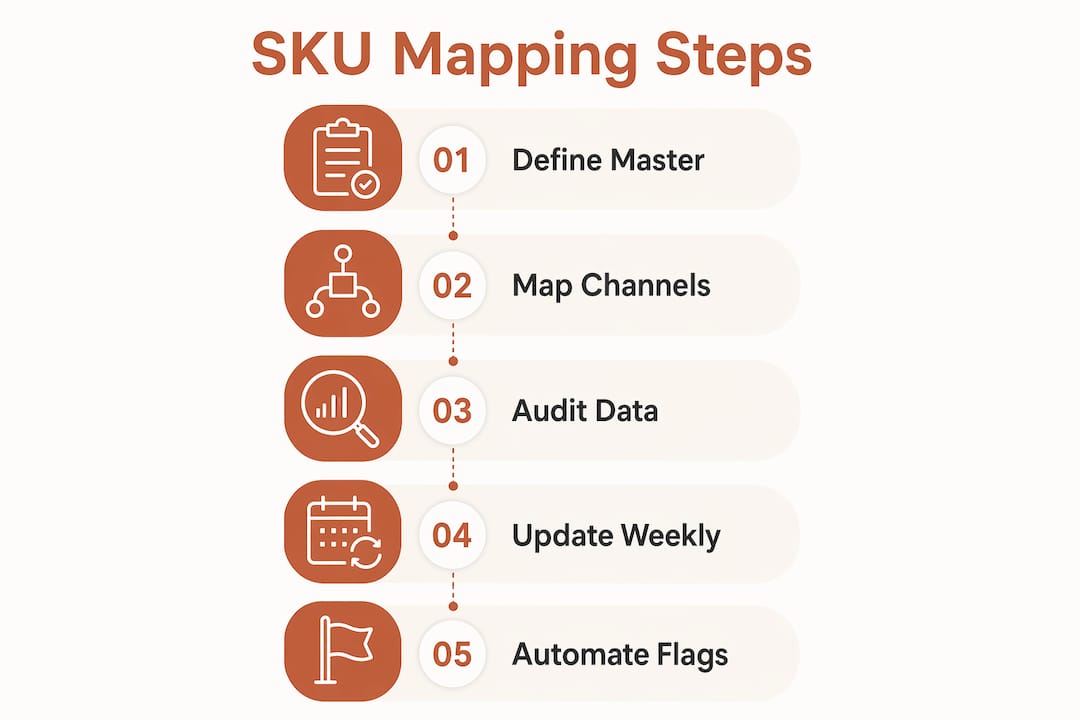
- Assign a catalog owner — one person accountable for naming rules and change control
- Design your SKU format — document the segment structure, abbreviation dictionary, and allowed characters
- Populate the master table — every active variant gets a master SKU, UPC, and channel IDs
- Map all channels — link master SKUs to ASIN, Shopify Variant ID, eBay item number
- Test ingest — export a sample CSV and confirm your analytics tool or IMS reads every field correctly
- Run pilot analytics — pull 90 days of order history and run one MBA pass to validate SKU consistency
- Schedule the 90-day audit — rank SKUs by units sold, flag low-velocity items for rationalization or retirement
Roles and responsibilities:
| Role | Responsibility |
|---|---|
| Catalog owner | Naming rules, change control, retirement decisions |
| Ops lead | Channel mapping, reconciliation cadence |
| Data engineer | CSV/API ingest, mapping validation, pipeline maintenance |
| Analyst | MBA runs, RFM segments, reporting, anomaly flags |
Timeline: Pilot (1–2 weeks for under 500 SKUs); full roll-out (4–8 weeks depending on SKU count and channel complexity).
Sample master-mapping CSV header row:
MasterSKU, Title, Category, UPC, ASIN, ShopifyVariantID, SupplierSKU, Cost, Price, RetiredFlag, DateRetired
How Affinsy ingests SKU-linked transaction data and delivers analytics outputs
Affinsy takes the CSV or API export you already have and turns it into MBA and RFM outputs without requiring a data science team.
Workflow:
- Export order history from Shopify, WooCommerce, BigCommerce, Stripe, or any platform that produces transactional data
- Upload via CSV or connect via API; Affinsy maps your column headers (including
MasterSKU) on ingest - Apply cleaning rules: deduplicate SKUs, enforce case normalization, flag retired-reused codes
- Run MBA to surface association rules and bundle candidates that lift average order value
- Run RFM segmentation to produce export-ready customer lists
Outputs analysts can expect:
- Association rules ranked by confidence and lift (e.g., “customers who buy X buy Y 34% of the time”)
- Top bundle candidates with co-occurrence counts
- RFM customer segments with export-ready IDs for Klaviyo, MailerLite, or Omnisend
- Suggested upsell pairs per SKU category
- Dashboard views of SKU-level velocity and segment overlap
Affinsy’s free tier covers up to 20K line items with full product access and no credit card required. Paid plans (Pro at $49/month, Max at $199/month) unlock larger datasets and automated retail analytics via API.
Pro Tip: Before uploading, confirm your CSV includes MasterSKU, OrderID, CustomerID, Quantity, and Price columns. Those five fields are the minimum Affinsy needs to generate reliable association rules and RFM scores.
Key Takeaways
A clean master SKU, mapped to every channel ID and audited every 90 days, is the single prerequisite for reliable market-basket analysis and customer segmentation.
| Point | Details |
|---|---|
| Master SKU first | Create one internal master SKU per variant before mapping to ASIN, Shopify, or UPC. |
| Uppercase and hyphens only | Case mismatches silently create duplicate records and break channel sync. |
| 90-day audit cadence | Rank SKUs by units sold every quarter; retire low-velocity codes rather than reusing them. |
| SKU hygiene enables AI | Merged, duplicated, or reused SKUs corrupt MBA association rules and RFM segment accuracy. |
| Affinsy for fast analytics | Upload your master-mapped CSV to Affinsy’s free tier and run MBA and RFM without a data science team. |
The part most teams get wrong
Most e-commerce teams treat SKU governance as a one-time setup task. They spend a weekend building a naming convention, populate the master table, and then let it drift for 18 months. By the time they try to run market-basket analysis, they have three naming formats in the same catalog, retired SKUs reused for new products, and channel IDs that no longer match the master record.
The fix is not a better spreadsheet. It is a governance habit: one named owner, a written abbreviation dictionary, and a quarterly audit that actually happens. Small teams can do this in a few hours per quarter. Larger catalogs need a PIM and a data engineer on the reconciliation loop.
When resources are tight, prioritize in this order: master-mapping first (it unblocks everything downstream), then naming enforcement for new SKUs (do not fix old ones all at once — triage by channel volume), then the 90-day audit. If you want MBA and RFM outputs without building the models yourself, that is exactly the trade-off Affinsy is designed for.
Run your first market-basket analysis with Affinsy
Your SKU-linked transaction data is already sitting in Shopify, WooCommerce, or your order management system. Affinsy turns that export into ranked association rules and RFM segments in one upload — no data science background needed, no long setup.
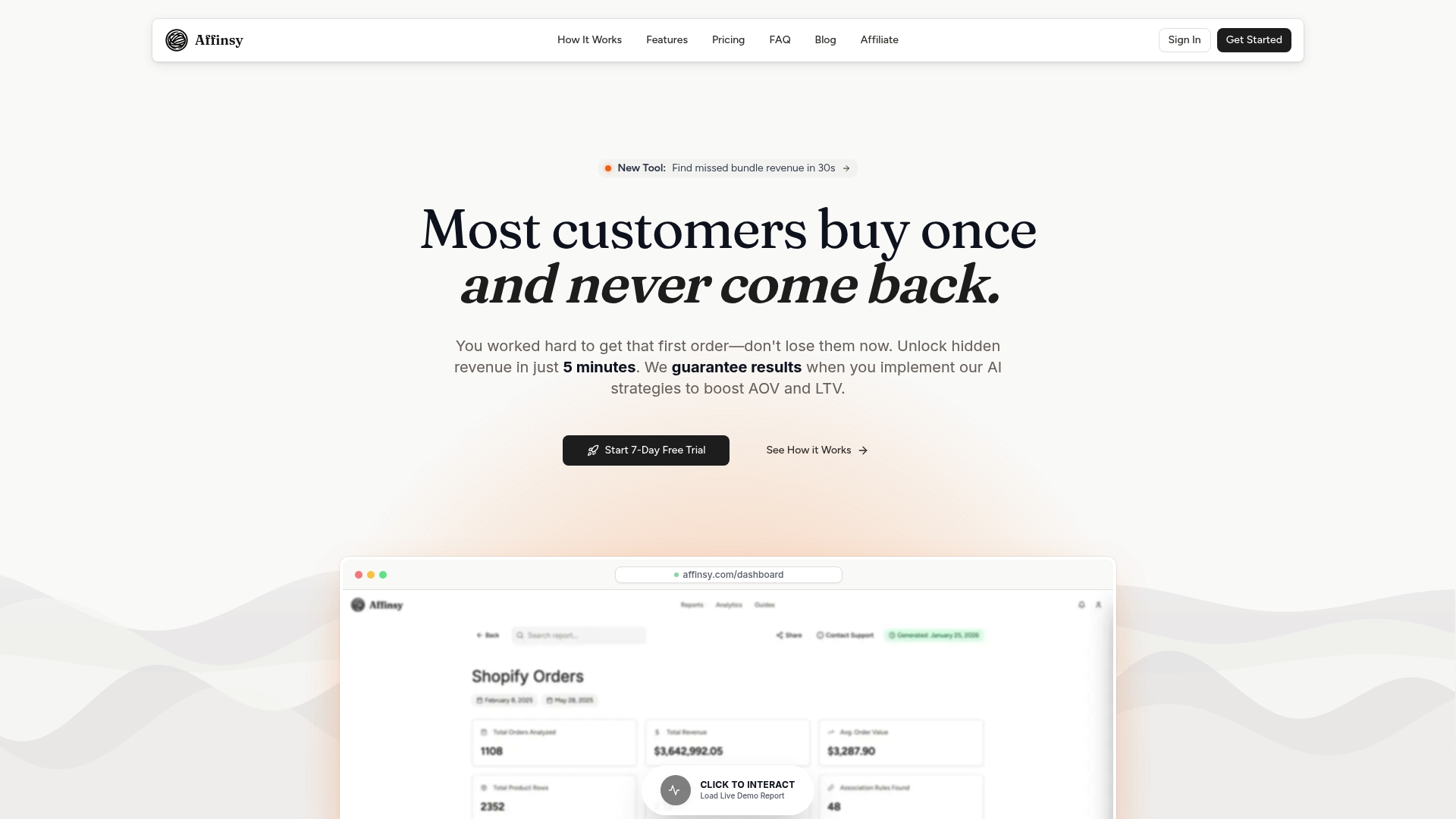
Upload a CSV with your MasterSKU, OrderID, CustomerID, Quantity, and Price columns, and Affinsy maps them automatically on ingest. The free tier handles up to 20K line items with full access to market basket analysis and segmentation features. When your dataset grows, Pro ($49/month) and Max ($199/month) plans scale with you, and enterprise pricing is available for high-volume catalogs. Start with the free tier at affinsy.com — no credit card required.
Authoritative sources and further reading
- Schema.org SKU property definition — canonical definition of SKU as a merchant-assigned identifier, with GS1/GoodRelations vocabulary context
- Shopify: What is a SKU Number? — practical guide to SKU creation, variant-level storage, and IMS integration
- Amazon: SKU definition and management guide — how SKUs connect to ASINs and Amazon catalog records
- VNDLY: SKU format guide and naming best practices — naming rules, length constraints, and what not to encode
- AcquireX: SKU management best practices for multi-channel sellers — 90-day audit cadence and uppercase enforcement
- OmniOrders: SKU management for e-commerce — master mapping, rationalization, and channel sync workflows
- Inriver: Managing 10,000 SKUs across 30 countries — PIM upgrade triggers and governance at scale
- ShipBob: SKU management — transactional SKU data as the foundation for MBA and analytics
- Affinsy: Market basket analysis glossary — how Affinsy applies MBA to SKU-linked order data