
TL;DR:
- Retail insights derived from transaction data and shopper behavior drive sales, margins, and customer retention. Acting promptly on these insights, such as through dynamic pricing and inventory optimization, significantly boosts profitability and sales lift. Overcoming challenges like decision latency, analyst bottlenecks, and inconsistent governance is essential for embedding insights into retail operations and enabling growth.
Retail insights are defined as the actionable knowledge extracted from transaction data, shopper behavior, and market signals that directly drive sales, margin, and customer retention decisions. The role of insights in retail growth goes far beyond reporting: AI-powered platforms consolidate touchpoint data and deliver recommendations fast enough to influence decisions before trading windows close. Retailers who act on shopper intelligence, dynamic pricing signals, and demand forecasts consistently outperform those who rely on intuition. This guide explains exactly how insights translate into measurable growth, where most retail teams fall short, and how to build a system that keeps improving.
How retail insights directly drive sales and profit growth
The clearest proof that insights move the needle is in the numbers. Dynamic pricing informed by real-time data can boost profit margins by up to 10% in categories with volatile demand. That figure is not theoretical. It reflects what happens when pricing algorithms respond to competitor moves, inventory levels, and purchase velocity instead of waiting for a weekly category review.
Shelf placement is another high-impact area. Optimized planogram placement informed by shopper insights drives a sales lift of approximately 4.32%, particularly when products move from low-visibility positions to eye-level or end-cap locations. A 4% lift across a full store assortment compounds fast.
Inventory is where insights quietly save the most money. Demand-sensing analytics reduce inventory waste by 15–25% while improving in-stock rates. Less overstock means less markdown exposure. Better in-stock rates mean fewer lost sales to competitors.
| Insight Application | Potential Impact | Primary Mechanism |
|---|---|---|
| Dynamic pricing | Up to 10% margin improvement | Real-time competitor and demand signals |
| Planogram optimization | ~4.32% sales lift | Shopper behavior and visibility data |
| Demand sensing | 15–25% waste reduction | Predictive inventory positioning |
| Customer segmentation | Higher repeat purchase rate | Personalized offers by segment |
| Market basket analysis | Increased average order value | Cross-sell and bundle recommendations |
Pro Tip: Start with one high-velocity category when piloting dynamic pricing. A focused test gives you clean signal on margin impact before you scale the model across the full assortment.
What are the biggest challenges in using retail analytics?
The most common failure in retail analytics is not bad data. It is slow action. Decision latency, defined as the time between detecting a data signal and executing a business response, is the critical metric that separates high-performing retail analytics programs from expensive dashboards nobody uses. In volatile categories like fresh food, seasonal apparel, or consumer electronics, a 48-hour delay in acting on a demand signal can cost more than the analytics platform itself.
The second structural problem is the analyst bottleneck. Most retail organizations route every data question through a small analytics team. That team becomes the constraint. Data democratization solves this by giving merchandising, marketing, and supply chain teams self-service tools to explore data independently. When a category manager can pull her own basket analysis without waiting three days for a ticket, decisions happen at the speed of the market.
Governance is the third challenge, and the one most teams skip. Without defined governance rules specifying how metrics like “active shopper” or “attribution window” are calculated, different departments produce conflicting reports. Conflicting reports create decision paralysis, not growth.
Key pitfalls to avoid and the practices that fix them:
- Slow decision cycles. Automate alerts for threshold breaches so teams act in hours, not days. Explore automating retail analytics to reduce latency at scale.
- Analyst bottlenecks. Deploy self-service dashboards for merchandising and marketing teams so they can answer their own questions.
- Metric conflicts. Define a single source of truth for every KPI before building any dashboard.
- Vanity metrics. Track margin impact and incremental lift, not just clicks and impressions.
- Siloed data. Connect point-of-sale, e-commerce, and loyalty data into one unified view before drawing conclusions.
Pro Tip: Before your next analytics rollout, hold a one-hour cross-functional meeting to agree on metric definitions. That single conversation prevents months of conflicting reports downstream.
What are the four types of retail insights?
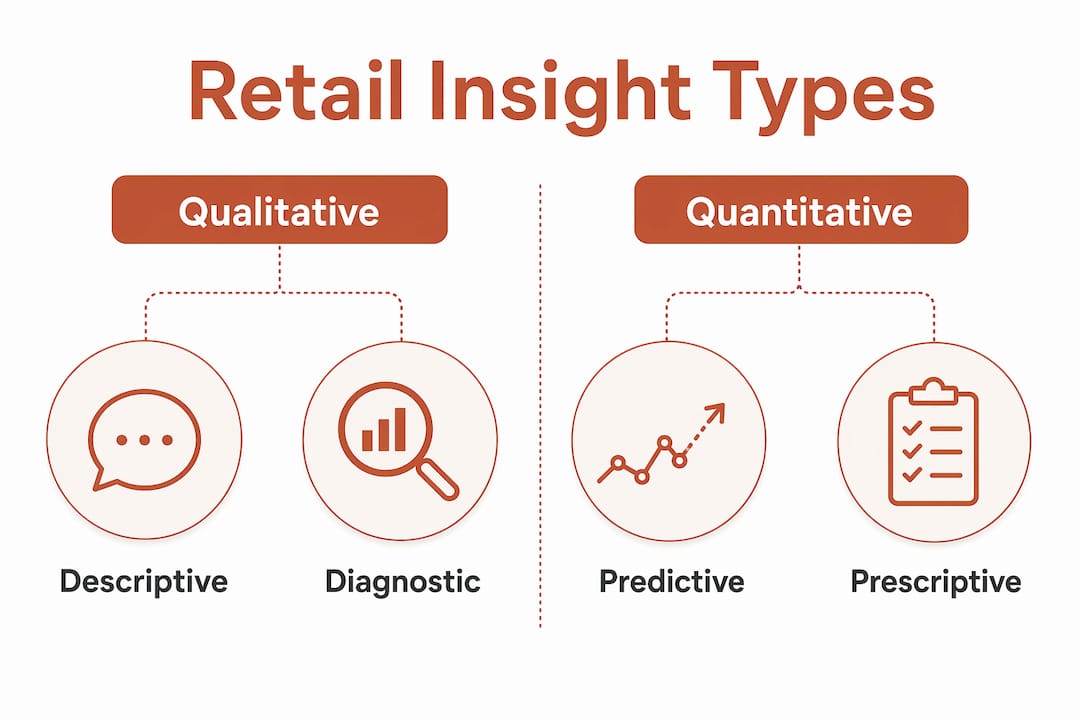
The four types of insights are descriptive, diagnostic, predictive, and prescriptive. Each type answers a different business question and supports a different level of decision-making. Retail teams that use all four in sequence build a compounding advantage over those who stop at descriptive reporting.

| Insight Type | Question Answered | Retail Example |
|---|---|---|
| Descriptive | What happened? | Weekly sales by category, returns rate, basket size |
| Diagnostic | Why did it happen? | Sales dropped because a key SKU went out of stock |
| Predictive | What will happen? | Demand forecast for the next 30 days by region |
| Prescriptive | What should we do? | Reorder 500 units now and promote the substitute SKU |
Descriptive insights are the foundation. They tell you what is happening across sales, inventory, and customer behavior right now. Most retailers have this layer covered through their POS or e-commerce platform reporting.
Diagnostic insights go one level deeper. They explain why a trend emerged. If a product category underperformed last quarter, diagnostic analysis identifies whether the cause was pricing, out-of-stocks, a competitor promotion, or a shift in shopper preference. Without this layer, teams repeat the same mistakes.
Predictive modeling is where analytics in retail growth starts to create real separation from competitors. Demand forecasting, customer churn prediction, and next-best-product recommendations all fall here. Prescriptive analytics then closes the loop by recommending the specific action, the exact SKU to reorder, the segment to target, the price to set.
How do you integrate insights into retail operations?
Retail intelligence is defined as delivering the right product, at the right time, place, and price by customizing the consumer journey based on data. Operationalizing that definition requires connecting insights to the workflows where decisions actually happen.
Here is a practical sequence for embedding insights into daily retail operations:
- Unify your data sources. Connect transaction data, loyalty program records, web behavior, and inventory feeds into a single analytics environment. Fragmented data produces fragmented decisions.
- Define your decision triggers. Specify the exact thresholds that prompt action. For example: if a top-20 SKU drops below five days of cover, trigger an automatic reorder and alert the category manager.
- Link purchase intelligence to supply chain. Connecting shopper data to supply chain in real time reduces stockouts by reacting faster than traditional weekly forecasts allow. This is coordinated action, and it is the operational model that separates modern retailers from legacy operators.
- Personalize at the segment level. Use RFM segmentation (Recency, Frequency, Monetary value) to identify your highest-value customers and your at-risk churners. Send different offers to each group. Generic promotions waste margin on customers who would have bought anyway.
- Measure incrementality, not just ROAS. Holdout testing confirms whether a promotion drove net margin lift or simply shifted sales you would have made regardless. This is the difference between growing the business and moving numbers around on a spreadsheet.
- Automate recurring decisions. Replenishment, price adjustments, and triggered email campaigns should run without manual intervention. Reserve analyst time for strategic questions, not operational maintenance.
- Review and recalibrate monthly. Models drift. Shopper behavior changes. A monthly review of forecast accuracy and segment performance keeps your insight engine calibrated to current reality.
The retailers who grow fastest are not the ones with the most data. They are the ones who have built workflows where insights automatically translate into action. Data-driven retail strategies work when the gap between signal and response is measured in hours, not weeks.
Key takeaways
Retail growth through market insights depends on acting fast, governing data consistently, and connecting intelligence across every operational function.
| Point | Details |
|---|---|
| Decision latency is the core metric | Reduce the time from data signal to business action to protect margin and competitive position. |
| Four insight types work in sequence | Move from descriptive to prescriptive analytics to turn observations into specific, profitable actions. |
| Governance prevents paralysis | Define metric calculations across departments before building dashboards to avoid conflicting reports. |
| Incrementality testing is non-negotiable | Use holdout groups to confirm promotions generate net margin lift, not just sales redistribution. |
| Democratize data access | Self-service tools for merchandising and marketing teams eliminate analyst bottlenecks and speed up decisions. |
Why most retailers are still leaving growth on the table
I have spent years watching retail teams invest in analytics platforms and then fail to grow. The pattern is almost always the same. They collect more data, build more dashboards, and then wait for someone to tell them what to do with it. The insight sits in a report. The trading window closes. The margin opportunity disappears.
The uncomfortable truth is that more data is not better. The retailers I have seen grow consistently are not the ones with the biggest data warehouses. They are the ones who have made a cultural decision to act on imperfect information quickly rather than wait for perfect information too late.
The second thing most teams get wrong is trusting platform-reported metrics without testing incrementality. A promotion that shows strong ROAS in your ad platform may simply be capturing customers who would have converted anyway. Until you run a holdout test, you do not know whether you grew the business or just paid for sales you already owned.
My strongest recommendation is this: before you add another data source or analytics tool, define what decision each insight is supposed to trigger. If you cannot name the decision, you do not need the data. That discipline, more than any technology, is what separates retailers who grow from retailers who just report.
— Mateusz
See how Affinsy turns transaction data into retail growth
Affinsy is built for retail professionals who want to act on insights without needing a data science team. The platform analyzes your historical transaction data to surface product association patterns through market basket analysis and segment your customers by purchase behavior using RFM scoring.
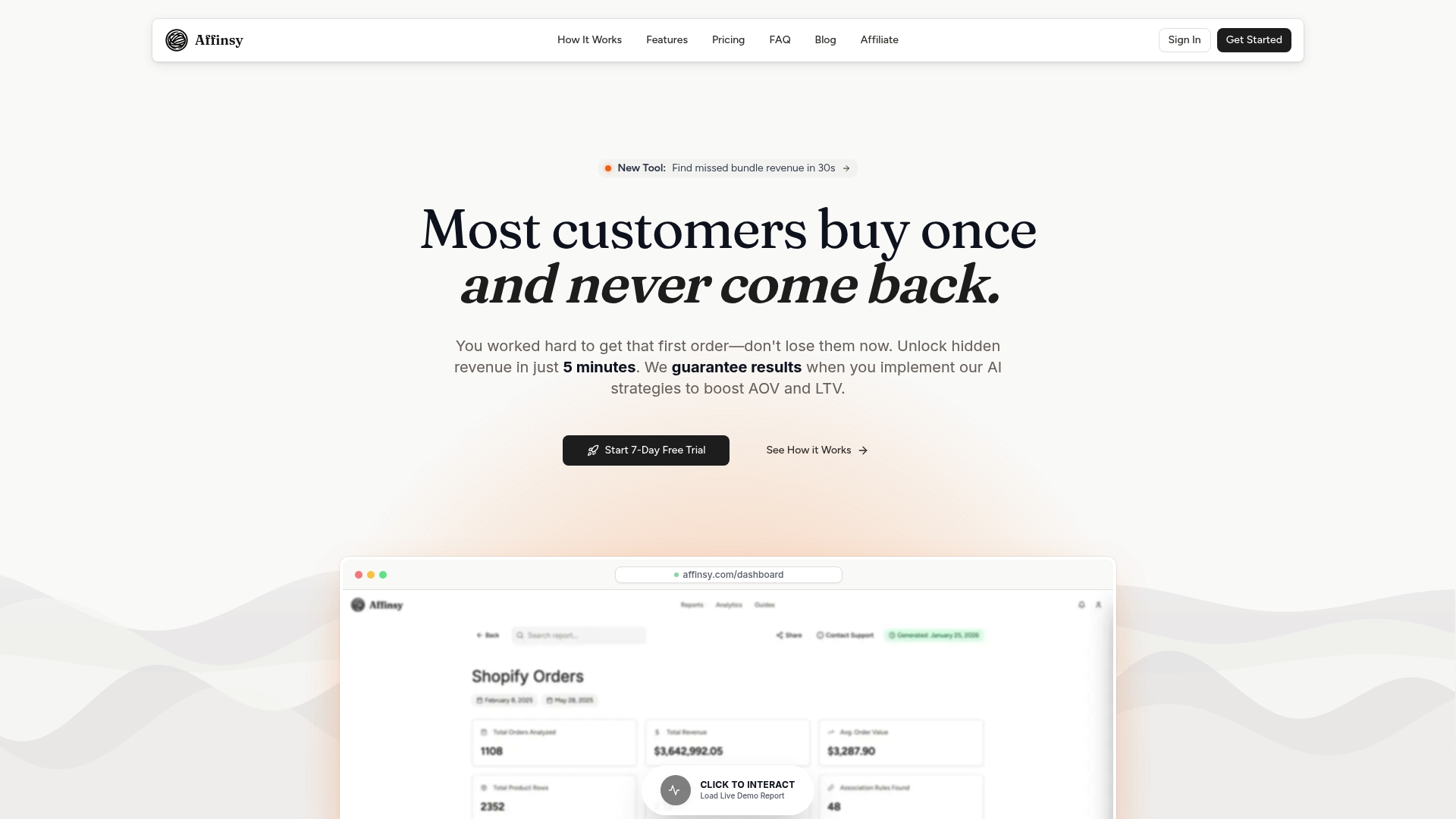
You export your order data from Shopify, WooCommerce, BigCommerce, Stripe, or any platform that produces transactional records, then load it into Affinsy via CSV upload or API. The platform identifies which products are bought together, which customer segments are at risk of churning, and which bundles will increase average order value. Affinsy’s free tier covers up to 20,000 line items with no credit card required, so you can validate the approach against your own data before committing. Paid plans start at $49 per month for larger datasets and API access.
FAQ
What is the role of insights in retail growth?
Retail insights translate raw transaction and shopper data into specific decisions that improve margins, reduce waste, and increase customer retention. The role of insights in retail growth is to replace intuition with evidence at every stage of the buying and selling cycle.
How does decision latency affect retail analytics ROI?
Decision latency is the time between detecting a data signal and executing a business response. Shorter latency means faster reaction to demand shifts, competitor moves, and inventory gaps, which directly protects margin and drives revenue.
What is the difference between predictive and prescriptive analytics in retail?
Predictive analytics forecasts what will happen, such as demand for a SKU over the next 30 days. Prescriptive analytics recommends the specific action to take, such as reordering a set quantity and promoting a substitute product.
Why is incrementality testing important for retail promotions?
Holdout testing confirms whether a promotion generated net new margin or simply captured sales that would have occurred without the spend. Without incrementality measurement, retailers routinely overstate the impact of their marketing investments.
How does customer segmentation support retail growth strategies?
RFM segmentation identifies high-value customers, at-risk churners, and new buyers so retailers can send targeted offers to each group. Personalized outreach based on customer segmentation consistently outperforms generic promotions on both conversion rate and margin efficiency.
Recommended
- Understanding Retail Analytics Guide 2025 for E-Commerce Success - Affinsy Blog | Affinsy
- Ecommerce Analytics Trends 2026: Unlocking Growth Through AI - Affinsy Blog | Affinsy
- AI Insights for Online Stores: 2026 Playbook - Affinsy Blog | Affinsy
- Ecommerce Insights Explained: Driving Store Growth - Affinsy Blog | Affinsy