
TL;DR:
- Segmentation modeling groups data into meaningful clusters to reveal patterns and improve targeting. It applies in marketing for customer groups and in computer vision for pixel classification. Quality data and appropriate technique choice are essential for accurate, useful segments.
Segmentation modeling is defined as the process of partitioning a dataset into distinct, meaningful groups based on shared characteristics. The term covers two related but separate disciplines: customer segmentation in marketing and pixel-level segmentation in computer vision. Marketing professionals use customer segmentation to divide audiences by demographics, behavior, and preferences. Data analysts working in computer vision apply semantic, instance, and panoptic segmentation to classify every pixel in an image. Both disciplines share the same core logic: group similar data points together to extract patterns that a single undivided dataset would hide.
What is segmentation modeling and why does it matter?
Segmentation modeling is the analytical practice of dividing a population or dataset into subgroups where members share measurable traits. The goal is to make each group internally consistent and distinct from every other group. That structure lets marketers send the right message to the right customer, and lets computer vision systems identify the right object in the right region of an image.
The business case for customer segmentation is direct. Segmentation reduces processing complexity and uncovers patterns that improve targeting and revenue outcomes. By grouping similar customers, marketers deploy tailored offers that lift engagement instead of broadcasting generic campaigns to an undivided list.
In computer vision, the stakes are equally concrete. Segmentation classifies every pixel in an image into a category, giving systems a precise map of a scene rather than a rough bounding box. That precision matters in autonomous driving, medical imaging, and retail shelf analysis, where the difference between a bounding box and an exact pixel boundary changes the quality of every downstream decision.
What are the main types of segmentation models?
The answer depends on your domain. Computer vision and marketing each have their own taxonomy, and confusing the two leads to poor tool selection.
Image segmentation types
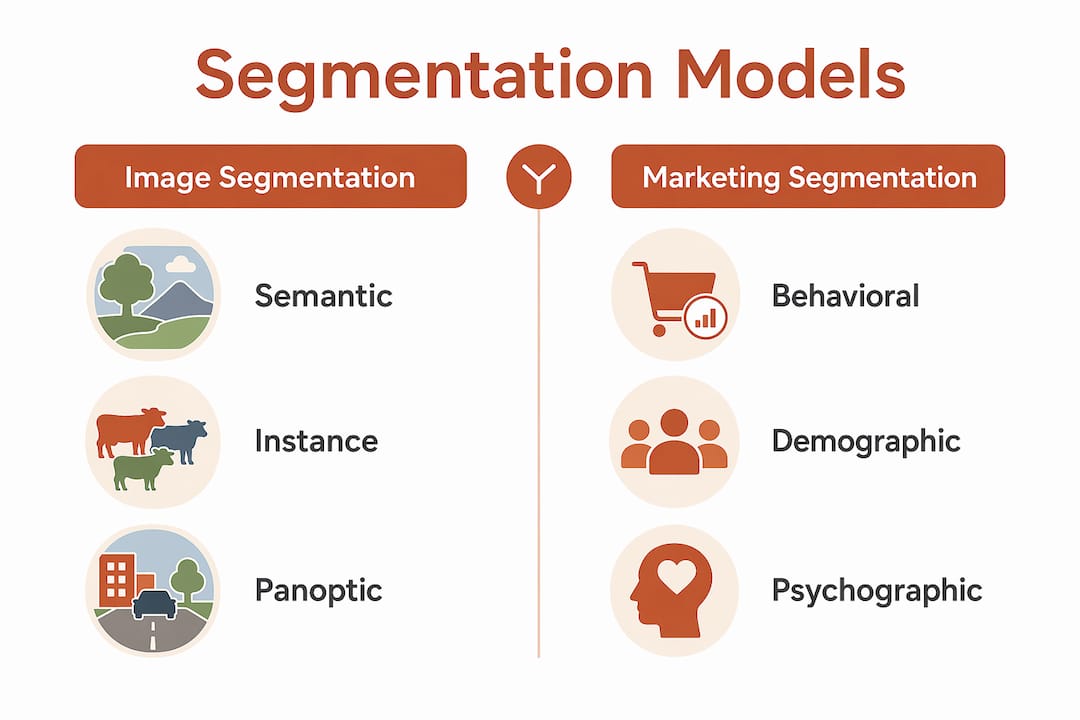
The three primary types are semantic, instance, and panoptic segmentation. Semantic segmentation labels every pixel with a class name but does not separate individual objects within that class. Instance segmentation goes further: it distinguishes each individual object, so two cars in the same image get separate labels. Panoptic segmentation combines both approaches into one unified scene map, making it the most complete option for complex environments.
Panoptic segmentation is the current gold standard in computer vision for combining object detection and background classification in one output. That completeness comes at a computational cost, which is why simpler tasks often use semantic segmentation instead.
Marketing segmentation types
Marketing segmentation divides customers by four primary dimensions:
- Demographic: age, gender, income, education
- Geographic: country, region, city, climate zone
- Psychographic: values, lifestyle, personality traits
- Behavioral: purchase history, usage frequency, brand loyalty
These four types drive targeted messaging, personalization, and improved engagement. A behavioral segment built from purchase history, for example, lets you identify high-value repeat buyers and treat them differently from first-time visitors.
The terminology overlap between image and customer segmentation trips up many teams. Semantic segmentation means something specific in computer vision. In marketing, “semantic” is not a standard segment type. Keeping the two vocabularies separate prevents tool mismatches and wasted budget.
What techniques and algorithms are used in segmentation modeling?
The right technique depends on your data type and the precision your use case demands.
Deep learning models for image segmentation
- U-Net excels with small, labeled datasets. It was designed for medical imaging, where annotated data is scarce, and it remains the go-to architecture when you cannot afford thousands of labeled examples.
- Mask R-CNN adds a segmentation branch to an object detection network, making it well suited for instance segmentation tasks where individual object boundaries matter.
- DeepLab v3+ uses atrous convolution to capture multi-scale context, which improves accuracy on complex scenes with objects at varying sizes.
- Meta’s Segment Anything Model (SAM 3) represents a different category entirely. SAM 3 enables zero-shot segmentation with prompts like clicks or bounding boxes, pre-trained on over a billion images and masks. That scale means it adapts to new tasks with minimal retraining, which cuts annotation costs dramatically.
U-Net excels with small datasets in medical imaging, while advanced transformer models require large labeled datasets but deliver superior accuracy on general scenes. Choosing between them is a trade-off between data availability and output quality.
Clustering methods for customer segmentation
Traditional clustering techniques like K-Means and DBSCAN remain the workhorses of customer segmentation when data lacks pixel-level labels. K-Means partitions customers into a fixed number of clusters by minimizing within-cluster variance. DBSCAN identifies clusters of arbitrary shape and flags outliers, making it useful for detecting unusual buying patterns. Hierarchical clustering builds a tree of nested groups, which helps analysts explore segment structure at multiple levels of granularity.

These methods rely on feature engineering. The quality of your input features, such as recency, frequency, and monetary value in RFM analysis, determines the quality of the resulting segments more than the algorithm itself.
Pro Tip: Before choosing between K-Means and DBSCAN, plot your customer data in two dimensions using PCA or t-SNE. If clusters look roughly spherical, K-Means works well. If they look irregular or contain noise, DBSCAN is the better fit.
Effective segmentation requires balancing computational costs with accuracy and real-time performance criteria. A model that runs perfectly in a research notebook but takes 10 seconds per inference is not production-ready.
How to apply segmentation modeling for marketing and customer engagement
Applying segmentation to marketing follows a clear sequence. Skipping steps produces segments that look good on paper but fail in production.
Start with clean, structured data. Raw transaction logs, CRM exports, and behavioral event streams all need normalization before any algorithm can group them meaningfully. Missing values and inconsistent formats corrupt cluster boundaries.
Define your segmentation goal before selecting a model. Retention campaigns need behavioral segments built from purchase recency and frequency. Acquisition campaigns need demographic and geographic segments that match your best existing customers. The goal determines the features, and the features determine the algorithm.
Validate segments against business outcomes. A segment is only useful if it predicts different behavior. Test whether your high-value segment actually converts at a higher rate. If it does not, the segment boundary is in the wrong place.
Practical applications include:
- Personalized email sequences triggered by behavioral segment membership
- Dynamic pricing rules applied to geographic and demographic clusters
- Cross-sell recommendations built from market basket analysis layered on top of behavioral segments
- Churn prediction models trained separately for each behavioral cohort
Combining segmentation with market basket analysis is particularly effective for e-commerce. Segmentation paired with basket analysis can drive meaningful revenue growth by revealing which product combinations appeal to which customer groups. That pairing turns a list of transactions into a map of customer intent.
Pro Tip: Run your segmentation model on a rolling 90-day window of transaction data rather than all-time history. Recent behavior predicts future behavior more accurately than lifetime averages, especially in categories with seasonal demand.
Analytics in marketing drives measurably better ROI when segmentation feeds campaign targeting rather than replacing it. Segmentation narrows the audience; analytics measures whether the narrowing worked.
What are the advantages and limitations of segmentation modeling?
Every segmentation approach carries trade-offs. The table below maps the key strengths and weaknesses of the three main image segmentation types alongside customer segmentation.
| Approach | Primary advantage | Primary limitation |
|---|---|---|
| Semantic segmentation | Fast, low computational cost | Cannot distinguish individual objects in the same class |
| Instance segmentation | Separates individual objects precisely | Higher annotation effort and inference cost |
| Panoptic segmentation | Complete scene understanding | Most computationally expensive; complex to implement |
| Customer segmentation (clustering) | Works on structured data without pixel labels | Sensitive to feature quality and cluster count selection |
Segmentation quality is extremely sensitive to annotation quality rather than solely to model complexity. Adding more high-quality labeled data improves results more reliably than upgrading the model architecture. That finding has a direct implication for budget allocation: invest in data quality before investing in model complexity.
The advantages of customer segmentation in marketing are concrete. Improved targeting reduces wasted ad spend. Personalized offers increase conversion rates. Segment-specific retention campaigns reduce churn. The limitations are equally concrete: poor input data produces misleading segments, and over-segmentation creates so many groups that no group is large enough to act on.
Choosing the minimal segmentation detail required is the key cost-control decision in any segmentation project. If your use case only needs to know whether a pixel is road or not-road, semantic segmentation is sufficient. Panoptic segmentation adds cost without adding value in that scenario.
Key Takeaways
Segmentation modeling delivers its highest value when the chosen technique matches the data type, the business goal, and the available annotation or labeling resources.
| Point | Details |
|---|---|
| Match technique to data type | Use clustering for structured customer data; use deep learning models for pixel-level image tasks. |
| Prioritize data quality | Improving annotation or feature quality raises model performance more than upgrading architecture. |
| Choose minimal required detail | Select semantic, instance, or panoptic segmentation based on what your use case actually needs. |
| Combine methods for marketing | Pair customer segmentation with market basket analysis to reveal which products appeal to which groups. |
| Validate against outcomes | A segment is only useful if it predicts different behavior; test conversion rates before scaling campaigns. |
Segmentation modeling is more nuanced than most marketers realize
The biggest mistake I see marketing teams make is treating segmentation as a one-time project. They run K-Means on their customer list, label the clusters, and then use those same segments for 18 months while their customer base shifts underneath them. Segmentation is a living model, not a static report.
The second mistake is conflating image segmentation terminology with customer segmentation concepts. I have sat in meetings where a data scientist presented a “semantic segmentation” approach and the marketing director assumed it meant segmenting customers by meaning or intent. It meant pixel-level class labeling. That confusion delayed the project by three weeks.
The rise of foundation models like SAM 3 is genuinely changing the image segmentation side of this field. Foundation models reduce annotation costs and enable quick adaptation to new tasks, which means teams that previously could not afford custom image segmentation can now access it. That shift will push more marketing teams into visual commerce applications, and they will need to understand the terminology before they can evaluate vendors.
On the customer segmentation side, the most underused technique I see is combining RFM segmentation with AI-driven customer analysis. RFM alone tells you who bought recently and often. AI layered on top tells you why, and what they are likely to buy next. That combination is where the real targeting gains live.
My honest recommendation: start with the simplest segmentation method that answers your business question. Add complexity only when you can measure that the added complexity improves a real outcome, not just a model metric.
— Mateusz
How Affinsy brings segmentation to your e-commerce data
Affinsy applies AI-powered analytics to your transaction history to surface customer segments and product associations you would not find manually.
The platform runs RFM customer segmentation and market basket analysis on data you already have, whether you export it from Shopify, WooCommerce, BigCommerce, or Stripe via CSV or API. No data science skills are required. The free tier covers up to 20,000 line items with full product access and no credit card. If you want to go deeper on the concepts before connecting your data, the Affinsy customer segmentation glossary covers definitions, methods, and practical examples in one place. For teams ready to combine segmentation with product affinity analysis, the e-commerce analytics glossary is a useful starting point.
FAQ
What is segmentation modeling in simple terms?
Segmentation modeling is the process of dividing a dataset into groups where members share similar characteristics. In marketing, those groups are customer segments; in computer vision, they are regions of pixels classified by category.
What is the difference between semantic and instance segmentation?
Semantic segmentation labels every pixel with a class but treats all objects of the same class as one region. Instance segmentation assigns a separate label to each individual object, even when two objects belong to the same class.
How do marketers use segmentation modeling?
Marketers use behavioral and demographic segments to personalize campaigns, set dynamic pricing, and build churn prediction models. Segments are built from transaction history, CRM data, and behavioral event streams.
What is the best algorithm for customer segmentation?
K-Means is the most widely used starting point for customer segmentation because it is fast and interpretable. DBSCAN is better when customer clusters have irregular shapes or when outlier detection matters.
How does data quality affect segmentation model results?
Data quality affects segmentation results more than model complexity does. High-quality, well-labeled training data or clean, well-engineered customer features consistently produce better segment boundaries than a more complex algorithm applied to poor data.
Recommended
- Customer Segmentation — E-Commerce Glossary | Affinsy | Affinsy
- Customer segmentation explained: boost retention 2026 - Affinsy Blog | Affinsy
- Segmentation + market basket analysis: 40% more revenue - Affinsy Blog | Affinsy
- Customer segmentation workflows that drive e-commerce growth - Affinsy Blog | Affinsy