
TL;DR:
- Sending identical emails to all customers wastes budget and reduces engagement, while segmentation enables personalized messaging. Shopify’s tools and AI-driven analytics facilitate dynamic, behavior-based customer groupings that improve ROI and lifetime value. Regular data cleaning, automated updates, and performance measurement are essential to maintaining effective, real-time segmentation strategies.
Sending the same email to every customer on your list is like handing everyone in a crowded room the same flyer and hoping a few people bite. It wastes budget, annoys buyers, and leaves real revenue on the table. Shopify customer segmentation changes that equation by letting you group buyers based on actual behavior, demographics, and purchase patterns, then speak to each group in a way that actually resonates. AI segmentation boosts marketing ROI and customer lifetime value, and this guide shows you exactly how to make it work for your store.
Table of Contents
- Understanding the basics of Shopify customer segmentation
- Preparing your Shopify store for effective customer segmentation
- Step-by-step guide to building customer segments in Shopify
- Common pitfalls and how to avoid mistakes in Shopify segmentation
- Measuring and optimizing segmentation performance for better marketing ROI
- Why traditional segmentation methods aren’t enough anymore
- Explore Affinsy’s solutions for powerful Shopify customer segmentation
- Frequently asked questions
Key Takeaways
| Point | Details |
|---|---|
| Segmentation drives personalization | Grouping customers by behavior and needs enables targeted marketing that increases sales and loyalty. |
| Data integration is critical | Combining data from Shopify, CRM, email, and social media creates richer segments for better insights. |
| RFM and AI enable precision | Using RFM scoring alongside AI-powered predictions uncovers actionable micro-segments. |
| Automation boosts effectiveness | Shopify Flow automates segment updates and campaign triggers for real-time engagement. |
| Measure and refine continuously | Tracking segment performance and adapting strategies ensures sustained marketing ROI growth. |
Understanding the basics of Shopify customer segmentation
Shopify’s built-in tools, combined with external analytics platforms, give you several ways to slice your customer base. Before you build a single segment, it helps to understand the four core types and what each one tells you.
Shopify’s marketing automation lets you build segments using demographic, geographic, psychographic, and behavioral data. Here is what each category actually looks like in practice:
- Demographic: Age, gender, income level, and household status. Useful for product relevance but shallow on its own.
- Geographic: Country, city, or even climate zone. A swimwear brand targeting cold-weather regions in February is wasting ad spend.
- Psychographic: Values, lifestyle, and buying motivations. This one is harder to collect but powerful when you have it.
- Behavioral: Purchase frequency, cart abandonment, product category affinity, and email click patterns. This is where most stores find their highest-ROI segments.
AI-driven segmentation takes behavioral data further. Rather than grouping customers once and leaving the list static, machine learning continuously updates group membership as customer behavior shifts. Someone who bought once six months ago and has since opened every email is a very different prospect from someone who bought twice last month but never clicks. Static lists treat them the same. AI does not.
For richer customer segmentation types beyond what Shopify captures natively, you need data from outside the platform: CRM records, email engagement, social interactions, and support tickets. Integration across these sources is what separates surface-level segmentation from genuinely useful groupings.
Pro Tip: If you are just starting out, prioritize behavioral segmentation first. Purchase history and email engagement data is already sitting in your Shopify account and requires zero additional setup to use.
Preparing your Shopify store for effective customer segmentation
Before you can segment customers, you need to be confident that your data is clean, centralized, and actually reflective of how customers behave. Skipping this step means your segments will be built on shaky ground.
Effective segmentation requires integrating data from multiple platforms including your CRM, Shopify, email platform, social media, and support logs into a centralized system. Here is how to approach that preparation:
- Audit your current data sources. List every place customer information lives: Shopify orders, email platform, support inbox, loyalty program, social ad accounts. You cannot unify what you have not identified.
- Clean your records. Merge duplicate customer profiles, remove invalid email addresses, and flag incomplete records. Even a 10% error rate in your data creates misleading segments.
- Set up behavioral tracking. Install Shopify’s pixel and, if relevant, connect your email platform’s tracking to capture opens, clicks, and browse-abandonment signals. This behavioral layer is what powers your most actionable segments.
- Choose a centralized home for your data. Shopify’s native customer profiles work for many stores. Larger operations often connect a CRM or export data to a dedicated analytics platform for deeper analysis.
- Define your segmentation goals before you build. Are you trying to recover lapsed buyers? Upsell high-spenders? Reduce first-purchase churn? Your goal shapes which data points actually matter.
For boosting store performance, the preparation phase is often where the real work happens. Marketers who skip it end up with segments that look clean in a dashboard but behave unpredictably in campaigns.
- Validate email addresses against engagement history, not just format.
- Confirm that purchase dates and order values are consistent across all connected platforms.
- Document your data refresh schedule so segments do not drift silently over time.
Pro Tip: Export a sample of 500 customer records and manually review them before building any segment. You will almost always find anomalies that would have corrupted your first campaign.
Step-by-step guide to building customer segments in Shopify

With clean, unified data in place, you can build segments that actually drive results. The most effective Shopify segmentation strategies combine RFM analysis, predicted spend modeling, and automation to keep segments current without manual effort.
Shopify customer segmentation strategy uses RFM analysis, behavioral data, predicted spend tiers, and Shopify Flow automation for dynamic segmentation. Here is how to execute that in practice:
- Run RFM analysis. Score every customer on Recency (how recently they bought), Frequency (how often), and Monetary value (how much they spend). This single framework immediately surfaces your champions, your at-risk customers, and your dormant buyers.
- Build predicted spend tiers. Shopify’s predictive analytics can flag customers as high, medium, or low predicted spenders. High-tier customers warrant white-glove treatment. Low-tier ones need a different nurture path.
- Create needs-based segments. Beyond numbers, document what motivates each group. A high-frequency buyer of skincare basics wants replenishment reminders, not new product launches. Build buyer personas around these motivations and pain points.
- Automate with Shopify Flow. Set triggers so customers automatically move between segments when their behavior changes. A customer who has not purchased in 90 days should drop into your win-back sequence without anyone manually updating a list.
- Deploy across channels. Push your segments to email, SMS, and paid ad audiences. Consistency across channels matters. A customer who sees a personalized email should encounter the same offer in a retargeting ad.
| Segment | RFM Profile | Recommended action |
|---|---|---|
| Champions | High R, High F, High M | Loyalty rewards, early access, referral asks |
| At-risk customers | Low R, High F, High M | Win-back campaigns, personal outreach |
| New buyers | High R, Low F, Low M | Onboarding sequence, second-purchase incentive |
| Dormant buyers | Low R, Low F, Any M | Sunset or re-engagement discount |
| High-potential buyers | High R, Low F, High M | Cross-sell, premium product introduction |
For a deeper look at how to drive profitable growth from these segments, the RFM model is your starting point. Pair it with Shopify analytics insights to confirm which product categories each segment gravitates toward.
Pro Tip: Do not create more segments than your team can actually act on. Five well-maintained segments with targeted campaigns outperform twenty stale ones every time.
Common pitfalls and how to avoid mistakes in Shopify segmentation
Building segments is the easy part. Keeping them accurate and avoiding the errors that quietly kill campaign performance is harder. Most segmentation failures trace back to a few recurring mistakes.
Segmentation quality depends on continuous data integration and stateful segments that update with customer behavior changes. The most common ways stores undermine that quality:
- Relying on snapshot segments. Building a segment once and never updating it is the single biggest segmentation mistake. A “loyal customer” list from six months ago may now be full of churned buyers.
- Ignoring non-purchase signals. Email opens, site visits, wishlist additions, and support contacts all signal intent. Stores that only segment on purchase history miss the customer who is on the edge of buying but has not yet converted.
- Over-segmenting early. Creating 30 micro-segments before you have the content and campaigns to serve them leads to neglected lists and inconsistent messaging.
- Missing the re-entry path. Segments need entry rules and exit rules. A customer who re-engages after 120 days of dormancy should not stay in the win-back sequence indefinitely.
The goal of segmentation is not to label customers. It is to predict what they need next and reach them before a competitor does.
Automation is what makes real-time accuracy feasible. Without it, your team is manually updating tags while customer behavior moves faster than any spreadsheet can track. Shopify Flow, connected to your email and SMS platforms, keeps segment membership current as customers take action.
Regularly scheduled persona reviews, quarterly at minimum, catch the drift that happens when your customer base evolves but your segments do not. For a broader look at AI applications in ecommerce that support this kind of dynamic segmentation, there is a practical breakdown worth reading.
Pro Tip: Set a calendar reminder every 90 days to audit your top five segments. Check that entry/exit criteria still reflect your actual customer journey, not the one you designed a year ago.
Measuring and optimizing segmentation performance for better marketing ROI
Segmentation without measurement is just guesswork with extra steps. To know whether your segments are working, you need a clear set of KPIs and a testing discipline that lets you improve over time.
- Define segment-level KPIs. Track open rates, click-through rates, conversion rates, average order value, and revenue per segment. These metrics tell you which segments are performing and which need attention.
- Run A/B tests comparing segmented vs. unsegmented campaigns. This is the clearest way to quantify the ROI of your segmentation effort. The numbers tend to be convincing.
- Monitor segment migration rates. How many customers move from “new buyer” to “returning customer” each month? Stagnant migration rates signal a broken nurture sequence.
- Track churn by segment. If high-value customers are churning at a rising rate, that is an early warning sign that your retention campaigns are not landing.
- Refine triggers and personas regularly. Add new behavioral signals as you collect them. A customer who starts browsing a new product category is telling you something important about a shifting need.
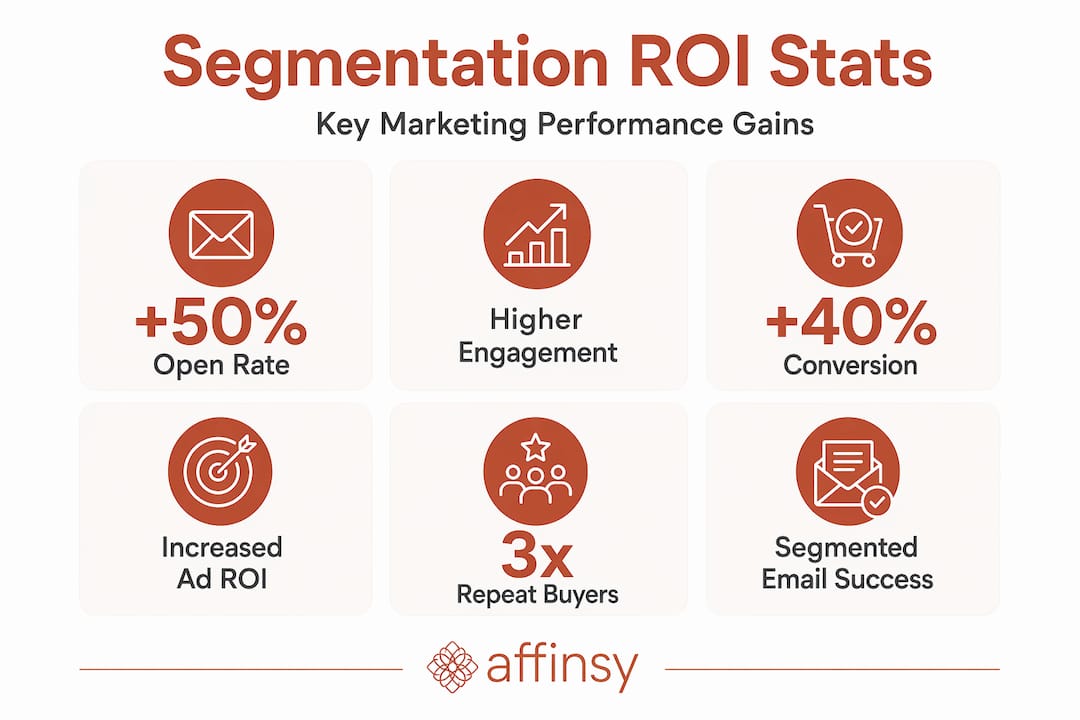
Segmented email campaigns show 40 to 60% higher open rates and improved return on ad spend compared to unsegmented blasts. That gap compounds over time as your segments become more precise and your campaigns more relevant.
| Metric | What it tells you | Action threshold |
|---|---|---|
| Open rate by segment | Email relevance for that group | Below 15% means messaging mismatch |
| Conversion rate | Offer alignment with segment intent | Below category benchmark, review the CTA |
| Segment size change | Audience health and list growth | Shrinking segment needs re-entry campaign |
| Revenue per segment | Business value of each group | Guides where to invest campaign budget |
| Churn rate by segment | Retention effectiveness | Rising churn triggers persona review |
Understanding why a segment converts, not just that it converts, is what allows you to boost ecommerce sales consistently rather than accidentally. The KPI table above gives you a diagnostic framework. The real skill is knowing which lever to pull when a number moves in the wrong direction.
Why traditional segmentation methods aren’t enough anymore
Here is something most segmentation guides will not tell you: the way most Shopify stores segment customers today would have been considered advanced five years ago. In 2026, it is table stakes, and in many cases, it is actively misleading.
Traditional segmentation builds a list, assigns customers to it, and then sends campaigns. The problem is that customers do not stay still. Someone who was a champion buyer in Q3 may have completely shifted their purchasing behavior by Q1 of the following year. A static list does not know that. Your campaign still treats them like a loyal, high-intent buyer while they are actually on the verge of churning.
Machine learning uncovers hidden behavioral patterns missed by traditional segmentation, enabling nuanced micro-segments and real-time activation. That is not a small improvement. It is a fundamentally different way of understanding your customer base. Instead of asking “who bought three times last year,” you start asking “who is exhibiting the behavioral pattern that precedes a third purchase” and reaching them before they need to decide.
Needs-based segmentation is the piece that most brands still underinvest in. Knowing that a customer is a high-frequency buyer is useful. Knowing that they buy frequently because they run a small business and need consistent restocking, not because they love your brand, completely changes your messaging strategy. One group responds to loyalty perks. The other responds to bulk pricing and reliability signals.
The brands that will win in the next few years are the ones treating segmentation as a living system, not a quarterly project. That means automation, real-time data feeds, and regular persona updates built into the marketing calendar as standard operating procedure. The question is not whether AI-driven segmentation works. The evidence is clear. The question is how long you can afford to wait before making it a core part of your Shopify marketing strategy.
For a sharper look at why segmenting customers is now a baseline competitive requirement rather than an advanced tactic, that article makes the case directly.
Explore Affinsy’s solutions for powerful Shopify customer segmentation
If the segmentation framework in this guide sounds like the direction you want to take your store, Affinsy is built to make that transition practical rather than painful. The platform analyzes your historical transaction data to surface RFM segments, product associations, and customer behavior patterns that are not visible in standard Shopify reports.
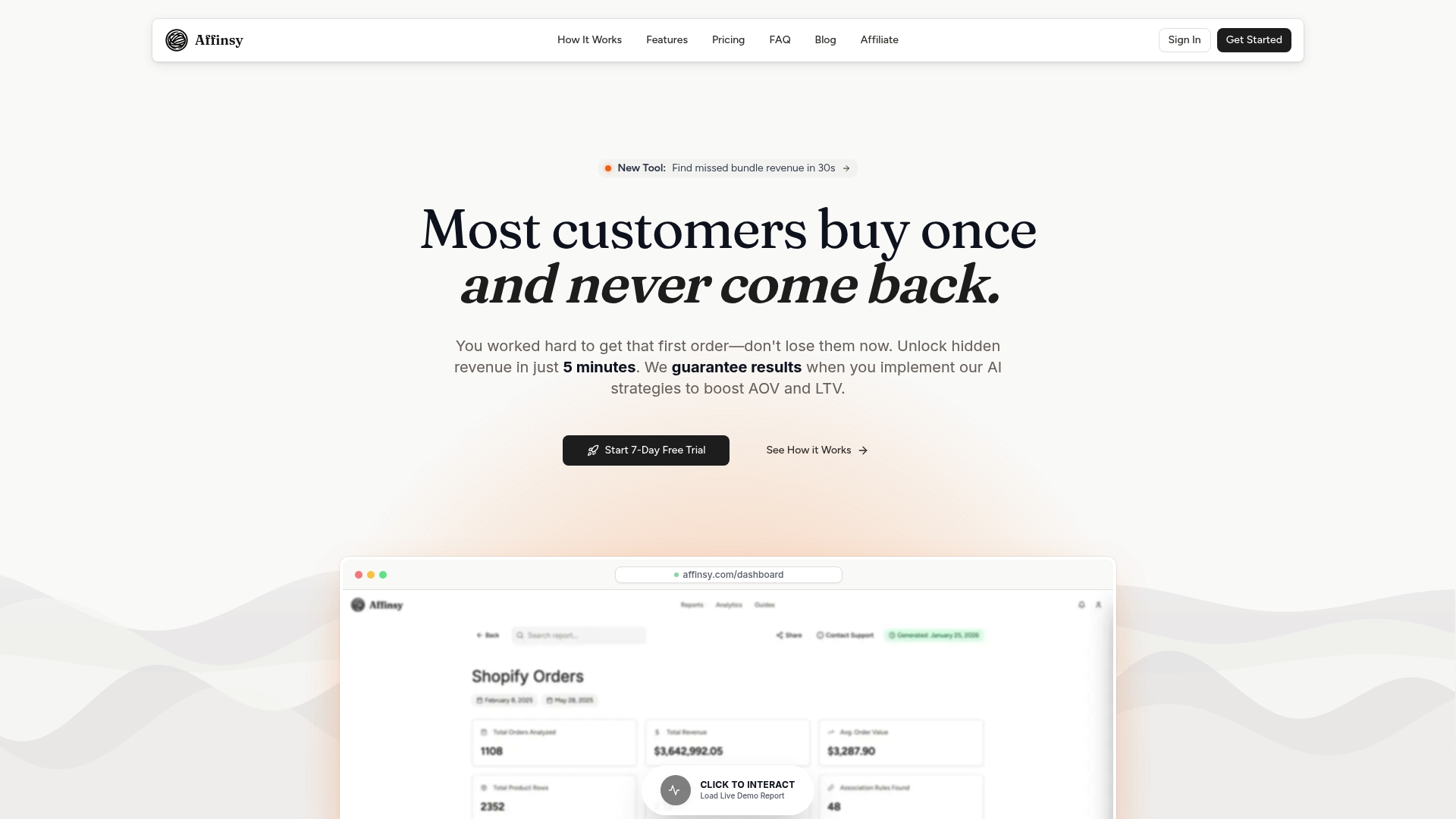
You export your order data from Shopify as a CSV or connect via API, and Affinsy runs market basket analysis and RFM segmentation on top of it. No data science background required. The free tier covers up to 20,000 line items with full product access and no credit card needed, making it a low-risk way to see what your transaction data actually contains. Explore the full customer segmentation glossary and the broader e-commerce analytics glossary to sharpen your understanding before your next campaign build.
Frequently asked questions
What is Shopify customer segmentation?
Shopify customer segmentation is the process of grouping your store’s customers based on shared characteristics like behavior, demographics, and preferences to tailor marketing efforts. Customer data segmentation groups customers based on behaviors, preferences, demographics, or value so that campaigns reach the right people with the right message.
How does AI improve customer segmentation on Shopify?
AI improves segmentation by continuously analyzing multiple data sources to uncover hidden customer patterns and updating segments in real time. Machine learning uncovers behavioral patterns that traditional methods miss, allowing micro-segments to update continuously as customer behavior changes.
What data is needed for effective Shopify segmentation?
Effective segmentation requires purchase history, email engagement, website behavior, social interactions, and customer support logs. Segmentation quality depends on integrating data from your CRM, Shopify platform, email tools, social media, and service logs into one centralized view.
Can I automate customer segmentation updates in Shopify?
Yes. Shopify Flow lets you automate segment membership updates based on behavioral triggers, so customers move between segments in real time without manual list management. Shopify Flow automates segment tagging and transitions based on customer behavior triggers, enabling dynamic segmentation across your marketing stack.
How do I measure the effectiveness of segmentation in Shopify?
Track open rates, conversion rates, segment growth, and retention rates, then use A/B tests to compare segmented against unsegmented campaigns for clear ROI data. Segmented email campaigns show 40 to 60% higher open rates and improved return on ad spend compared to unsegmented blasts, giving you a concrete baseline to measure against.
Recommended
- Why segment customers: boost e-commerce sales in 2026 - Affinsy Blog | Affinsy
- Customer segmentation explained: boost retention 2026 - Affinsy Blog | Affinsy
- Why segment online customers to boost e-commerce sales - Affinsy Blog | Affinsy
- Customer segmentation workflows that drive e-commerce growth - Affinsy Blog | Affinsy