
TL;DR:
- Most Stripe customer segmentation efforts overlook the importance of accurate data hygiene and event unification, risking misleading analysis. Proper preparation involves confirming unique identifiers, reliable timestamps, and complete event tracking to ensure meaningful insights. Effective segmentation, combined with targeted strategies, drives growth, retention, and revenue optimization.
Stripe holds a goldmine of behavioral and transactional signals about your customers, yet most e-commerce teams barely scratch the surface when it comes to turning that raw data into actionable segments. They look at overall revenue trends, spot a dip in retention, and reach for generic email blasts. The real opportunity lies in systematically grouping customers by cohort, behavior, and payment patterns to uncover who is at risk, who is primed for a bundle upsell, and who could become a long-term brand advocate. This guide walks you through every stage, from foundational concepts to advanced Stripe Sigma queries and continuous iteration, so you can build segmentation that actually drives growth.
Table of Contents
- Understand Stripe customer segmentation and why it matters
- Key requirements for effective Stripe segmentation
- Step-by-step: Segmenting customers in Stripe and analyzing results
- Verifying and iterating: Troubleshooting and optimizing segmentation efforts
- Stripe customer segmentation: What most brands miss (and how to win)
- Power up your Stripe segmentation with Affinsy’s advanced analytics
- Frequently asked questions
Key Takeaways
| Point | Details |
|---|---|
| Clean data is critical | Accurate event tracking and unified customer data make segmentation reliable in Stripe. |
| Segment for action | Always build segments aimed at clear business outcomes like retention or bundling. |
| Custom queries unlock more | Stripe Sigma allows you to go deeper than default dashboards for tailored segments. |
| Continuous iteration pays | Regular review and business alignment of segments keep them valuable and actionable. |
Understand Stripe customer segmentation and why it matters
Customer segmentation in Stripe is the practice of grouping buyers or subscribers into meaningful clusters based on shared attributes such as when they first paid, how frequently they purchase, their lifetime value, and their payment behavior. It is not just a reporting exercise. Done well, it becomes the engine that powers personalized retention campaigns, targeted bundle offers, and smarter pricing decisions.
Stripe supports customer lifecycle segmentation via cohort analysis in its subscription analytics within Stripe Billing. Cohorts are grouped by first billing date, and retention is tracked across subsequent months, giving you a clear visual of how different customer classes behave over time. A February cohort might retain at 80% after three months, while a May cohort drops to 60%. That gap is a strategic signal, not just a data point.
Why does this matter for growth teams? Because segmentation explained at a granular level tells you which levers to pull. You can tailor product bundles for high-value customers who are showing signs of disengagement. You can create win-back campaigns for recently churned cohorts. You can identify the behavioral fingerprint of your best customers and use it to guide acquisition targeting.
Stripe’s analytics guidance emphasizes that customer segmentation should be action-oriented for retention and churn, with behavioral analysis specifically designed to identify which segments carry the highest churn risk, including involuntary churn driven by failed payments. That distinction is important. Involuntary churn, where a card declines or a payment method expires, is often mistaken for deliberate cancellation. Segmentation helps you separate those populations so you can respond appropriately.
Key insight: Treating every churned customer the same wastes budget and goodwill. Segment first, then personalize the intervention.
Here is a quick comparison of the primary segmentation lenses available in Stripe:
| Segmentation type | What it measures | Best used for |
|---|---|---|
| Cohort-based | Retention by signup period | Spotting seasonal or campaign quality trends |
| Value-based | Revenue, ARPU, CLV per group | Prioritizing high-value retention and upsells |
| Behavior-based | Payment success, engagement frequency | Identifying at-risk and re-engagement candidates |
| Status-based | Active, past due, canceled | Operational triage and recovery automation |
Understanding why segment customers requires seeing beyond the dashboard numbers. Segmentation is a strategic infrastructure decision, not a one-time report.
Key requirements for effective Stripe segmentation
Knowing what segmentation can achieve, preparation ensures your results aren’t misleading or distorted. Before running a single cohort query, you need to confirm that your event tracking, data hygiene, and identifier unification are in order. Skipping this step is the fastest way to build confidence in wrong conclusions.
Stripe’s cohort analysis documentation warns that segmentation becomes misleading when key customer actions, or events, are not properly tracked, timestamped, and unified before analysis. Over-segmentation is a related risk. When you split a dataset into too many micro-segments, each group becomes statistically too small to trust, and you end up chasing noise instead of patterns.
Core requirements before you begin:
- Unique customer identifiers: Every transaction record must map to a consistent customer ID. Duplicate profiles or anonymous records will skew cohort sizes.
- Accurate timestamps: Events must carry reliable timestamps. A subscription upgrade logged a day late can misassign a customer to the wrong cohort.
- Event completeness: Payment succeeded, payment failed, subscription canceled, and trial started events must all be firing reliably. Missing events create invisible gaps in behavioral data.
- Unified payment methods: If customers have multiple saved payment methods, confirm your tracking distinguishes the payment method used per transaction, not just the customer profile.
- Consistent product taxonomy: Product or plan names must be standardized. “Pro Plan,” “pro_plan,” and “ProPlan” are three different labels in a SQL filter but represent the same product.
Pro Tip: Before running any segmentation analysis, export a sample of 100 to 200 recent transactions and manually verify that event types, customer IDs, and timestamps align. It takes 30 minutes and can save weeks of backtracking.
Check your segmentation types guide to confirm you’re choosing the right framework for your business model before you start building.
Here is a practical requirements checklist to work through before building your first Stripe segment:
| Requirement | What to verify | Risk if skipped |
|---|---|---|
| Customer ID unification | No duplicate profiles across payment methods | Inflated or deflated cohort counts |
| Event tracking completeness | All lifecycle events firing correctly | Missing behavioral signals |
| Timestamp accuracy | Events logged in real time, not batch-delayed | Wrong cohort assignment |
| Plan/product naming | Consistent naming convention across all records | SQL queries return partial results |
| Sample size per segment | Minimum 50 to 100 customers per cohort | Statistically meaningless retention curves |
Step-by-step: Segmenting customers in Stripe and analyzing results
With systems and tracking in place, you’re ready for practical execution. Stripe gives you two main paths: the native cohort tools in the Stripe Dashboard and the custom SQL environment called Stripe Sigma. Each serves a different level of analytical depth, and knowing when to use each is part of the skill.

Step 1: Start with native cohort analysis in the dashboard Navigate to the Stripe Billing analytics section and locate the cohort analysis view. Select the time period for your cohorts, typically monthly, and choose the metric you want to track, such as revenue retention or subscriber retention. This view gives you a color-coded grid showing how each cohort behaves over subsequent months. It is fast, visual, and requires no SQL knowledge.
Step 2: Identify the segments that need deeper investigation Look for cohorts with sharply different retention curves. A cohort that drops 25% in month two while others drop only 10% deserves investigation. Is it a seasonal issue? A pricing experiment? A specific acquisition channel? The native dashboard tells you there is a problem. Stripe Sigma tells you why.
Step 3: Move to Stripe Sigma for custom segmentation Stripe Sigma enables custom segmentation by querying your full Stripe data with SQL directly inside the Stripe Dashboard. You can filter customers by payment status, plan type, subscription start date, lifetime spend, number of failed payments, and more. This is where segmentation becomes genuinely powerful.
A practical example SQL structure in Sigma might look like this: select all customers who started a subscription between specific dates, had at least one failed payment in their first 60 days, and did not upgrade to a higher plan within 90 days. That is a precise at-risk segment you can act on immediately with a targeted recovery offer or a tailored bundle.
Step 4: Structure segments around time, value, and behavior A practical segmentation methodology for e-commerce growth teams is to build segments around three axes: time (which cohort period a customer belongs to), value (their ARPU, total spend, or CLV tier), and behavior (payment success rate, engagement frequency, upgrade or downgrade history). Layering these axes lets you create highly specific audiences like “high-value customers from Q3 who had a failed payment but did not churn.”
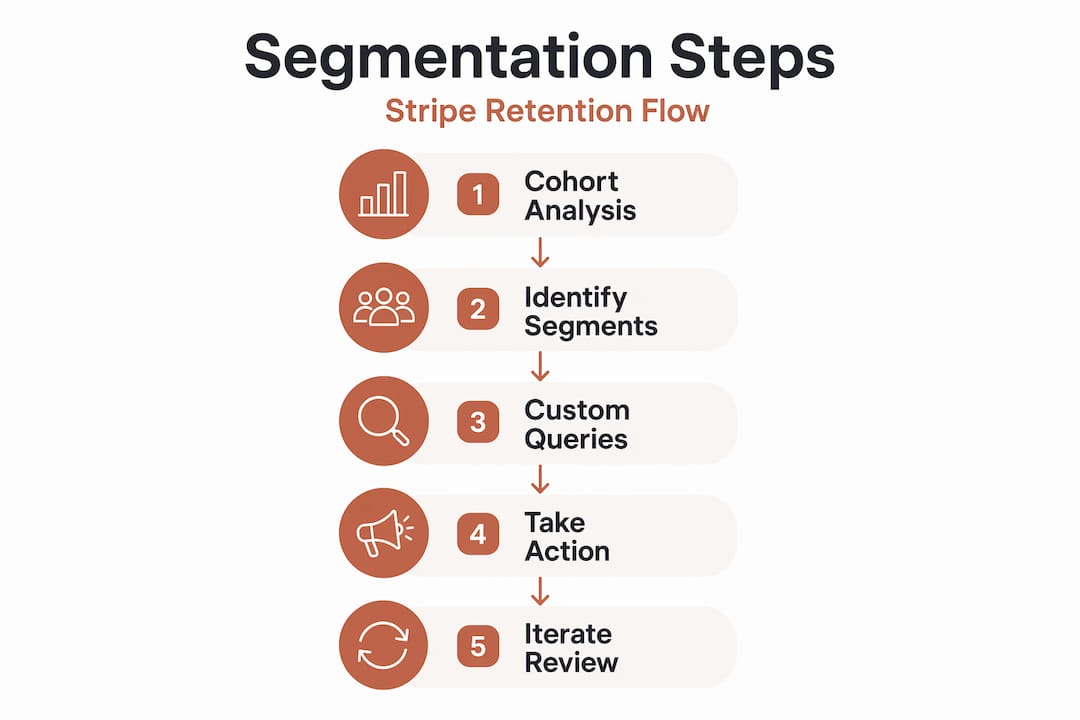
Step 5: Map each segment to a specific retention or bundling intervention This is where most teams stop short. They build segments and then look at them. The point is to connect each segment to an action. High-value, low-engagement customers might receive a bundle offer featuring complementary products. Recently failed-payment customers get an immediate dunning campaign with a frictionless payment update link. Newly activated customers from a specific cohort receive an onboarding sequence designed to hit key activation milestones.
Pro Tip: Start with your two or three highest-impact segments rather than trying to act on everything at once. Build the playbook for those first, measure results for 30 to 60 days, and then expand. Complexity added too early in Sigma creates maintenance debt that slows iteration.
Explore segmentation workflows and segmentation types for success to build the operational muscle around executing these steps at scale.
Verifying and iterating: Troubleshooting and optimizing segmentation efforts
Accurate segmentation is only valuable when you can trust and act on your results. A segment that looks good in a dashboard but is built on incomplete event data will drive campaigns that underperform and waste budget. Verification is not optional, it is part of the process.
Stripe Sigma positions its SQL environment as a tool specifically built for answering nuanced questions by filtering and slicing cohorts, such as churn by signup cohort or customers with failed payments within a defined time window. That flexibility is an advantage, but it also means the quality of your output depends entirely on the quality of your query logic and underlying data.
Verification checklist for every segmentation build:
- Cross-reference segment sizes against your expected customer population. If a high-value segment contains only five customers when you expected fifty, something is wrong with your filter logic.
- Spot-check individual customer records within a segment to confirm they actually meet the criteria you defined.
- Compare segment retention curves against your overall baseline. Dramatic outliers in either direction warrant a second look before acting.
- Verify that the segment’s defining event (first payment, failed payment, upgrade) is appearing with the correct timestamp distribution.
- Re-run the query after two weeks to confirm the segment is stable and not fluctuating wildly due to event lag.
Remember: A clean segment built on accurate data is worth ten segments built on assumptions. Prioritize trust in your data before scaling campaigns.
When you spot problems, the most common culprits are missing events due to webhook failures, cohort drift caused by plan renames or merges, and over-segmentation that fragments your audience below statistically reliable thresholds. Fix the data issue first, then re-run the segmentation.
Iteration is where the real value compounds. Once you optimize ecommerce retention by acting on one segment and measuring results, you have new behavioral data to feed back into your segmentation logic. A retention campaign targeting failed-payment customers might reveal that customers who completed a specific onboarding step before their failed payment recovered at twice the rate. That insight becomes a new segmentation variable.
Segmentation should also connect to pricing and packaging strategy, because different segments extract different types of value from your product and may respond better to different offer structures. A high-frequency, lower-spend segment might respond well to a volume bundle. A low-frequency, high-spend segment might value a premium service add-on. Understanding that distinction at the segment level prevents you from offering the wrong incentive to the wrong group.
Pro Tip: Schedule a monthly segmentation review to check for drift. Customer behavior evolves, and segments defined six months ago may no longer represent the same population. Regular reviews keep your playbooks current and your campaigns accurate.
Use behavior segmentation as an ongoing feedback loop, not a one-time diagnostic.
Stripe customer segmentation: What most brands miss (and how to win)
Here is the uncomfortable truth most Stripe segmentation guides skip: the technical mechanics are not the hard part. Setting up Sigma, writing SQL queries, and building cohort views is learnable in a few sessions. What actually separates brands that drive real retention gains from those that just have clean-looking dashboards is business context applied to segment insights.
Most teams fall into the same trap. They build sophisticated segmentation infrastructure and then route every segment to the same three campaign templates. The segment definitions become precise while the interventions stay generic. That is not a data problem. It is a strategy problem.
The default dashboards in Stripe are tempting precisely because they are fast and visual. But they answer the questions Stripe decided to ask on your behalf. The real unlock is Stripe Sigma’s custom logic, where you define the questions based on what your specific business actually needs to know. Which customers bought during your last sale event and then went quiet? Which subscribers upgraded within 30 days and have the highest six-month retention? Those questions require custom queries, not default filters.
The second missed opportunity is connecting segment insights to offer strategy. Knowing that a cohort has low engagement is useful. Knowing that the same cohort purchased a specific product category and has not been shown a complementary bundle yet is actionable. The teams that win treat segmentation as the input to an offer strategy conversation, not the end product.
Finally, the brands that consistently outperform on retention review and refresh their segments quarterly. Customer behavior shifts with your product roadmap, your pricing changes, and market conditions. A segment built around a product you retired three months ago is actively misleading your team. Quarterly reviews are not overhead. They are how you keep your strategic playbook honest.
Power up your Stripe segmentation with Affinsy’s advanced analytics
If you’re pulling Stripe transaction data and want to go further than Stripe’s native tools allow, Affinsy is built exactly for that next layer of analysis.
Affinsy ingests your exported Stripe data via CSV upload or API and runs AI-powered market basket analysis and RFM customer segmentation to surface product associations and retention patterns that standard cohort tools simply cannot detect. You can identify which product combinations drive the highest long-term value, which customer segments are primed for a bundle offer, and where churn risk is clustering before it hits your revenue line. Affinsy also offers predictive analytics resources to help your team move from reactive reporting to proactive growth strategy. The permanent free tier covers up to 20K line items with full feature access and no credit card required.
Frequently asked questions
What is the difference between Stripe cohort analysis and regular segmentation?
Cohort analysis in Stripe groups customers by a specific event date, such as first billing date, and tracks retention across subsequent months, while regular segmentation can group customers by any shared attribute including location, plan type, or spend level.
Can Stripe Sigma help find customers at risk of churn?
Yes. Stripe Sigma’s SQL environment lets you query for customers showing high-risk indicators like repeated failed payments, reduced login frequency, or no upgrade activity within a defined window, giving you a precise list to target with retention campaigns.
How can segmentation improve product bundling strategy?
Segmentation reveals which customer groups extract the most value from specific products or features, and connecting those insights to pricing and packaging allows you to offer bundles that are relevant to each segment’s actual usage patterns rather than guessing at what might appeal to everyone.
What’s a common mistake when segmenting Stripe customers?
The most damaging mistake is failing to unify and accurately timestamp key customer events before building segments, which Stripe explicitly flags as a prerequisite because missing or delayed events produce cohorts that don’t reflect actual customer behavior.
Recommended
- Behavior segmentation: 5 ways it drives retention and sales - Affinsy Blog | Affinsy
- How to optimize e-commerce retention for lasting growth - Affinsy Blog | Affinsy
- Customer segmentation workflows that drive e-commerce growth - Affinsy Blog | Affinsy
- Customer segmentation explained: boost retention 2026 - Affinsy Blog | Affinsy