
TL;DR:
- Product associations are deliberate links between related products that influence customer choices and increase revenue. They guide cross-selling strategies through methods like Market Basket Analysis, with the Lift score being a key metric for meaningful relationships. Continuously updating and refining these associations based on customer behavior delivers better sales outcomes.
Product associations are defined as deliberate links between related products that guide customers toward complementary or alternative purchases, directly shaping buying decisions. Every time a customer sees “frequently bought together” or a bundle offer, a product association is at work. For e-commerce professionals, understanding product associations is not optional. It is the foundation of cross-selling, catalog management, and average order value growth. Methods like Market Basket Analysis, metrics like the Lift score, and catalog frameworks used in systems like SAP all depend on well-defined product associations to function effectively.
What is the role of product associations in e-commerce?
Product associations are the connective tissue of any e-commerce catalog. They tell your store which products belong together, which items customers buy in sequence, and which combinations drive the most revenue. Without them, your catalog is just a flat list.
Catalog management systems like SAP and NetSuite organize associations into four core categories: accessories, replacement parts, bundles, and similar or alternative items. Each category serves a different purpose in guiding customer navigation. Accessories increase order value at the point of purchase. Replacement parts drive repeat visits. Bundles simplify decisions. Alternatives retain customers who might otherwise leave empty-handed.
The impact of brand associations extends beyond the transaction itself. When a customer consistently sees two products paired together, their brain begins to link them. That mental link shortens the path to purchase on every future visit. This is why the importance of product branding and catalog structure are inseparable from revenue strategy.
Pro Tip: Start by auditing your catalog for untagged associations. Most stores have natural co-purchase patterns in their data that have never been formalized as catalog relationships. Formalizing even five strong pairs can measurably lift average order value.
| Association type | Primary purpose | Typical placement |
|---|---|---|
| Accessories | Increase order value | Product detail page |
| Replacement parts | Drive repeat purchases | Post-purchase email, product page |
| Bundles | Simplify buying decisions | Category and cart pages |
| Similar items | Retain browsing customers | Out-of-stock and search pages |
| Alternative items | Prevent cart abandonment | Cart and checkout pages |
How does Market Basket Analysis quantify product associations?
Market Basket Analysis (MBA) is the standard method for identifying which products customers buy together, using three core metrics: Support, Confidence, and Lift. Support measures how often a product pair appears across all transactions. Confidence measures how often customers who buy product A also buy product B. Lift is the metric that separates meaningful associations from coincidence.
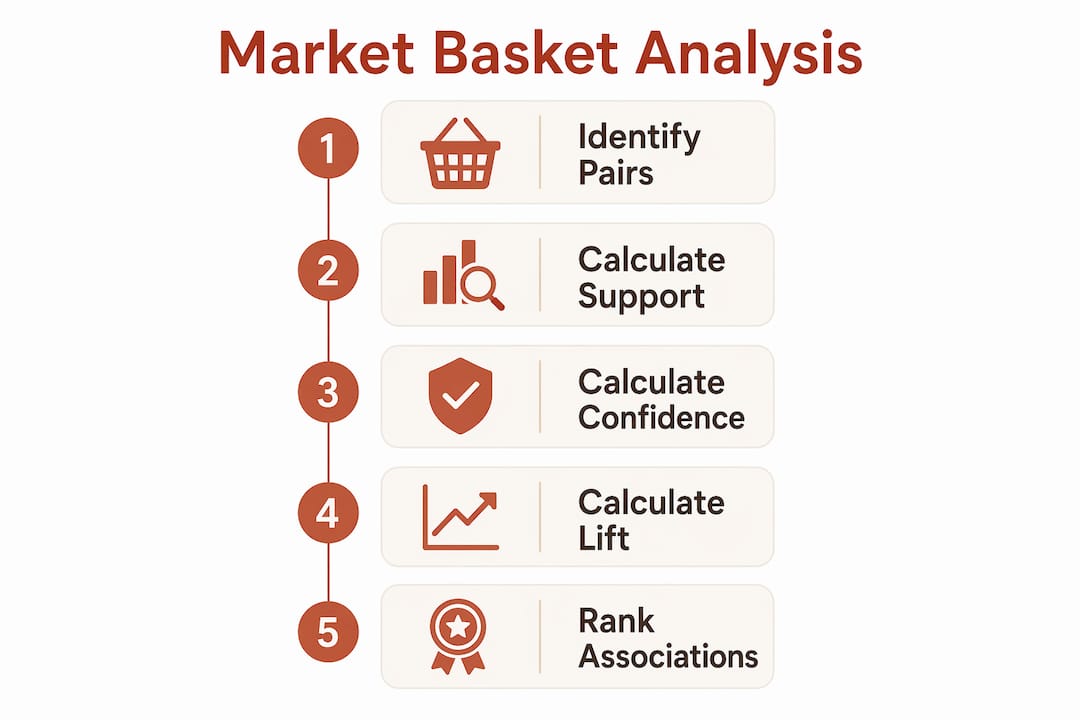
Lift above 1.0 indicates a real, positive association between two products. Lift equal to 1.0 means the co-purchase is random. Lift below 1.0 signals that buying one product actually makes the other less likely. That distinction matters enormously for cross-sell strategy.
A classic example makes this concrete. Bread and milk are bought together constantly, but their Lift score sits near 1.0. That means their co-purchase is driven by shopping habits, not product affinity. Wine and cheese, by contrast, carry a strong Lift because customers actively seek that pairing. Promoting bread alongside milk wastes placement. Promoting wine alongside cheese generates real incremental revenue.
Pro Tip: Never rely on Support or Confidence alone. A product pair can have high Confidence but a Lift near 1.0, meaning the second product sells itself regardless of the first. Always filter your association rules by Lift first, then rank by Confidence.
| Product pair | Support | Confidence | Lift | Interpretation |
|---|---|---|---|---|
| Wine + Cheese | 12% | 74% | 3.2 | Strong positive association |
| Bread + Milk | 31% | 68% | 1.05 | Random co-purchase |
| Camera + Memory Card | 18% | 81% | 4.7 | Very strong association |
| Shampoo + Conditioner | 22% | 63% | 2.8 | Solid cross-sell opportunity |
The practical output of MBA is a ranked list of product pairs worth promoting. Store owners can feed this list directly into their “frequently bought together” widgets, bundle offers, and post-purchase email sequences. Marketing managers can use it to build targeted campaigns around high-Lift pairs rather than guessing at what customers want.
What are embedding models and why do they improve association accuracy?
Classical MBA finds associations based on transaction frequency. That works well for obvious pairs, but it misses a large class of relationships that never show up in the same cart. Embedding models like Product2Vec and Graph Neural Networks solve that problem by mapping products into a mathematical space where proximity reflects behavioral similarity, not just co-purchase history.
Product2Vec treats each product like a word in a sentence. It learns that customers who browse running shoes also browse compression socks, even when they rarely buy both in the same order. Graph Neural Networks go further, capturing multi-hop relationships across entire purchase sequences. Both methods reveal substitutes and complementaries that frequency-based rules would never surface.
The real advantage of these models shows up in hybrid recommendation systems that layer AI behavioral signals on top of business rules. A pure machine learning model might recommend a product with strong behavioral affinity but zero margin or no stock. A hybrid system filters those recommendations through constraints like inventory levels and profitability targets. The result is a recommendation engine that is both accurate and commercially sound.
Here is what the shift to advanced association methods delivers in practice:
- Broader coverage: Embedding models surface associations for new or low-frequency products that MBA cannot analyze due to sparse transaction data.
- Substitute detection: Graph models identify products customers treat as interchangeable, which is critical for out-of-stock redirection.
- Personalization depth: Latent associations allow recommendations to vary by customer segment, not just by product category.
- Reduced noise: Embedding proximity filters out coincidental co-purchases that inflate Lift scores in small datasets.
- Business constraint integration: Hybrid AI and business rule models prevent recommending behaviorally relevant but unprofitable items.
The challenge is implementation complexity. Embedding models require clean, historical transaction data and developer resources to deploy. For most mid-size e-commerce brands, the practical entry point is MBA for immediate wins, with embedding models as a second phase once the data infrastructure is in place. How color, product attributes, and fit signals feed into these models also matters in fashion and apparel, where visual similarity drives substitution behavior as much as purchase history does.
How do product associations influence purchasing behavior and sales outcomes?
Product associations influence purchasing behavior through three mechanisms: trust transfer, decision simplification, and price anchoring. When a well-known product is paired with a newer or less familiar one, the association transfers trust from the established item to the unfamiliar one. Customers become less skeptical and more willing to add the second item without extensive research.

Decision simplification is equally powerful. A customer choosing a camera does not want to research memory cards separately. A bundle that includes both removes friction and increases the likelihood of a larger order. This is why product bundling strategies built on strong association data consistently outperform bundles assembled by intuition alone.
Strong associations also reduce price sensitivity. When two products are mentally linked, customers evaluate the pair as a unit rather than comparing each item against alternatives. That shifts the competitive frame away from price and toward value. Association strength is continuously shaped by every customer interaction, which means every touchpoint is an opportunity to reinforce or weaken a pairing.
Applying these insights requires consistency across channels. Here are the core practices that translate association data into measurable sales results:
- Audit your “frequently bought together” widgets quarterly and refresh them with current MBA output.
- Build post-purchase email sequences around high-Lift pairs, not bestsellers.
- Use association data to inform average order value strategies rather than relying on blanket discount offers.
- Segment association recommendations by customer cohort. A first-time buyer and a repeat customer have different affinity profiles.
- Track Lift changes over time. A pair that had strong Lift six months ago may have weakened due to seasonal shifts or catalog changes.
The brands that treat product associations as a living system, not a one-time setup, consistently outperform those that configure associations once and forget them. Top-performing brands view association management as an ongoing reliability practice that shapes customer perception over time.
Key Takeaways
Product associations drive e-commerce revenue when they are grounded in Lift-validated data, organized by catalog type, and continuously refreshed to reflect current customer behavior.
| Point | Details |
|---|---|
| Lift is the decisive metric | Filter all association rules by Lift above 1.0 before acting on Support or Confidence. |
| Catalog types structure discovery | Accessories, bundles, replacements, and alternatives each serve a distinct role in guiding purchases. |
| Hybrid models outperform pure AI | Combining behavioral signals with business constraints like margins and stock improves recommendation quality. |
| Associations transfer trust | Pairing a known product with a new one reduces customer skepticism and lowers price sensitivity. |
| Continuous optimization is required | Association strength shifts with seasons, catalog changes, and customer cohort behavior. |
Why I think most stores are leaving association revenue on the table
Most e-commerce stores set up their “frequently bought together” section once, during launch or a site redesign, and never revisit it. That is the single most common and most costly mistake I see. Product associations are not static. Customer behavior shifts, catalogs grow, and seasonal patterns change the Lift scores of every pair in your store.
The second mistake is treating high co-purchase frequency as proof of a strong association. Bread and milk taught me that lesson early. Frequency without Lift is noise. I have seen stores promote pairs with 40% co-purchase rates that had Lift scores barely above 1.0. They were wasting prime page real estate on coincidence.
The hybrid approach is where the real gains are. Pure MBA gives you a ranked list. Embedding models give you coverage for long-tail products. Business rules keep you from recommending out-of-stock items or zero-margin products. None of those three layers works as well alone as they do together. If you are only running one of them, you are leaving precision on the table.
My practical recommendation: run MBA on your last 12 months of transaction data, filter by Lift above 1.5, and build your first association layer from that output. Then measure the impact on average order value over 90 days. That single cycle will tell you more about your catalog’s association potential than any amount of manual curation.
— Mateusz
Affinsy makes product association analysis accessible
Affinsy’s Market Basket Analysis tools turn your existing transaction data into ranked association rules, complete with Support, Confidence, and Lift scores, without requiring a data science team.
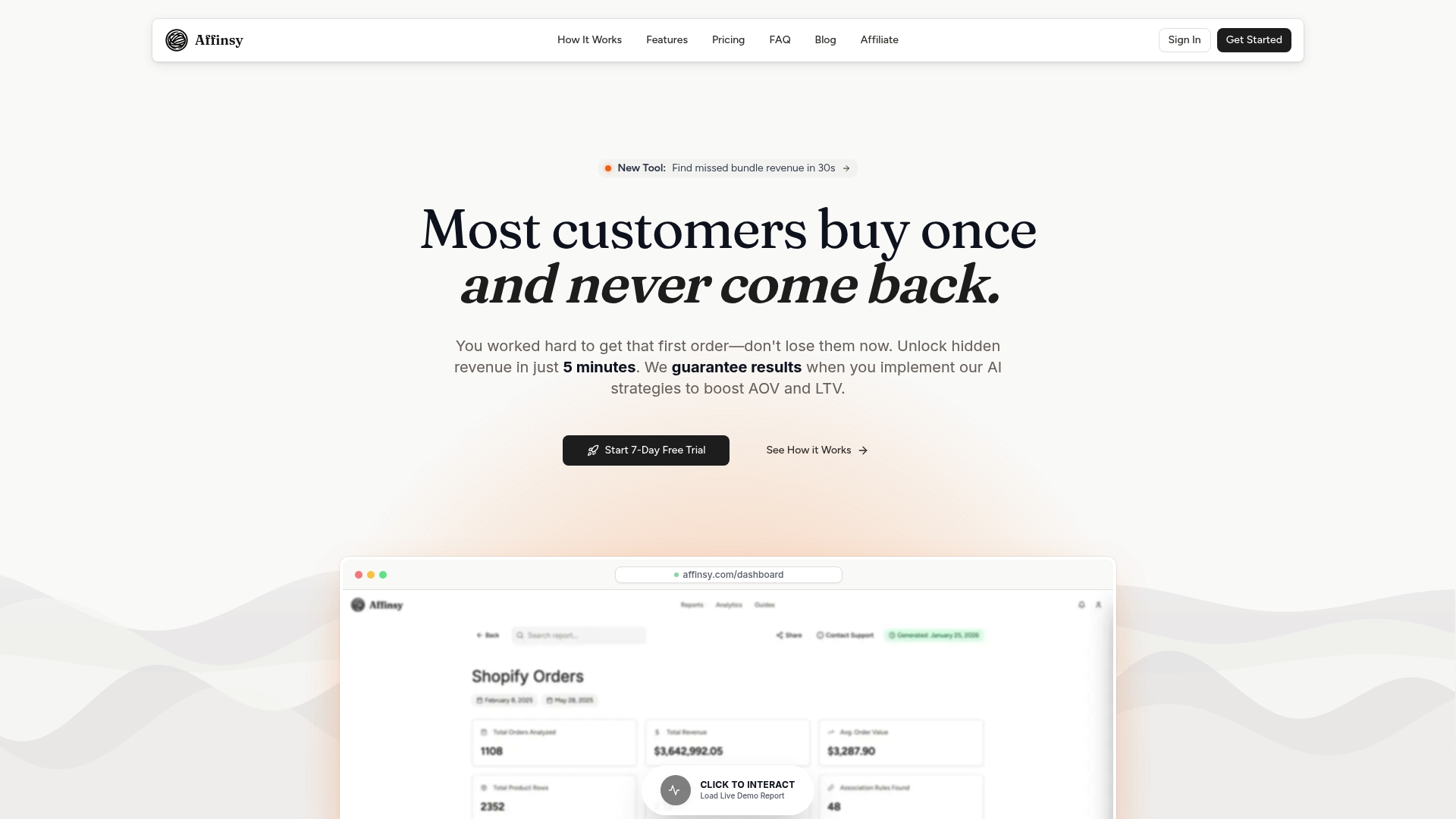
You can upload a CSV export from Shopify, WooCommerce, BigCommerce, Stripe, or any platform that produces order data. Affinsy processes it and surfaces the high-Lift pairs your store should be promoting. The free tier covers up to 20,000 line items with full product access and no credit card required. For teams that need deeper analysis, customer segmentation tools let you layer RFM cohorts on top of association data, so you can target the right pairs to the right buyers at the right time.
FAQ
What is a product association definition in e-commerce?
A product association is a defined relationship between two or more products that indicates they are complementary, substitutable, or frequently purchased together. These relationships are used to guide customer navigation, power cross-sell recommendations, and structure product bundles.
How does Lift differ from Confidence in Market Basket Analysis?
Confidence measures how often customers who buy product A also buy product B, but it does not account for how popular product B already is. Lift corrects for that by comparing the observed co-purchase rate to what random chance would predict, making it the more reliable metric for identifying genuine associations.
Why do product associations affect brand perception?
Strong product associations transfer trust from a familiar product to a paired one, reducing customer skepticism and making new products easier to sell. Every customer interaction reinforces or weakens that mental link, which is why consistent pairing across channels matters.
What types of product associations exist in catalog management?
The four standard types are accessories, replacement parts, bundles, and similar or alternative items. Systems like SAP and NetSuite use these categories to organize catalog relationships and control how products appear to customers during browsing and checkout.
How often should product associations be updated?
Product associations should be reviewed at least quarterly, since Lift scores shift with seasonal demand, catalog changes, and evolving customer behavior. Brands that treat associations as a continuous practice consistently outperform those that configure them once and leave them static.
Recommended
- Hidden Product Associations: What E-Commerce Marketers Need to Know - Affinsy Blog | Affinsy
- Role of AI in E-Commerce: Boosting Sales and Retention - Affinsy Blog | Affinsy
- Why Optimize Product Pairs: A 2026 E-Commerce Guide - Affinsy Blog | Affinsy
- 7 Smart Product Recommendation Ideas for E-Commerce Growth - Affinsy Blog | Affinsy