
TL;DR:
- Customer retention measures how well a business keeps existing customers engaged and purchasing over time. Improving retention boosts profits faster than acquiring new customers and signals product-market fit. AI-powered workflows and personalized marketing strategies significantly enhance long-term customer loyalty and reduce churn.
Customer retention is a business’s ability to keep existing customers buying and engaging with a brand over time, directly reducing churn and increasing customer lifetime value (CLV). Customer-obsessed businesses grow revenue 41% faster and profits 49% faster than their peers. For e-commerce leaders, understanding customer retention is not a nice-to-have. It is the primary lever for sustainable, compounding growth. Platforms like Salesforce, Zendesk, and AI-powered analytics tools have made retention measurable and manageable at scale, turning what was once guesswork into a data-driven discipline.
What is customer retention and why does it matter?
Customer retention is the percentage of customers who continue to purchase from a business over a defined period. The industry standard metric is the customer retention rate (CRR), calculated as: ((Customers at end of period minus new customers) / Customers at start of period) × 100. Its inverse, the churn rate, tells you how fast you are losing customers.

The financial case is direct. A 5% retention increase can lift overall profits by 25% or more. That happens because retained customers spend more over time, cost less to serve, and refer others. Acquiring a new customer costs five to seven times more than keeping an existing one, which means every dollar spent on retention compounds more efficiently than acquisition spend.
Retention also signals product-market fit. When customers stay, they are voting with their wallets that your product solves a real problem. When they leave, churn signals are feedback on pricing, experience, or product gaps. The smartest e-commerce brands treat every cancellation as a data point, not just a loss.
What are the core metrics for measuring retention?
Tracking the right numbers separates brands that react to churn from those that prevent it. The table below defines the four metrics every e-commerce team should monitor.
| Metric | Definition | Business implication |
|---|---|---|
| Customer retention rate (CRR) | % of customers retained over a period | Baseline health of your customer base |
| Churn rate | % of customers lost over a period | Direct cost signal; high churn erodes revenue fast |
| Customer lifetime value (CLV) | Total revenue expected from one customer | Guides acquisition spend and retention investment |
| Net revenue retention (NRR) | Revenue retained including expansions, minus churn | Best indicator of growth quality for SaaS and subscriptions |
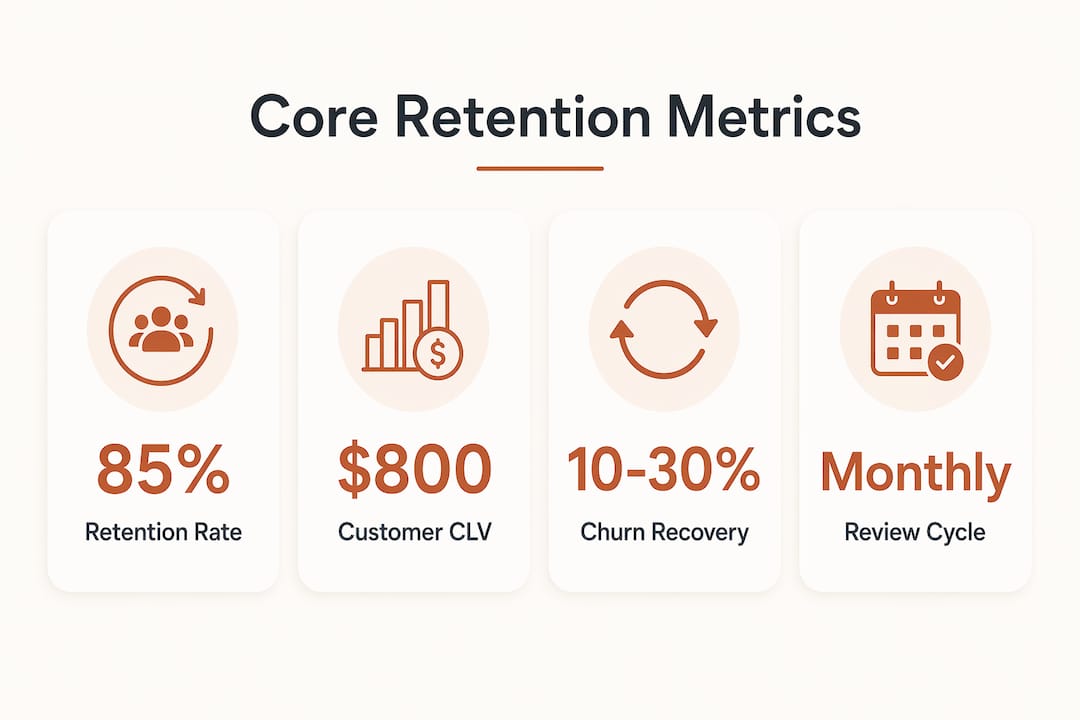
CLV deserves special attention. A customer with a CLV of $800 justifies far more retention investment than one with a CLV of $80. Segmenting your base by CLV lets you allocate budget where it produces the highest return. Tools like Salesforce and cohort analysis methods make this segmentation practical without a dedicated data science team.
Customer health scores are a newer addition to the toolkit. They combine behavioral signals such as login frequency, purchase recency, and support ticket volume into a single score that predicts churn risk before it becomes churn reality. Zendesk and similar CX platforms surface these scores natively.
Pro Tip: Set a monthly review cadence for all four metrics together. CRR alone can look stable while NRR is declining, which means you are losing high-value customers even as total headcount holds steady.
How do AI-driven churn prevention workflows enhance retention?
An AI-driven churn prevention workflow is a structured, automated process that identifies at-risk customers, triggers personalized outreach, and escalates complex cases to human support. It replaces the reactive “we noticed you haven’t purchased lately” email with a predictive, behavior-based intervention system.
The workflow runs in three stages. First, a risk-scoring engine analyzes behavioral data such as declining purchase frequency, reduced session time, or increased support contacts to assign each customer a churn probability score. Second, automated communication sequences fire based on score thresholds: a score above 60 might trigger a personalized discount email, while a score above 85 triggers a direct outreach from a customer success manager. Third, the CRM pipeline routes the highest-risk accounts to human review, preventing alert fatigue by filtering out low-risk noise.
Structured churn prevention workflows recover 10–30% of customers who would otherwise leave and improve CLV by 20–30%. For a business running $50,000 in monthly recurring revenue with 3% monthly churn, recovering just 25% of those customers saves $4,500 in annual recurring revenue. That is not a rounding error.
The technical foundation matters as much as the logic. Standardized data naming across all event types is a prerequisite. If your platform logs “add_to_cart” in one system and “cart_add” in another, your scoring model will produce garbage. Getting data consistency right means a churn-risk engine can be operational in roughly half a day.
Key features of a well-built AI retention workflow:
- Unified event taxonomy: All behavioral data uses consistent naming before it enters the scoring model.
- Tiered alert thresholds: CRM stages trigger at defined risk scores, not arbitrary time intervals.
- Automated first-touch sequences: Email, SMS, or in-app messages fire without human intervention for mid-risk accounts.
- Human escalation rules: Only the highest-risk accounts reach a customer success manager, preserving their time for complex cases.
- Feedback loop: Outcomes from each intervention feed back into the model to improve future scoring.
Pro Tip: Manual interventions alone are inefficient at scale. Reserve your human team for accounts where a conversation can genuinely change the outcome. Let automation handle the rest.
What retention marketing techniques build long-term loyalty?
Retention marketing is the set of campaigns, programs, and communications designed to keep existing customers engaged and purchasing. The most effective approaches share one trait: they use real-time data to make every interaction feel relevant.
Personalized messaging using real-time behavioral data consistently outperforms generic broadcast campaigns in building brand advocacy. A customer who receives a recommendation based on their last three purchases is far more likely to convert than one who receives a mass promotion. Platforms like Klaviyo and Attentive make this level of personalization accessible to mid-market e-commerce brands without enterprise budgets.
Here are the five retention marketing techniques that produce the strongest results in 2026:
- Behavioral email sequences. Trigger emails based on specific actions: post-purchase follow-ups, browse abandonment, or milestone rewards. Behavioral triggers outperform time-based sends because they meet customers at the moment of highest relevance.
- Loyalty and rewards programs. Points-based systems like those run by Sephora’s Beauty Insider or Starbucks Rewards create habitual purchase behavior. The key is making rewards attainable quickly, so customers feel progress early.
- Social media engagement and listening. Social platforms enable direct brand-customer dialogue and surface real-time sentiment data. Brands that respond to comments and complaints publicly demonstrate accountability, which builds trust with the entire audience, not just the individual.
- Customer feedback loops. Post-purchase surveys, NPS campaigns, and product review requests give customers a voice. More importantly, acting visibly on that feedback signals that the brand listens. Closing the loop with “you asked, we built it” messaging is one of the highest-trust moves available.
- Community building. Private groups, user forums, and brand ambassador programs create identity-level loyalty. When customers see themselves as part of a community, switching to a competitor carries a social cost, not just a functional one.
For a deeper look at retention strategies for online retailers, the combination of personalization and community consistently delivers the highest long-term CLV.
How does customer experience directly affect churn?
Customer experience (CX) is the single most controllable factor in retention. 85% of CX leaders report that customers are likely to leave after just one unresolved issue. That number should recalibrate how much budget and attention you allocate to support quality.
Support speed and resolution quality
Speed matters, but resolution quality matters more. A customer who waits 24 hours for a response but gets a complete, empathetic resolution is more likely to stay than one who gets an instant auto-reply followed by silence. Zendesk’s research consistently shows that first-contact resolution rate is a stronger predictor of retention than response time alone.
Product-need fit and expectation management
Churn often has nothing to do with support. It happens when the product stops matching the customer’s evolving needs, or when it never matched their expectations in the first place. Onboarding sequences that set accurate expectations and proactively surface advanced features reduce this type of churn significantly. CRM behavioral analytics, available in tools like HubSpot and Salesforce, identify customers who have never used a key feature, flagging them for proactive outreach before they decide the product is not worth renewing.
The role of behavioral analytics in CX gaps
Behavioral data reveals where customers get stuck, what they ignore, and when they disengage. Mapping these signals against churn events shows which friction points are actually driving departures. Fixing a single high-friction step in the checkout or onboarding flow can move retention metrics more than any loyalty program. AI analytics make this kind of gap analysis repeatable and scalable for teams without dedicated data engineers.
Key takeaways
Effective customer retention requires combining precise measurement, AI-driven automation, personalized marketing, and high-quality customer experience into a single, proactive company-wide strategy.
| Point | Details |
|---|---|
| Retention drives profit faster than acquisition | A 5% retention increase can boost profits by 25% or more, compounding faster than new customer spend. |
| Track four core metrics | Monitor CRR, churn rate, CLV, and NRR together to get a complete picture of retention health. |
| AI workflows recover at-risk customers | Structured churn prevention workflows recover 10–30% of customers who would otherwise leave. |
| Personalization outperforms broadcast marketing | Real-time behavioral data makes every retention campaign more relevant and more likely to convert. |
| CX quality is the primary churn driver | One unresolved issue is enough to lose 85% of at-risk customers, making support quality non-negotiable. |
Why I think most retention strategies fail before they start
Most retention programs I have seen fail not because of bad tactics but because of bad timing. Teams build loyalty programs and churn workflows after the customer has already mentally checked out. By the time a cancellation email arrives, the decision was made weeks earlier.
The shift that actually moves the needle is treating retention as a company-wide strategy from the first customer touchpoint, not a downstream reaction to churn signals. That means sales teams set accurate expectations, onboarding teams surface value fast, and marketing teams use behavioral data to intervene before disengagement becomes visible.
The second failure I see consistently is the over-automation trap. Teams deploy AI scoring and automated sequences, then assume the work is done. The best retention calls are discovery-oriented and non-confrontational. They anchor on specific behaviors the customer has shown, not on the fact that they are about to cancel. A consulting tone recovers accounts that a sales pitch loses every time. Automation handles volume. Humans handle nuance. Getting that division right is what separates a retention program that looks good in a dashboard from one that actually keeps customers.
— Mateusz
How Affinsy helps you act on retention data
Understanding retention is one thing. Having the data infrastructure to act on it is another. Affinsy gives e-commerce teams the analytical foundation to move from intuition to precision.
Affinsy’s RFM customer segmentation identifies your highest-value customers, your at-risk segments, and your lapsed buyers from your existing transaction data. No data science skills required. Export your order history from Shopify, WooCommerce, BigCommerce, or Stripe, upload it via CSV or API, and Affinsy surfaces the segments your retention campaigns should prioritize. Pair that with market basket analysis to identify which product combinations drive repeat purchase behavior, and you have a retention strategy grounded in what your customers actually do. The free tier covers up to 20,000 line items with no credit card required.
FAQ
What is the standard definition of customer retention?
Customer retention is the percentage of existing customers who continue to purchase from a business over a set period. It is measured using the customer retention rate formula and tracked alongside churn rate and CLV.
Why is customer retention more valuable than acquisition?
Retained customers cost less to serve, spend more over time, and refer others. A 5% increase in retention can increase profits by 25% or more, making it a higher-return investment than most acquisition channels.
What factors affect customer retention the most?
Support quality, product-need fit, onboarding effectiveness, and personalized communication are the primary factors. Research from Zendesk shows that 85% of customers are likely to leave after a single unresolved support issue.
How do AI workflows improve retention outcomes?
AI-driven churn prevention workflows score customers by behavioral risk, trigger automated outreach at defined thresholds, and escalate the highest-risk accounts to human support. Structured workflows recover 10–30% of customers who would otherwise churn.
How does RFM segmentation support retention marketing?
RFM (Recency, Frequency, Monetary) segmentation groups customers by purchase behavior, letting marketers target high-value and at-risk segments with precision. This makes retention campaigns more relevant and more cost-efficient than broad-audience outreach.
Recommended
- How to optimize e-commerce retention for lasting growth - Affinsy Blog | Affinsy
- Ecommerce Cohort Analysis Tips That Improve Retention - Affinsy Blog | Affinsy
- Behavioral Analytics: 95% Churn Prediction Boosts Sales - Affinsy Blog | Affinsy
- Top retention strategies for online retailers: boost loyalty - Affinsy Blog | Affinsy