
TL;DR:
- Customer loyalty combines emotional commitment and repeat behavior, driving long-term business growth. Building genuine loyalty requires addressing convenience, service quality, perceived value, and personalization; measuring it involves share of wallet and loyalty indicators beyond purchase frequency. Many loyalty programs fail because they overlook foundational experience issues, emphasizing the need for an integrated strategy that fosters true emotional connections.
Customer loyalty is defined as the ongoing emotional commitment and consistent behavioral preference that drives customers to choose one brand repeatedly over competitors. It is not simply repeat purchasing. The most cited number in retention comes from Frederick Reichheld's research at Bain, published in Harvard Business Review in 1990: a 5% increase in customer retention can raise profits by 25% to 95%. The range is wide because it varies enormously by industry, but the direction has held up well enough that loyalty remains one of the highest-return levers available to a marketing manager or store owner. Brands like Amazon, Starbucks, and Apple have built entire growth models around this principle. Understanding the definition of customer loyalty, and more importantly what drives it, is the starting point for any serious retention strategy.

What is customer loyalty and how is it actually defined?
Customer loyalty combines two distinct dimensions: behavioral loyalty and attitudinal loyalty. Behavioral loyalty refers to the observable pattern of repeat purchases. Attitudinal loyalty refers to the emotional preference and psychological commitment a customer holds toward a brand. Both dimensions matter, but they are not interchangeable.
A customer who buys from you every month because your checkout is the fastest option is behaviorally loyal. Remove that convenience advantage and they leave. That is what researchers call spurious loyalty. Customers loyal due to convenience alone are prone to churn the moment a competitor offers a better option. This fragility is the central risk of building retention programs on transactional mechanics alone.
True loyalty, by contrast, includes emotional preference beyond repeat purchasing. A customer who recommends your brand to colleagues, defends it in online reviews, and returns even when a cheaper alternative exists is demonstrating attitudinal loyalty. This type of loyalty is far more durable and far more valuable to your business.
The practical implication for e-commerce owners is significant. If your retention metrics look strong but your Net Promoter Score is flat, you may be measuring habit rather than genuine commitment. Distinguishing between the two changes how you design programs, allocate budget, and measure success.
- Behavioral loyalty: Repeat purchases driven by habit, convenience, or price
- Attitudinal loyalty: Emotional preference, brand advocacy, and resistance to competitor offers
- Spurious loyalty: Surface-level retention with no emotional foundation, highly vulnerable to churn
- True loyalty: The combination of both dimensions, where customers choose you by preference, not default
Pro Tip: Survey your repeat buyers with a single question: “Would you recommend us if a better-priced alternative existed?” The answer separates genuine loyalty from convenient habit.
Why does customer loyalty matter for revenue and growth?
The financial case for loyalty is direct and well-documented. Loyal customers spend 67% more on average than new customers. That gap alone justifies shifting budget from pure acquisition toward retention programs, particularly for mid-to-large e-commerce brands where customer acquisition costs have risen sharply.
Customer Lifetime Value (CLV) is the metric that captures this most clearly. A loyal customer who makes five purchases per year at a higher average order value than a first-time buyer generates compounding returns over time. Every dollar spent retaining that customer works harder than a dollar spent acquiring a new one.
“Loyalty provides a crucial buffer against market volatility and rising marketing costs. Businesses with strong retention foundations weather economic downturns more predictably than those dependent on continuous new customer acquisition.” — openloyalty.io
Loyal customers also reduce your marketing spend indirectly. They act as brand evangelists, generating trusted referrals that convert at higher rates than paid advertising. Word-of-mouth from a satisfied, emotionally connected customer carries credibility that no ad budget can replicate.
| Business benefit | What it means in practice |
|---|---|
| Higher CLV | Loyal customers spend more per transaction and return more frequently |
| Lower acquisition costs | Referrals from advocates reduce paid channel dependency |
| Predictable revenue | Repeat buyers create stable baseline revenue, reducing forecasting risk |
| Market resilience | Emotionally loyal customers are less likely to defect during price wars |
| Product feedback | Loyal customers provide zero-party data that guides product development |
The importance of customer loyalty extends beyond revenue. Loyal customers provide valuable feedback and zero-party data that guides product innovation and tailored marketing. They tell you what they want before you have to guess. For e-commerce brands managing large catalogs, that signal is operationally significant.
How to build customer loyalty: proven strategies and triggers
Building genuine loyalty requires addressing four core triggers: convenience, service quality, perceived value, and personalization. Personalized loyalty programs that address all four consistently outperform programs that focus on points and discounts alone. Here is how to apply each trigger in practice.
-
Convenience: Reduce friction at every touchpoint. Fast checkout, easy returns, and clear navigation are not optional extras. Most loyalty programs fail when foundational experiences like checkout or customer service are broken, regardless of how generous the rewards are. Fix the experience before you build the program.
-
Service quality: Responsive, empathetic customer service builds emotional connection faster than any discount. Customers remember how problems were resolved. A single well-handled complaint can convert a frustrated buyer into a long-term advocate. Tools like Zendesk and Gorgias help e-commerce teams manage service at scale without losing the personal touch.
-
Perceived value: Value is not synonymous with low price. Customers assess value relative to their expectations. Exclusive access, early product launches, and member-only content all increase perceived value without eroding margins. Platforms like Yotpo and Loyalty Lion let you structure these benefits within a formal loyalty program.
-
Personalization: Generic communications are ignored. Personalized product recommendations, birthday offers, and replenishment reminders signal that you understand the individual customer. 74% of customers are more likely to return to brands offering loyalty programs, and personalization is the factor that separates programs customers engage with from those they forget.
A common pitfall is treating loyalty programs as purely transactional. Points for purchases create behavioral loyalty at best. Without emotional connection, customers will defect to a competitor offering a better points ratio. The most effective customer loyalty strategies integrate rewards with genuine relationship-building, including personalized outreach, community features, and recognition that goes beyond transaction history.
Pro Tip: Segment your customer base by RFM (Recency, Frequency, Monetary value) before designing loyalty tiers. Customers in different segments respond to different triggers. High-frequency buyers want recognition; lapsed buyers need re-engagement offers. You can explore customer segmentation strategies to apply this in practice.
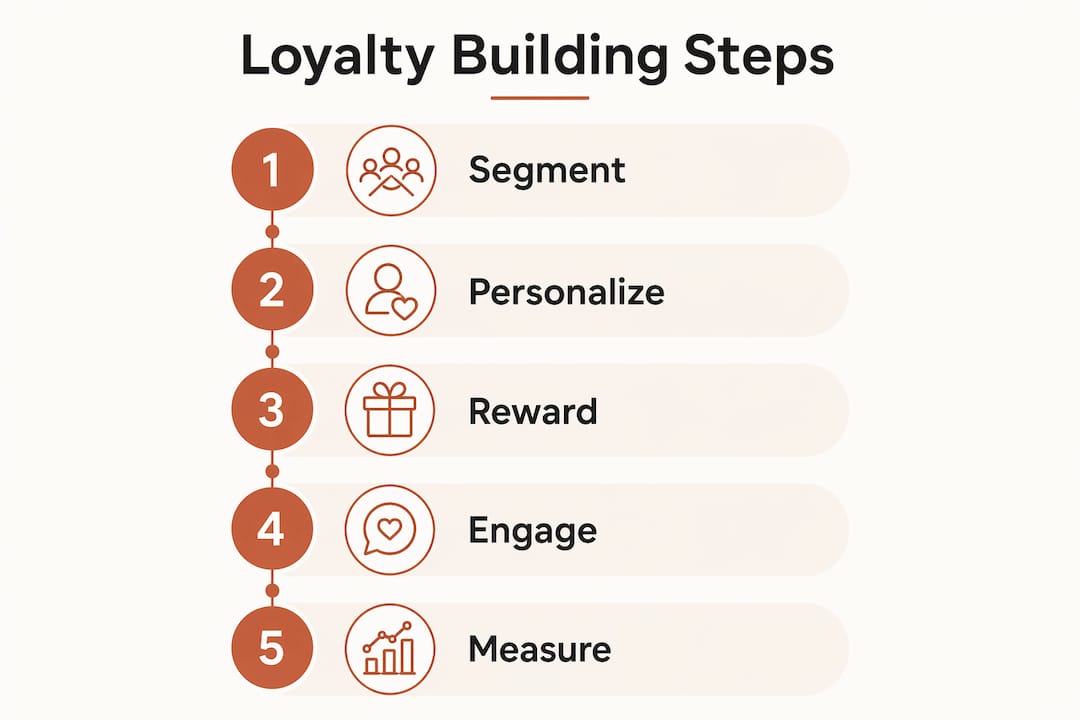
For a deeper look at retention strategies for online retailers, the tactical options extend well beyond loyalty programs into pricing, content, and post-purchase experience design.
How do you measure customer loyalty beyond repeat purchases?
Repeat purchase rate is the most commonly tracked loyalty metric, but it is also the least informative on its own. A customer who buys twice a year from you and twice a year from three competitors is technically a repeat buyer. Their actual commitment to your brand is minimal.
Share of wallet provides a more accurate picture. It measures what percentage of a customer’s total category spending goes to your brand. A customer spending 80% of their apparel budget with you is far more loyal than one spending 20%, even if both have identical purchase frequencies. This metric requires more data to calculate but delivers proportionally more insight.
| Metric | What it measures | Limitation |
|---|---|---|
| Repeat purchase rate | How often customers return | Misses share of wallet and emotional commitment |
| Net Promoter Score (NPS) | Likelihood to recommend | Self-reported, can lag behavioral reality |
| Share of wallet | Percentage of category spend captured | Requires external benchmarking data |
| Customer Lifetime Value | Total projected revenue per customer | Predictive, depends on model assumptions |
| Churn rate | Rate of customer loss over time | Reactive rather than predictive |
Measuring loyalty solely by repeat purchase misses the emotional and financial nuances necessary for building durable retention. Marketing managers who rely only on purchase frequency often underinvest in the segments most likely to churn and overinvest in segments that are already saturated.
Analytics platforms that combine RFM segmentation with behavioral data give you a clearer view of where true loyalty exists in your customer base. Affinsy, for example, uses transaction history to surface segmentation patterns that reveal which customers are genuinely committed versus which are at risk of defecting. Understanding these patterns is what separates reactive retention from proactive loyalty strategy. You can explore analytics-driven loyalty insights to see how this works in practice.
Building trust and loyalty through retention also requires consistent measurement cadence. Loyalty is not a static state. Customers move between segments based on their experiences, life changes, and competitive exposure. Tracking movement across segments over time is more valuable than any single-point metric.
Key takeaways
Customer loyalty is the combination of emotional commitment and consistent repeat behavior, and building it requires addressing both dimensions simultaneously rather than optimizing for purchase frequency alone.
| Point | Details |
|---|---|
| Loyalty has two dimensions | Behavioral and attitudinal loyalty must both be present for durable retention. |
| Retention drives profit | A 5% increase in retention can boost profits by 25% to 95%, per Reichheld's Bain research in Harvard Business Review. |
| Loyal customers spend more | Repeat buyers spend 67% more on average than new customers, raising CLV significantly. |
| Four triggers drive loyalty | Convenience, service quality, perceived value, and personalization are the core loyalty levers. |
| Measure beyond purchases | Share of wallet and NPS reveal true loyalty that repeat purchase rate alone cannot capture. |
Why most loyalty programs are solving the wrong problem
I have reviewed dozens of loyalty programs for e-commerce brands, and the pattern is consistent. The program launches with a points structure, a tiered badge system, and a launch email. Engagement spikes for 60 days. Then it flatlines. The team concludes that “loyalty programs don’t work for our category” and moves on.
The real problem is almost never the program mechanics. It is that the program was built on top of a broken experience. Checkout friction, slow customer service, and inconsistent product quality cannot be papered over with a points multiplier. Customers notice the gap between the loyalty promise and the actual experience, and that gap destroys trust faster than any competitor offer.
The gap between perceived importance and effectiveness of loyalty programs is striking: 75% of executives see loyalty programs as vital, but only 50% believe their programs are actually effective. That 25-point gap is not a technology problem. It is a strategy problem.
What I advocate for is treating loyalty as a business architecture decision, not a marketing campaign. That means auditing the full customer journey before designing any reward structure. It means investing in service quality and personalization infrastructure before launching a points program. And it means measuring emotional loyalty indicators alongside behavioral ones, because a customer who buys frequently but would switch tomorrow is not an asset. They are a liability waiting to materialize.
Loyalty programs must evolve from transactional rewards to core growth strategies that integrate emotional connection at every touchpoint. The brands that understand this are not running loyalty programs. They are building loyal customer relationships, and the program is just one visible layer of something much deeper.
— Mateusz
How Affinsy helps you turn transaction data into loyalty intelligence
Understanding customer loyalty at the segment level requires more than intuition. It requires data. Affinsy analyzes your historical transaction data to surface RFM customer segments, revealing which customers are genuinely loyal, which are at risk, and which have already lapsed without triggering a retention response.
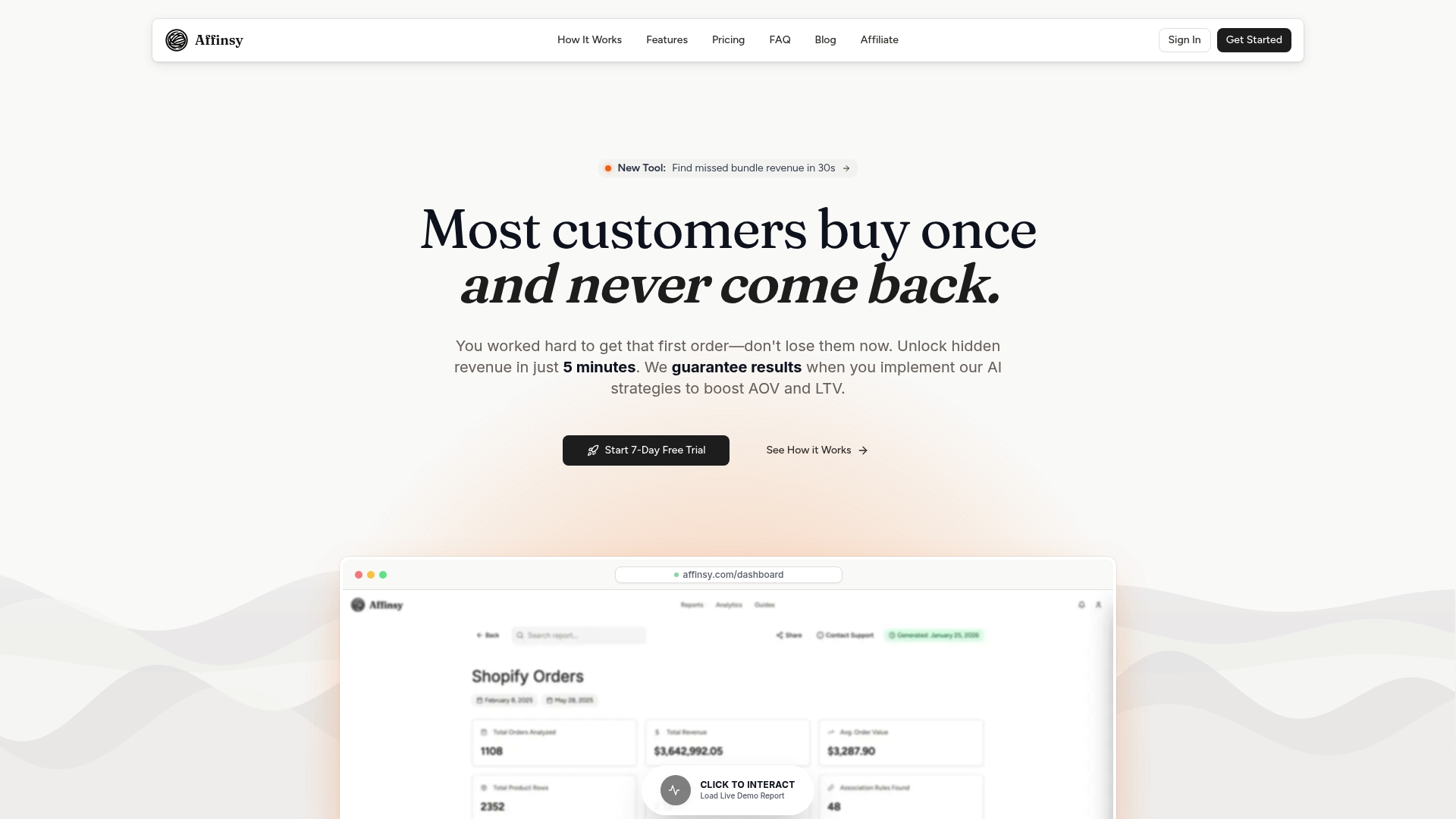
The platform’s market basket analysis identifies which product combinations drive the highest repeat purchase rates, giving you the cross-sell and bundling intelligence to increase CLV without increasing acquisition spend. Customer segmentation tools let you target each loyalty tier with the right offer at the right time. Affinsy connects via CSV upload or API, works with data from Shopify, WooCommerce, Stripe, and any platform that exports transaction records. The permanent free tier covers up to 20,000 line items with no credit card required.
FAQ
What is the simplest definition of customer loyalty?
Customer loyalty is the combination of emotional commitment and consistent repeat behavior that leads customers to choose one brand over competitors. It includes both the act of returning to purchase and the preference to do so even when alternatives exist.
What is the difference between behavioral and attitudinal loyalty?
Behavioral loyalty is repeat purchasing driven by habit or convenience. Attitudinal loyalty is emotional preference and brand commitment. True loyalty requires both, since behavioral loyalty alone is fragile and vulnerable to churn when competitors improve their offer.
How does customer loyalty affect profitability?
A 5% increase in customer retention can improve profits by 25% to 95%, and loyal customers spend 67% more on average than new customers. These two factors combined make retention investment significantly more efficient than equivalent acquisition spend.
What are the most effective customer loyalty strategies?
The four core triggers are convenience, service quality, perceived value, and personalization. Programs that address all four consistently outperform those built on transactional rewards alone. Fixing foundational experience issues before launching a loyalty program is the most commonly overlooked prerequisite.
How should businesses measure customer loyalty accurately?
Share of wallet, Net Promoter Score, and Customer Lifetime Value provide more accurate loyalty signals than repeat purchase rate alone. RFM segmentation adds behavioral depth by identifying which customers are active, at risk, or lapsed based on recency, frequency, and monetary patterns.
Recommended
- Top retention strategies for online retailers: boost loyalty - Affinsy Blog | Affinsy
- How to optimize e-commerce retention for lasting growth - Affinsy Blog | Affinsy
- Customer segmentation explained: boost retention 2026 - Affinsy Blog | Affinsy
- Customer Lifetime Value (CLV/LTV) — E-Commerce Glossary | Affinsy | Affinsy